
🌻 Beyond Behaviour What professionals must consider before responding
🌻 Beyond Behaviour
What professionals must consider before responding
Autism Professional Poster | A2 Printable | UK Edition
For healthcare professionals, specialist schools and social care.
When an autistic child's behaviour changes, it is easy to focus on the behaviour itself. But behaviour is often the only way a child can show that something is wrong, especially a nonspeaking child.
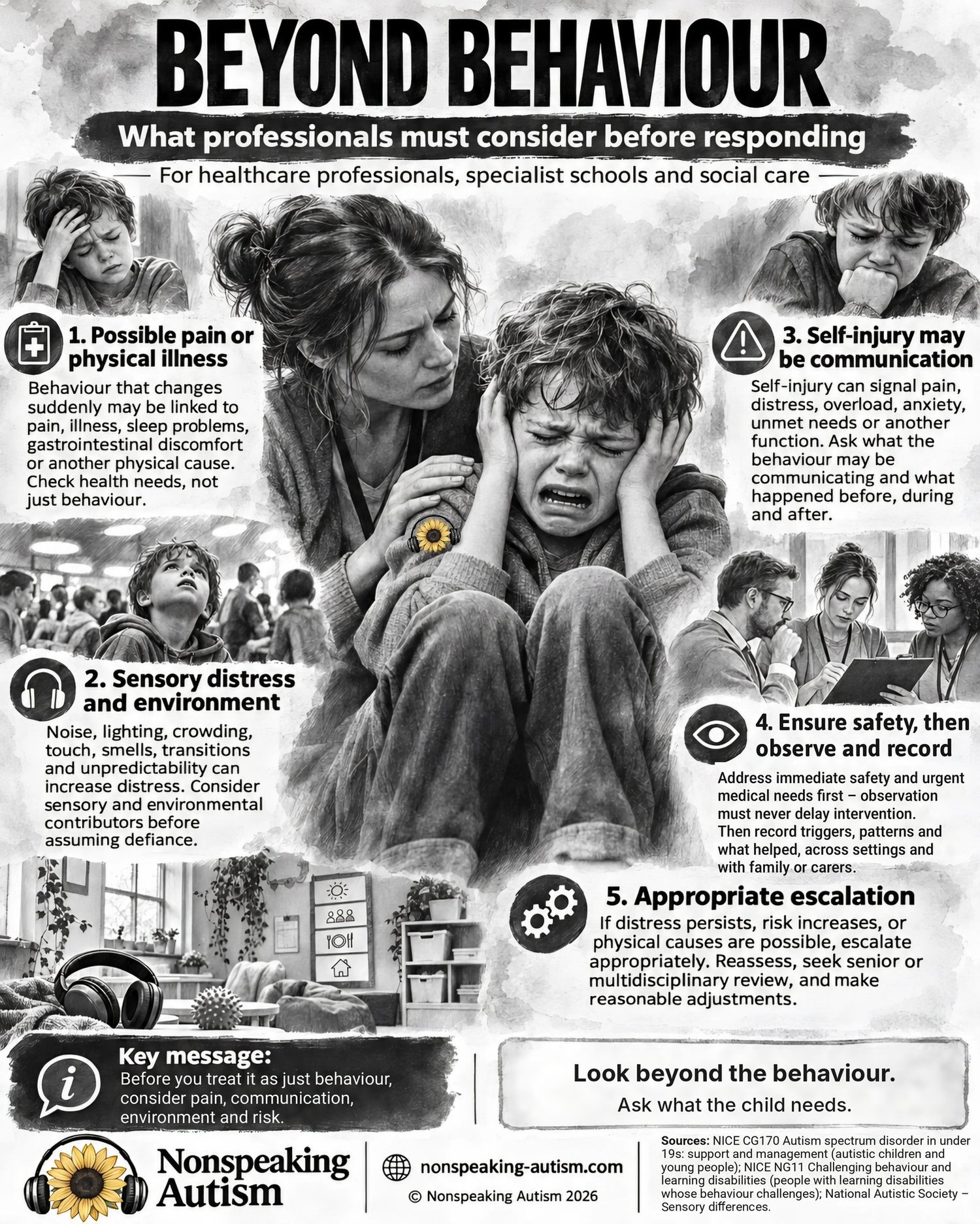
Beyond Behaviour is a striking black-and-white A2 poster that sets out five things every professional should consider before responding, so that pain, distress, sensory overload and risk are not missed.
Before you treat it as just behaviour, consider pain, communication, environment and risk.
🧠 THE FIVE CONSIDERATIONS
1. Possible pain or physical illness
Behaviour that changes suddenly may be linked to pain, illness, sleep problems, gastrointestinal discomfort or another physical cause. Check health needs, not just behaviour.
2. Sensory distress and environment
Noise, lighting, crowding, touch, smells, transitions and unpredictability can increase distress. Consider sensory and environmental contributors before assuming defiance.
3. Self-injury may be communication
Self-injury can signal pain, distress, overload, anxiety, unmet needs or another function. Ask what the behaviour may be communicating and what happened before, during and after.
4. Ensure safety, then observe and record
Address immediate safety and urgent medical needs first – observation must never delay intervention. Then record triggers, patterns and what helped, across settings and with family or carers.
5. Appropriate escalation
If distress persists, risk increases or physical causes are possible, escalate appropriately. Reassess, seek senior or multidisciplinary review, and make reasonable adjustments.
💙 WHY THIS MATTERS
Many autistic children, particularly those who are nonspeaking or have learning disabilities, cannot easily tell us when they are in pain, unwell or overwhelmed. When distress is treated as "just behaviour", physical illness, injury and sensory overload can be missed, and children may face responses that increase their distress instead of meeting their needs.
Look beyond the behaviour. Ask what the child needs.
👩⚕️ WHO IS THIS POSTER FOR?
- Doctors, nurses and allied health professionals
- Paediatric, A&E and learning disability teams
- Specialist schools and SEND settings
- SENCOs, teachers and teaching assistants
- Social workers, residential and respite care staff
- Positive behaviour support and CAMHS teams
- Parents and carers who want to share it with professionals
Ideal for staff rooms, clinical areas, training sessions and multidisciplinary meetings.
📦 WHAT YOU RECEIVE
- A2 print-ready PDF (420 x 594 mm)
- A2 high-resolution image (300 DPI)
Instant digital download. No physical product will be posted.
The downloadable files are provided without a watermark.
🔗 FURTHER RESOURCES
NICE CG170 – Autism spectrum disorder in under 19s: support and management
https://www.nice.org.uk/guidance/cg170
NICE NG11 – Challenging behaviour and learning disabilities: prevention and interventions for people with learning disabilities whose behaviour challenges
https://www.nice.org.uk/guidance/ng11
NICE QS51, Quality statement 7: Assessing possible triggers for behaviour that challenges
https://www.nice.org.uk/guidance/qs51/chapter/Quality-statement-7-Assessing-possible-triggers-for-behaviour-that-challenges
National Autistic Society – Sensory differences
https://www.autism.org.uk/advice-and-guidance/topics/sensory-differences/sensory-differences/all-audiences
📚 RESEARCH & REFERENCES
Mapped to poster sections:
- 1. Possible pain or physical illness: NICE CG170, recommendation 1.4.1 (physical health problems, pain and other factors that may trigger behaviour that challenges); NICE QS51, Quality statement 7.
- 2. Sensory distress and environment: NICE CG170, recommendations 1.1.9 and 1.4.4 (the sensory and physical environment); National Autistic Society, Sensory differences.
- 3. Self-injury may be communication: NICE NG11 (understanding the possible function of behaviour that challenges); NICE CG170, 1.4.1 (communication difficulties as a possible trigger).
- 4. Ensure safety, then observe and record: NICE NG11 (assessment of behaviour that challenges, including what happens before, during and after, involving family members and carers).
- 5. Appropriate escalation: NICE NG11 (multidisciplinary assessment and review); NICE CG170, 1.4.2.
Foundational references (printed on the poster):
1. National Institute for Health and Care Excellence (2013, updated 2021). Autism spectrum disorder in under 19s: support and management (CG170).
2. National Institute for Health and Care Excellence (2015). Challenging behaviour and learning disabilities: prevention and interventions for people with learning disabilities whose behaviour challenges (NG11).
3. National Autistic Society. Sensory differences.
Sources by poster section:
SectionSource1. Possible pain or physical illnessNICE CG170 1.4.1; NICE QS51, statement 72. Sensory distress and environmentNICE CG170 1.1.9 and 1.4.4; NAS, Sensory differences3. Self-injury may be communicationNICE NG11; NICE CG170 1.4.14. Ensure safety, then observe and recordNICE NG115. Appropriate escalationNICE NG11; NICE CG170 1.4.2
⚠️ IMPORTANT DISCLAIMER
This resource is for educational and information purposes only.
It is not a diagnostic tool, clinical protocol, risk assessment or behaviour support plan, and it does not replace professional judgement, local policies, safeguarding procedures or advice from a qualified professional.
Always address immediate safety and urgent medical needs first. If a child is injured, seriously unwell or at immediate risk, seek urgent medical help: contact NHS 111, or call 999 in an emergency.
All support should respect the child's communication, dignity, preferences, safety and wellbeing.
©️ COPYRIGHT & PERMITTED USE
© 2026 Nonspeaking Autism. All rights reserved.
For use in one home, classroom, clinic or setting only.
Please keep the original branding and copyright notice intact. The digital file must not be resold, modified, redistributed, uploaded to other websites or included in commercial products without permission.
💛 PLEASE LEAVE US FEEDBACK
If you find this poster helpful, please consider leaving a review on Payhip. We would love to hear how you used it and what you would like us to create next.
Thank you for supporting Nonspeaking Autism! 🌻
Connection over correction. Understanding over expectation.
Nonspeaking Autism © 2026
nonspeaking-autism.com