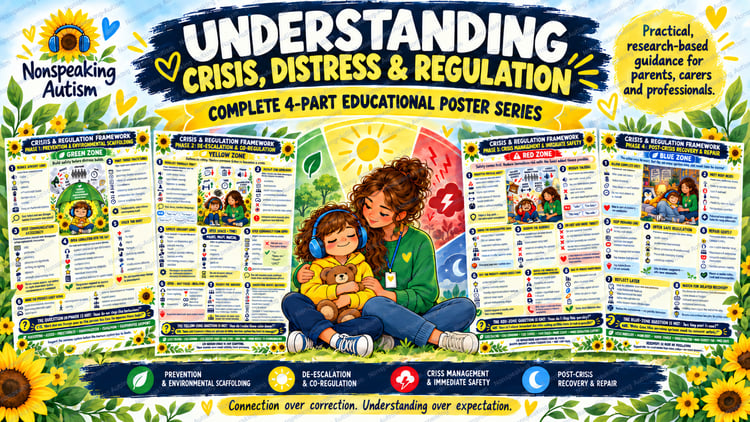

Crisis & Regulation Framework
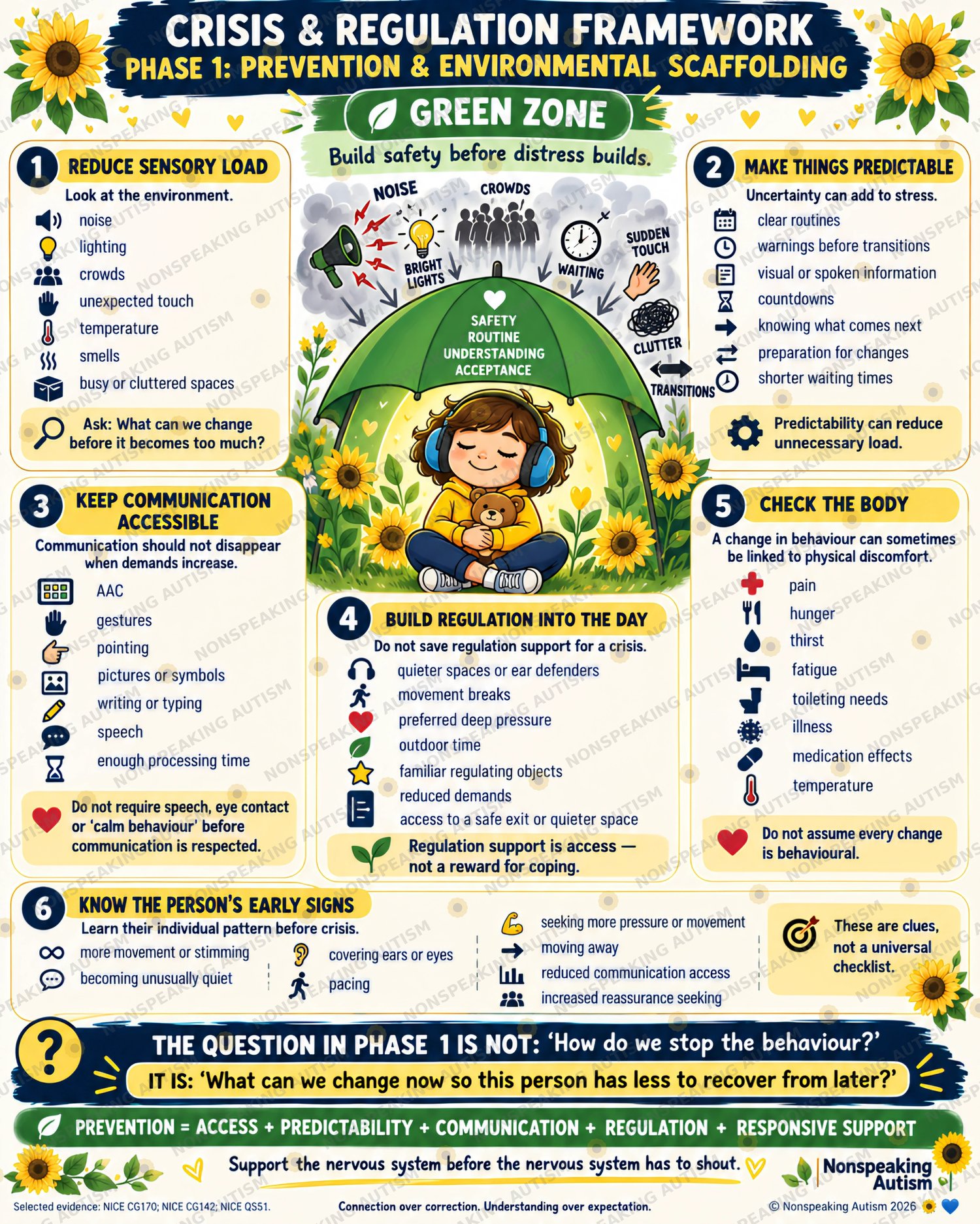
Crisis & Regulation Framework — Phase 1
Prevention & Environmental Scaffolding | Green Zone
Build safety before distress builds
The most effective crisis support often begins before there is a crisis.
When a person is regularly becoming overwhelmed, the first question should not automatically be:
“How do we stop the behaviour?”
A more useful question may be:
“What can we change now so this person has less to recover from later?”
Crisis & Regulation Framework — Phase 1: Prevention & Environmental Scaffolding is a practical, neurodiversity-affirming educational resource designed to help families, caregivers, educators and professionals think proactively about sensory load, predictability, communication, regulation, physical needs and early signs of distress.
Rather than waiting until someone reaches crisis point, Phase 1 focuses on building an environment in which the person has greater access, predictability, communication and responsive support from the beginning.
🌿 Prevention = Access + Predictability + Communication + Regulation + Responsive Support
🌿 What Is the Green Zone?
The Green Zone represents the preventative stage of this framework — the time to build support before distress becomes intense.
It does not mean that the person must appear perfectly calm, still or compliant.
Instead, this phase asks adults to look at the conditions surrounding the person.
Are sensory demands manageable?
Can they predict what is happening?
Can they communicate in a way that works for them?
Do they have access to regulation throughout the day?
Could pain, hunger, fatigue or another physical need be contributing?
Do we recognize their early signs of increasing load?
The aim is to create more opportunities for:
Safety • Routine • Understanding • Acceptance
1️⃣ Reduce Sensory Load
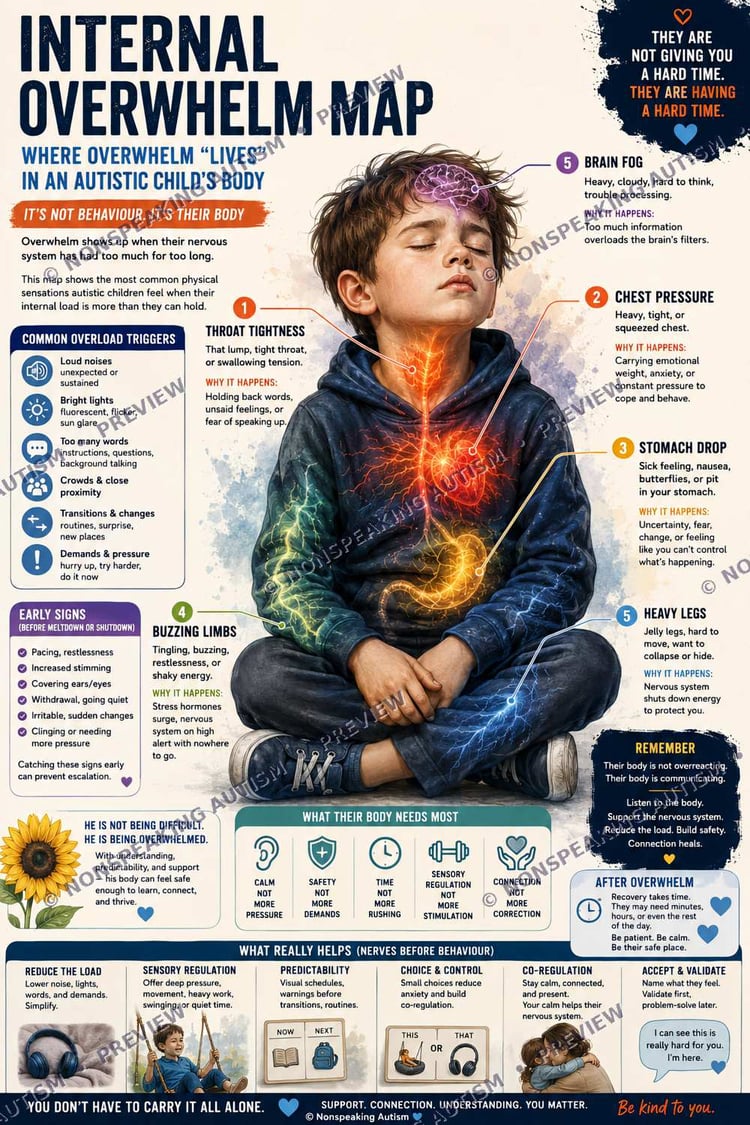
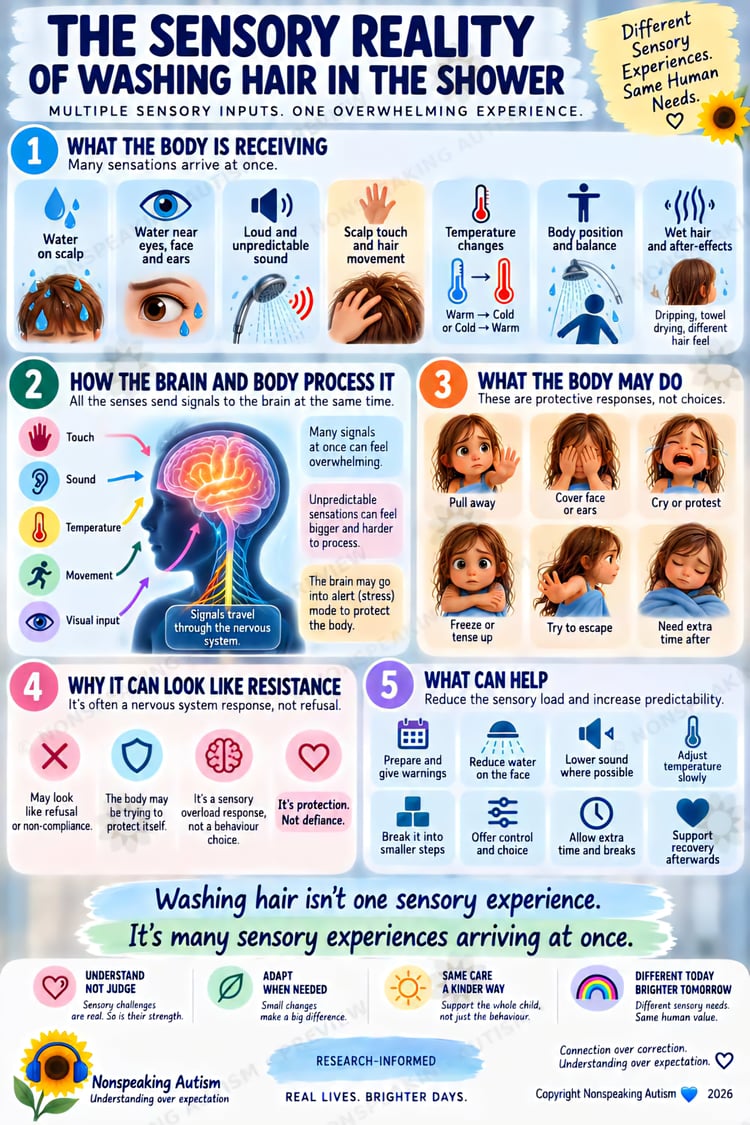
Sensory environments can place significant demands on some autistic and otherwise neurodivergent people.
Phase 1 encourages adults to look at the environment before expecting the individual to simply tolerate it.
Consider:
🔊 Noise
💡 Lighting
👥 Crowds
✋ Unexpected touch
🌡️ Temperature
👃 Smells
📦 Busy or cluttered spaces
Sometimes several individually manageable demands occur at the same time and create a much greater cumulative load.
Instead of asking only:
“Why are they struggling?”
ask:
“What can we change before it becomes too much?”
Possible changes might involve reducing unnecessary noise, modifying lighting, providing more personal space, reducing visual clutter, offering access to a quieter environment or allowing preferred sensory supports.
The appropriate response will depend on the individual.
2️⃣ Make Things Predictable
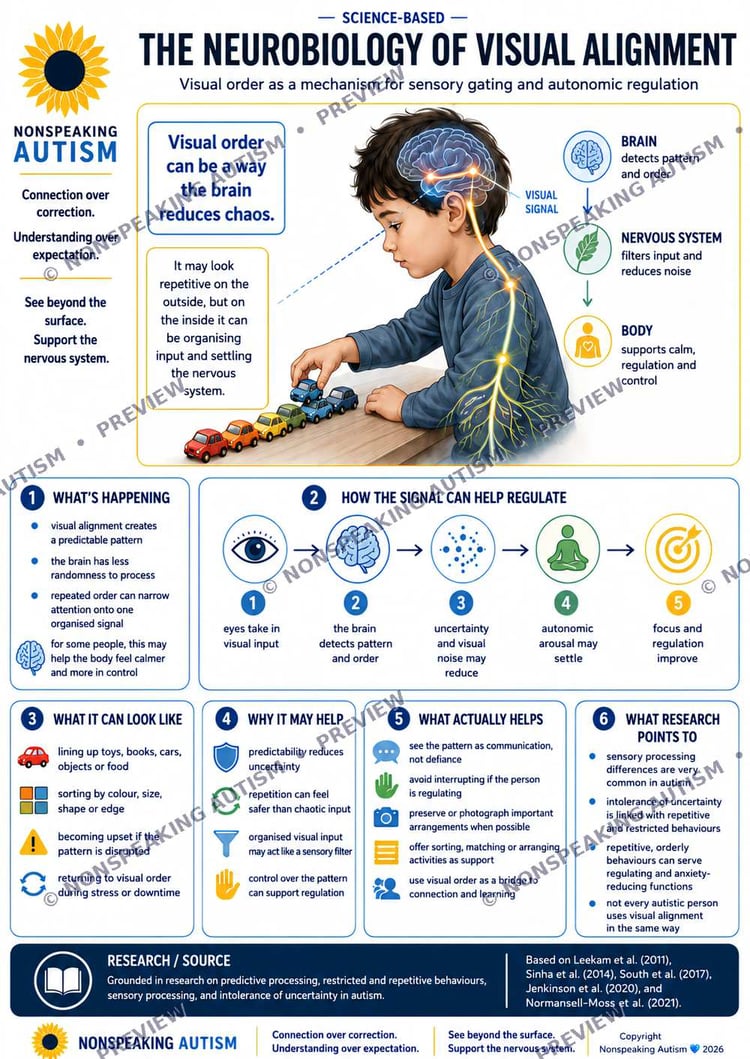
Uncertainty can add another layer of demand.
Predictability does not mean making every moment of life identical.
It means providing useful information and preparation where possible.
This might include:
clear routines
warnings before transitions
visual or spoken information
countdowns
knowing what comes next
preparation for changes
and shorter waiting periods where possible.
For some people, knowing:
what is happening → what comes next → when it will finish
can make an experience significantly easier to navigate.
⚙️ Predictability can reduce unnecessary load.
3️⃣ Keep Communication Accessible
Communication should not disappear when demands increase.
In fact, the moments when someone is becoming overwhelmed may be the moments when accessible communication matters most.
Communication may include:
AAC
gestures
pointing
pictures or symbols
writing
typing
speech
and sufficient processing time.
A person should not have to demonstrate calm behaviour, make eye contact or successfully use speech before their communication is respected.
If speech becomes harder during periods of stress or overload, this is not a reason to remove AAC or alternative communication.
Communication access is support — not a reward for regulation.
4️⃣ Build Regulation Into the Day
Regulation support should not be saved until somebody reaches crisis.
Depending on the individual, preventative regulation might include:
quieter spaces
ear defenders or other preferred hearing protection
movement breaks
preferred deep pressure
outdoor time
familiar regulating objects
reduced demands
or access to a safe exit or quieter space.
Crucially, these are possibilities rather than a universal sensory prescription.
Deep pressure, headphones, movement or any other sensory strategy should only be used when it is appropriate, safe and wanted by the individual.
🌱 Regulation support is access — not a reward for coping.
🧠 Regulation Does Not Mean “Looking Calm”
The purpose of regulation support is not to create a person who:
sits still,
stops stimming,
makes eye contact,
speaks on demand,
or looks calm enough for the adults around them.
A person's outward appearance does not necessarily tell us everything about their internal experience.
The goal is to provide conditions that support comfort, communication, autonomy, safety and meaningful participation.
5️⃣ Check the Body
A change in behaviour can sometimes have a physical cause.
Before assuming that something is “behavioural,” consider:
pain
hunger
thirst
fatigue
toileting needs
illness
medication effects
temperature
and other physical needs relevant to the individual.
For people who communicate pain or internal body sensations differently, changes in behaviour or regulation may sometimes be one of the first things other people notice.
❤️ Do not assume every change is behavioural.
Sudden, significant, persistent or unusual changes deserve particular attention and may require medical assessment.
6️⃣ Know the Person's Early Signs
There is no universal checklist showing exactly what somebody will do before becoming distressed.
That is why knowing the individual matters.
Possible early changes could include:
more movement or stimming
becoming unusually quiet
covering the ears or eyes
pacing
seeking additional pressure or movement
moving away
reduced communication access
or increased reassurance seeking.
These should be treated as possible clues, not proof of what somebody is feeling.
One person's pacing may indicate rising distress.
Another person's pacing may simply be enjoyable or regulating movement.
The meaning comes from the person's individual pattern and context.
🎯 Learn the pattern before crisis — without turning the pattern into a fixed label.
🔎 Look for Patterns, Not Isolated Behaviours
A useful preventative framework considers what was happening around the person.
For example:
What was the sensory environment like?
Had demands increased?
Was something unexpected happening?
Had communication become harder?
Was the person hungry, tired, thirsty or in pain?
Had they had access to their usual regulation strategies?
What happened immediately before the change?
What support actually helped?
Repeated observations can help build a more useful picture than interpreting one behaviour in isolation.
💛 Prevention Is Not Perfect Prevention
Even excellent support cannot guarantee that someone will never experience distress, overload, shutdown or crisis.
That distinction is important.
A crisis occurring does not automatically mean that the person, parent, caregiver, teacher or support professional failed.
Some triggers cannot be predicted or removed.
Health can change.
Unexpected events happen.
Environments cannot always be controlled.
And sometimes a person's capacity changes from one day to another.
The purpose of Phase 1 is therefore not to promise that every crisis can be prevented.
It is to identify avoidable barriers and unnecessary sources of load, provide accessible support early and reduce preventable distress where possible.
🏠 Using the Framework Across Settings
The principles can be considered across:
home
school
community environments
healthcare
respite or support services
and other relevant settings.
The exact support may look different in each environment.
Consistency does not necessarily mean doing precisely the same thing everywhere.
It means maintaining the same underlying respect for:
communication, autonomy, accessibility, regulation and safety.
🔬 Research & Guidance-Informed
This resource draws particularly on established autism guidance emphasizing the importance of considering environmental factors, communication needs, predictability, physical health, sensory sensitivities and individualized support.
NICE guidance for autistic children and young people recommends considering factors that may increase behaviour that challenges, including communication difficulties, physical disorders, environmental factors, changes to routines and the absence of predictability and structure. It also recommends considering adjustments to the physical environment, including sensory factors such as lighting and noise.
NICE guidance on behaviour that challenges and learning disabilities similarly emphasizes proactive strategies, environmental adaptations, meaningful activity, predictability, communication and addressing physical or mental-health problems that may contribute to distress.
For autistic adults, NICE guidance likewise emphasizes individualized support, environmental adjustments and attention to physical and sensory factors.
📚 Selected Guidance
National Institute for Health and Care Excellence (NICE). Autism spectrum disorder in under 19s: support and management (CG170).
National Institute for Health and Care Excellence (NICE). Challenging behaviour and learning disabilities: prevention and interventions for people with learning disabilities whose behaviour challenges (NG11).
National Institute for Health and Care Excellence (NICE). Autism spectrum disorder in adults: diagnosis and management (CG142).
Evidence Note
This framework translates broad evidence and professional guidance into an accessible educational format.
The Green Zone, the six numbered sections and the formula used on this poster are educational organizing tools created for this resource. They should not be interpreted as a validated clinical model, diagnostic system or guarantee that crisis can be prevented.
👨👩👧 Who Is This Resource For?
This resource may be useful for:
- autistic people and their families
- parents and caregivers
- teachers and teaching assistants
- SENCOs and SEND teams
- support workers
- occupational therapists
- speech and language therapists
- healthcare professionals
- social-care professionals
- respite and residential-support teams
- multidisciplinary teams
- autism and disability organizations
- anyone supporting a person who experiences periods of significant distress or overload
It is designed to encourage proactive discussion and individualized planning, rather than provide a one-size-fits-all crisis protocol.
📦 What You Receive
This download includes:
1 × Crisis & Regulation Framework — Phase 1: Prevention & Environmental Scaffolding educational poster
1 × high-resolution printable PDF
The downloadable file is supplied clear and without the promotional preview watermark shown in the Payhip listing image.
Watermarks visible on promotional images are for preview and copyright protection only and will not appear on the downloaded resource.
💛 DIGITAL DOWNLOAD
This educational resource is available to purchase through Payhip. It provides practical, research-informed sensory information for autistic people, families, educators and professionals.
This is a digital PDF download only. No physical product will be supplied.
Digital download only — no physical product will be shipped.
⚠️ Important Safety, Medical & Professional Disclaimer
This resource is for general educational and informational purposes only.
It is not a medical or mental-health assessment, diagnosis, behavioural assessment, occupational therapy assessment, individualized crisis plan, risk assessment, safeguarding plan or substitute for advice from appropriately qualified professionals.
The examples of possible triggers, early signs and regulation strategies are possibilities rather than universal meanings or recommendations. A behaviour cannot reliably tell us its cause when viewed in isolation.
Distress or changes in behaviour may have many causes, including pain, illness, injury, medication effects, sleep difficulties, communication barriers, anxiety, environmental demands and other physical or psychological factors.
Sudden, severe, unusual, persistent or rapidly worsening changes — or concerns about a person's immediate safety or health — require appropriate professional or medical attention. In an emergency, use the emergency services appropriate to your location.
Any sensory or regulation strategy should be individualized, safe, appropriate and acceptable to the person. Support should not involve forcing unwanted sensory input, removing communication, suppressing harmless stimming, coercing eye contact or requiring outward calm before needs are respected.
Where there is a known or foreseeable risk of serious harm, families and services should seek individualized professional assessment and safety planning rather than relying on this poster alone.
💛 The Message Behind the Resource
Crisis support does not begin when somebody is already overwhelmed.
It begins with noticing.
Noticing the room is too loud.
Noticing the transition was unexpected.
Noticing communication is becoming harder.
Noticing the person has not had an opportunity to regulate.
Noticing that something in their body might hurt.
Noticing the small changes that tell us:
“Something is becoming harder.”
Instead of waiting for the nervous system to shout, Phase 1 asks what we can change while there is still room to respond.
Not to create compliance.
Not to eliminate autistic behaviour.
Not to make someone appear calm.
But to create greater:
Access. Predictability. Communication. Regulation. Safety.
And to remember:
Support the nervous system before the nervous system has to shout. 💛
Connection over correction. Understanding over expectation.
© Nonspeaking Autism 2026 🌻💙