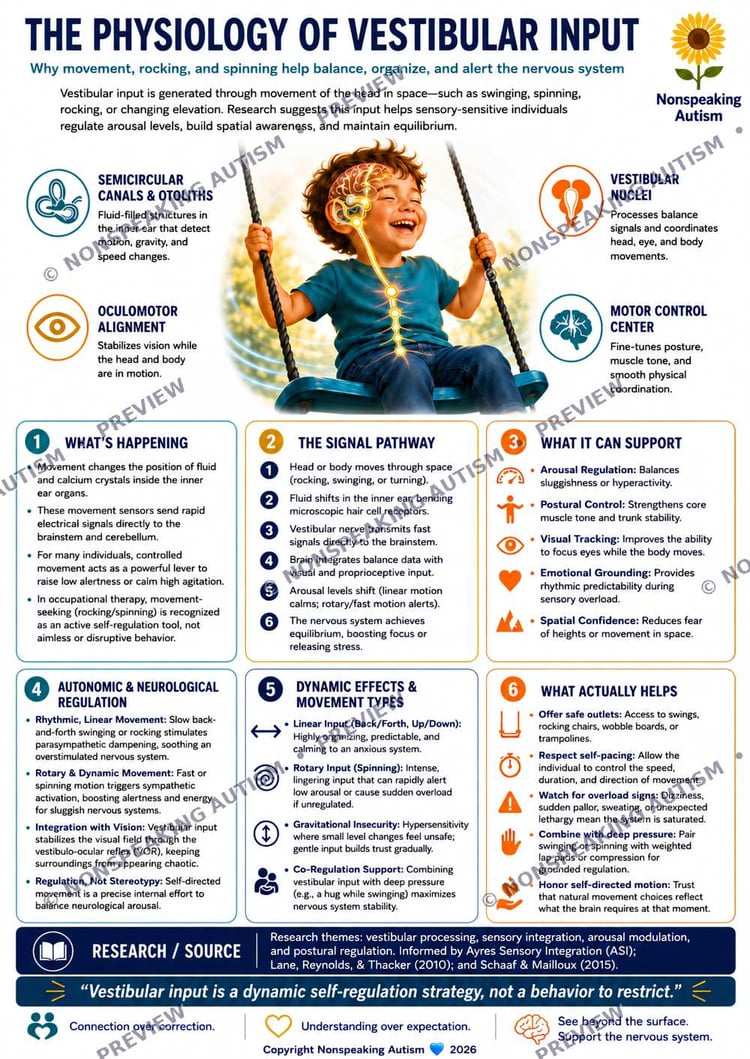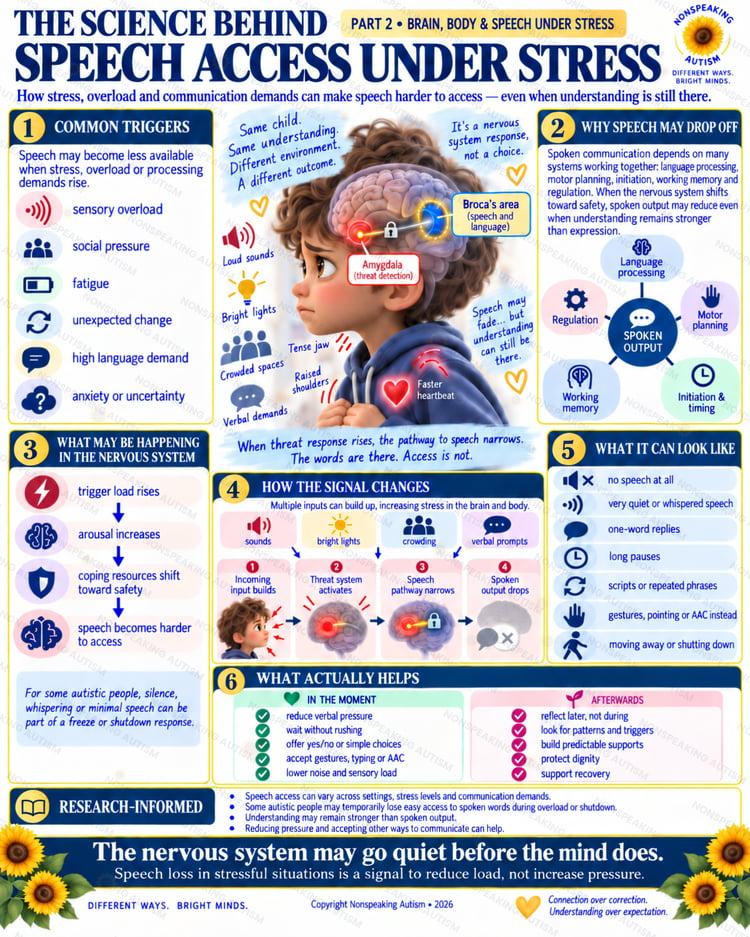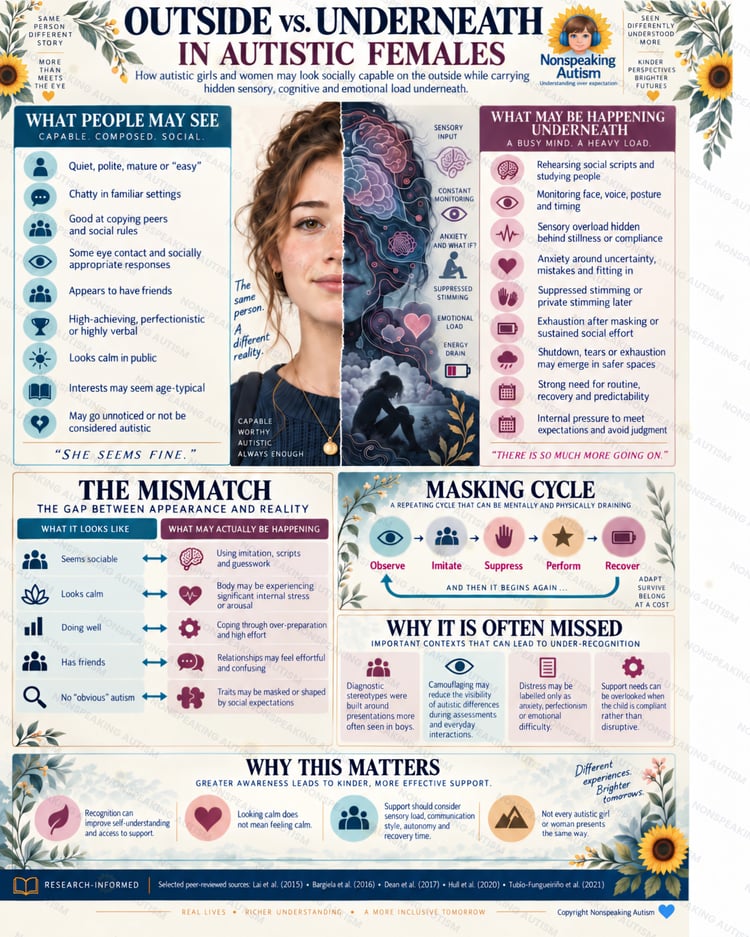


Sensory Regulation & De-Escalation
Sensory Regulation & De-Escalation
Quick visual guides for what to try when sensory overload hits
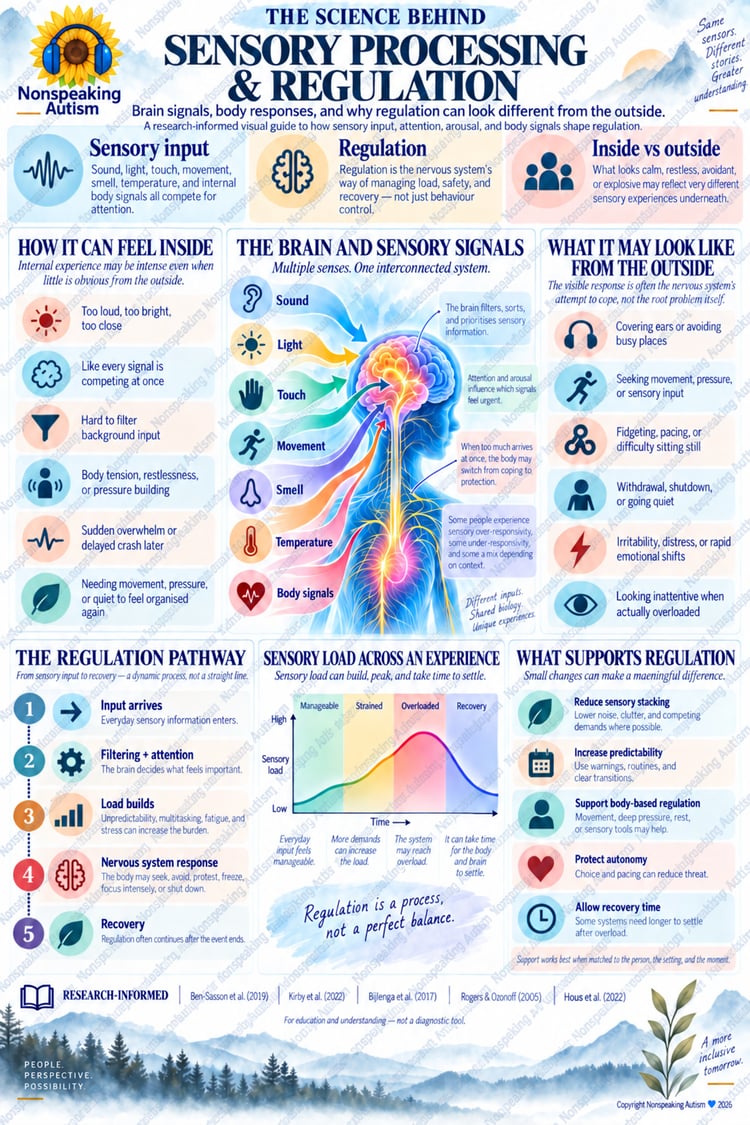
Sensory overload can sometimes look like distress, withdrawal, fleeing, crying, increased movement, difficulty communicating or a complete shutdown. What we see on the outside may be only one part of what is happening inside the nervous system.
Sensory Regulation & De-Escalation is a research-informed educational poster designed to help parents, carers, educators and professionals respond to sensory overload with less pressure, greater understanding and practical supportive strategies.
Rather than focusing on stopping behaviour in the moment, this resource encourages adults to consider sensory load, communication, safety, regulation and recovery.
The central message is:
Reduce the load. Protect the nervous system. Support recovery.
De-escalation is about safety, regulation and connection — not control.
🧠 What This Poster Explores
The poster provides an accessible visual guide to recognising and responding to sensory overload.
It covers:
- What sensory overload may look like
- What to try first when overload occurs
- Co-regulation techniques
- Body-based grounding ideas
- What not to do during the peak of distress
- Research-informed principles behind sensory regulation and support
- The importance of individualising strategies rather than assuming one approach works for everyone
It is designed to be easy to refer to during everyday situations while also helping adults understand the reasoning behind a lower-pressure response.
🌻 What Sensory Overload Can Look Like
Sensory overload does not have one appearance.
A person experiencing overload may:
- Cover their ears or attempt to block sounds
- Shut down or withdraw
- Cry, panic or become visibly distressed
- Flee, escape or hide
- Show anger, aggression or meltdown responses
- Become very quiet or appear “not there”
- Stim more frequently, including rocking, hand movements or repetitive actions
- Find speaking or processing information much harder
Importantly, a new or unusually prolonged change in responsiveness should not automatically be assumed to be sensory overload and may require medical assessment.
The poster helps shift the focus from:
“How do we stop this behaviour?”
towards:
“What is overwhelming this person, and what can we change around them?”
💙 What to Try First
During sensory overload, adding more instructions, questions and expectations can sometimes increase the person's processing load.
The poster therefore provides simple first-response ideas, including:
Reduce talking
Use fewer words, short phrases and clear communication.
Lower noise
Turn down or remove unnecessary sources of sound where possible.
Dim the lights
Reduce bright or uncomfortable lighting when appropriate.
Reduce people
Less audience and more physical space may reduce social and sensory demand.
Offer space
Allow the person to move away rather than crowding them.
Pause non-urgent demands
This may not be the right moment to continue requests that can safely wait.
Offer access to a quieter environment
A familiar, lower-input space may make recovery easier.
Protect safety
Address immediate risks while avoiding unnecessary escalation.
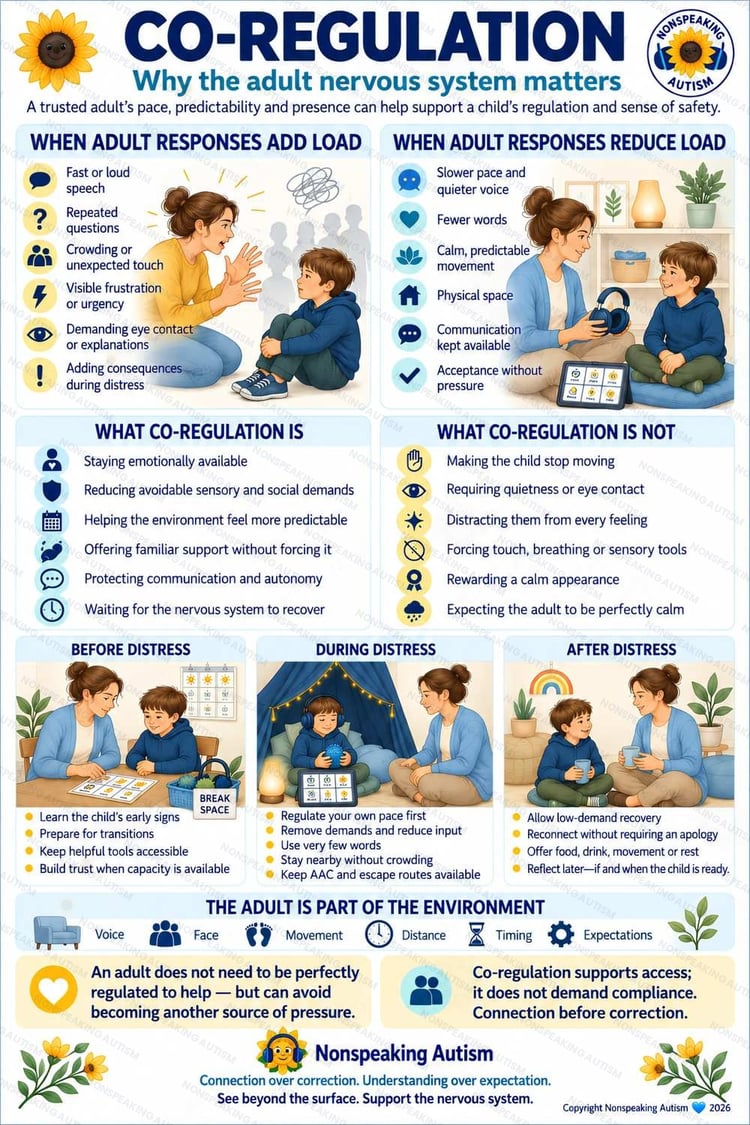
🤝 Co-Regulation Techniques
Regulation does not always happen in isolation.
A calm, predictable and supportive adult can become part of a safer environment during distress.
The poster suggests approaches such as:
- Using a calm voice and slower pace
- Staying nearby without crowding
- Acknowledging and validating distress
- Matching the person's pace before gradually slowing interaction
- Offering predictable reassurance
- Being present before attempting to problem-solve
The emphasis is on connection rather than compliance.
The aim is not to force somebody to appear calm. It is to reduce unnecessary pressure while their nervous system has time to recover.
🌿 Body-Based Grounding & Sensory Ideas
The poster also provides examples of body-based strategies that may help some individuals when they are safe, welcomed and appropriate.
Examples include:
- Deep pressure, if welcomed
- Pushing the feet into the floor
- Wall pushes
- Slow breathing together
- Holding a familiar comfort object
- Wrapping in a blanket, if wanted and freely removable
- Sipping water
- Rocking or another preferred repetitive movement
- Accessing a quiet, darker space
These are options, not requirements.
Every autistic person has an individual sensory profile. A strategy that regulates one person may be uncomfortable or overwhelming for another.
Choice, consent, safety and individual preference matter.
🚫 What Not to Do in the Peak Moment
The resource also highlights responses that can unintentionally add more pressure during overload.
These include:
- Asking large numbers of questions
- Forcing eye contact
- Insisting on spoken communication
- Rushing or hurrying the person
- Adding unnecessary sensory input such as touch, noise or bright light
- Punishing distress
- Expecting immediate recovery
Recovery can take time.
Reducing pressure does not mean ignoring safety or removing every boundary. It means recognising that the peak of sensory distress is generally not the best time for additional processing demands, lengthy explanations or problem-solving.
🔬 Research-Informed
The poster is informed by research and clinical guidance concerning sensory processing, environmental support, regulation and autism.
Selected references include:
Chen, Y., Xi, Z., Saunders, R., Simmons, D., Totsika, V., & Mandy, W. (2024). A systematic review and meta-analysis of the relationship between sensory processing differences and internalising/externalising problems in autism. Clinical Psychology Review, 114, 102516.
Edelson, S. M., Edelson, M. G., Kerr, D. C., & Grandin, T. (1999). Behavioral and physiological effects of deep pressure on children with autism: A pilot study evaluating the efficacy of Grandin's Hug Machine. American Journal of Occupational Therapy, 53(2), 145–152.
National Institute for Health and Care Excellence (NICE). Autism spectrum disorder in under 19s: support and management (CG170). NICE.
Research into individual sensory and body-based regulation strategies continues to develop. The poster intentionally uses language such as “may help,” “if welcomed” and “individualised” rather than presenting any sensory strategy as universally effective.
👨👩👧 Who Is This Resource For?
This poster may be useful for:
- Parents and carers
- Autistic people and their families
- Teachers and teaching assistants
- SENCOs and SEND teams
- Mainstream and specialist schools
- Autism and inclusion teams
- Occupational therapists
- Speech and language professionals
- Support workers
- Social-care professionals
- Respite and residential settings
- Community organisations
- Training and staff-development sessions
It can be displayed at home, in classrooms, SEND spaces, calm areas, therapy rooms or professional settings, or used as a visual discussion aid when creating individual support plans.
📦 What You Receive
Your purchase includes:
1 × Sensory Regulation & De-Escalation — Quick Visual Guide
This is a digital educational poster from Nonspeaking Autism, supplied as a PDF file.
The purchased version is supplied clear and without the promotional preview watermark. Watermarks visible on Payhip listing images are used for preview and copyright-protection purposes.
Digital download only — no physical product will be shipped.
⚠️ Important Disclaimer
This resource is provided for educational and informational purposes only. It is not medical advice, diagnosis, therapy or a substitute for individual assessment or guidance from an appropriately qualified professional.
Sensory and regulation needs vary considerably between individuals. Strategies should be adapted to the person's communication, sensory profile, preferences, consent, health needs and circumstances.
Never force touch, deep pressure, breathing exercises, sensory equipment or other regulation strategies on someone who does not want them.
Sudden or unusual changes in behaviour, responsiveness, pain, breathing or consciousness should be medically assessed.
💛 The Message Behind the Resource
Sensory overload is not simply a behaviour to control.
When the nervous system is overwhelmed, the most useful response may be to reduce demands, reduce sensory load, preserve communication, protect safety and allow recovery.
Different people need different forms of support — and the same person may need something different from one day to the next.
Softer environments. Brighter tomorrows.
Connection over correction.
Understanding over expectation.
Different sensory needs. Equal belonging.
© Nonspeaking Autism 2026. All rights reserved.