

🧠 THE SCIENCE BEHIND MASKING
🧠 THE SCIENCE BEHIND MASKING
What It Costs the Nervous System to Hold It Together
Research-Informed Autism Educational Poster | UK Edition | Nonspeaking Autism
🌻 Understand the system. Support the recovery.
An autistic child may appear calm, cooperative, sociable or completely fine throughout the school day — yet arrive home exhausted, withdrawn, tearful or overwhelmed.
What adults see on the outside does not always reflect what the child is experiencing internally.
For some autistic people, appearing to cope involves significant effort: monitoring facial expressions, managing conversations, suppressing natural movements, adapting communication and trying to meet expectations that may not feel comfortable or accessible.
This is often described as autistic masking, also known as camouflaging.
Masking can help someone navigate social situations, avoid unwanted attention or protect themselves from rejection. However, sustained masking may also be associated with fatigue, stress, reduced wellbeing and emotional exhaustion.
The Science Behind Masking is a detailed, illustrated educational poster exploring what autistic masking may involve, why people mask, the potential costs of sustained camouflaging and how adults can create environments where autistic people feel safer being themselves.
The central message:
Masking can protect a person in the moment, but it may come at a significant cost over time.
🧠 WHAT THIS POSTER EXPLORES
1. What Autistic Masking May Involve
Masking is not simply being polite or learning social skills.
It can involve consciously or automatically changing natural behaviours, communication or emotional expression to meet expectations or avoid negative reactions.
Examples may include:
👁️ Monitoring the environment: Constantly observing other people, social cues and expectations.
⚙️ Suppressing natural responses: Hiding stimming, discomfort or signs of distress.
👥 Changing social presentation: Making eye contact, altering posture or participating in ways that feel unnatural.
💬 Using learned scripts: Rehearsing conversations or copying communication patterns to appear socially comfortable.
🧠 Self-monitoring: Continually checking facial expressions, tone of voice and body language.
Research using the Camouflaging Autistic Traits Questionnaire (CAT-Q) describes three related dimensions:
Compensation: Developing strategies to navigate social situations.
Masking: Concealing or suppressing autistic characteristics.
Assimilation: Trying to fit into social situations and meet expectations.
These experiences vary considerably between individuals.
Not every autistic person masks, and not every form of social adaptation is necessarily harmful.
⚡ 2. WHAT MASKING MAY COST THE NERVOUS SYSTEM
Masking can require ongoing attention, effort and self-monitoring.
For some autistic people, this may be associated with:
🧠 Increased Mental Effort
Continually thinking about what to say, how to respond and whether behaviour appears socially acceptable can be mentally demanding.
🔋 Cognitive Fatigue
Sustained concentration and self-monitoring may leave someone feeling exhausted, particularly after school, work or busy social situations.
💜 Emotional Strain
Hiding discomfort or trying to meet expectations may be associated with anxiety, stress or reduced emotional wellbeing.
💪 Physical Tension
Some people report muscle tension or physical discomfort during stressful situations.
🌧️ Delayed Distress
Someone may appear composed in one environment and experience greater distress or exhaustion later, when demands have reduced.
🌱 Possible Longer-Term Consequences
Research has found associations between greater camouflaging and poorer mental health outcomes in some autistic groups.
However, these findings do not mean masking inevitably causes burnout, or that every autistic person experiences the same effects.
Appearing calm does not necessarily mean feeling comfortable.
🛡️ 3. WHY AUTISTIC PEOPLE MAY MASK
Masking is often shaped by the expectations and reactions of other people.
Some autistic people may camouflage to:
- Avoid rejection, bullying or social exclusion.
- Reduce the risk of being criticised or misunderstood.
- Meet school, workplace or family expectations.
- Avoid punishment for natural autistic behaviours.
- Navigate situations where their communication needs are not accommodated.
- Protect privacy or feel safer in an unfamiliar environment.
For some, masking may become habitual after repeated experiences of being corrected, criticised or pressured to appear less autistic.
It is important not to assume that masking is always a freely chosen behaviour.
Equally, an autistic person's decision about when to disclose, adapt or conceal aspects of themselves should be respected.
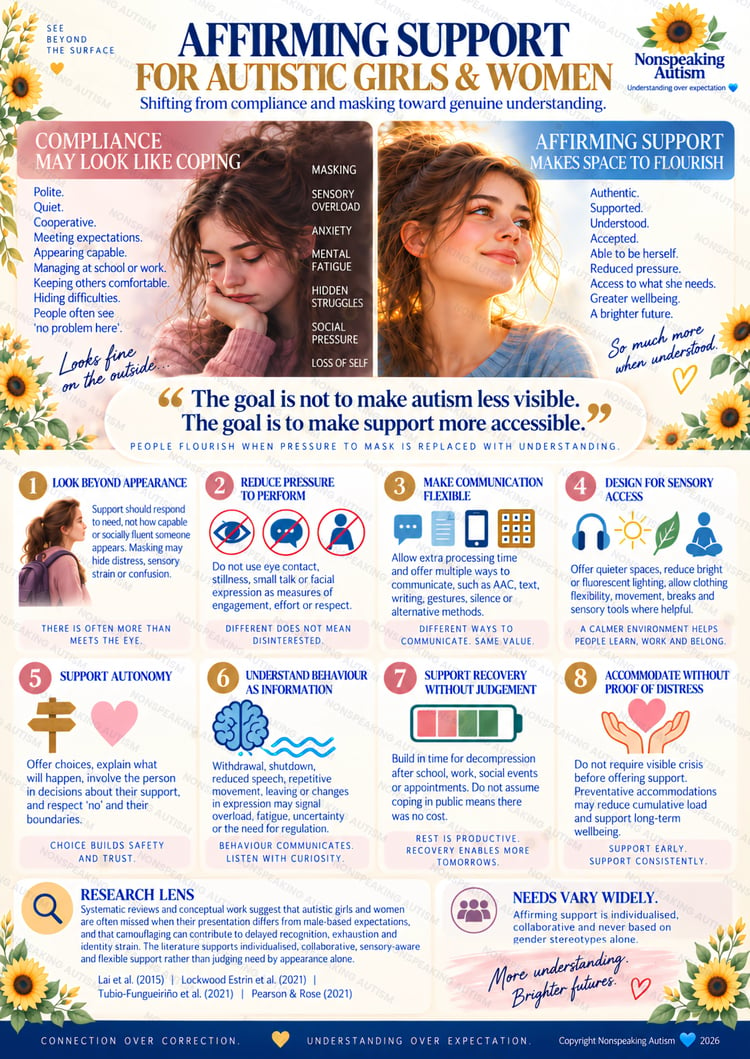
The goal is not to demand that someone unmasks. The goal is to make unmasking safer and more possible when they choose.
🔄 4. ONE POSSIBLE PATTERN — NOT FIXED STAGES
The poster illustrates one possible pattern of sustained masking:
CALM OR COPING → INCREASING STRAIN → OVERLOAD → DISTRESS OR EXHAUSTION LATER
💙 Appearing to Cope
The person may seem settled and engaged while using considerable effort to manage expectations.
💛 Increasing Strain
As demands continue, fatigue and stress may increase.
🧡 Feeling Overloaded
The person may have less capacity to manage further sensory, social or communication demands.
💜 Releasing Distress Later
Once in a familiar or less demanding environment, the person may become quieter, cry, withdraw, need solitude or experience heightened distress.
Some families describe this as a child holding everything together at school and struggling after returning home.
This is an illustrative pattern, not a scientifically established sequence.
Not every episode of distress after school is caused by masking. Sensory overload, fatigue, pain, unmet needs, transitions and other factors may also contribute.
👀 5. WHAT MASKING CAN LOOK LIKE
Masking is not always easy to recognise.
Possible experiences include:
- Quietly following instructions despite feeling overwhelmed.
- Saying “I'm fine” when feeling distressed.
- Working hard to interpret and meet social expectations.
- Suppressing preferred movements or stimming.
- Copying peers' expressions or communication.
- Hiding confusion rather than asking for help.
- Avoiding visible signs of discomfort.
- Feeling exhausted after social interaction.
- Needing significant recovery time after school.
- Appearing settled in public but struggling later in private.
These examples are not diagnostic signs.
The same outward behaviours can have many different explanations.
A child who is quiet may be comfortable, concentrating, masking, anxious, tired or experiencing something else entirely.
Understanding requires listening, observation and respect for individual communication.
💛 6. WHAT HELPS REDUCE THE COST OF MASKING
🛡️ Create Psychological Safety
Build environments where autistic communication, movement and sensory needs are respected.
Avoid punishing harmless stimming or requiring unnecessary conformity.
⏰ Protect Recovery Time
Allow opportunities to decompress after demanding activities.
This might mean quiet time, a preferred interest, movement, rest or reduced social expectations.
❤️ Make Space for Authenticity
Do not require eye contact, typical facial expressions or conventional social performance as proof of attention, respect or understanding.
👥 Believe the Effort
Take reports of exhaustion and discomfort seriously, even when the person appeared to cope earlier.
🌱 Offer Low-Demand Connection
Provide supportive presence without immediate questioning or pressure to explain what happened.
💬 Respect Communication Differences
Keep AAC and other preferred communication methods available.
Allow additional processing time and accept different ways of participating.
🏫 Review Environmental Expectations
Consider whether school or workplace expectations are creating unnecessary demands.
Reasonable adjustments may include sensory accommodations, flexible participation, accessible communication and opportunities for recovery.
Support should reduce unnecessary barriers rather than teach someone to hide their needs more effectively.
🏫 MASKING AT SCHOOL: WHY ADULTS MAY SEE DIFFERENT SIDES
A child may appear settled in the classroom but become exhausted or distressed at home.
This difference does not automatically mean the child is choosing where to behave well.
Different environments place different demands on sensory processing, communication, attention and social interaction.
Home may also be a place where the child feels more comfortable expressing needs or distress.
Useful questions include:
- How much effort does the child use to meet classroom expectations?
- Are sensory accommodations consistently available?
- Is the child expected to maintain eye contact or suppress movement?
- Can they use AAC or other preferred communication without pressure?
- Do they have genuine opportunities to rest?
- Are signs of fatigue or distress being missed because the child appears compliant?
- What does the child communicate about their experience?
- What patterns do families and school staff notice together?
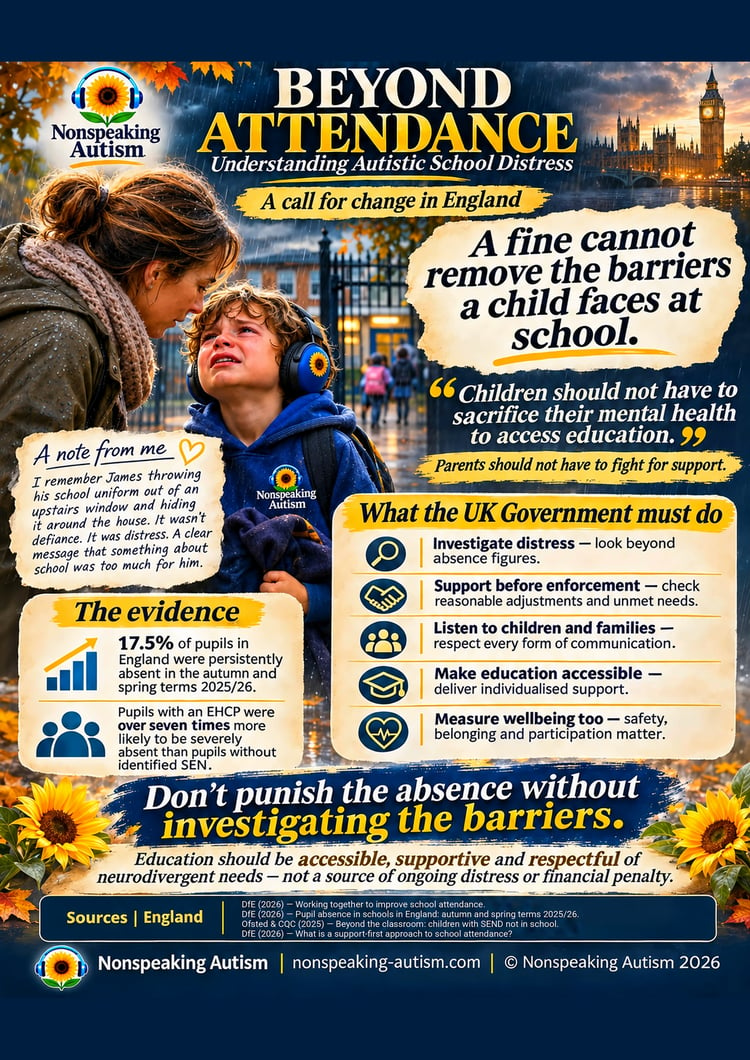
For UK schools, these discussions may inform individual support planning, SEND provision and reasonable adjustments.
The aim is not to remove all challenge or social learning.
It is to ensure that participation does not depend on unnecessary discomfort or concealment.
🔬 RESEARCH-INFORMED: WHAT THE SCIENCE ACTUALLY SAYS
Research into autistic camouflaging has grown significantly.
Studies describe masking as a complex set of experiences involving compensation, concealment and attempts to fit into social environments.
Research has also identified associations between camouflaging and outcomes such as anxiety, depression, stress, exhaustion and reduced wellbeing in some autistic populations.
However, there are important limitations.
Current research does not establish one specific neurological pathway through which masking causes exhaustion or burnout.
The brain and nervous system illustration on this poster is conceptual artwork. It is not a brain scan, a map of measured neural activity or proof of a particular mechanism.
Many studies rely on self-reported experiences, and much of the research has involved autistic adolescents or adults. Findings should not automatically be applied to every child.
📚 SELECTED RESEARCH REFERENCES
Hull, L., Mandy, W., Lai, M.-C., Baron-Cohen, S., Allison, C., Smith, P., & Petrides, K. V. (2019). Development and validation of the Camouflaging Autistic Traits Questionnaire (CAT-Q). Journal of Autism and Developmental Disorders, 49, 819–833.
https://doi.org/10.1007/s10803-018-3792-6
Hull, L., Petrides, K. V., & Mandy, W. (2020). The female autism phenotype and camouflaging: A narrative review. Review Journal of Autism and Developmental Disorders, 7, 306–317.
https://doi.org/10.1007/s40489-020-00197-9
Cassidy, S. A., Bradley, L., Shaw, R., & Baron-Cohen, S. (2018). Risk markers for suicidality in autistic adults. Molecular Autism, 9, 42.
https://doi.org/10.1186/s13229-018-0226-4
Important evidence distinction: The Cassidy study examines broader risk markers and should not be interpreted as demonstrating that masking alone causes a particular mental health outcome.
Research & References Section 1 – What masking may involve: - Hull, L., Mandy, W., Lai, M.-C., Baron-Cohen, S., Allison, C., Smith, P., & Petrides, K. V. (2019). Development and validation of the Camouflaging Autistic Traits Questionnaire (CAT-Q). Journal of Autism and Developmental Disorders, 49(3), 819–833. https://doi.org/10.1007/s10803-018-3792-6 Sections 2 & 3 – What it may cost, and why people mask: - Zhuang, S., Tan, D. W., Reddrop, S., Dean, L., Maybery, M., & Magiati, I. (2023). Psychosocial factors associated with camouflaging in autistic people and its relationship with mental health and well-being: a mixed methods systematic review. Clinical Psychology Review, 105, 102335. https://doi.org/10.1016/j.cpr.2023.102335 Sections 4 & 5 – Exhaustion, release and burnout: - Arnold, S. R. C., Higgins, J. M., Weise, J., Desai, A., Pellicano, E., & Trollor, J. N. (2023). Confirming the nature of autistic burnout. Autism, 27(7), 1906–1918. https://doi.org/10.1177/13623613221147410 Emerging research on children and young people (published online 2026; volume and pages not yet confirmed): - Dighton, S., & McAloon, J. (2026). Camouflaging, internalizing symptoms, and externalizing symptoms in children and adolescents with autism spectrum disorder. Advances in Neurodevelopmental Disorders. https://doi.org/10.1007/s41252-026-00476-2 Foundational references (printed on the poster): Hull et al. (2019) • Zhuang et al. (2023) • Arnold et al. (2023)
Sources:
- Zhuang et al. 2023 (Crossref)
- Arnold et al. 2023 (Macquarie University)
- Arnold et al. 2023 (Western Sydney University)
- Hull et al. 2019 (Crossref)
👨👩👧 WHO IS THIS RESOURCE FOR?
This poster may be useful for:
- Parents and carers of autistic children
- Autistic teenagers and adults
- Families supporting nonspeaking and minimally speaking autistic people
- Teachers and teaching assistants
- SENCOs and SEND teams
- Mainstream and specialist schools
- Educational psychologists
- Occupational therapists
- Speech and language therapists
- Autism support professionals
- Mental health practitioners
- Professionals supporting autistic people in education or employment
It can be used to start conversations about masking, exhaustion, social expectations, sensory needs, emotional wellbeing and recovery.
📦 WHAT YOU RECEIVE
💙 PAID DIGITAL DOWNLOAD
1 × The Science Behind Masking educational poster
The poster includes:
- What autistic masking may involve
- Why autistic people may mask
- Potential mental, emotional and physical costs
- One possible pattern of accumulated strain
- Everyday examples of camouflaging
- Practical approaches to reducing pressure
- Support for recovery and authentic participation
- A research-informed explanation with scientific cautions
Digital product only. No physical item will be shipped.
The supplied listing image is a branded preview. The customer download should be the final clean version, without promotional watermarks.
Print size and resolution should be confirmed against the actual downloadable file before being advertised.
⚠️ IMPORTANT DISCLAIMER
This resource is intended for educational and informational purposes only.
It is not a diagnostic assessment, mental health screening tool, medical treatment, therapy programme or substitute for individual professional advice.
Masking experiences differ between autistic people, and outward behaviour cannot establish whether a person is camouflaging or experiencing distress.
Fatigue, withdrawal and emotional distress may have many causes, including medical conditions, pain, sleep difficulties, anxiety and environmental demands.
If a person is experiencing significant or persistent distress, seek appropriate professional support.
©️ COPYRIGHT & PERMITTED USE
Copyright © 2026 Nonspeaking Autism. All rights reserved.
This resource may be used for personal, home, classroom, school and individual professional educational purposes.
You may print and display your purchased copy within those settings.
You may not resell, redistribute, share the downloadable file, upload it elsewhere, remove copyright branding or reproduce the artwork for commercial use.
Please share the original Payhip product link rather than distributing copies.
💛 THE MESSAGE BEHIND THE RESOURCE
An autistic person should not have to look distressed before their needs are taken seriously.
They should not have to suppress harmless movements to be accepted.
They should not have to perform comfort, confidence or compliance to deserve support.
And they should not have to reach exhaustion before being offered recovery time.
Masking may be the appearance of regulation, not the experience of it.
Look beyond the performance.
Believe the effort.
Reduce unnecessary demands.
Create space for authenticity.
🌻 See the science. Support the nervous system. Look beyond the performance.
💙 Connection over correction. Understanding over expectation.
Nonspeaking Autism © 2026