
Why Some Autistic Children May Seek Chin Pressure
Why Some Autistic Children May Seek Chin Pressure
What Sensory Neuroscience Can — and Cannot — Tell Us
A Research-Informed Educational Poster
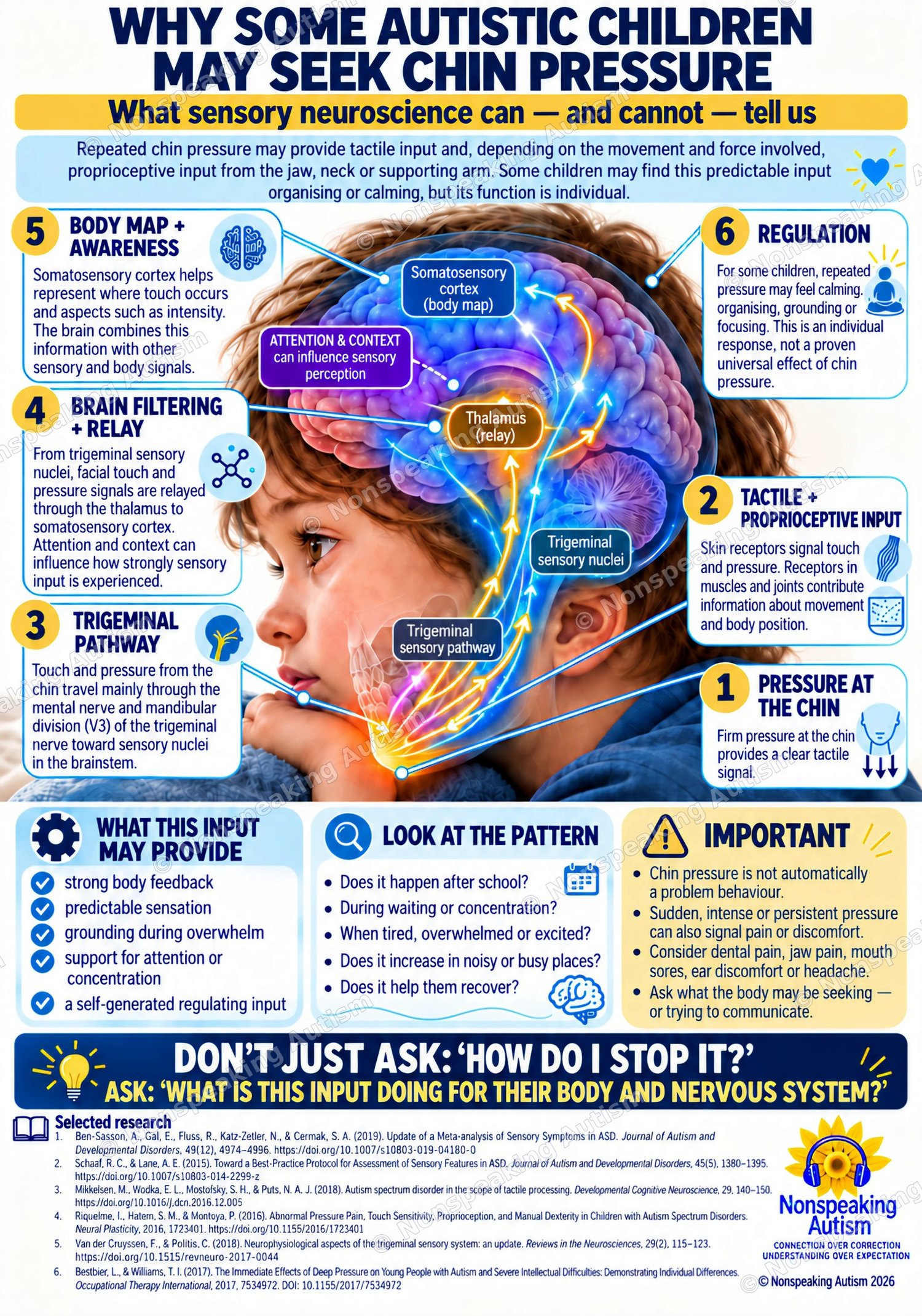
Repeatedly resting or pressing the chin into a hand, arm, surface or object can provide clear tactile input and, depending on the movement and force involved, may also involve proprioceptive feedback from the jaw, neck and supporting arm.
For some autistic children, this predictable, self-generated pressure may feel grounding, organizing, calming or useful during concentration, waiting or periods of sensory overload.
For others, the same visible behaviour may have a completely different explanation — including physical discomfort.
The movement is information. It is not a diagnosis of what the child is feeling or why they are doing it.
Why Some Autistic Children May Seek Chin Pressure is a research-informed educational poster from Nonspeaking Autism designed to explain the sensory neuroscience that may be relevant while clearly separating what research can reasonably tell us from what must be understood about the individual child.
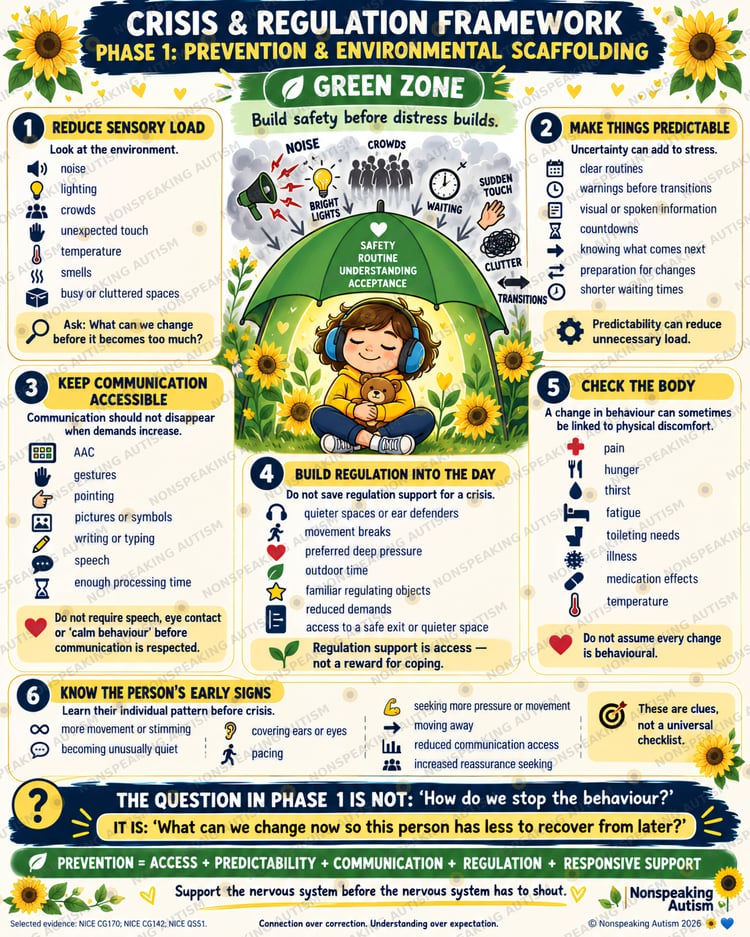
The central question is not simply:
“How do I stop it?”
but:
“What might this input be doing for their body and nervous system?”
🫶 1. Pressure at the Chin
Firm pressure against the chin creates a tactile signal.
When children generate the pressure themselves — for example, by resting their chin firmly in their hand or against another surface — they have some control over:
- how much pressure they use
- where it occurs
- when it starts
- how long it lasts
- when it stops
That predictability and control may be meaningful for some children.
But the action itself does not prove that the child is seeking sensory regulation.
Observe first. Interpret carefully.
✋ 2. Tactile & Proprioceptive Input
Skin receptors provide information about touch and pressure.
Depending on the action, sensory information associated with muscles and joints may also contribute to awareness of movement, force and body position.
If the child is supporting their chin with their hand, for example, sensory feedback may come from several parts of the body simultaneously.
This helps explain what kind of input the movement can create.
It does not establish why an individual child performs it.
🧠 3. The Trigeminal Pathway
The chin and lower facial region receive sensory innervation largely through the mandibular division (V3) of the trigeminal nerve, including its mental nerve branch.
Sensory information travels towards trigeminal sensory nuclei in the brainstem and interacts with wider sensory-processing pathways.
The trigeminal system is important for sensation across the face and oral structures.
The pathway shown on the poster is intentionally simplified for educational purposes.
It is not a brain scan or proof of what is happening neurologically in an individual child.
🔄 4. Brain Filtering, Relay & Context
Sensory information is not experienced in isolation.
The thalamus participates in relaying much sensory information towards cortical regions, while wider neural networks contribute to perception.
How input feels can also be influenced by:
- attention
- predictability
- current sensory load
- stress or arousal
- fatigue
- previous experiences
- competing sensory information
- pain
- environmental context
This means identical pressure may not produce an identical experience every time.
Context can change sensory experience.
🗺️ 5. Body Map & Awareness
The somatosensory cortex contributes to processing and representing sensory information from different areas of the body.
It is involved in aspects of identifying where touch occurs and characteristics of that sensory input.
But sensory perception is much more complex than one region of the brain.
Multiple neural systems contribute to sensation, attention, emotion, movement, learning and context.
The colourful brain illustration on this poster should therefore be understood as a simplified educational representation.
💙 6. Regulation — What Can We Say?
For some children, repeated self-generated pressure may accompany:
- concentration
- waiting
- excitement
- uncertainty
- fatigue
- sensory overload
- recovery after a demanding environment
A child may experience the pressure as:
predictable • grounding • organizing • focusing • calming • pleasant
But these are possibilities.
There is no evidence that pressing the chin has a single universal regulatory effect for autistic children.
A response that helps one child may do nothing for another.
⚙️ What Might This Input Provide?
Depending on the individual child, chin pressure may provide:
- strong body feedback
- predictable sensation
- tactile input
- self-generated sensory input
- an activity used during concentration
- something used during overwhelm or uncertainty
- a familiar sensory experience
These are possible functions to explore, not meanings to automatically assign.
🔍 Look at the Pattern
Repeated observations can tell us more than one isolated incident.
Consider:
Does it happen after school?
Does it happen while waiting or concentrating?
Is it more frequent when the child is tired, overwhelmed or excited?
Does it increase in noisy or busy places?
Does it occur during particular tasks or transitions?
Does it seem to help the child continue, focus or recover?
Has the behaviour recently changed?
And importantly:
What does the child communicate about the experience?
Communication may be through speech, AAC, gesture, symbols, pointing, body movement, facial expression or another individualized method.
⚠️ Don't Automatically Assume Sensory Seeking
Chin pressure is not automatically a problem behaviour.
But it is also not automatically sensory seeking.
Sudden, unusually forceful, persistent or significantly increased pressure can sometimes occur alongside pain or discomfort.
Depending on the circumstances, consider possible:
- dental pain
- tooth or gum problems
- mouth sores
- jaw/TMJ discomfort
- ear discomfort
- headache
- facial pain
- injury
- illness
- sensory overload
A behaviour change cannot prove that pain is present.
But it can provide a reason to check the body rather than assume the behaviour is simply “autism.”
Sensory explanations should never prevent appropriate medical or dental assessment.
🚫 Does Chin Pressure Need to Be Stopped?
Not simply because it looks unusual.
Where the behaviour is harmless, comfortable and self-directed, consider its function before attempting to suppress it.
Ask:
Is it safe?
Is the child comfortable?
Is there excessive force or risk of injury?
Could something hurt?
Is the behaviour new or significantly different?
Does the child appear to choose the input?
Does it support participation or recovery?
The aim should not be to eliminate harmless autistic behaviour for the sake of appearing typical.
Safety, comfort, communication and participation matter more than appearance.
🧠 What About Deep Pressure?
Research into deep-pressure interventions provides some useful background, but it does not prove a specific mechanism for chin pressure.
Research has reported beneficial responses to deep-pressure input for some autistic people, while also demonstrating substantial individual differences.
Self-generated chin pressure and externally applied deep-pressure interventions are not the same thing.
Evidence concerning one form of sensory input should therefore not automatically be transferred to another.
Individual response matters.
🔬 Research-Informed
The broader scientific literature supports several principles used in this resource.
Sensory-processing differences are common among autistic people, although sensory profiles are highly individual.
Research has identified group-level differences in tactile processing.
The trigeminal system provides major sensory pathways for the face.
Tactile and proprioceptive systems contribute information about touch, pressure, movement and body position.
Research also demonstrates individual variation in responses to pressure-based sensory input.
What research cannot establish from simply watching a child is why that particular child presses their chin.
Observe the pattern. Consider context. Check the body. Listen to the child. Individualize support.
📚 Selected Research & References
Ben-Sasson, A., Gal, E., Fluss, R., Katz-Zetler, N., & Cermak, S. A. (2019). Update of a Meta-analysis of Sensory Symptoms in ASD: A New Decade of Research. Journal of Autism and Developmental Disorders, 49(12), 4974–4996.
Schaaf, R. C., & Lane, A. E. (2015). Toward a Best-Practice Protocol for Assessment of Sensory Features in ASD. Journal of Autism and Developmental Disorders, 45(5), 1380–1395.
Mikkelsen, M., Wodka, E. L., Mostofsky, S. H., & Puts, N. A. J. (2018). Autism spectrum disorder in the scope of tactile processing. Developmental Cognitive Neuroscience, 29, 140–150.
Riquelme, I., Hatem, S. M., & Montoya, P. (2016). Abnormal Pressure Pain, Touch Sensitivity, Proprioception, and Manual Dexterity in Children with Autism Spectrum Disorders. Neural Plasticity, 2016, 1723401.
van der Cruyssen, F., & Politis, C. (2018). Neurophysiological aspects of the trigeminal sensory system: an update. Reviews in the Neurosciences, 29(2), 115–123.
Bestbier, L., & Williams, T. I. (2017). The Immediate Effects of Deep Pressure on Young People with Autism and Severe Intellectual Difficulties: Demonstrating Individual Differences. Occupational Therapy International, 2017, 7534972.
📚 RESEARCH & REFERENCES
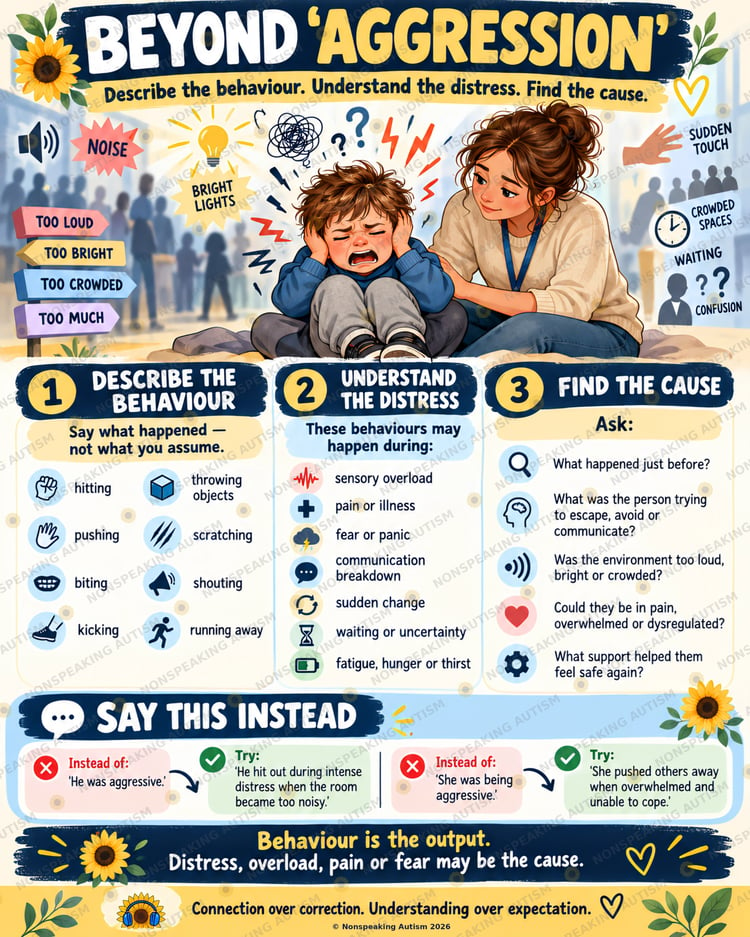
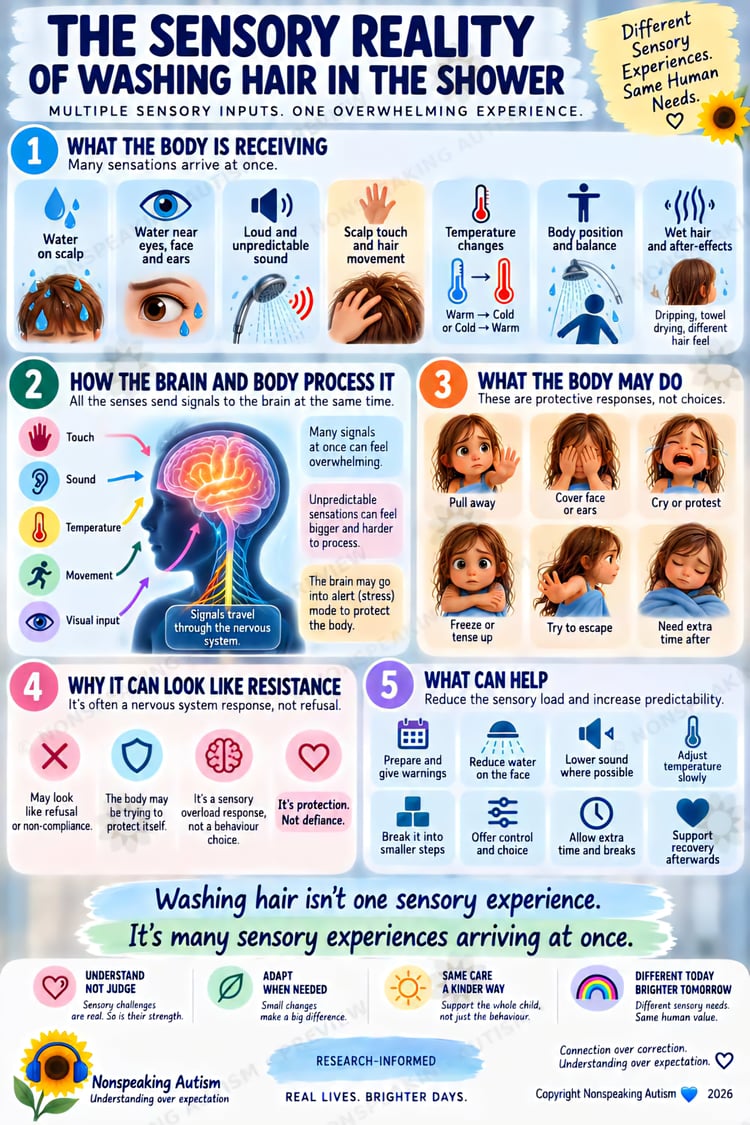
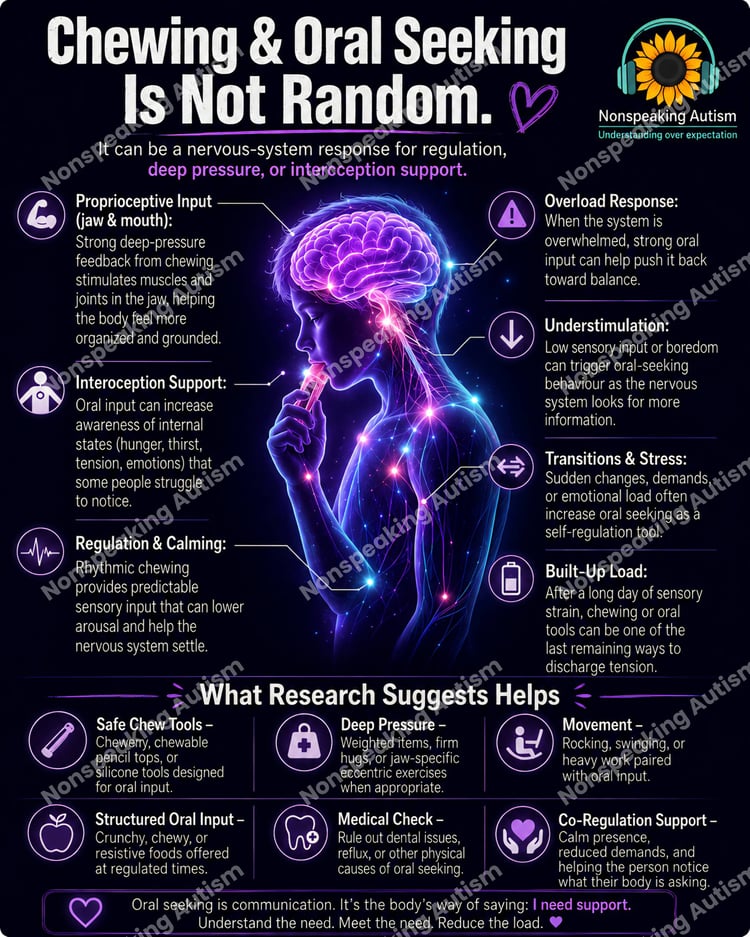
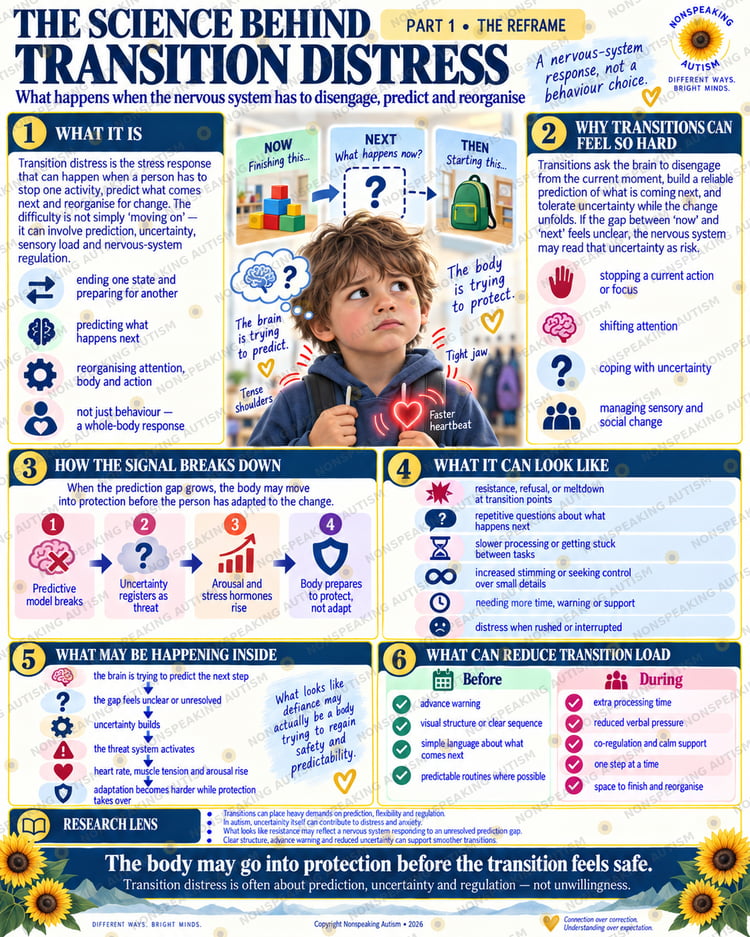
This poster is research-informed, drawing on published literature on sensory reactivity, intolerance of uncertainty, repetitive behaviour and stimming, overload and shutdown, interoception and pain communication in autism.
🔬 References printed on the poster
Bird, S., Moid, L. A. E., Jones, C. A., & Surtees, A. D. R. (2024). The relationships between restrictive/repetitive behaviours, intolerance of uncertainty, and anxiety in autism: A systematic review and meta-analysis. Research in Autism Spectrum Disorders, 117, 102428.
→ Supports: Uncertainty / Unpredictability; Early Stress
O'Donnell, S., Deitz, J., Kartin, D., Nalty, T., & Dawson, G. (2012). Sensory processing, problem behavior, adaptive behavior, and cognition in preschool children with autism spectrum disorders. American Journal of Occupational Therapy, 66(5), 586–594. https://doi.org/10.5014/ajot.2012.004168
→ Supports: Overload; links between sensory processing and distress behaviour
Ben-Sasson, A., Hen, L., Fluss, R., Cermak, S. A., Engel-Yeger, B., & Gal, E. (2009). A meta-analysis of sensory modulation symptoms in individuals with autism spectrum disorders. Journal of Autism and Developmental Disorders, 39(1), 1–11. https://doi.org/10.1007/s10803-008-0593-3
→ Supports: Sensory Seeking; Overload; individual variation
Johnson, E., van Zijl, K., & Kuyler, A. (2023). Pain communication in children with autism spectrum disorder: A scoping review. Paediatric and Neonatal Pain, 5(4), 127–141. https://doi.org/10.1002/pne2.12115
→ Supports: Pain / Body Distress
Tavassoli, T., Marco, E. J., & Puts, N. A. J. (2026). Sensory reactivity in autism: Integrating behavioural, affective, physiological, and neural dimensions. Current Psychiatry Reports, 28, Article 36.
→ Supports: the whole-body framing; Ears, Eyes, Skin, Heart & Breathing
📖 Additional recent research (2024–2025)
Morris, I. F., Sykes, J. R., Paulus, E. R., Dameh, A., Razzaque, A., Vander Esch, L., Gruenig, J., & Zelazo, P. D. (2025). Beyond self-regulation: Autistic experiences and perceptions of stimming. Neurodiversity, 3. https://doi.org/10.1177/27546330241311096
→ Supports: Sensory Seeking ("Movement can be regulation"); Key Messages
Paris, K., Lodestone, A. Z., Houser, M., & Lewis, L. F. (2025). "Shutdowns are like you're stuck on the blue screen of death": A metaphor analysis of autistic shutdowns. Autism in Adulthood, 8(4), 687–697. https://doi.org/10.1089/aut.2024.0193
→ Supports: Overload (freezing or shutting down); Recovery
Loureiro, F., Ringold, S. M., & Aziz-Zadeh, L. (2024). Interoception in autism: A narrative review of behavioral and neurobiological data. Psychology Research and Behavior Management, 17, 1841–1853. https://doi.org/10.2147/PRBM.S410605
→ Supports: Body signals; Heart & Breathing; Digestion; Pain / Body Distress
Klein, M., Witthöft, M., & Jungmann, S. M. (2025). Interoception in individuals with autism spectrum disorder: A systematic literature review and meta-analysis. Frontiers in Psychiatry, 16, 1573263. https://doi.org/10.3389/fpsyt.2025.1573263
→ Supports: Body signals; "There is no single pattern"
🔬 How the research is used
Findings are presented as group-level evidence, not predictions about an individual child. Research can identify patterns and associations; it cannot tell us, from a single behaviour, exactly what one child's nervous system is experiencing.
Observe the individual. Look at context. Track patterns. Adjust support. Review again.
🔎 Evidence Note
These references support the broader sensory-processing, tactile, proprioceptive, trigeminal and pressure-response principles discussed in this poster.
They do not establish chin pressing as a validated autism-specific regulation strategy and do not prove that a particular child's chin pressure has a sensory function.
The neurological pathways and brain regions shown on the poster are simplified educational illustrations rather than individualized diagnostic findings.
👨👩👧 Who Is This Resource For?
This educational poster may be useful for:
- autistic children and their families
- parents and carers
- teachers and teaching assistants
- SENCOs and SEND teams
- occupational therapists
- speech and language therapists
- dentists and oral-health professionals
- paediatric professionals
- healthcare professionals
- psychologists
- support workers
- mainstream and specialist schools
- autism and disability organisations
It can support family education, staff training, professional reflection and discussions about individualized sensory support.
📦 What You Receive
Your purchase includes:
1 × Why Some Autistic Children May Seek Chin Pressure educational poster
1 × high-resolution printable digital PDF
The purchased file is supplied clear and without the promotional preview watermark shown on the Payhip listing image.
Watermarks visible in Payhip listing images are used for preview and copyright protection only.
Digital download only — no physical product will be shipped.
⚠️ Important Disclaimer
This is a research-informed educational resource.
It is not medical or dental advice, diagnosis, occupational therapy assessment, sensory assessment, neurological assessment, pain assessment, psychological assessment, behaviour assessment or an individualized treatment plan.
The possible functions described are examples for consideration, not fixed interpretations of an individual child's behaviour.
New, painful, intense, persistent, significantly increased or otherwise unexplained chin, jaw or facial-pressure behaviour should not automatically be attributed to autism or sensory seeking.
Appropriate dental or medical assessment should be sought where there are concerns about pain, injury, swelling, dental problems, jaw difficulties, eating or drinking, or other significant physical changes.
Sensory supports should be individualized, safe and voluntary. Pressure should never be forced because it is assumed to be regulating.
©️ Copyright & Permitted Use
Copyright © 2026 Nonspeaking Autism. All rights reserved.
Purchase permits use for personal/home use, your own classroom or educational setting, your own clinic or individual professional educational practice, and direct educational/support work with people you support.
The digital file may not be resold, redistributed, file-shared, uploaded elsewhere, commercially reproduced, altered for resale or incorporated into another product for sale or distribution.
Please direct others wishing to obtain a copy to the original Nonspeaking Autism listing.
💛 The Message Behind the Resource
When a child repeatedly presses their chin into their hand, arm or another surface, we can see the movement.
We cannot automatically see its purpose.
It may provide useful sensory feedback.
It may accompany concentration.
It may appear during overload.
It may simply feel comfortable.
Or it may be telling us that something hurts.
That is why curiosity should come before correction.
**Observe the pattern.
Check the context.
Check the body.
Keep communication accessible.
Listen to the child.**
DON'T JUST ASK: “HOW DO I STOP IT?”
ASK: “WHAT MIGHT THIS INPUT BE DOING FOR THEIR BODY AND NERVOUS SYSTEM?”
Connection over correction. Understanding over expectation. 💙🌻
© Nonspeaking Autism 2026