
Understanding Emotional Dysregulation in AuDHD
Understanding Emotional Dysregulation in AuDHD
Why emotions can feel bigger, come on faster and take longer to settle
Emotional dysregulation can be one of the most misunderstood experiences associated with autism and ADHD (AuDHD).
Big emotional responses may be interpreted as overreacting, defiance, attention-seeking or a lack of self-control. But what we see on the outside may be the end result of a much more complex interaction between sensory processing, attention regulation, executive functioning, interoception, stress, environmental demands and emotional arousal.
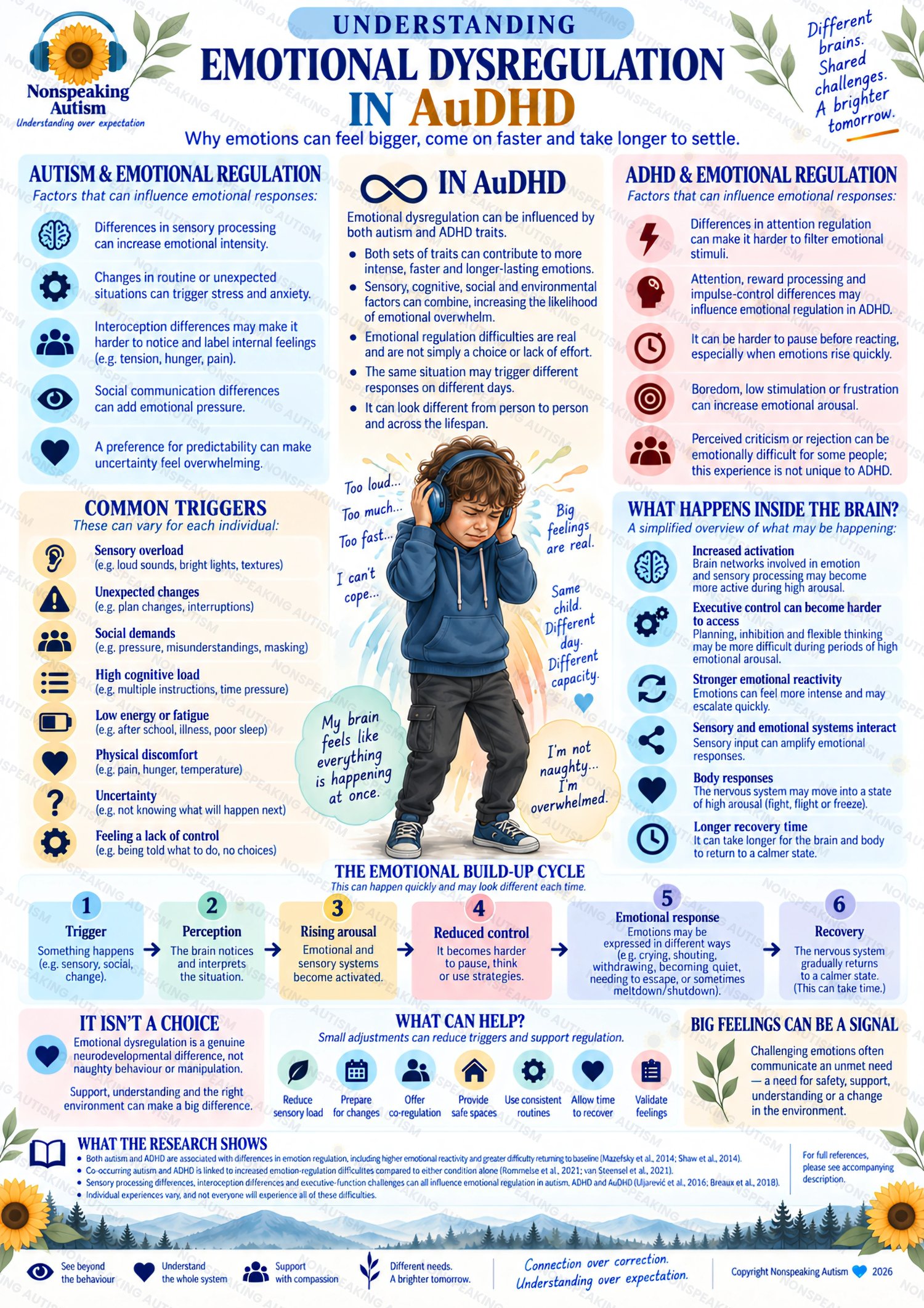
Understanding Emotional Dysregulation in AuDHD is a research-informed educational poster designed to help parents, carers, educators and professionals look beyond behaviour and understand why emotions may sometimes arrive quickly, feel extremely intense and require more time to settle.
The central message is:
Same child. Different day. Different capacity.
Emotional dysregulation is not simply a choice or a lack of effort. Understanding what is happening underneath the response can help us replace judgement with support.
🧠 What This Poster Explores
This visual resource brings autism and ADHD together to explain how characteristics associated with both may contribute to emotional regulation difficulties.
It explores:
- Autism and emotional regulation
- ADHD and emotional regulation
- How autism and ADHD traits may interact in AuDHD
- Common triggers for emotional overwhelm
- What may be happening inside the brain and nervous system
- The emotional build-up cycle
- Why regulation can become harder as arousal increases
- Why recovery may take time
- Practical environmental and relational supports
- What research currently tells us about emotional regulation in autism and ADHD
The poster also emphasises that individual experience matters. The same situation may produce very different responses between people — or even for the same person on different days.
♾️ Emotional Regulation in AuDHD
For someone with both autistic and ADHD traits, emotional regulation may be influenced by several overlapping factors.
Autistic experiences can include differences in sensory processing, interoception, social communication and predictability, while ADHD can involve differences in attention regulation, impulse control, reward processing and executive functioning.
When these factors interact, sensory, cognitive, social and environmental demands may combine.
This can mean that emotions sometimes:
- Become intense very quickly
- Feel difficult to pause or organise
- Last longer before settling
- Become harder to communicate
- Be affected by sensory or physical states
- Look different depending on the person's current capacity
This does not mean that every AuDHD person experiences emotional dysregulation in the same way.
🌻 Common Triggers
The poster highlights several experiences that may increase emotional load.
These include:
Sensory overload
Loud sounds, bright lights, uncomfortable textures or multiple sources of sensory input can increase stress.
Unexpected changes
Changes to plans, interruptions and uncertainty may create additional processing demands.
Social demands
Pressure, misunderstandings, masking and complex social expectations can increase emotional load.
High cognitive load
Multiple instructions, time pressure, decision-making and task switching can become overwhelming.
Low energy or fatigue
Poor sleep, illness, an exhausting school day or accumulated stress may reduce available capacity.
Physical discomfort
Pain, hunger, temperature and other internal sensations can affect regulation.
Uncertainty
Not knowing what will happen next can increase anxiety and arousal.
Feeling a lack of control
Being told what to do without meaningful choice or autonomy may add further pressure.
Triggers are individual. What feels manageable one day may feel overwhelming on another.
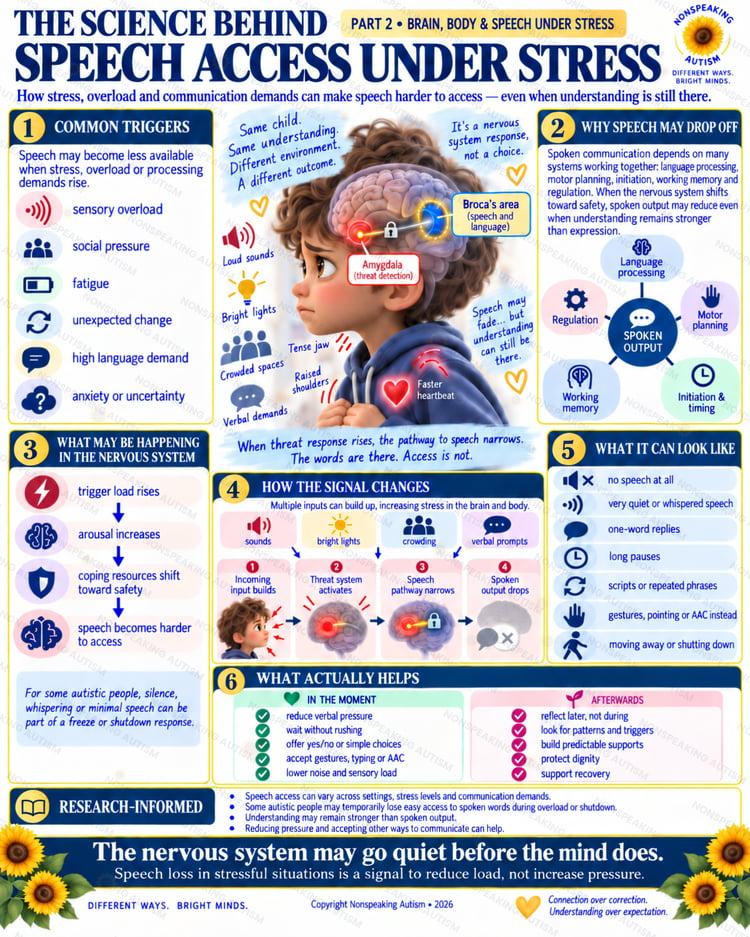
🧠 What May Be Happening Inside the Brain & Body?
The poster provides a simplified visual explanation of processes that may contribute to emotional dysregulation.
Increased Activation
Brain networks involved in emotion and sensory processing may become more active during periods of high arousal.
Executive Control Can Become Harder to Access
Planning, inhibition, flexible thinking and decision-making may become more difficult when someone is already emotionally overwhelmed.
Stronger Emotional Reactivity
Emotions may escalate quickly and feel particularly intense.
Sensory & Emotional Systems Can Interact
Sensory input can amplify emotional responses, while emotional arousal can also make sensory input harder to tolerate.
Body Responses
The nervous system may move into a higher-arousal state associated with fight, flight or freeze responses.
Longer Recovery Time
Even after the immediate situation has ended, the brain and body may need additional time before returning to a calmer state.
🔄 The Emotional Build-Up Cycle
One of the key features of this poster is a clear six-stage visual showing how emotional dysregulation can develop:
1. Trigger → 2. Perception → 3. Rising arousal → 4. Reduced control → 5. Emotional response → 6. Recovery
A sensory, social or emotional event may first be detected and interpreted by the brain.
As emotional and sensory systems become increasingly activated, the ability to pause, think or use familiar strategies may become harder to access.
The resulting emotional response may appear as crying, shouting, withdrawing, becoming quiet, needing to escape, or sometimes meltdown or shutdown.
Recovery then begins gradually.
This process can happen quickly, and it may look different each time.
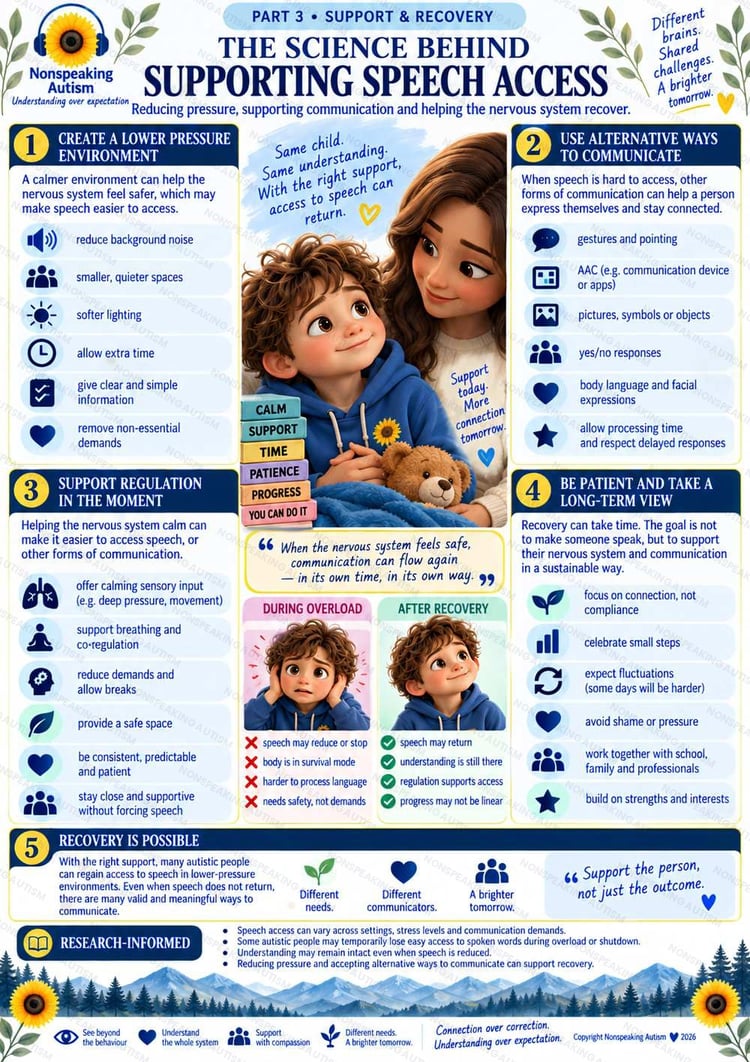
💙 What Can Help?
Support does not have to begin with trying to stop an emotion.
Often, reducing the overall load and supporting regulation can be more useful.
The poster highlights practical approaches including:
Reduce sensory load
Consider noise, lighting, crowds, clothing, movement and other sensory demands.
Prepare for changes
Advance information, visual supports and predictable transitions can reduce uncertainty.
Offer co-regulation
A calm, predictable and supportive person may help create conditions in which regulation becomes easier.
Provide safe spaces
Access to quieter or lower-demand environments can allow time and space for recovery.
Use consistent routines
Predictability can reduce unnecessary cognitive and emotional load.
Allow time to recover
Returning to a regulated state may take longer than observers expect. Recovery should not be rushed.
Validate feelings
Recognising the person's emotional experience does not mean agreeing with every action. It communicates that their distress has been noticed and taken seriously.
Small adjustments can sometimes reduce triggers before the person reaches their limit.
❤️ It Isn't a Choice
A central message of this resource is that emotional dysregulation should not automatically be interpreted as naughty behaviour, manipulation or deliberate non-compliance.
A person can know what they are “supposed” to do when calm and still find that skill much harder to access during intense emotional arousal.
Support, understanding and changes to the environment can make a meaningful difference.
Big feelings can also be a signal.
Challenging emotions may communicate an unmet need — including a need for safety, support, understanding, communication access, reduced demands or environmental change.
🔬 Research-Informed
This poster is informed by research examining emotional regulation in autism, ADHD and co-occurring autism and ADHD.
The research highlighted on the poster includes work relating to emotional reactivity, return to baseline, emotion-regulation difficulties, sensory processing, interoception and executive functioning.
Selected research referenced on the resource includes:
Mazefsky et al. (2014) — research examining emotional regulation and emotional reactivity in autism.
Shaw et al. (2014) — research concerning emotion dysregulation in ADHD.
Rommelse et al. (2021) and Samson et al. (2021) — literature relevant to autism, ADHD and emotional-regulation difficulties.
Lopez-Serrano et al. (2016) and Breaux et al. (2018) — research relevant to sensory, executive-function and emotional-regulation processes.
The evidence should be understood at a group level rather than as a prediction of how any individual autistic, ADHD or AuDHD person will respond.
Individual experiences vary, and not everyone will experience all of the difficulties described on this poster.
👨👩👧 Who Is This Resource For?
This poster may be useful for:
- Parents and carers
- Autistic and ADHD/AuDHD people and their families
- Teachers and teaching assistants
- SENCOs and SEND teams
- Mainstream and specialist schools
- Autism and inclusion teams
- ADHD support services
- Occupational therapists
- Speech and language professionals
- Psychologists and other relevant professionals
- Support workers
- Social-care professionals
- Family-support organisations
- Training and staff-development sessions
It can be displayed at home, in classrooms, SEND spaces, therapy rooms and professional settings, or used as a visual starting point for conversations about emotional regulation and individual support needs.
📦 What You Receive
Your purchase includes:
1 × Understanding Emotional Dysregulation in AuDHD — Educational Poster
This is a digital educational poster from Nonspeaking Autism, supplied as a PDF file.
The purchased version is supplied clear and without the promotional preview watermark. Watermarks visible on Payhip listing images are used for preview and copyright-protection purposes.
Digital download only — no physical product will be shipped.
⚠️ Important Disclaimer
This resource is provided for educational and informational purposes only.
It is not medical advice, a diagnostic tool, psychological treatment or a substitute for individual assessment or guidance from an appropriately qualified healthcare, educational or other professional.
Autism, ADHD and emotional regulation are highly individual. The experiences and strategies described on this poster will not apply equally to every person.
Significant, sudden or unusual changes in mood, behaviour, responsiveness or functioning should not automatically be attributed to autism, ADHD or emotional dysregulation. Where there are concerns about a person's physical or mental health, appropriate professional assessment should be sought.
Support strategies should always take account of the individual's communication, sensory profile, preferences, autonomy, health and circumstances.
💛 The Message Behind the Resource
Big feelings do not automatically mean bad behaviour.
Sometimes what looks like an excessive response from the outside reflects a nervous system dealing with too much sensory input, too many demands, uncertainty, fatigue, emotional intensity or reduced access to regulation skills in that moment.
Looking beyond the behaviour allows us to ask a different question:
“What does this person need right now?”
See beyond the behaviour.
Understand the whole system.
Support with compassion.
Different brains. Shared challenges. A brighter tomorrow.
Connection over correction.
Understanding over expectation.
© Nonspeaking Autism 2026. All rights reserved.