
💙 THE SCIENCE BEHIND INTEROCEPTION
💙 THE SCIENCE BEHIND INTEROCEPTION
Understanding the Body's Internal Signals
Research-Informed Autism Educational Poster | UK Edition | Nonspeaking Autism
🌻 Connection over correction. Understanding over expectation.
How does a child know when they are hungry, thirsty, tired, uncomfortable or need the toilet?
For many people, these sensations seem automatic. But noticing, interpreting and responding to signals from inside the body can be a complex process.
This is where interoception comes in.
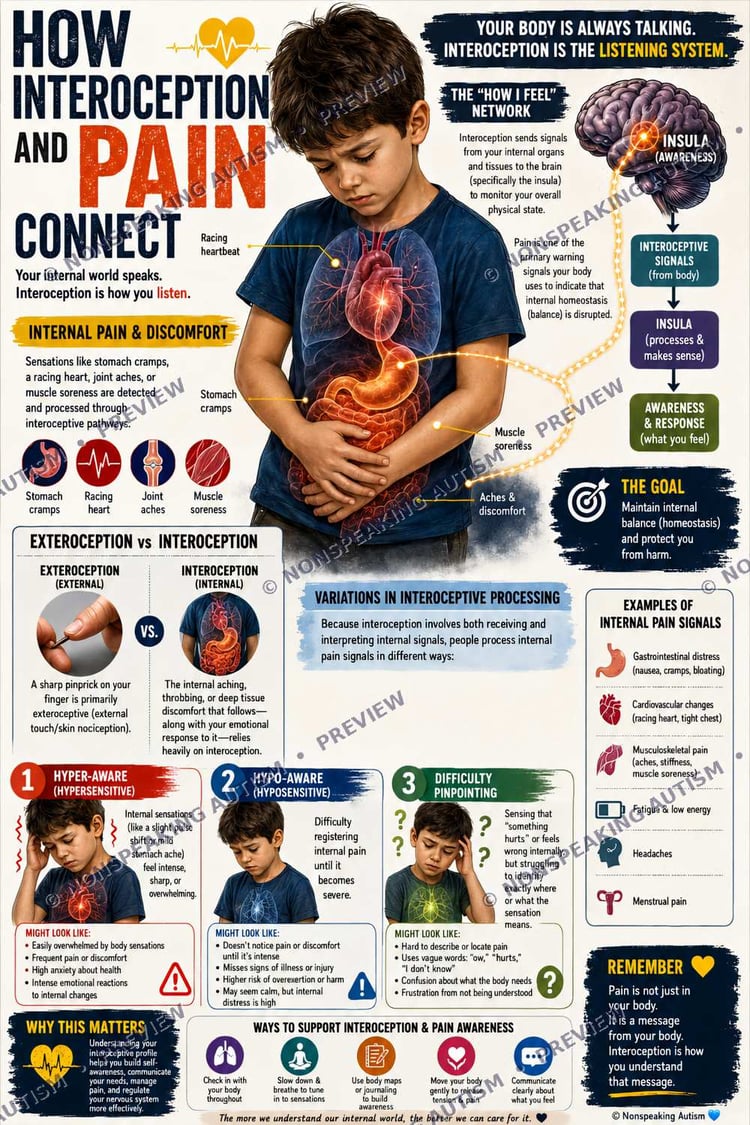
Interoception is the process of sensing and interpreting internal bodily signals, including those related to hunger, fullness, thirst, breathing, heartbeat, temperature and other physical sensations.
Research suggests that interoceptive experiences can differ among autistic people. Some may notice certain body signals intensely, while others may find particular sensations difficult to detect, interpret or communicate.
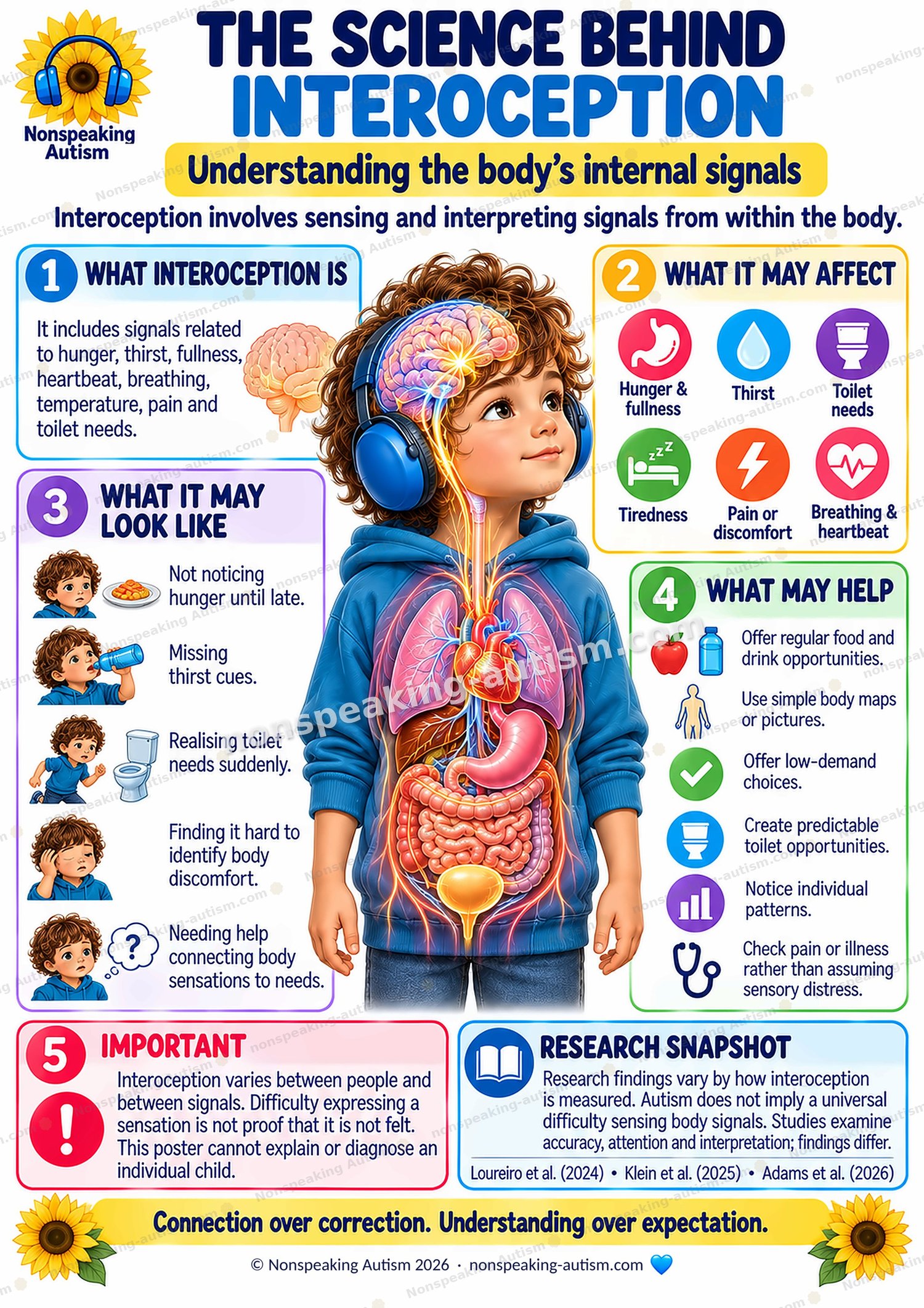
The Science Behind Interoception is a colourful, accessible educational poster designed to help families, educators and professionals understand these differences and respond with practical, compassionate support.
The central message is simple:
A child may struggle to identify or communicate a body sensation without that meaning the sensation is absent.
🧠 WHAT THIS POSTER EXPLORES
1. 💙 What Is Interoception?
Interoception refers to the sensing and interpretation of signals originating within the body.
These signals contribute to our awareness of physical needs and internal states.
The poster introduces sensations associated with:
- Hunger and fullness
- Thirst
- Heartbeat
- Breathing
- Body temperature
- Pain and discomfort
- Toilet needs
These processes involve interactions between the body, nervous system and brain.
Interoception is not a single ability that works identically for everyone. A person may notice some internal signals clearly while finding others difficult to recognise or interpret.
Different interoceptive experiences do not automatically mean that a child lacks body awareness.
2. 💧 What Interoception May Affect
Internal body signals can influence everyday experiences in ways that adults may not immediately recognise.
Hunger and fullness
Some children may find it difficult to notice early hunger cues or recognise when they are becoming full.
Thirst
A child may not consistently identify thirst or communicate a need for a drink.
Toilet needs
Some children may notice the need to use the toilet only when the sensation becomes urgent.
Tiredness
Recognising fatigue and understanding when rest is needed may be difficult for some individuals.
Pain and discomfort
A child may experience discomfort without being able to identify its location, explain its meaning or communicate it in an expected way.
Breathing and heartbeat
Some people notice changes in heartbeat or breathing intensely. Others may have difficulty recognising or interpreting these sensations.
These are possible experiences, not universal characteristics of autism.
3. 🌻 What Interoceptive Differences May Look Like
The poster provides everyday examples of how internal body-signal differences might affect a child.
A child may:
- Not notice hunger until they are very hungry.
- Miss or have difficulty identifying thirst cues.
- Realise they need the toilet suddenly.
- Find it difficult to identify or describe physical discomfort.
- Need support connecting body sensations with particular needs.
These experiences can also have other explanations, including illness, medication effects, communication barriers, routines or environmental factors.
An outward response cannot reliably tell us exactly what a child is experiencing internally.
🌿 WHAT MAY HELP?
🍎 Offer Regular Food and Drink Opportunities
Predictable opportunities to eat and drink may help children who do not consistently notice or communicate early hunger and thirst signals.
Support should remain responsive to individual medical, dietary and sensory needs.
🧍 Use Simple Body Maps or Pictures
Visual resources may help some children explore where sensations occur and how they might describe them.
Body maps, symbols, pictures and AAC can provide additional communication options.
They should be offered without assuming that every child can identify or label internal sensations on demand.
💚 Offer Low-Demand Choices
Instead of requiring a child to explain exactly what they feel, adults can offer accessible choices.
For example:
“Would you like some water?”
“Would a break help?”
“Do you want to use the toilet?”
Children should be able to respond using their preferred communication methods, including AAC, gestures, signs or other accessible options.
🚻 Create Predictable Toilet Opportunities
Regular, respectful opportunities to use the toilet may support some children.
Avoid punishment, shame or pressure. Toileting difficulties can have medical, developmental, sensory and communication-related causes.
🔍 Notice Individual Patterns
Observe when discomfort, fatigue or unmet needs may be occurring.
Look for patterns across different activities, environments and times of day without treating any one behaviour as proof of a specific internal sensation.
🩺 Check for Pain or Illness
Do not automatically attribute distress, changes in behaviour or difficulty communicating discomfort to interoception.
Pain, constipation, infection, sleep problems and other health conditions may need appropriate assessment.
Support should be guided by the individual child, not by assumptions about what their nervous system is doing.
💛 WHY THIS MATTERS FOR NONSPEAKING AUTISTIC CHILDREN
Interoception and communication are related, but they are not the same thing.
A child may notice an internal sensation without being able to explain it through speech.
Another child may communicate discomfort through movement, AAC, changes in activity, gestures or other individual signals.
Some children may also find it difficult to interpret what a sensation means.
These possibilities should not be confused.
Difficulty expressing a sensation is not proof that it is not being felt.
For nonspeaking and minimally speaking autistic children, adults can support access by:
- Keeping AAC available throughout the day.
- Offering meaningful communication choices.
- Allowing processing and response time.
- Taking non-speech communication seriously.
- Respecting refusal and consent.
- Avoiding demands to identify feelings or body sensations before offering help.
Communication support should increase autonomy, not create additional pressure.
🔬 RESEARCH-INFORMED: WHAT THE EVIDENCE TELLS US
Research into interoception and autism is developing.
Studies explore different aspects of interoception, including:
- Interoceptive accuracy: Performance on tasks intended to measure detection of internal signals.
- Interoceptive attention: How much attention a person directs towards internal sensations.
- Interoceptive interpretation: How bodily sensations are understood and given meaning.
- Self-reported interoceptive experiences: How people describe their awareness of internal states.
These are not interchangeable measures.
Research findings vary depending on the methods used, the signals studied and the individuals participating.
Autism does not imply one universal pattern of interoceptive difficulty.
📚 SELECTED RESEARCH
Loureiro, F., Ringold, S. M., & Aziz-Zadeh, L. (2024). Interoception in autism: A narrative review of behavioral and neurobiological data. Psychology Research and Behavior Management, 17, 1841–1853.
https://doi.org/10.2147/PRBM.S410605
Butera, C., et al. (2023). Relationships between alexithymia, interoception, and emotional empathy in autism spectrum disorder. Autism, 27(3), 690–703.
https://doi.org/10.1177/13623613221111310
Mahler, K., et al. (2024). An interoception-based intervention for improving emotional regulation in children in a special education classroom: Feasibility study. Occupational Therapy in Health Care, 38(3), 636–650.
https://doi.org/10.1080/07380577.2024.2313527
The poster also names Klein et al. (2025) and Adams et al. (2026) in its research snapshot. Their complete bibliographic details have not been independently verified here, so they are not presented as confirmed references in this description.
Research & References Sections 1 & 2 – What interoception is and what it may affect: - Loureiro, F., Ringold, S. M., & Aziz-Zadeh, L. (2024). Interoception in autism: a narrative review of behavioral and neurobiological data. Psychology Research and Behavior Management, 17, 1841–1853. https://doi.org/10.2147/PRBM.S410605 Sections 3 & 5 – What it may look like, and individual variation: - Adams, K. L., Catmur, C., & Bird, G. (2026). Associations between autism and self-reported dimensions of interoception. Autism, 30(6), 1465–1477. https://doi.org/10.1177/13623613261434431 Research Snapshot – findings vary by measurement: - Klein, J., Witthöft, M., & Jungmann, S. M. (2025). Interoception in autism: a meta-analysis. Frontiers in Psychiatry, 16, 1573263. https://doi.org/10.3389/fpsyt.2025.1573263 Foundational references (printed on the poster): Loureiro et al. (2024) • Klein et al. (2025) • Adams et al. (2026)
Sources:
Evidence Note
The research supports studying interoception as a multidimensional process, but it does not establish that all autistic children have reduced internal awareness or that one intervention will help everyone.
Interoception-based activities and visual resources may be useful for some individuals. Their effects should be assessed through meaningful outcomes such as comfort, communication, autonomy and participation.
This poster is an educational explanation, not a validated assessment or treatment.
👨👩👧 WHO IS THIS RESOURCE FOR?
This poster may be useful for:
- Parents and carers
- Autistic children and young people, with accessible support
- Teachers and teaching assistants
- SENCOs and SEND teams
- Mainstream and specialist schools
- Early years practitioners
- Occupational therapists
- Speech and language therapists
- Educational psychologists
- Autism support workers
- Professionals supporting nonspeaking and minimally speaking children
It can support conversations about body awareness, everyday needs, communication access and reasonable adjustments.
📦 WHAT YOU RECEIVE
💙 PAID DIGITAL DOWNLOAD
1 × The Science Behind Interoception — Understanding the Body's Internal Signals educational poster
Featuring:
- A child-friendly illustrated explanation of interoception
- Commonly discussed internal body signals
- Everyday examples of possible interoceptive differences
- Practical support strategies
- Communication and body-awareness considerations
- Important scientific cautions
- A research snapshot
Digital download only. No physical item will be shipped.
The final downloadable file should be supplied without promotional watermarks.
Print size and resolution should be confirmed against the actual file before advertising it as A2 or 300 DPI.
⚠️ IMPORTANT DISCLAIMER
This resource is intended for educational and informational purposes only.
It is not a diagnostic tool, clinical assessment, medical treatment or substitute for individualised professional advice.
Interoceptive experiences vary between people and between different body signals.
Difficulties with hunger, thirst, toileting, pain or fatigue may have medical, developmental, sensory or communication-related causes.
Seek appropriate healthcare advice for persistent, sudden, severe or concerning changes.
Never withhold food, water, toileting opportunities, rest or other essential support to test a child's awareness of their body signals.
©️ COPYRIGHT & PERMITTED USE
Copyright © 2026 Nonspeaking Autism. All rights reserved.
This resource may be used for personal, home, classroom, school and individual professional educational purposes.
The digital file must not be resold, redistributed, publicly uploaded, shared through file-sharing services or included in other commercial products without written permission.
Please share the Payhip product link rather than distributing the purchased file.
🌻 THE MESSAGE BEHIND THE RESOURCE
Not every need arrives as a clear sentence.
Not every sensation is easy to identify.
Not every child can explain what their body is telling them.
When we recognise these differences, we can offer support before discomfort becomes distress.
Notice the signals. Offer communication. Respect individual needs.
💙 Connection over correction. Understanding over expectation.
Nonspeaking Autism © 2026