
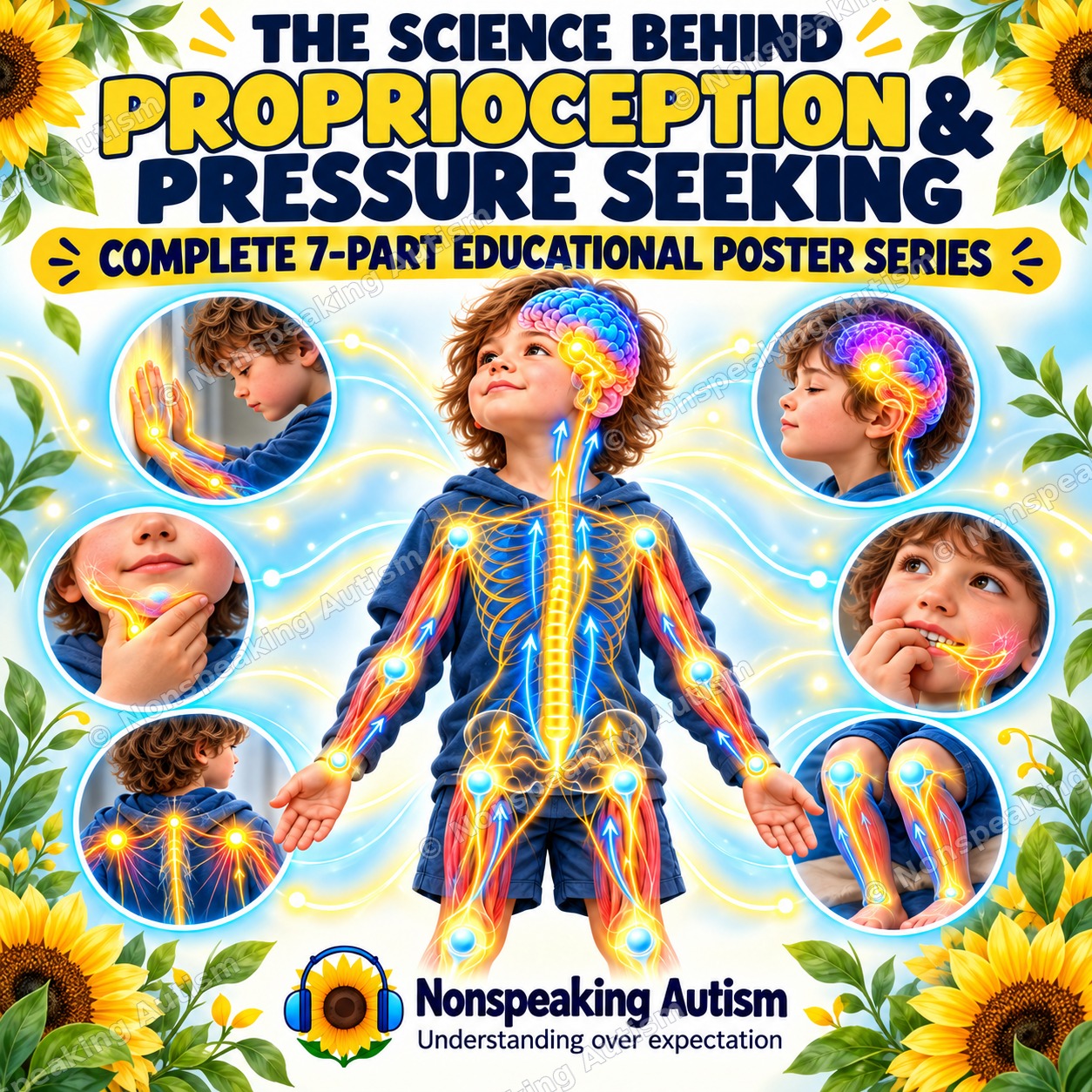
The Science Behind: Proprioception & Pressure Seeking
The Science Behind: Proprioception & Pressure Seeking
Complete 7-Part Educational Poster Series
Body Awareness • Deep Pressure • Sensory Processing • Regulation • Individual Differences
Why might an autistic child press their chin into their hand, squeeze their legs together, push their palms against a wall, seek pressure around their head, or repeatedly use firm pressure against different parts of their body?
These behaviours can sometimes be misunderstood as habits that need to be stopped.
But another question may be far more useful:
“What might this input be doing for their body and nervous system?”
The Science Behind: Proprioception & Pressure Seeking is a complete 7-part research-informed educational poster collection from Nonspeaking Autism, exploring proprioception, tactile and deep-pressure input, sensory pathways, body awareness and why some autistic people may seek pressure in different ways.
The collection combines accessible neuroscience with an important message: pressure seeking is not automatically problem behaviour, and its function cannot be determined simply by observing the behaviour.
🧠 What This 7-Part Collection Explores
The series looks at pressure seeking from both a whole-body sensory perspective and through specific examples.
It explores:
- proprioception and body-position information
- tactile and deep-pressure input
- receptors in the skin, muscles, tendons and joints
- peripheral sensory pathways
- spinal and brainstem processing
- the thalamus and sensory relay
- somatosensory processing and body mapping
- the influence of attention and context
- body awareness
- sensory seeking and self-generated input
- individual differences in regulation
- recognising patterns rather than assuming meaning
- distinguishing possible sensory seeking from pain or physical discomfort
The posters deliberately use language such as “may,” “for some individuals” and “can” because the same outward behaviour can have different functions for different people.
🌻 The 7 Posters Included
1️⃣ The Science Behind: Proprioception
Body Position, Deep Pressure and Signals to the Brain
The foundation poster introduces proprioception: sensory information arising largely from muscles, tendons and joints that contributes to awareness of movement, force and body position.
It explores the pathway from body receptors through peripheral nerves and spinal pathways toward central sensory processing.
The poster also considers how proprioceptive input may support, for some individuals:
- body awareness
- awareness of position in space
- grounding during overwhelm
- attention or concentration
- self-generated regulation
Importantly, it explains that proprioceptive input is not a universal regulatory solution.
2️⃣ Why Some Autistic Children May Seek Chin Pressure
This poster explores repeated pressure around the chin and jaw.
It covers:
- tactile input at the chin
- possible proprioceptive contribution depending on movement and force
- trigeminal sensory pathways
- brainstem sensory nuclei
- thalamic relay
- somatosensory body mapping
- attention and context
- possible individual regulatory effects
Rather than immediately asking “How do I stop it?”, the poster encourages supporters to look at when the behaviour happens and what may be occurring around it.
It also highlights an essential safety consideration:
Sudden, intense or persistent chin pressure may warrant consideration of dental pain, jaw pain, mouth sores, ear discomfort, headache or other physical causes.
3️⃣ Why Some Autistic Individuals Seek Head & Temple Pressure
Repeated pressure against the head or temples may provide strong tactile input, while movement or muscular involvement may add other sensory information.
This poster explores:
- pressure at the head and temples
- tactile and deep-pressure input
- head, facial and scalp sensory pathways
- trigeminal pathways
- contributions from upper cervical nerves to parts of the scalp
- sensory relay and processing
- body mapping
- context and attention
- possible regulation
It also reminds supporters that head pressure should not automatically be interpreted as sensory seeking.
Headache, migraine, sinus discomfort, dental or jaw pain, ear discomfort, eye strain and other physical causes may need consideration.
4️⃣ Why Some Autistic Individuals Seek Knee & Leg Pressure
Crossing the legs tightly, tucking them underneath the body, squeezing the legs or seeking firm pressure may provide tactile and proprioceptive information.
This poster explores:
- pressure around the knees and legs
- skin receptors
- muscles, tendons and joints
- peripheral nerves
- spinal sensory pathways
- brain sensory processing
- body awareness
- possible postural feedback
- individual regulation
It encourages supporters to look for patterns during overwhelm, uncertainty, concentration, fatigue, excitement and busy environments.
Physical possibilities such as joint pain, muscular fatigue, injury or other discomfort should also remain part of the picture.
5️⃣ Why Some Autistic Individuals Seek Lip & Tooth Pressure
Biting, pressing objects against the lips or applying pressure around the teeth and mouth may provide strong tactile and oral sensory input.
This poster explores:
- pressure at the lips, teeth and oral area
- tactile and oral-proprioceptive information
- trigeminal sensory pathways
- brainstem processing
- sensory relay
- body mapping
- attention and context
- possible self-generated regulation
The poster also stresses the importance of considering:
- dental pain
- mouth sores
- jaw discomfort
- reflux
- ear discomfort
- headache
- other medical or oral-health needs
Sensory explanations should never automatically replace investigation of pain.
6️⃣ Why Some Autistic Individuals Seek Palm & Forearm Pressure
Pressing the palms together, leaning or pushing against a wall, or applying pressure through the arms can create strong tactile and proprioceptive feedback.
This poster follows sensory information from the hands and forearms through peripheral and central pathways and explores how this type of self-generated input may feel predictable or grounding for some people.
It also encourages consideration of wrist, hand or joint pain, muscular soreness, fatigue and other physical needs when pressure seeking changes suddenly or becomes persistent.
7️⃣ Why Some Autistic Individuals Seek Shoulder & Upper-Back Pressure
Firm pressure around the shoulders and upper back can provide tactile and proprioceptive information.
The poster explores:
- pressure at the shoulders and upper back
- tactile and proprioceptive receptors
- peripheral nerves
- spinal and brainstem pathways
- thalamic relay
- somatosensory processing
- body mapping
- individual regulation responses
For some people this input may feel grounding or organising; for others it may be neutral, uncomfortable or distressing.
Pressure should never be assumed to be wanted simply because another autistic person finds it helpful.
🔍 Look at the Pattern
One of the most useful themes running through the entire collection is pattern recognition.
Rather than interpreting a single behaviour in isolation, consider questions such as:
- Does it happen during overwhelm or uncertainty?
- Does it appear while waiting or concentrating?
- Does it increase when the person is tired or excited?
- Is it more frequent in noisy, crowded or highly stimulating places?
- Does the person actively seek the sensation?
- Does it appear to help them remain engaged?
- Does it happen during recovery from overload?
- Has the behaviour suddenly changed?
- Are there signs of pain or physical discomfort?
Observe first. Look for patterns. Avoid assuming function.
💙 What Pressure Input May Provide
For some autistic people, self-generated or preferred pressure may provide:
- strong body feedback
- predictable sensation
- information about body position
- grounding during overwhelm
- support for attention or concentration
- postural feedback
- familiar sensory input
- a personally preferred form of self-regulation
But these are possibilities, not guaranteed explanations.
A person pressing their head, jaw, legs or hands does not prove that they are seeking proprioception or regulating their nervous system.
🧠 Sensory Processing Is More Than a Simple Input → Response Pathway
The collection intentionally shows sensory pathways while also acknowledging that real sensory processing is more complex than a poster diagram can represent.
Sensory experiences are influenced by multiple interacting factors, including:
the type of stimulus + intensity + body location + context + attention + previous experience + current physical state + individual sensory processing
The diagrams therefore provide an educational simplification, rather than a literal complete map of everything occurring in an individual's brain.
❤️ Regulation Is Individual
One of the most important messages across all seven posters is:
Deep pressure is not universally calming.
Some autistic people actively seek strong pressure.
Others dislike it.
The same person may want pressure in one context and reject it in another.
Some may prefer self-generated pressure because they can control the location, force, duration and timing themselves.
Support should therefore focus on the person's own preferences and responses rather than applying a generic sensory strategy.
Offer — don't force.
⚠️ Pressure Seeking Does Not Automatically Mean “Sensory”
This distinction matters.
New, intense, persistent or substantially changed pressure-seeking behaviour can sometimes accompany physical discomfort.
Depending on the location and circumstances, consider possibilities such as:
- dental or oral pain
- jaw discomfort
- headache or migraine
- ear discomfort
- muscular pain or fatigue
- joint pain
- injury
- illness
- gastrointestinal discomfort
- other physical or medical needs
Do not allow a sensory explanation to prevent appropriate health assessment.
🔬 Research-Informed — Without Overclaiming
This collection draws on research concerning:
- sensory-processing differences in autism
- tactile processing
- proprioception
- somatosensory processing
- body representation and body awareness
- sensory seeking
- stimming and self-regulation
- deep-pressure research
- individual variability in sensory responses
Research supports the broader understanding that sensory experiences can differ substantially among autistic people.
However, research does not establish that a particular pressure-seeking behaviour has one universal neurological function.
The posters therefore distinguish between:
what sensory neuroscience can tell us — and what it cannot.
📚 Selected Research & Foundations
The collection draws on research and literature including work by Ben-Sasson and colleagues on sensory features in autism; Schaaf & Lane on assessment of sensory features; Mikkelsen and colleagues on tactile processing; Riquelme and colleagues on pressure pain, touch sensitivity and proprioception; Bestbier & Williams on individual responses to deep pressure; and broader neuroscience literature concerning proprioception, somatosensory processing and body representation.
The collection also incorporates newer research themes concerning sensory processing, interoception, body representation and autistic experiences of self-regulatory behaviour.
📚 UPDATED REFERENCES FOR THE COMPLETE SERIES — 2024–2026
1. Chen, Y., Xi, Z., Saunders, R., Simmons, D., Totsika, V., & Mandy, W. (2024).
A systematic review and meta-analysis of the relationship between sensory processing differences and internalising/externalising problems in autism. Clinical Psychology Review, 114, 102516.
DOI: 10.1016/j.cpr.2024.102516.
This is particularly useful because the meta-analysis found relationships involving sensory processing differences, including sensation seeking. ScienceDirect
2. Lock Man Lung, S., Picard, È., Soulières, I., & Bertone, A. (2024).
Identifying the functions of restricted and repetitive behaviours and interests in Autism: A scoping review. Research in Autism Spectrum Disorders, 117, 102458.
DOI: 10.1016/j.rasd.2024.102458.
Especially relevant to your posters' message that repetitive behaviours can have regulatory, sensory and adaptive functions rather than automatically being behaviours to suppress. ScienceDirect
3. Brouche, S., Rigal, N., & Cazalis, F. (2024).
Parental descriptions of sensory processing in Autism. Research in Autism Spectrum Disorders, 118, 102488.
DOI: 10.1016/j.rasd.2024.102488.
Useful for sensory profiles, sensory overload, regulation strategies and the relationship caregivers observe between sensory experiences and stimming. ScienceDirect
4. Klein, M., Witthöft, M., & Jungmann, S. M. (2025).
Interoception in individuals with autism spectrum disorder: A systematic literature review and meta-analysis. Frontiers in Psychiatry, 16, 1573263.
DOI: 10.3389/fpsyt.2025.1573263.
Useful for the broader body-awareness component while also showing why interoception and proprioception should not be treated as the same sensory system. Frontiers
5. Morris, I. F., Sykes, J. R., Paulus, E. R., et al. (2025).
Beyond self-regulation: Autistic experiences and perceptions of stimming. Neurodiversity, 3.
DOI: 10.1177/27546330241311096.
This is particularly valuable for the neurodiversity-affirming side of your series because it directly examines autistic people's experiences and perceptions of stimming rather than treating repetitive behaviour only as pathology. Sage Journals
6. Systematic review of sensory-based interventions for children and youth (2015–2024) (2025).
Frontiers in Pediatrics.
DOI: 10.3389/fped.2025.1720179.
This is useful for your deep-pressure sections. The review included 21 studies and reported supportive evidence for some deep-pressure tactile approaches, while also showing that effectiveness varies by intervention and outcome. Frontiers
Very recent body-representation evidence
A 2026 systematic review is especially relevant to your main proprioception poster because it reviewed body representation in autism across 54 studies and specifically identified research involving proprioception, interoception, multisensory integration and sensorimotor body representation. PubMed
Proprioception — main poster: 2026 body-representation systematic review + Chen et al. (2024) + Klein et al. (2025) + recent sensory-intervention review + selected foundational proprioception literature.
Chin Pressure: Chen et al. (2024) + Mikkelsen et al. (2018) + recent tactile/somatosensory research + appropriate trigeminal anatomy source + Morris et al. (2025).
Head & Temple Pressure: Chen et al. (2024) + Mikkelsen et al. (2018) + current somatosensory/tactile research + a dedicated current trigeminal/scalp anatomy reference + Morris et al. (2025).
Knee & Leg Pressure: Chen et al. (2024) + 2026 body-representation review + Klein et al. (2025) + Morris et al. (2025) + 2025 sensory-intervention review.
Lip & Tooth Pressure: Chen et al. (2024) + Mikkelsen et al. (2018) + current tactile/somatosensory evidence + appropriate trigeminal/oral sensory anatomy + Morris et al. (2025).
Palm & Forearm Pressure: Chen et al. (2024) + 2026 body-representation review + Mikkelsen et al. (2018) + Morris et al. (2025) + 2025 sensory-intervention review.
Shoulder & Upper Back Pressure: Chen et al. (2024) + 2026 body-representation review + Morris et al. (2025) + 2025 sensory-intervention systematic review + appropriate foundational proprioception source.
📖 Evidence Note
The research supports the broader sensory and neurophysiological principles discussed throughout this collection.
It should not be interpreted as proving that every example of chin, head, leg, oral, palm, forearm, shoulder or back pressure is caused by proprioceptive seeking or serves a regulatory function.
The neural diagrams are educational illustrations and simplify complex, distributed sensory systems.
Likewise, terms such as “grounding,” “organising” and “regulating” describe possible subjective or functional experiences rather than guaranteed neurological effects.
Evidence concerning deep-pressure interventions remains limited and responses are individual.
This collection is therefore designed to encourage observation, curiosity and individualized support — not neurological certainty from behaviour alone.
👨👩👧 Who Is This Collection For?
Designed for:
- autistic people and their families
- parents and carers
- teachers and teaching assistants
- SENCOs and SEND teams
- mainstream and specialist schools
- support workers
- occupational therapists
- speech and language therapists
- healthcare professionals
- social-care professionals
- psychology and behavioural professionals
- multidisciplinary teams
- autism and disability organisations
The collection can be used for home learning, classroom and staff-room displays, professional reflection, parent education, staff training and conversations about individual sensory needs.
📦 What You Receive
Your purchase includes the complete 7-part Proprioception & Pressure Seeking educational poster series:
- The Science Behind: Proprioception — Body Position, Deep Pressure & Signals to the Brain
- Why Some Autistic Children May Seek Chin Pressure
- Why Some Autistic Individuals Seek Head & Temple Pressure
- Why Some Autistic Individuals Seek Knee & Leg Pressure
- Why Some Autistic Individuals Seek Lip & Tooth Pressure
- Why Some Autistic Individuals Seek Palm & Forearm Pressure
- Why Some Autistic Individuals Seek Shoulder & Upper-Back Pressure
7 educational posters in total.
The purchased files are supplied clear and without the promotional preview watermarks visible in the Payhip listing images.
The watermarks shown on the preview images are for copyright and listing protection only.
Digital download only — no physical product will be shipped.
⚠️ Important Disclaimer
This is a research-informed educational resource.
It is not a diagnostic tool, medical assessment, occupational therapy assessment, standardized sensory profile, neurological assessment, behavioural assessment, treatment plan or substitute for individualized professional advice.
The examples describe possible sensory functions and should not be used to determine why a particular person performs a behaviour without considering their individual context.
Pressure, touch, deep-pressure input or other sensory strategies should never be forced. Preferences, communication, consent/assent, comfort and safety should be respected.
Sudden, severe, persistent, painful or unexplained changes in pressure-seeking behaviour should not automatically be attributed to autism or sensory processing. Appropriate medical, dental or other professional assessment may be required.
©️ Copyright & Permitted Use
Copyright © 2026 Nonspeaking Autism. All rights reserved.
Purchase permits use for personal/family use, your own classroom or educational setting, your own clinic or individual professional educational practice, and direct support work.
The files may not be resold, redistributed, file-shared, uploaded elsewhere, commercially reproduced, altered for resale or incorporated into another product.
Please direct others who would like their own copy to the original Nonspeaking Autism listing.
💛 The Message Behind the Collection
Pressure-seeking behaviour does not always need to begin with:
“How do I stop it?”
Start with curiosity.
What happened beforehand?
What does the person seem to seek?
Is the input self-generated?
Is it predictable?
When does it increase?
Does it appear helpful?
Could something hurt?
What does the person communicate about it?
Then support the individual rather than trying to make the individual fit a predetermined explanation.
Don’t just ask: “Why are they seeking pressure?”
Ask: “What is their body trying to tell the brain?”
Different sensory needs. Individual responses. Equal respect.
Connection over correction. Understanding over expectation. 💛🌻
© Nonspeaking Autism 2026