
Puberty, Periods & Autistic Girls
Puberty, Periods & Autistic Girls
Parent & Carer Practical Support Pack
A practical, sensory-aware resource designed to help autistic girls and their families feel more informed, prepared, supported and in control.
Puberty and menstruation can bring significant changes to the body, emotions, routines and sensory environment.
For an autistic girl, those changes may also interact with sensory sensitivities, interoception, communication differences, uncertainty, pain, executive-function demands and a need for predictability.
A period is therefore not simply a hygiene task.
It can involve learning unfamiliar body sensations, understanding bleeding, tolerating new products, recognising and communicating pain, managing several steps in sequence, coping with disrupted routines and maintaining privacy and dignity — sometimes all at once.
Puberty, Periods & Autistic Girls is a practical educational resource pack created to help parents and carers prepare before difficulties arise, identify individual sensory and communication needs, and support menstruation in a respectful, affirming and manageable way.
The central message is:
Preparation + Sensory Fit + Communication + Dignity = Better Support
The goal is not perfect independence.
The goal is safety, understanding, comfort and agency.
🌻 What This Resource Pack Explores
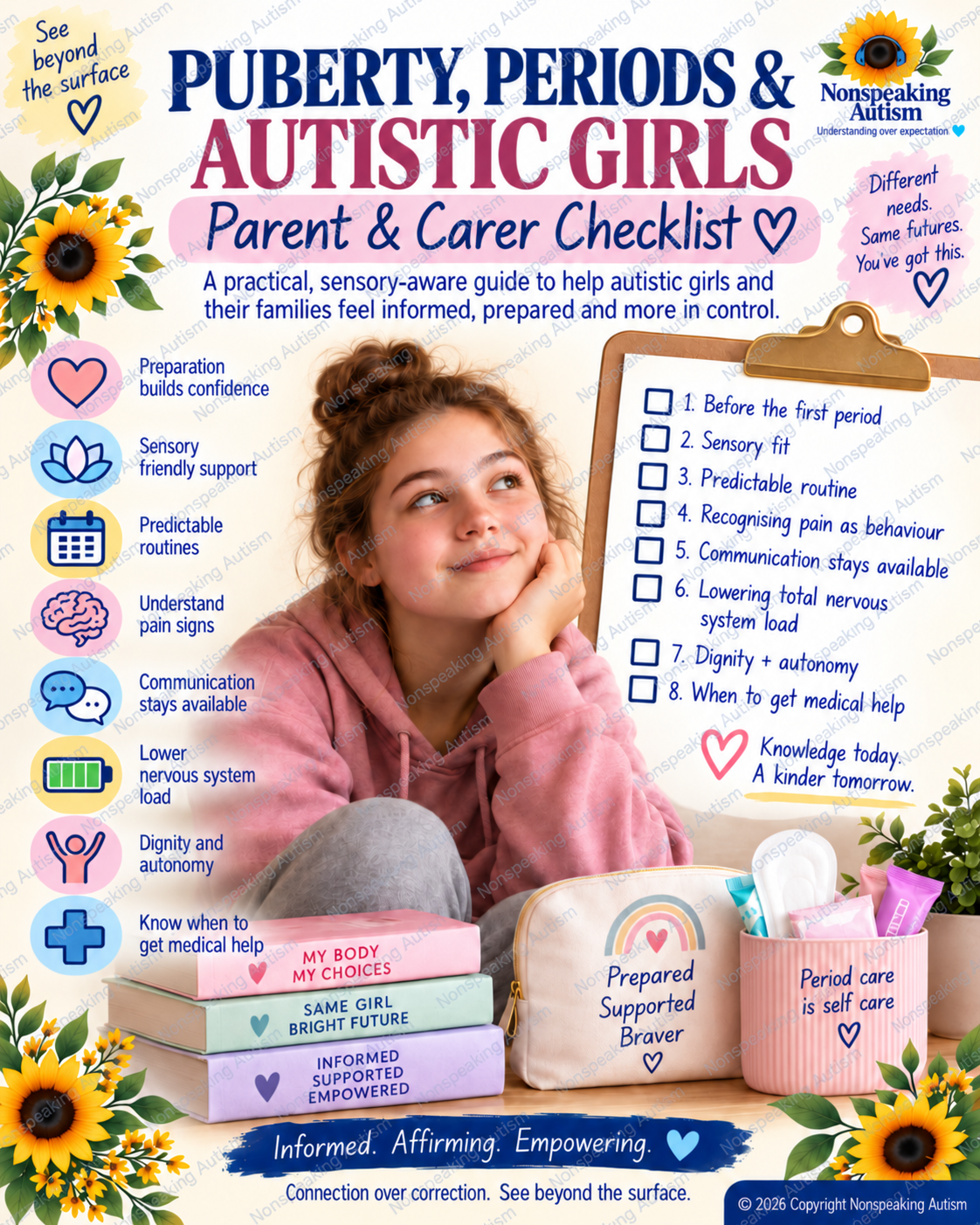
The pack focuses on eight practical areas:
- preparing before the first period
- finding a sensory-compatible period product
- creating a predictable menstrual-care routine
- recognising that pain may sometimes appear through changes in behaviour or communication
- keeping communication accessible
- reducing the total nervous-system load
- protecting dignity, privacy and autonomy
- recognising when medical assessment may be needed
It combines visual education with a practical parent/carer checklist, making it suitable both for learning and for planning support around an individual child.
1️⃣ Prepare Before the First Period
Preparation can begin before menstruation starts.
Introducing the subject during calm, low-pressure moments gives a young person an opportunity to become familiar with what periods are, what may happen to their body and what products might be available.
Depending on the individual, preparation might include:
SEE — looking at and talking about different period products.
TOUCH — allowing the person to explore products without pressure to wear or use them immediately.
PRACTISE — rehearsing the routine step by step when there is no urgent need to complete it.
REPEAT — returning to the routine enough times for it to become more familiar.
Visual schedules, social information and simple First → Then → Next sequences may also make an unfamiliar process more predictable.
The aim is not to create fear around menstruation.
It is to reduce the amount of completely new information that has to be processed during the first period.
Information today. Less worry tomorrow.
2️⃣ Sensory Fit First
There is no single “best” menstrual product for every autistic girl.
Pads, period underwear, tampons and other products can create very different sensory experiences.
Someone may react strongly to:
texture
adhesive
pressure
heat
smell
wetness
seams
movement
or the sensation of a product against the body.
A product that appears convenient to an adult may be intolerable to the person expected to wear it.
Where appropriate, trying different options can help identify what the individual can comfortably and safely tolerate.
And sensory preferences may change.
Something that worked previously may become uncomfortable at another time.
The “best” product is the one that works safely for the individual while supporting comfort and dignity.
3️⃣ Make the Routine Predictable
Menstrual care involves multiple steps.
For someone who finds sequencing, transitions or unfamiliar routines difficult, breaking the process into a consistent sequence can reduce cognitive demand.
For example:
1. Toilet
2. Remove product
3. Clean/wipe
4. Put on fresh product
5. Dispose and wash hands
Using the same location, familiar language and a consistent period kit may make the routine easier to learn.
A personal period kit might contain items such as:
preferred menstrual products
spare underwear
wipes or other appropriate hygiene supplies
a disposal bag
spare clothing if useful
communication or visual supports
The exact contents should be individualized.
Predictability is not about demanding rigid perfection.
It is about making an unfamiliar task easier to understand.
Consistency can build confidence.
4️⃣ Recognising Pain That May Look Like “Behaviour”
Menstrual discomfort is real.
But not everyone communicates pain by saying:
“I have cramps.”
For a child who is nonspeaking, minimally speaking, communicates differently, has difficulty identifying internal sensations or loses access to reliable speech when distressed, pain may sometimes be communicated through a change from their usual behaviour or communication.
Possible changes might include:
withdrawal
agitation
increased distress
refusal
shutdown
sleep changes
seeking pressure or comfort
changes in communication
changes in usual activity
These signs are not proof of menstrual pain.
They are reasons to become curious rather than immediately interpreting the change as “challenging behaviour.”
A simple tracker may help families notice patterns involving:
date • menstrual flow • pain • sleep • sensory load • behaviour/communication
Pain is real, even if it looks different.
5️⃣ Communication Must Stay Available
A person should have a reliable way to communicate menstrual needs without being dependent on spoken language.
Useful concepts may include:
PAIN
TOILET
CHANGE
STOP
PRIVACY
HELP
HOT
COLD
NO
Communication might happen through speech, AAC, symbols, signs, gestures, writing, typing, pointing or another established method.
Ideally, these options should be introduced and practised before they are urgently needed during pain or distress.
Adults should also respond to communication.
Teaching someone to communicate “stop” is not meaningful if “stop” is routinely ignored.
Communication access includes having communication respected.
6️⃣ Lower the Total Nervous-System Load
A period does not occur in isolation from everything else happening in someone's life.
Pain or discomfort, sensory input, uncertainty, sleep disruption, emotional demands, school expectations and the additional practical work of menstrual care may combine.
For some individuals, support during menstruation might therefore include:
a quieter environment
fewer non-essential demands
comfortable and familiar clothing
preferred sensory supports
ear defenders if useful
additional rest or downtime
hydration
movement if helpful
appropriate warmth or other comfort measures
The goal is not to assume every autistic girl requires the same accommodations.
It is to identify what increases or reduces load for that individual.
Small changes can make a big difference.
7️⃣ Dignity + Autonomy
Menstrual support involves intimate care, making privacy, consent, dignity and bodily autonomy particularly important.
Wherever possible:
Explain before touching.
Ask permission.
Protect privacy.
Offer meaningful choices.
Support independence without forcing it prematurely.
Respect communication indicating discomfort or refusal.
Some people will become fully independent with menstrual care.
Others may need temporary, partial or ongoing assistance.
Independence should not be treated as an all-or-nothing measure of success.
Needing help does not reduce someone's right to dignity.
My body. My choices.
8️⃣ Know When to Get Medical Help
Autism should never be used to explain away significant menstrual symptoms.
Parents and carers should seek appropriate healthcare advice when there are concerns such as periods becoming increasingly painful, unusually heavy, irregular or disruptive to ordinary activities.
Urgent medical advice may be appropriate for severe or unusual pelvic/period pain or other concerning symptoms, depending on the circumstances.
If menstrual management is extremely difficult, families can discuss available options with an appropriately qualified clinician.
Any intervention should be considered individually, with attention to the young person's health, circumstances, communication, dignity and autonomy.
Do not assume significant pain or distress is “just autism.”
🧠 Interoception, Puberty & Menstruation
Interoception broadly concerns the perception of signals originating from within the body.
These internal signals contribute to experiences such as hunger, thirst, temperature, toileting, pain and aspects of emotional and physiological awareness.
Some autistic people experience differences in noticing, interpreting or communicating internal sensations.
During puberty and menstruation, this can be particularly relevant.
A young person may know that something feels different without immediately understanding:
where the sensation is coming from,
whether it means pain,
whether bleeding is expected,
or how to communicate what they need.
Clear education and accessible communication can help turn an unfamiliar bodily experience into something more understandable.
💬 Period Care Is More Than Hygiene
Successful menstrual support should not be measured solely by whether a child can independently change a pad.
A better picture includes:
Does she understand what is happening?
Can she communicate discomfort?
Does she have a menstrual product she can tolerate?
Does she know what will happen next?
Can she access privacy?
Are adults responding to pain appropriately?
Is her autonomy being respected?
Does she feel safe?
These outcomes matter.
Period care is self-care.
☀️ A Gentle Reminder for Parents & Carers
You do not have to create a perfect period routine overnight.
Start with the individual in front of you.
Remember:
✓ Preparation builds confidence
✓ Sensory fit matters
✓ Pain is real
✓ Communication must remain available
✓ Dignity and autonomy come first
✓ Support can be temporary, partial or ongoing
Different days may bring different needs.
Something that works this month may need adapting later.
Different days. Different needs. Both are valid.
🔬 Research-Informed
This resource is informed by research and clinical guidance concerning autism and menstruation, menstrual health, sensory experiences, communication, pain, puberty and menstrual management.
Research concerning menstruation and autism indicates that autistic people may experience additional challenges around menstrual symptoms, sensory experiences, emotional regulation, self-care and managing menstrual routines, while individual experiences vary substantially.
The practical recommendations in this resource should therefore be understood as options to individualize rather than rules that every autistic girl must follow.
The resource also recognizes an important evidence principle:
Autism does not make ordinary medical concerns unimportant.
Physical symptoms deserve appropriate investigation when clinically indicated rather than automatically being interpreted through an autism or behavioural lens.
👨👩👧 Who Is This Resource For?
This practical pack may be particularly useful for:
- parents and carers of autistic girls
- families preparing for a child's first period
- autistic young people who benefit from visual information
- families supporting nonspeaking or minimally speaking children
- families using AAC
- teachers and special-education/SEND staff
- school nurses and pastoral teams
- occupational therapists
- speech-language professionals
- pediatric and developmental professionals
- support workers
- disability and autism organizations
- professionals providing puberty or menstrual education
The resources can be used at home, school, clinic or other appropriate educational/support settings.
📦 What You Receive
Your purchase includes the Puberty, Periods & Autistic Girls — Parent & Carer Practical Support Pack, containing:
1 × Puberty, Periods & Autistic Girls — Parent & Carer Checklist Cover / Overview
1 × Puberty, Periods & Autistic Girls — Practical Strategies That Work Educational Guide
1 × Puberty, Periods & Autistic Girls — Detailed Parent & Carer Checklist
The purchased digital files are supplied clear and without the promotional preview watermarks visible in the Payhip listing images.
The preview watermarks are included solely for copyright and listing protection and are not part of the purchased resources.
Digital download only — no physical product will be shipped.
⚠️ Important Medical & Educational Disclaimer
This resource is provided for educational and informational purposes only.
It is not medical advice, diagnosis, treatment, individualized menstrual management advice or a substitute for assessment and advice from an appropriately qualified healthcare professional.
Menstrual experiences vary substantially between individuals.
Pain, changes in behaviour or communication, fatigue, distress, withdrawal, agitation or other symptoms can have many possible causes and should not automatically be attributed to autism, sensory processing or menstruation.
New, severe, unusual, worsening or persistent symptoms should be appropriately medically assessed.
Seek urgent medical advice when symptoms are severe or concerning. Families should use their local healthcare services or emergency services where appropriate.
Any decisions concerning medication, menstrual suppression or other medical menstrual-management options should be discussed with an appropriately qualified clinician and individualized to the person's circumstances.
This resource supports education and preparation; it does not replace professional medical care.
💛 The Message Behind the Resource
A first period can be unfamiliar for any young person.
For an autistic girl, it may also mean a completely new combination of body sensations, sensory experiences, routines, products, pain, communication needs and expectations.
Preparation can change that experience.
Not by making every period easy.
Not by expecting perfect independence.
And not by teaching a child simply to tolerate discomfort.
But by giving her:
information before she needs it,
choices she can understand,
products her body can tolerate,
communication that remains available,
adults who take pain seriously,
predictability where possible,
and dignity throughout the process.
The goal is not perfect independence.
The goal is safety, understanding, comfort and agency.
Prepared. Supported. Braver.
Knowledge today. A kinder tomorrow.
Informed. Affirming. Empowering.
Connection over correction. See beyond the surface.
©️ Copyright & Permitted Use
Copyright © 2026 Nonspeaking Autism. All rights reserved.
Purchase permits use of these resources for personal, home, classroom, school, clinic or individual professional educational use.
The files may not be resold, redistributed, file-shared, uploaded to other websites or marketplaces, commercially reproduced, altered for resale or incorporated into another product for sale without permission.