
The Science Behind: Why Some Autistic Individuals Seek Knee & Leg Pressure
The Science Behind: Why Some Autistic Individuals Seek Knee & Leg Pressure
What Sensory Neuroscience Can — and Cannot — Tell Us
A Research-Informed Educational Poster
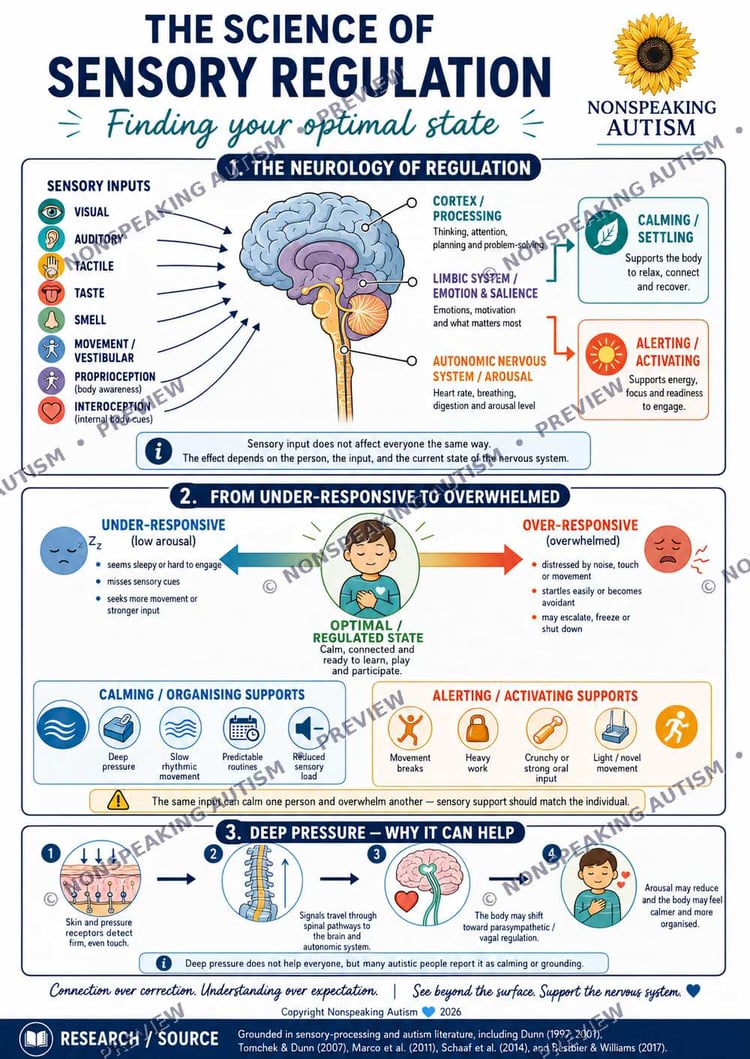
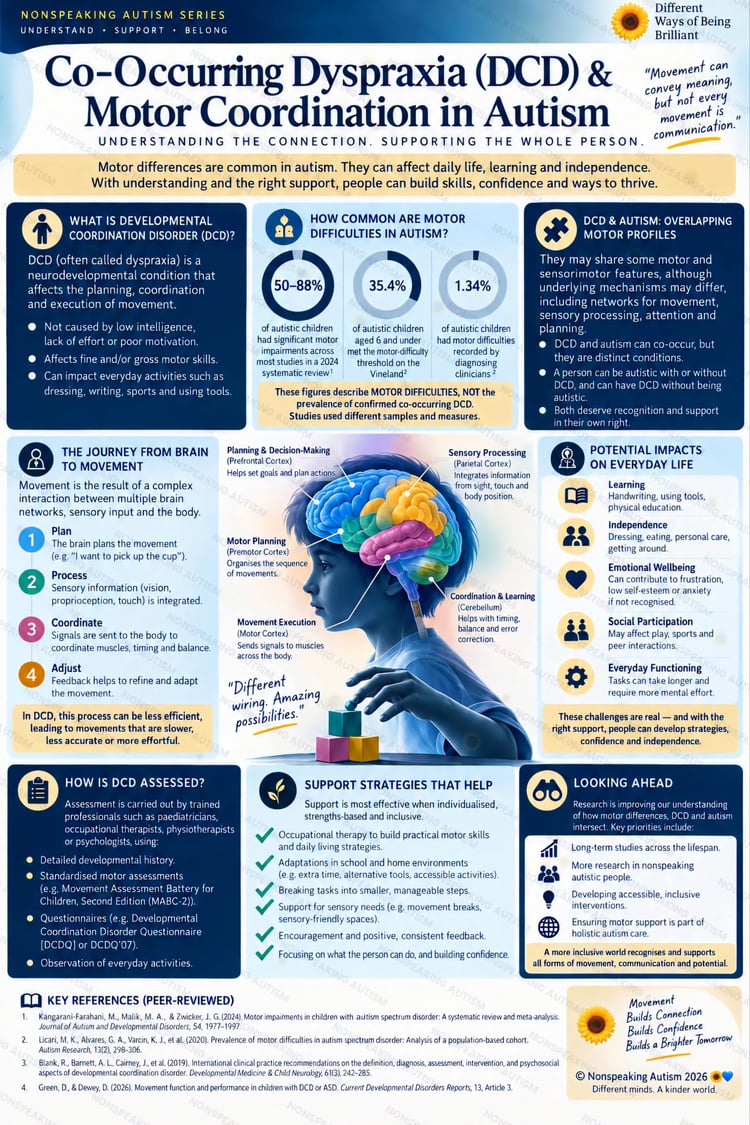
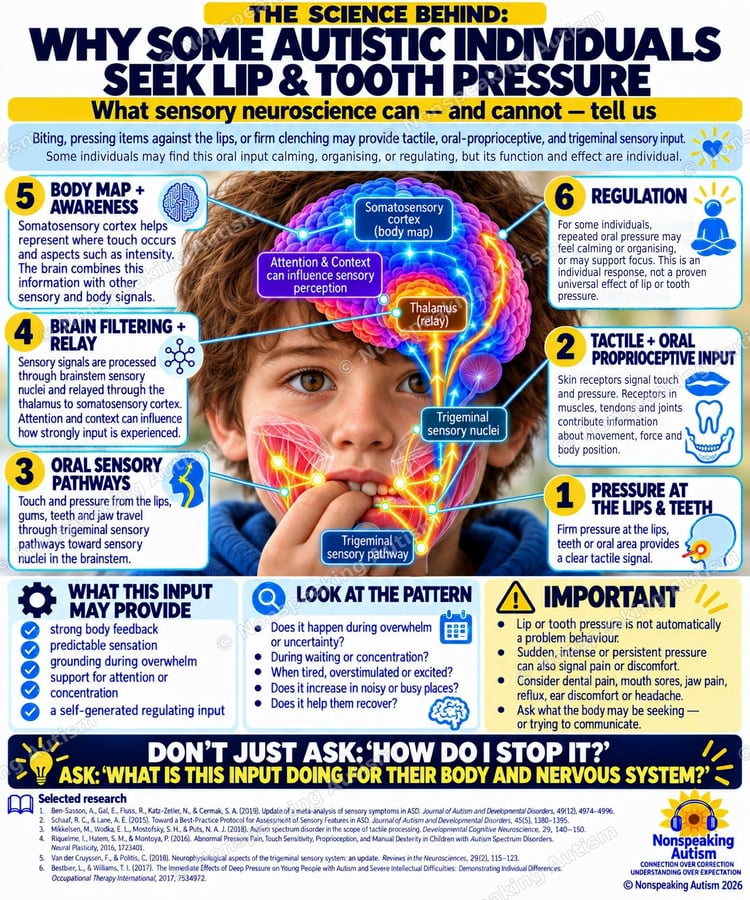
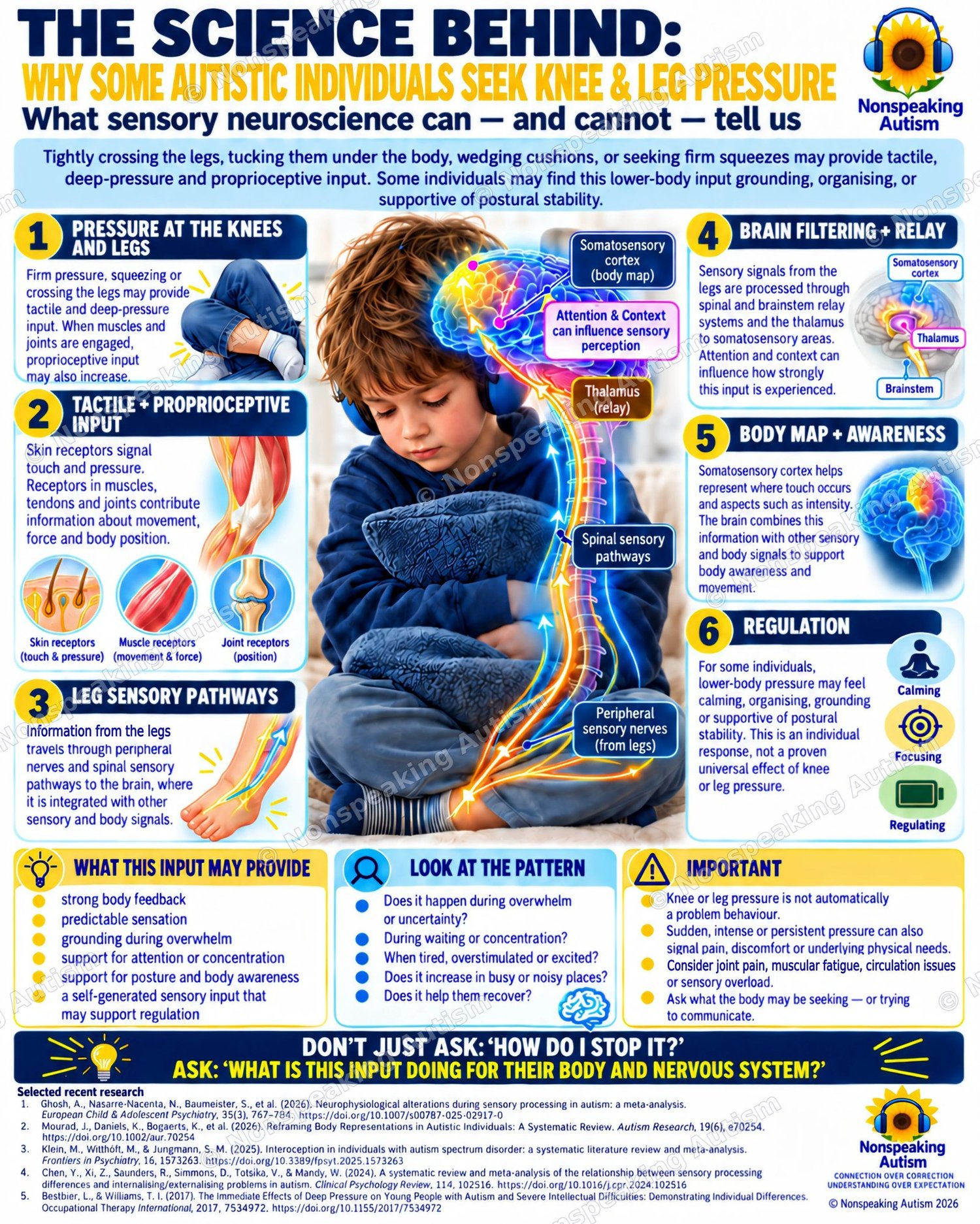
Tightly crossing the legs, tucking them underneath the body, squeezing the knees together, wedging cushions around the legs or seeking firm lower-body pressure can provide tactile, deep-pressure and proprioceptive sensory input.
For some autistic people, this type of self-generated pressure may feel grounding, organising or supportive of body awareness and postural stability. It may appear more often during concentration, uncertainty, sensory overload, tiredness or recovery.
But there is an important distinction:
Seeing someone seek pressure does not tell us exactly why they are doing it.
Why Some Autistic Individuals Seek Knee & Leg Pressure is a research-informed educational poster from Nonspeaking Autism, designed to help parents, carers, educators and professionals move beyond simply trying to stop an unusual-looking behaviour and instead investigate its possible function, context and meaning.
The central question becomes:
“What might this input be doing for their body and nervous system?”
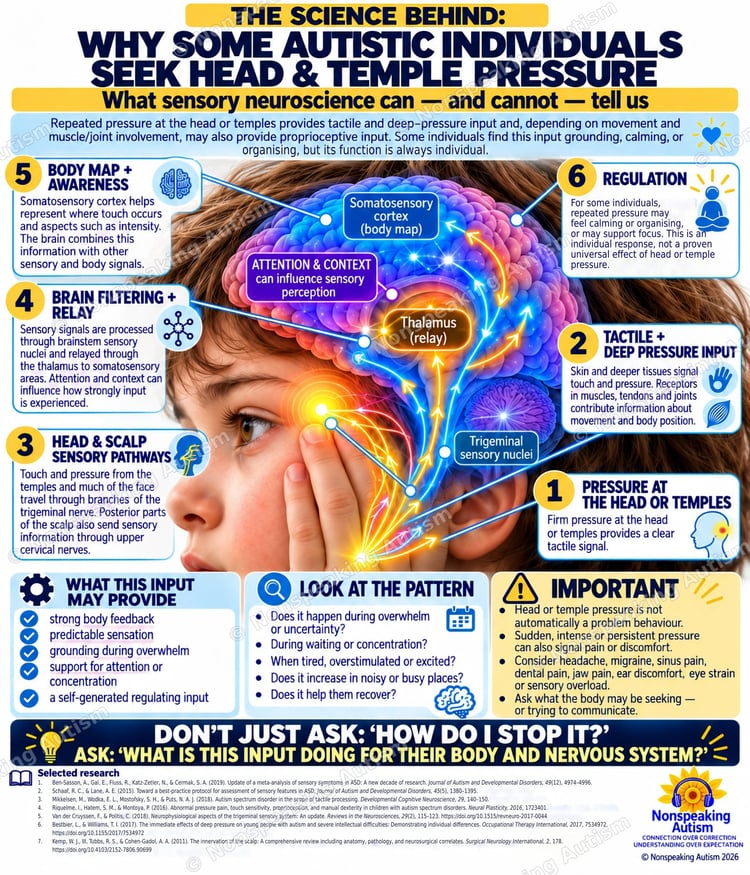
🦵 1. Pressure at the Knees & Legs
Firm pressure, squeezing, tightly crossing the legs or tucking the legs underneath the body can create noticeable tactile input.
When muscles and joints are involved, the movement may also increase proprioceptive feedback — sensory information related to movement, force and body position.
A person may create this pressure in different ways, including:
- tightly crossing their legs
- sitting on one or both legs
- curling the legs towards the body
- squeezing the knees together
- wrapping the legs around objects or furniture
- wedging cushions around the legs
- seeking firm pressure through blankets or other preferred supports
These behaviours can look similar while serving very different functions.
The movement is observable. Its purpose must not be assumed.
✋ 2. Tactile & Proprioceptive Input
Skin receptors provide information about touch and pressure.
Sensory receptors associated with muscles, tendons and joints contribute information about movement, force and body position.
Together, tactile and proprioceptive information helps the nervous system understand what is happening to the body and where different parts of the body are positioned.
For some individuals, stronger or more predictable lower-body input may be particularly noticeable or preferred.
But this does not mean every person who crosses, squeezes or tucks their legs is seeking sensory regulation.
🧠 3. Leg Sensory Pathways
Sensory information from the legs travels through peripheral nerves and spinal sensory pathways towards the central nervous system, where it is integrated with other sensory and body information.
This process involves complex interactions between peripheral nerves, the spinal cord, brainstem and multiple brain regions.
The pathway illustrated on the poster is therefore a simplified educational model.
It should not be interpreted as a neurological scan, individualized finding or proof that a particular neural pathway explains someone's behaviour.
🔄 4. Brain Filtering, Relay & Context
Sensory experience is not produced by a single brain structure.
The thalamus participates in relaying much sensory information towards cortical regions, while broader networks involved in attention, perception, movement and context contribute to how sensory information is experienced.
This helps explain why the same physical input may feel different depending on circumstances.
A person's response can potentially vary with:
- sensory load
- attention
- fatigue
- stress or arousal
- predictability
- pain or physical discomfort
- posture
- environment
- previous experiences
- competing sensory information
Sensory responses are contextual as well as individual.
🗺️ 5. Body Map & Awareness
The somatosensory cortex contributes to processing information about the body, including aspects of where touch occurs and characteristics of that input.
Proprioceptive information also contributes to awareness of movement and body position.
For some people, strong lower-body input may provide clear body feedback.
This does not mean that knee or leg pressure has one universal neurological effect.
The brain illustration in this resource is intended to help explain broad sensory concepts — not to claim that we can see what an individual autistic person's brain is doing when they seek pressure.
💙 6. Regulation
Some autistic people may experience pressure as:
grounding • organising • predictable • focusing • calming • stabilising
For some individuals, lower-body pressure may appear during:
- overwhelm or uncertainty
- waiting
- concentration
- excitement
- fatigue
- busy or noisy environments
- transitions
- recovery after demanding situations
For another person, however, the same pressure could be uncomfortable or have no regulatory value at all.
Individual response matters more than the name of the sensory strategy.
⚙️ What Might This Input Provide?
Depending on the individual, knee or leg pressure may provide:
- strong body feedback
- predictable sensation
- tactile input
- proprioceptive feedback
- grounding during overwhelm
- support during attention or concentration
- information about posture and body position
- familiar self-generated sensory input
- something used while recovering from sensory or emotional load
These are possible functions to explore — not meanings to assign automatically.
🔍 Look at the Pattern
Rather than asking only what the behaviour looks like, investigate when, where and how it happens.
Consider:
Does it happen during overwhelm or uncertainty?
Does it appear while waiting or concentrating?
Does it increase when the person is tired, overstimulated or excited?
Is it more common in busy or noisy environments?
Does it occur during particular tasks or transitions?
Does it appear after school or another demanding environment?
Does the person actively choose the pressure?
Does it seem to help them continue, focus or recover?
Has the pattern recently changed?
Repeated patterns across contexts can provide much more useful information than one isolated observation.
♿ Posture, Stability & Body Awareness
Not every unusual sitting position is simply a “sensory behaviour.”
A person's preferred position can potentially involve multiple interacting factors, including:
- comfort
- habit
- posture
- stability
- fatigue
- motor differences
- body awareness
- sensory preferences
- joint or muscle factors
- environmental demands
If a person repeatedly needs a particular position to feel stable or comfortable, it may be worth considering the whole sensory and motor picture rather than immediately correcting their posture.
Where there are concerns about mobility, pain, weakness, joint stability or functional movement, an appropriately qualified professional can assess possible contributing factors.
🛑 Pressure Should Not Be Forced
There is a major difference between a person creating pressure themselves and pressure being applied by somebody else.
If externally provided pressure is considered:
- respect consent and assent
- respect refusal
- stop when the person indicates they have had enough
- never use pressure to force compliance
- do not assume that liking one form of pressure means liking another
- keep communication accessible
- consider individualized professional advice where appropriate
A sensory preference is not blanket consent to touch or pressure.
⚠️ Don't Automatically Assume Sensory Seeking
Knee or leg pressure is not automatically a problem behaviour.
It is also not automatically sensory seeking.
Sudden, intense, persistent or significantly changed pressure-seeking can sometimes occur alongside physical discomfort or other needs.
Depending on the individual circumstances, consider possible:
- knee or joint pain
- muscle fatigue or soreness
- injury
- altered mobility
- circulation concerns
- discomfort from seating or positioning
- fatigue
- sensory overload
- other medical or physical factors
The behaviour itself cannot diagnose any of these.
But a meaningful change in someone's usual behaviour can be a reason to check the body rather than automatically attribute the change to autism.
🧠 What About Deep Pressure?
Research on deep-pressure interventions provides useful background but should be interpreted cautiously.
Some studies have reported positive or physiological responses to deep pressure in some autistic participants, while also demonstrating substantial individual differences.
Research on one deep-pressure intervention does not establish that squeezing or crossing the legs has the same mechanism or effect.
Nor does it mean that more pressure is necessarily better.
Sensory support should be preferred, individualized, safe and responsive to the person.
The goal is not to make somebody sit still or appear less autistic.
The meaningful outcome is whether a support improves comfort, communication, regulation, participation or wellbeing.
🔬 Research-Informed
This poster draws on research concerning:
- sensory-processing differences in autism
- tactile processing
- proprioception and body representation
- interoception
- sensory processing and distress
- individual responses to deep-pressure input
Research supports the existence of significant sensory-processing differences across autistic populations.
At the same time, autistic sensory experiences are heterogeneous.
Group-level research cannot tell us the precise function of one individual's knee or leg pressure.
Observe the pattern. Check the context. Check the body. Keep communication accessible. Individualize support.
📚 Selected Research & References
Ghosh, A., Nasarre-Nacenta, N., Baumeister, S., et al. (2026). Neurophysiological alterations during sensory processing in autism: a meta-analysis. European Child & Adolescent Psychiatry, 35(3), 767–784.
Mourad, J., Daniels, K., Bogaerts, K., et al. (2026). Reframing Body Representations in Autistic Individuals: A Systematic Review. Autism Research, 19(6), e70254.
Klein, M., Witthöft, M., & Jungmann, S. M. (2025). Interoception in individuals with autism spectrum disorder: a systematic literature review and meta-analysis. Frontiers in Psychiatry, 16, 1573263.
Chen, Y., Xi, Z., Saunders, R., Simmons, D., Totsika, V., & Mandy, W. (2024). A systematic review and meta-analysis of the relationship between sensory processing differences and internalising/externalising problems in autism. Clinical Psychology Review, 114, 102516.
Bestbier, L., & Williams, T. I. (2017). The Immediate Effects of Deep Pressure on Young People with Autism and Severe Intellectual Difficulties: Demonstrating Individual Differences. Occupational Therapy International, 2017, 7534972.
Gardinal, M., Fiebrantz, A. L. S., Viana, M. O., Rodacki, A. L. F., & Pavão, S. L. (2026). Dynamic postural control in children with autism spectrum disorder: A systematic review. Physical & Occupational Therapy in Pediatrics, 46(2), 172–203. https://doi.org/10.1080/01942638.2025.2564233
→ Supports: Regulation ("supportive of postural stability"); What This Input May Provide ("support for posture and body awareness")
Baeza-Velasco, C., Vergne, J., Poli, M., Kalisch, L., & Calati, R. (2025). Autism in the context of joint hypermobility, hypermobility spectrum disorders, and Ehlers–Danlos syndromes: A systematic review and prevalence meta-analyses. Autism, 29(8), 1939–1958. https://doi.org/10.1177/13623613251328059
→ Supports: Important ("Consider joint pain, muscular fatigue…")
📖 Evidence Note
These references support the broader sensory-processing, tactile, body-awareness, interoceptive and deep-pressure principles relevant to this educational resource.
They do not establish knee or leg pressure as an autism-specific behaviour, nor do they prove that a particular person is using knee or leg pressure to regulate.
The neurological pathway illustrated on the poster is simplified for educational purposes.
This resource is research-informed rather than a standardized or validated sensory assessment instrument.
Hypermobility Syndromes Association (HMSA) — Joint hypermobility, neurodivergence, dysautonomia and pain
A UK charity summary of research into hypermobility in autistic, ADHD and Tourette's populations, and why it matters for pain and body awareness.
https://www.hypermobility.org/post/joint-hypermobility-links-neurodivergence-to-dysautonomia-and-pain
Free-to-read research: No association between joint hypermobility, musculoskeletal pain and neurodevelopmental problems in 11-year-old children (BJPsych Open, 2025)
A balancing study showing the hypermobility link seen in adults may not apply to younger children.
https://pmc.ncbi.nlm.nih.gov/articles/PMC12641418/
Research summary: Dynamic postural control in children with autism (Physical & Occupational Therapy in Pediatrics, 2025)
https://pubmed.ncbi.nlm.nih.gov/41047762/
Research summary: Autism, joint hypermobility and Ehlers–Danlos syndromes — systematic review (Autism, 2025)
https://journals.sagepub.com/doi/10.1177/13623613251328059
👨👩👧 Who Is This Resource For?
This educational poster may be useful for:
- autistic people and their families
- parents and carers
- teachers and teaching assistants
- SENCOs and SEND teams
- mainstream and specialist schools
- occupational therapists
- physiotherapists
- speech and language therapists
- paediatric professionals
- healthcare professionals
- psychologists
- support workers
- respite and social-care teams
- autism and disability organisations
It can support family education, staff training, professional reflection and discussions about individualized sensory and regulation needs.
📦 What You Receive
Your purchase includes:
1 × The Science Behind: Why Some Autistic Individuals Seek Knee & Leg Pressure educational poster
1 × high-resolution printable digital PDF
The purchased file is supplied clear and without the promotional preview watermark shown on the Payhip listing image.
Watermarks visible in promotional images are for preview and copyright protection only.
Digital download only — no physical product will be shipped.
⚠️ Important Disclaimer
This is a research-informed educational resource.
It is not medical advice, diagnosis, occupational therapy assessment, physiotherapy assessment, neurological assessment, sensory assessment, pain assessment, behaviour assessment or an individualized treatment plan.
The examples and possible functions described are possibilities rather than fixed interpretations of an individual's behaviour.
New, painful, unusually intense, persistent or significantly changed knee or leg pressure should not automatically be attributed to autism or sensory seeking. Concerns involving pain, swelling, weakness, circulation, injury, altered walking or mobility, loss of function or other significant physical changes should receive appropriate professional assessment.
Sensory supports should be individualized, safe, consensual and responsive to the person's preferences.
Pressure should never be forced because it is assumed to be regulating.
©️ Copyright & Permitted Use
Copyright © 2026 Nonspeaking Autism. All rights reserved.
Purchase permits use for personal/home use, your own classroom or educational setting, your own clinic or individual professional educational practice, and direct educational/support work with people you support.
The digital file may not be resold, redistributed, file-shared, uploaded elsewhere, commercially reproduced, altered for resale or incorporated into another product for sale or distribution.
Please direct others wishing to obtain their own copy to the original Nonspeaking Autism listing.
💛 The Message Behind the Resource
A tightly crossed leg, tucked position or repeated squeeze is easy to see.
Its meaning is not.
It may provide useful body feedback.
It may support posture or body awareness.
It may appear during concentration.
It may feel grounding during overload.
It may simply be a comfortable way to sit.
Or a change in the pattern may be communicating that something hurts.
The aim is not to attach one explanation to every movement.
It is to become better at observing, listening, investigating and supporting.
**See beyond the surface.
Support the whole system.
Respect communication.
Respect autonomy.
Individualize support.**
DON'T JUST ASK: “HOW DO I STOP IT?”
ASK: “WHAT MIGHT THIS INPUT BE DOING FOR THEIR BODY AND NERVOUS SYSTEM?”
Connection over correction. Understanding over expectation. 💙🌻