
Autistic Demand Avoidance in Girls and Women
Autistic Demand Avoidance in Girls and Women
Why everyday requests can feel like a threat to the nervous system
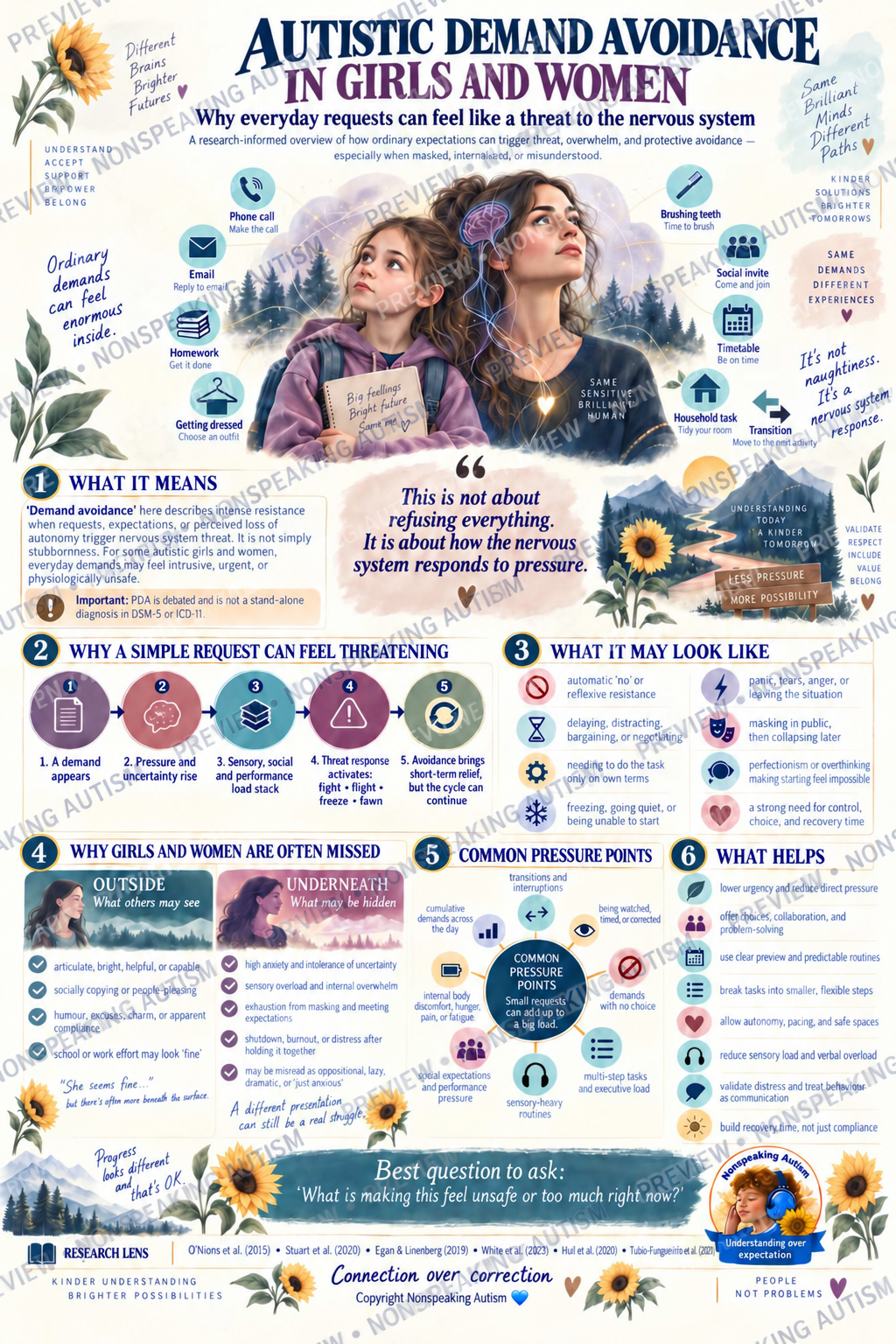
“Make the phone call.”
“Reply to the email.”
“Get your homework done.”
“Time to get dressed.”
“Come and join us.”
“Tidy your room.”
For many people, these may seem like ordinary everyday requests. But for some autistic girls and women, requests, expectations, transitions or a perceived loss of autonomy can create an intense nervous-system response.
What looks from the outside like refusing, delaying, arguing, negotiating or simply “not doing it” may sometimes be connected to something much more complex underneath: anxiety, uncertainty, sensory overload, executive-function demands, accumulated pressure or a powerful need to regain a sense of control and safety.
Autistic Demand Avoidance in Girls and Women is a research-informed educational poster designed to help families, educators and professionals look beyond behaviour and consider what may be making a demand feel overwhelming.
The central message is:
This is not about refusing everything.
It is about how the nervous system responds to pressure.
And perhaps the most useful question is:
“What is making this feel unsafe or too much right now?”
🧠 What This Poster Explores
This visual resource provides an accessible overview of:
- What “demand avoidance” can mean
- Why everyday requests may sometimes trigger intense resistance
- The role of anxiety, uncertainty and perceived loss of autonomy
- Sensory, social and performance demands
- Executive-function load
- Fight, flight, freeze and other protective responses
- Why avoidance can bring short-term relief
- What demand avoidance may look like in everyday life
- Why autistic girls and women may sometimes be misunderstood or overlooked
- Masking, people-pleasing and delayed distress
- Common pressure points
- Practical ways to reduce unnecessary pressure
- Choice, collaboration and autonomy
- Recovery and regulation
- Why behaviour should be understood in context
The aim is not to excuse every behaviour or remove every expectation.
It is to understand what makes participation difficult and what support may make it more accessible.
🌻 What Does “Demand Avoidance” Mean?
In this resource, demand avoidance describes intense resistance that may occur when requests, expectations or a perceived loss of autonomy create significant pressure.
For some autistic people, everyday demands can feel unusually urgent, intrusive or difficult to initiate — even when the person understands the task, wants the eventual outcome or knows that the request is reasonable.
This is different from simply assuming:
“She won't.”
Sometimes a more useful question is:
“What is getting in the way of being able to do this right now?”
Importantly, Pathological Demand Avoidance (PDA) is debated and is not a stand-alone diagnosis in DSM-5 or ICD-11. “Demand avoidance” is therefore used here descriptively rather than as a diagnosis.
The poster is intended to support curiosity and understanding — not to diagnose PDA.
🔄 Why a Simple Request Can Feel Threatening
The poster illustrates one possible cycle:
1. A demand appears
A task, request, transition, expectation or obligation enters the person's awareness.
2. Pressure and uncertainty rise
The demand may introduce urgency, uncertainty or a perceived reduction in autonomy.
3. Sensory, social and performance load stack
The task may involve much more than the words used to describe it.
“Get dressed,” for example, might involve choosing clothes, uncomfortable textures, temperature changes, time pressure, several executive-function steps and an upcoming transition.
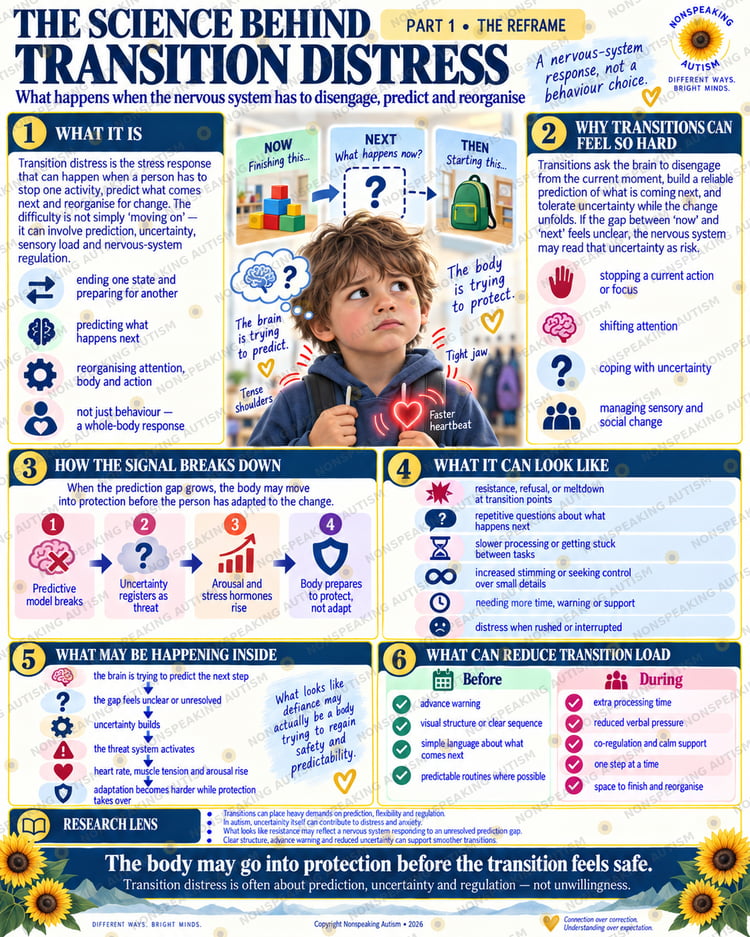
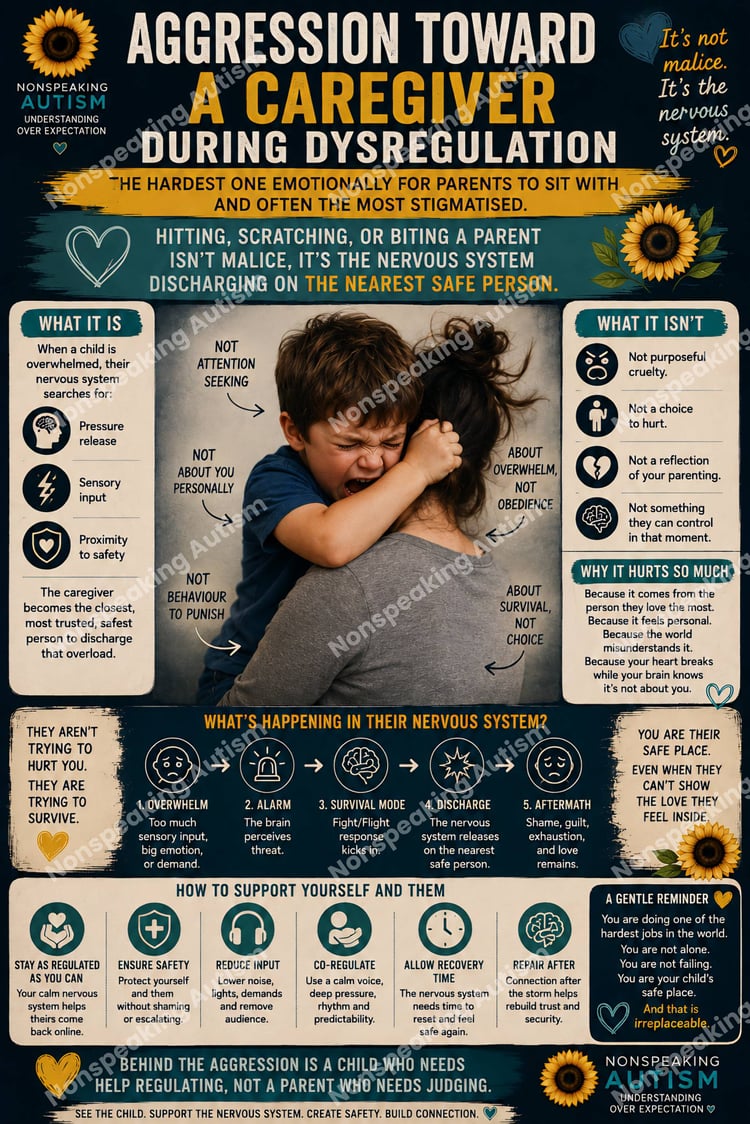
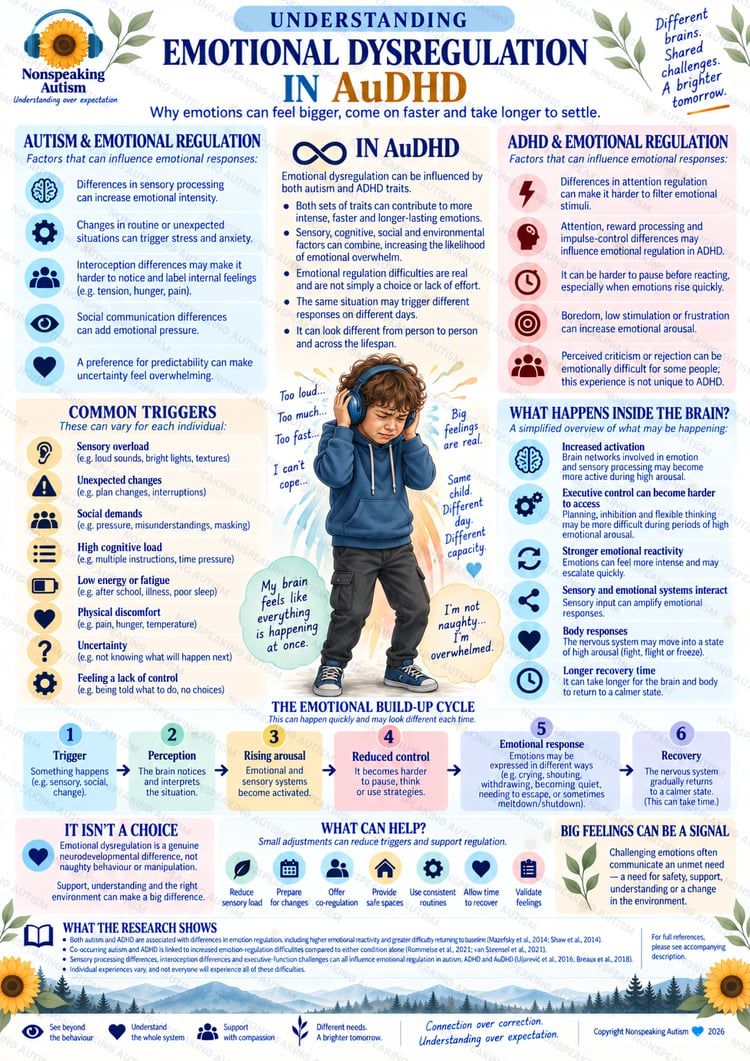
4. A protective stress response may activate
The person may experience heightened distress, resistance, freezing, escape behaviour or another protective response.
5. Avoidance brings short-term relief
Escaping or delaying the demand may reduce immediate pressure.
That relief can make avoidance more likely the next time a similar situation occurs.
This does not mean every episode of avoidance follows this exact process. It is a visual framework for understanding how pressure can build.
💭 What Demand Avoidance May Look Like
Demand-related distress does not always look like a direct “no”.
It may appear as:
Automatic or reflexive resistance
The person may reject a request almost immediately.
Delaying, distracting, bargaining or negotiating
These strategies may create additional processing time or restore some sense of control.
Needing to do something only on their own terms
The task itself may be manageable while the feeling of being directed is not.
Freezing or being unable to start
What looks like refusal can sometimes involve executive-function difficulty, overwhelm or a freeze response.
Panic, tears, anger or leaving the situation
Pressure may eventually exceed available capacity.
Masking in public and collapsing later
A person may maintain outward composure until reaching somewhere safer.
Perfectionism or overthinking
Fear of getting something wrong can add another layer of demand.
A strong need for control, choice and recovery time
Restoring predictability or autonomy may help the nervous system settle.
Understanding the function of behaviour is more useful than automatically assigning a moral judgement to it.
👩 Why Girls and Women May Be Missed
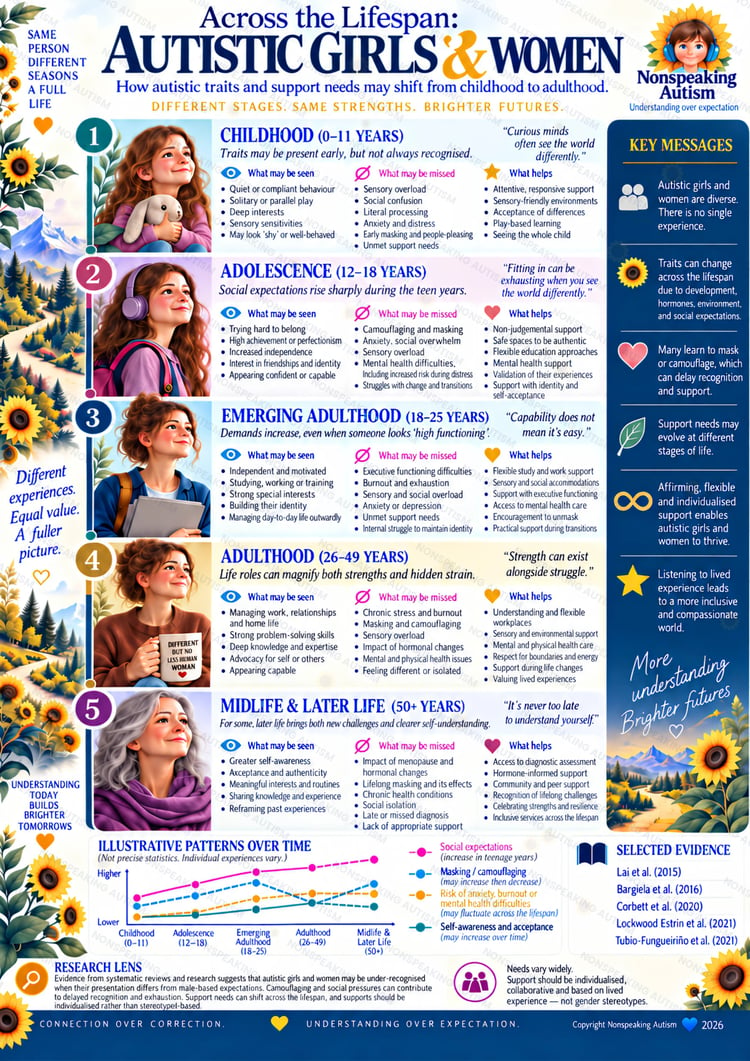
Demand-related difficulties may be particularly difficult to recognise when an autistic girl or woman has learned to mask, socially copy, please others or maintain an outward appearance of capability.
What others may see:
She may appear:
- Articulate, bright, helpful or capable
- Socially skilled
- Funny, charming or persuasive
- Compliant in structured environments
- Academically successful
- Apparently “fine” at school or work
What may be happening underneath:
There may simultaneously be:
- Significant anxiety or intolerance of uncertainty
- Sensory overload
- Internal overwhelm
- Exhaustion from masking and meeting expectations
- Shutdown or distress after holding everything together
- Difficulties that are interpreted as laziness, opposition or “just anxiety”
None of these patterns is exclusive to females, and not every autistic girl or woman will experience them.
A different presentation can still represent a genuine struggle.
⚡ Common Pressure Points
Sometimes it is not one enormous demand that overwhelms somebody.
It is many small demands accumulating across the day.
Pressure may come from:
Transitions and interruptions
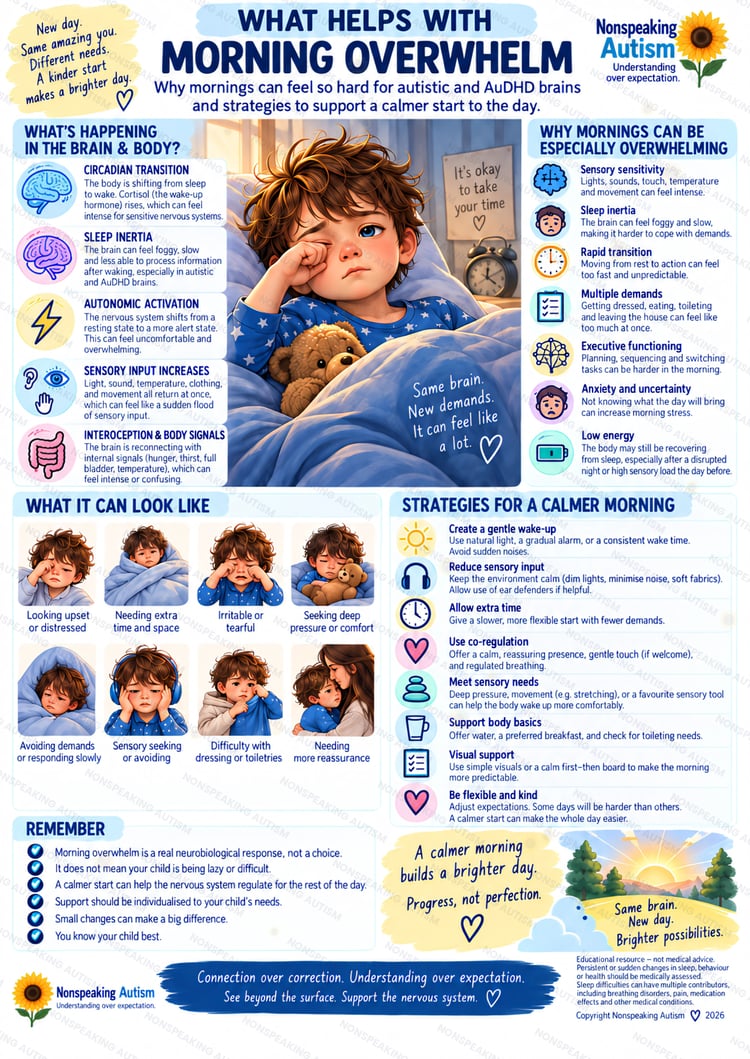
Stopping one activity and beginning another can require significant cognitive adjustment.
Being watched, timed or corrected
Performance pressure can make an otherwise manageable task much harder.
Demands with little or no choice
A lack of perceived autonomy may intensify resistance.
Multi-step tasks and executive load
A “simple” instruction may contain numerous planning, sequencing and initiation demands.
Sensory-heavy routines
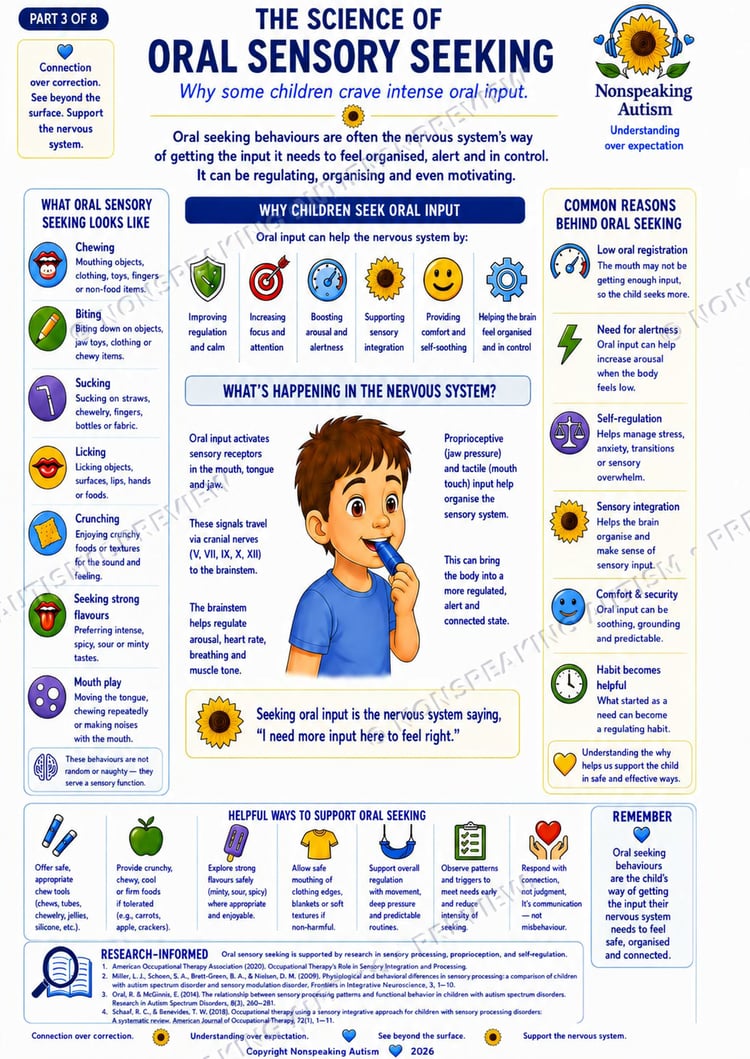
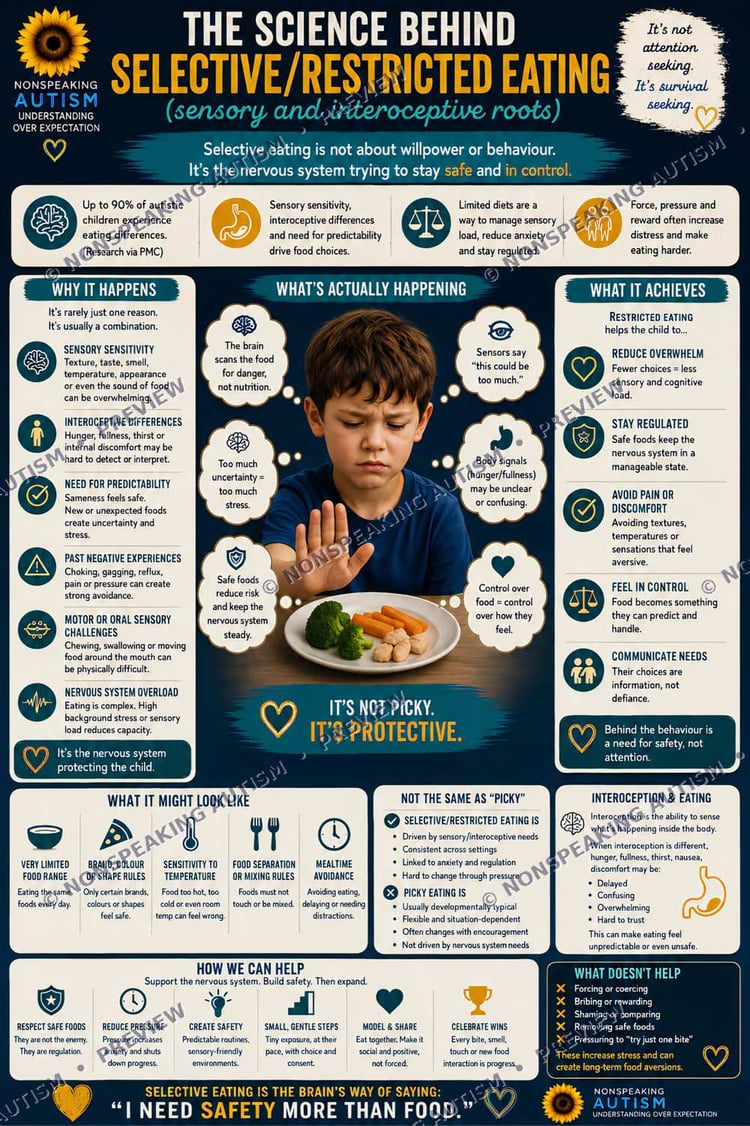
Dressing, showering, brushing teeth, travelling, eating or attending busy environments may contain significant sensory demands.
Social expectations
Conversation, eye contact, group participation or navigating unclear expectations can add substantial pressure.
Internal body discomfort
Hunger, fatigue, pain or other physical sensations may reduce available capacity.
Cumulative demands
A person's ability to manage a request at 9 a.m. may be very different from their ability to manage the same request after an exhausting day.
Small requests can add up to a big load.
💙 What Can Help?
The goal is not to eliminate every demand from life.
Instead, support can focus on reducing unnecessary pressure and increasing predictability, autonomy, accessibility and collaboration.
Lower urgency and direct pressure
Where possible, reduce confrontational or unnecessarily urgent language.
Offer meaningful choices
Choice can increase a sense of autonomy:
“Would you rather do this before or after lunch?”
can sometimes feel very different from:
“Do this now.”
Choices should be genuine rather than disguised commands.
Collaborate and problem-solve
Work with the person to identify what part of the demand is difficult.
Sometimes changing one element can make the whole task more manageable.
Use clear previews and predictable routines
Knowing what will happen, when it will happen and what comes afterwards can reduce uncertainty for some people.
Break tasks into flexible steps
A multi-step demand may become more accessible when divided into smaller parts.
Allow autonomy, pacing and safe spaces
Time, space and a sense of control can be regulatory.
Reduce sensory and verbal load
When somebody is overwhelmed, adding more instructions may increase rather than solve the difficulty.
Validate distress
Recognising that something is genuinely difficult does not mean agreeing that it can never be done.
It means beginning from understanding rather than judgement.
Build in recovery
The aim should not simply be achieving compliance at any cost.
Recovery matters too.
🤝 Behaviour as Communication
When behaviour changes, something may have changed in the person's capacity, environment, body or experience.
Instead of beginning with:
“How do we make her comply?”
try becoming curious about:
“What is making this difficult?”
“Is there too much uncertainty?”
“Is the sensory environment overwhelming?”
“Does she understand what is expected?”
“Is the task too large?”
“Does she need more processing time?”
“Has she already used most of her capacity today?”
“Can we preserve the goal while changing how we get there?”
Behaviour cannot tell us the answer by itself.
But it can tell us that there is something worth understanding.
🔬 Research-Informed
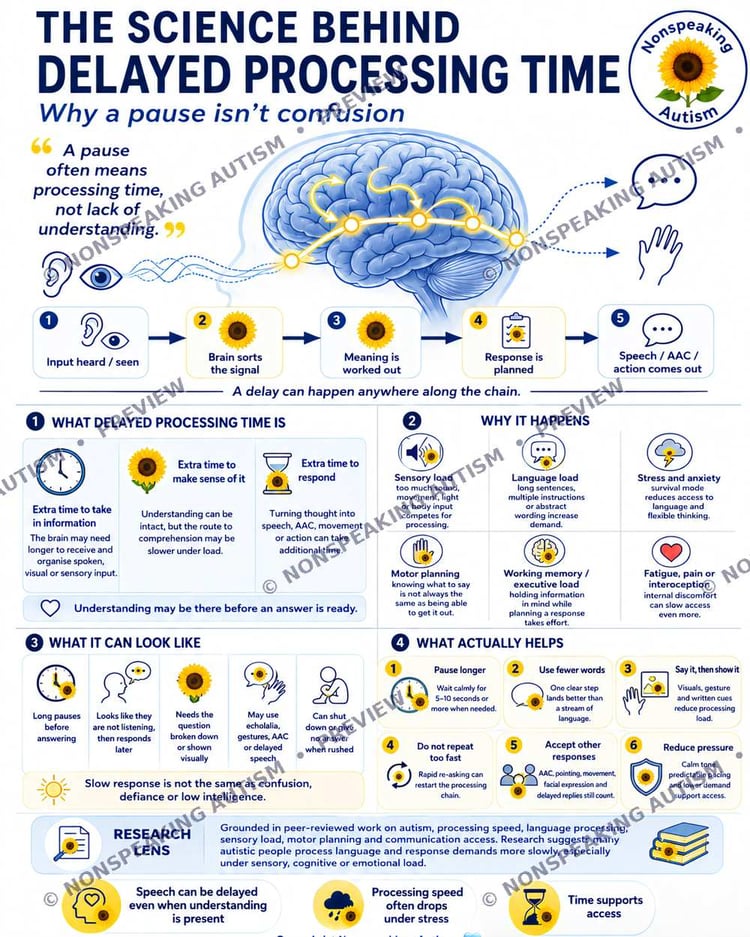
This poster draws on research and conceptual literature concerning demand avoidance, anxiety, intolerance of uncertainty, camouflaging and autistic female presentation.
The selected research lens on the poster includes work by:
O'Nions et al. (2015) — research examining extreme or pathological demand-avoidant characteristics in children and their relationship with other behavioural and emotional characteristics.
Stuart et al. (2020) — research contributing to the developing literature concerning demand avoidance and autistic experience.
Egan & Linenberg (2019) — work relevant to understanding demand-related experiences and associated psychological processes.
White et al. (2023) — more recent work contributing to discussion of demand avoidance.
The poster also draws on literature concerning autistic camouflaging, including work by Hull et al. (2020) and Tubío-Fungueiriño et al. (2021).
The evidence surrounding PDA and demand avoidance continues to develop, and terminology, conceptualisation and measurement remain debated.
For that reason, this resource deliberately avoids presenting a single theory as settled fact.
Instead, it uses a broader, practical principle:
When an ordinary demand repeatedly creates extraordinary distress, understanding why is more useful than assuming deliberate defiance.
👨👩👧 Who Is This Resource For?
This poster may be particularly useful for:
- Autistic girls and women
- Parents and carers
- Families and partners
- Teachers and teaching assistants
- SENCOs and SEND teams
- Mainstream and specialist schools
- Colleges and universities
- Autism and inclusion teams
- Occupational therapists
- Speech and language professionals
- Psychologists and other relevant professionals
- Healthcare and social-care professionals
- Support workers
- Employers and workplace-support teams
- Family-support organisations
- Autism and SEND training
It can be used at home, in classrooms, SEND spaces, therapy environments, clinics, workplaces or professional training as a starting point for discussions about pressure, autonomy, avoidance and nervous-system-informed support.
📦 What You Receive
Your purchase includes:
1 × Autistic Demand Avoidance in Girls and Women — Educational Poster
1 × high-resolution PDF
The purchased version is supplied clear and without the promotional preview watermark. Watermarks visible on Payhip listing images are used for preview and copyright-protection purposes only.
Digital download only — no physical product will be shipped.
⚠️ Important Disclaimer
This resource is provided for educational and informational purposes only.
It is not medical advice, psychological treatment, a diagnostic tool or a substitute for individual assessment or professional guidance.
Demand avoidance and PDA should not be used as assumptions or explanations for every instance of resistance, distress or difficulty completing tasks. PDA remains a debated construct and is not a stand-alone diagnosis in DSM-5 or ICD-11.
Avoidance can have many possible causes, including anxiety, sensory distress, executive-function difficulties, communication barriers, fatigue, pain, trauma, uncertainty, learning difficulties, competing needs or simply not wanting to do something.
Sudden, severe or unusual changes in behaviour or functioning should not automatically be attributed to autism or demand avoidance. Appropriate medical or professional assessment may be necessary.
Strategies should be individualised. Lowering unnecessary pressure does not mean abandoning safeguarding, health needs, appropriate boundaries or all everyday expectations.
The person's communication, autonomy, wellbeing and lived experience should remain central to support.
💛 The Message Behind the Resource
An everyday request can look small from the outside and still feel enormous inside.
The answer is not necessarily to remove every expectation.
Nor is it to increase pressure until somebody complies.
Often, the most productive place to begin is with curiosity:
What is making this hard?
Is it uncertainty?
Sensory overload?
Too many steps?
Fear of getting it wrong?
Loss of autonomy?
Exhaustion?
Or simply one demand too many after an already demanding day?
When we understand the source of pressure, we have more possibilities for changing the environment, adapting the task and supporting the person.
This is not about refusing everything.
It is about how the nervous system responds to pressure.
Less pressure. More possibility.
Best question to ask:
“What is making this feel unsafe or too much right now?”
Connection over correction.
Understanding over expectation.
© Nonspeaking Autism 2026. All rights reserved.