

💙 CO-REGULATION NEED
💙 CO-REGULATION NEED
Why Autistic Children May Need Connection Before Communication, Instructions or Expectations
Research-Informed Autism Educational Poster | UK Edition | Nonspeaking Autism
🌻 Connection over correction. Understanding over expectation.
Not more prompts. Not more pressure. Not “use your words”.
When an autistic child becomes overwhelmed, distressed or unable to communicate as they usually would, they may need something very different from another instruction.
They may need safety.
They may need less sensory input.
They may need time.
And sometimes, they may need a calm, trusted adult who can help them feel supported while their nervous system settles.
Co-Regulation Need is an illustrated educational poster exploring why autistic children may benefit from supportive adult presence during periods of distress, sensory overload and emotional overwhelm.
It encourages parents, carers, educators and professionals to look beyond outward behaviour and consider what the child may be experiencing internally.
The central message is simple:
A child who is overwhelmed may need support to regulate before they can comfortably process instructions, communicate or return to an activity.
Co-regulation is not about controlling a child's emotions or making distress disappear immediately.
It is about offering safety, connection, understanding and practical support without unnecessary pressure.
🧠 WHAT THIS POSTER EXPLORES
1. 💜 What Co-Regulation Really Means
Co-regulation is the process through which one person's supportive responses can help another person manage emotional and physiological arousal.
For children, this may involve a trusted adult offering calm, predictable and responsive support.
Co-regulation can include:
- Staying nearby when the child wants company.
- Responding with patience and reassurance.
- Reducing overwhelming sensory input.
- Using fewer words.
- Offering familiar comforts.
- Respecting the child's need for distance.
- Helping identify and address unmet needs.
- Allowing recovery without demanding an immediate explanation.
The aim is not to make the child behave in a particular way.
The aim is to help create conditions in which the child can feel safer and better supported.
Importantly, co-regulation does not always mean physical closeness. For some children, the most supportive response is quiet availability at a comfortable distance.
2. 🌿 Why Autistic Children May Need Co-Regulation
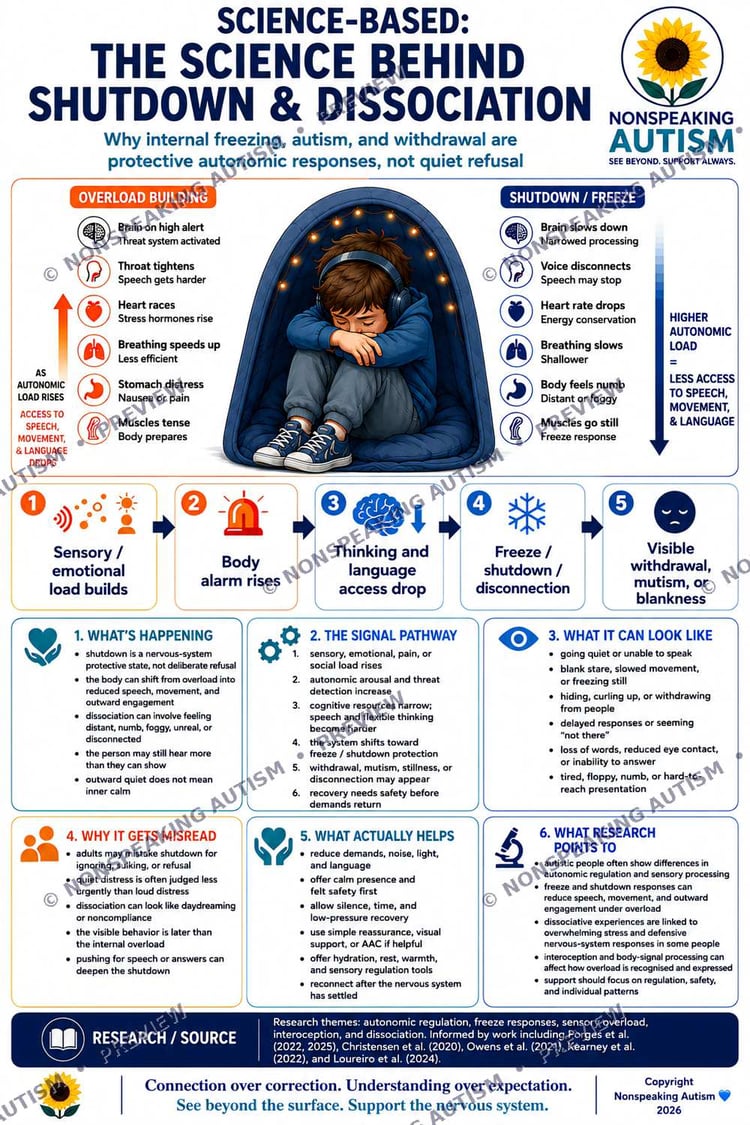
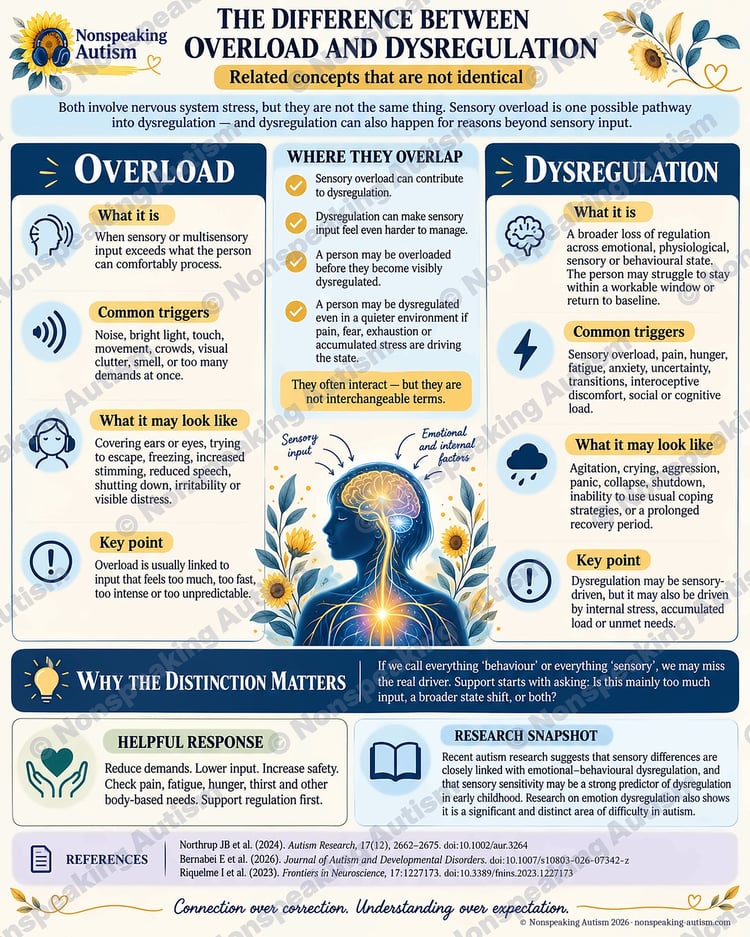
During sensory or emotional overwhelm, a child may find it harder to access skills that are usually available to them.
They may struggle with:
Thinking and processing
Instructions, questions and decisions may become harder to manage.
Communication
Speech, AAC access, gestures or other communication methods may become more difficult to use under stress.
Managing sensory input
Sounds, lights, touch, movement or busy environments may feel increasingly distressing.
Recognising body needs
Pain, hunger, thirst, fatigue or illness may contribute to distress.
Returning to a comfortable state
Some children may need additional time, environmental changes or trusted support before they feel settled.
These experiences are individual. Not every autistic child needs the same type or amount of co-regulation.
A child may need connection on one occasion and solitude on another.
💛 YOUR CALM PRESENCE MAY HELP
A trusted adult's presence can sometimes provide predictability, reassurance and emotional safety.
This might look like:
💙 Staying calm and close when closeness is welcomed.
💙 Offering presence rather than pressure.
💙 Speaking less and allowing more processing time.
💙 Adjusting your response to the child's individual needs.
💙 Helping make the environment feel safer.
💙 Remaining available without demanding interaction.
The adult does not have to be perfectly calm or know exactly what to say.
What matters is a responsive, respectful approach that prioritises the child's wellbeing.
You do not have to fix every feeling. You can help the child feel supported while it passes.
🚫 WHAT ADULTS OFTEN MISS
When a child becomes distressed, well-intentioned adults may accidentally increase the demands placed upon them.
❌ Giving More Instructions
Repeated directions may add to an already overwhelming situation.
Try instead: Pause non-essential instructions and prioritise safety.
❌ Asking Too Many Questions
Questions such as “What's wrong?”, “Why are you upset?” or “Tell me what happened” may be difficult to answer during distress.
Try instead: Allow time and offer accessible ways to communicate when the child is ready.
❌ Saying “Use Your Words”
A child may temporarily have reduced access to speech or other forms of communication when overwhelmed.
Try instead: Keep AAC available, accept gestures and other communication, and avoid pressuring speech.
❌ Expecting Immediate Calm
Recovery may take longer than an adult expects.
Try instead: Allow time without setting an arbitrary deadline for regulation.
❌ Removing Support Too Quickly
A child who becomes quiet may still need reassurance, practical assistance or a trusted person nearby.
Try instead: Check their preferences and remain available without crowding them.
The key is to respond to the child's needs rather than assuming one approach works for everyone.
🌻 WHAT CO-REGULATION MAY GIVE THE CHILD
Supportive co-regulation may contribute to:
🛡️ A Greater Sense of Safety
A predictable, respectful adult response may help a child feel less threatened or overwhelmed.
❤️ Reduced Distress
Comfort, reduced demands and environmental adjustments may make an overwhelming experience more manageable.
💜 Connection and Trust
Consistent, compassionate responses may strengthen relationships over time.
🌱 Opportunities to Develop Regulation Skills
Through repeated supportive experiences, some children may gradually develop greater awareness of what helps them manage distress.
However, self-regulation is not the same as independence from support.
People of all ages may continue to benefit from co-regulation throughout their lives.
Needing support is not a failure.
🫶 HOW TO CO-REGULATE IN THE MOMENT
1. Offer Closeness If Welcomed
Some children benefit from sitting beside a trusted adult, holding a hand or receiving a hug.
Others need physical distance.
Always respect personal space, consent and the child's communication.
2. Use a Calm Voice and Fewer Words
Keep communication simple and predictable.
Avoid unnecessary questions, explanations or repeated demands.
Silence can also be supportive.
3. Reduce the Trigger
Where possible, reduce the sensory or situational demands contributing to distress.
This might include:
- Lowering background noise.
- Dimming bright lighting.
- Moving away from crowds.
- Pausing an activity.
- Reducing language demands.
- Offering a quieter space.
4. Offer Comfort Without Forcing It
Comfort might involve a familiar object, preferred activity, movement, quiet company or sensory tool.
Never force touch, hugs or deep pressure.
5. Allow Recovery Time
A child may need several minutes or considerably longer to feel comfortable again.
Recovery should not be rushed simply because outward distress has reduced.
6. Stay Available
Some children prefer solitude but still benefit from knowing a trusted adult is nearby.
Respect the child's need for space while maintaining appropriate supervision and safety.
🎧 REDUCE THE LOAD: PRACTICAL SENSORY SUPPORT
Co-regulation is not only about what an adult says or how they behave.
The environment matters too.
🌳 Quieter Spaces
Offer access to calm, lower-stimulation environments when possible.
🎧 Sensory Protection
Ear defenders, comfortable clothing or other preferred sensory accommodations may help some children.
🧸 Preferred Sensory Tools
Some children find movement, familiar objects or deep-pressure input helpful.
Only offer these supports when appropriate and welcomed. Deep pressure should never be imposed.
💧 Physical Needs
Check whether hunger, thirst, pain, fatigue, illness or other discomfort may be contributing to distress.
💬 Low-Demand Communication
Keep preferred communication methods available, including AAC, visuals, gestures, typing or other accessible options.
A child should not have to communicate in a particular way to receive comfort and support.
🏫 LONGER-TERM CO-REGULATION SUPPORT
Effective support extends beyond moments of visible distress.
🔎 Notice Individual Patterns
Observe which situations, environments or demands tend to increase stress.
Consider the child's perspective and communication rather than relying only on adult interpretations.
Build a Sensory Profile
Identify preferred sensory experiences, known sensitivities, useful accommodations and signs that support may be needed.
🚶 Plan Movement and Sensory Breaks
Some children benefit from regular opportunities for movement, rest, outdoor time or quiet activities.
🏡 Adjust Home and School Environments
Look for practical ways to reduce unnecessary sensory, social and communication demands.
📅 Offer Predictability With Flexibility
Visual schedules, advance notice and familiar routines may help some children.
Predictability should provide reassurance rather than become another rigid expectation.
🤝 Work Together
Parents, carers, teachers, SENCOs, occupational therapists, speech and language therapists and other relevant professionals can collaborate to understand the child's needs.
Support should be individualised and reviewed as circumstances change.
🔬 RESEARCH-INFORMED: UNDERSTANDING CO-REGULATION
Research on emotional development, caregiver responsiveness and interpersonal regulation provides a foundation for understanding co-regulation.
Responsive relationships can influence how children experience and manage distress.
Autism research also highlights the importance of individual differences in sensory processing, communication, emotional regulation and environmental demands.
However, it is important to distinguish established findings from simplified explanations.
A calm adult does not automatically or directly regulate every autistic child's nervous system.
A child's response depends on many factors, including the relationship, the environment, the cause of distress, the child's preferences and the support offered.
Likewise, descriptions of an adult becoming a child's “nervous system anchor” are useful metaphors, not precise neurological mechanisms.
📚 SELECTED RESEARCH AND GUIDANCE
Morris, A. S., Silk, J. S., Steinberg, L., Myers, S. S., & Robinson, L. R. (2007). The role of the family context in the development of emotion regulation. Social Development, 16(2), 361–388.
https://doi.org/10.1111/j.1467-9507.2007.00389.x
Schaaf, R. C., & Lane, A. E. (2015). Toward a best-practice protocol for assessment of sensory features in ASD. Journal of Autism and Developmental Disorders, 45, 1380–1395.
https://doi.org/10.1007/s10803-014-2299-z
Part 1: Understanding Demand Avoidance in Autism
FURTHER RESOURCES
- PDA Society – information and support on demand avoidance: https://www.pdasociety.org.uk/
- National Autistic Society – Autism and sensory processing: https://www.autism.org.uk/advice-and-guidance/topics/sensory-differences/sensory-differences/all-audiences
RESEARCH & REFERENCES
What may make demands hard (anxiety, uncertainty, sensory load)
- Rai, A., Gutierrez, R., Rishworth, B., & Ludlow, A. (2026). Sensory reactivity and intolerance to uncertainty: What characterises demand avoidance behaviours in children and adolescents with pathological demand avoidance? Research in Autism, 131, 202816. https://doi.org/10.1016/j.reia.2026.202816
- Stuart, L., Grahame, V., Honey, E., & Freeston, M. (2020). Intolerance of uncertainty and anxiety as explanatory frameworks for extreme demand avoidance in children and adolescents. Child and Adolescent Mental Health, 25(2), 59–67. https://doi.org/10.1111/camh.12336
What research suggests (definitions still debated)
- Rotella, J.-A. (2026). A systematic review of pathological demand avoidance (PDA): A veritable diagnosis or a case of circular logic? Journal of Autism and Developmental Disorders. https://doi.org/10.1007/s10803-026-07432-y
- Kildahl, A. N., Helverschou, S. B., Rysstad, A. L., Wigaard, E., Hellerud, J. M. A., Ludvigsen, L. B., & Howlin, P. (2021). Pathological demand avoidance in children and adolescents: A systematic review. Autism, 25(8), 2162–2176. https://doi.org/10.1177/13623613211034382
Families' experiences
- Nawaz, S., & Speer, S. A. (2025). What are the experiences and support needs of families of autistic children with extreme (or 'pathological') demand avoidance (E/PDA) behaviours? Research in Autism Spectrum Disorders, 119, 102515. https://doi.org/10.1016/j.rasd.2024.102515
Foundational references printed on the poster: Rotella (2026); Rai et al. (2026); Nawaz & Speer (2025).
Part 2: Why Some Demands Can Feel Unsafe or Impossible
FURTHER RESOURCES
- PDA Society – information and support on demand avoidance: https://www.pdasociety.org.uk/
- National Autistic Society – Meltdowns: a guide for all audiences: https://www.autism.org.uk/advice-and-guidance/topics/behaviour/meltdowns/all-audiences
RESEARCH & REFERENCES
What can sit underneath it (anxiety, intolerance of uncertainty, sensory reactivity)
- Stuart, L., Grahame, V., Honey, E., & Freeston, M. (2020). Intolerance of uncertainty and anxiety as explanatory frameworks for extreme demand avoidance in children and adolescents. Child and Adolescent Mental Health, 25(2), 59–67. https://doi.org/10.1111/camh.12336
- Rai, A., Gutierrez, R., Rishworth, B., & Ludlow, A. (2026). Sensory reactivity and intolerance to uncertainty: What characterises demand avoidance behaviours in children and adolescents with pathological demand avoidance? Research in Autism, 131, 202816. https://doi.org/10.1016/j.reia.2026.202816
Meltdown or shutdown if pressure builds
- Soden, P. A., Bhat, A., Anderson, A. K., & Friston, K. J. (2025). The meltdown pathway: A multidisciplinary account of autistic meltdowns. Psychological Review, 132(5), 1209–1240. https://doi.org/10.1037/rev0000543
What research suggests (not one settled construct)
- Rotella, J.-A. (2026). A systematic review of pathological demand avoidance (PDA): A veritable diagnosis or a case of circular logic? Journal of Autism and Developmental Disorders. https://doi.org/10.1007/s10803-026-07432-y
- Green, J., Absoud, M., Grahame, V., Malik, O., Simonoff, E., Le Couteur, A., & Baird, G. (2018). Pathological demand avoidance: Symptoms but not a syndrome. The Lancet Child & Adolescent Health, 2(6), 455–464. https://doi.org/10.1016/S2352-4642(18)30044-0
Foundational references printed on the poster: Rotella (2026); Rai et al. (2026); Nawaz & Speer (2025).
Part 3: Supporting Autonomy, Reducing Pressure
FURTHER RESOURCES
- PDA Society – information and support on demand avoidance: https://www.pdasociety.org.uk/
- National Autistic Society – Autism and sensory processing: https://www.autism.org.uk/advice-and-guidance/topics/sensory-differences/sensory-differences/all-audiences
RESEARCH & REFERENCES
Family experiences and support needs (Build trust, Every individual is unique)
- Nawaz, S., & Speer, S. A. (2025). What are the experiences and support needs of families of autistic children with extreme (or 'pathological') demand avoidance (E/PDA) behaviours? Research in Autism Spectrum Disorders, 119, 102515. https://doi.org/10.1016/j.rasd.2024.102515
- Curtis, S., & Izett, E. (2025). The experience of mothers of autistic children with a pathological demand avoidance profile: An interpretative phenomenological analysis. Discover Mental Health, 5(1). https://doi.org/10.1007/s44192-025-00127-3
Reducing sensory load and supporting regulation
- Rai, A., Gutierrez, R., Rishworth, B., & Ludlow, A. (2026). Sensory reactivity and intolerance to uncertainty: What characterises demand avoidance behaviours in children and adolescents with pathological demand avoidance? Research in Autism, 131, 202816. https://doi.org/10.1016/j.reia.2026.202816
- Piller, A., McHugh Conlin, J., Glennon, T. J., Andelin, L., Auld-Wright, K., Teng, K., & Tarver, T. (2025). Systematic review of sensory-based interventions for children and youth (2015–2024). Frontiers in Pediatrics, 13, 1720179. https://doi.org/10.3389/fped.2025.1720179
Research limitations
- Rotella, J.-A. (2026). A systematic review of pathological demand avoidance (PDA): A veritable diagnosis or a case of circular logic? Journal of Autism and Developmental Disorders. https://doi.org/10.1007/s10803-026-07432-y
- Kildahl, A. N., Helverschou, S. B., Rysstad, A. L., Wigaard, E., Hellerud, J. M. A., Ludvigsen, L. B., & Howlin, P. (2021). Pathological demand avoidance in children and adolescents: A systematic review. Autism, 25(8), 2162–2176. https://doi.org/10.1177/13623613211034382
Foundational references printed on the poster: Rotella (2026); Rai et al. (2026); Nawaz & Speer (2025).
Evidence Note
These sources inform the wider principles of supportive relationships, sensory assessment and individualised autism support.
They do not demonstrate that every technique on this poster has been independently tested or proven effective for every autistic child.
The poster is a practical educational interpretation, not a validated neurological model or treatment protocol.
Sources:
- University of Manchester: Green et al. (2018)
- Edith Cowan University: Curtis & Izett (2025)
- PDA Society: Nawaz & Speer (2025)
- PDA Society
👨👩👧 WHO IS THIS RESOURCE FOR?
This educational poster may be useful for:
- Parents and carers of autistic children
- Families supporting nonspeaking and minimally speaking children
- Autistic children and young people
- Teachers and teaching assistants
- SENCOs and SEND teams
- Mainstream and specialist schools
- Early years practitioners
- Occupational therapists
- Speech and language therapists
- Educational psychologists
- Autism support workers
- Professionals working with children who experience sensory or emotional overwhelm
It can support staff training, family conversations, classroom awareness, sensory planning and discussions about individualised regulation support.
📦 WHAT YOU RECEIVE
💙 PAID DIGITAL DOWNLOAD
1 × Co-Regulation Need educational poster
The poster covers:
- What co-regulation means
- Why some autistic children may need adult support
- How calm, responsive presence may help
- Common adult responses that can increase pressure
- Potential benefits of supportive co-regulation
- Six practical approaches for moments of distress
- Ways to reduce sensory and communication demands
- Longer-term planning for home and school
- The importance of connection, consent and recovery
Digital product only. No physical item will be shipped.
The watermarked image shown in the product preview is for display and copyright protection. The customer download should be supplied as the clean, unwatermarked final file.
Print dimensions and resolution should be confirmed against the actual customer download before advertising a specific print size.
⚠️ IMPORTANT DISCLAIMER
This poster is intended for educational and informational purposes only.
It is not a diagnostic tool, clinical assessment, medical treatment, therapy programme or substitute for professional advice.
Co-regulation strategies should always be adapted to the individual's needs, preferences, communication and safety.
Not every child finds touch, closeness, verbal reassurance or sensory equipment comforting.
Persistent or unusual distress may also reflect pain, illness, injury or other medical needs and should not automatically be attributed to autism or sensory overload.
Seek appropriate professional guidance when concerns persist or when a child's needs change significantly.
©️ COPYRIGHT & PERMITTED USE
Copyright © 2026 Nonspeaking Autism. All rights reserved.
This digital resource is intended for personal, home, classroom, school and individual professional educational use.
You may print and display your purchased copy within those settings.
You may not:
- Resell the poster or digital file.
- Redistribute or share the downloadable file.
- Upload the file to other websites or resource libraries.
- Reproduce the artwork for commercial purposes.
- Remove branding or copyright notices.
- Include the poster in another digital or printed product for resale.
Please share the original Payhip product link rather than distributing copies.
💛 THE MESSAGE BEHIND THE RESOURCE
When an autistic child is overwhelmed, the answer is not always another instruction.
Sometimes the most meaningful support is a quieter room, fewer words, more time or the reassuring presence of someone they trust.
Connection should not be conditional on behaviour.
Comfort should not have to be earned.
And support should not disappear simply because a child cannot explain what they need.
Co-regulation is not a reward or privilege. It is a form of responsive support.
🌻 Connection first, then everything else.
💙 Connection over correction. Understanding over expectation.
Nonspeaking Autism © 2026