
🌻 THE DIFFERENCE BETWEEN OVERLOAD AND DYSREGULATION
🌻 THE DIFFERENCE BETWEEN OVERLOAD AND DYSREGULATION
Related Concepts That Are Not Identical
Understanding Sensory Overload, Nervous System Stress and Emotional Regulation in Autistic Children
💙 Research-Informed Educational Poster | UK Edition
Sensory overload and dysregulation can overlap, but they are not the same thing.
An autistic child may become overwhelmed by noise, lighting, touch, movement or several sensory demands happening at once.
Another child may experience intense distress in a relatively quiet environment because of pain, anxiety, fatigue, uncertainty or accumulated demands.
Both experiences may involve nervous system stress, but understanding what is contributing to the child's difficulties matters.
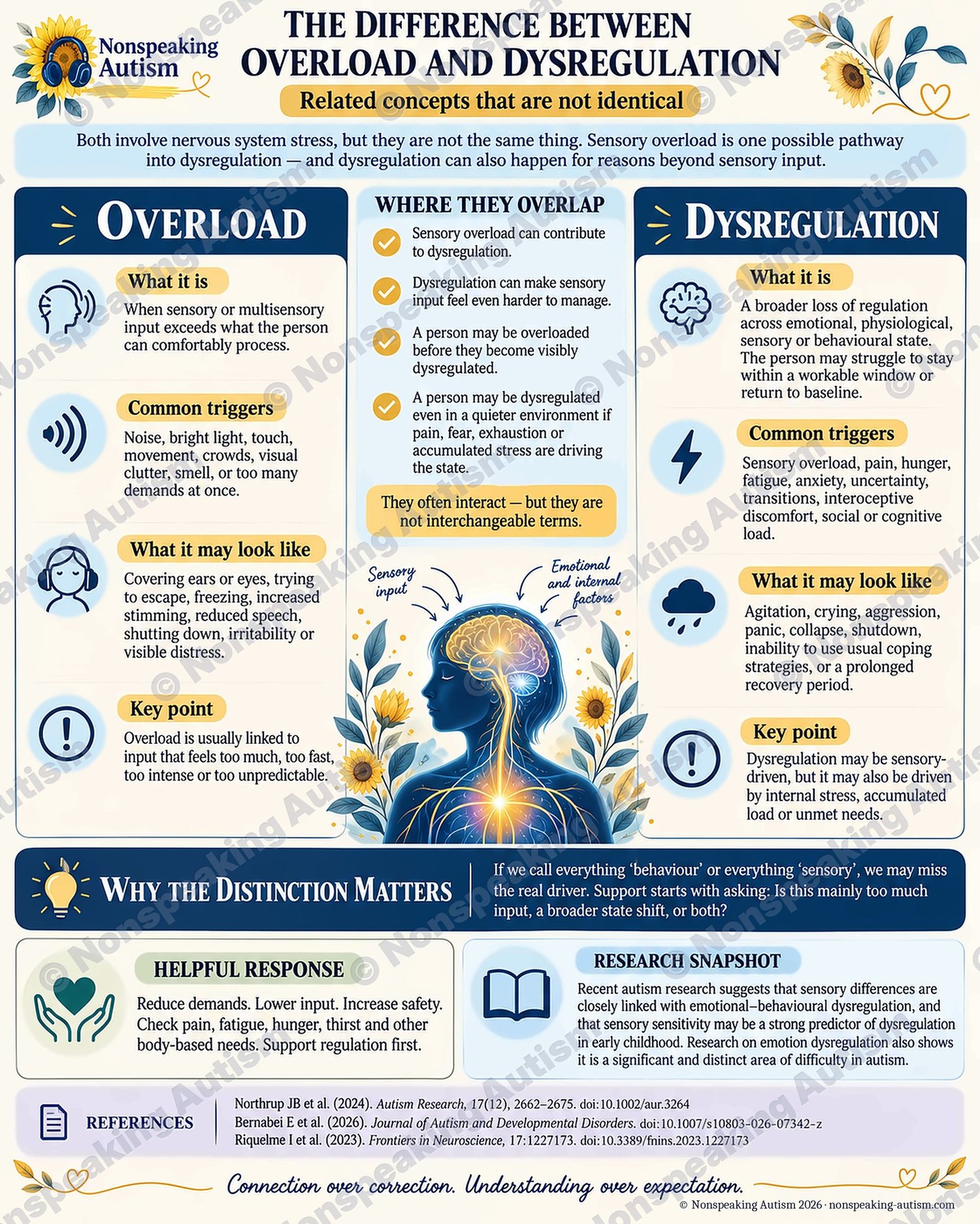
The Difference Between Overload and Dysregulation is an illustrated educational poster designed to help parents, carers, educators and professionals recognise the differences between sensory overload and broader difficulties with regulation.
The resource explores what each concept means, where they overlap, possible contributing factors, how distress may appear and what adults can do to provide compassionate, individualised support.
Rather than treating every difficult moment as a behavioural problem or assuming that all distress is sensory, this poster encourages adults to look at the child's experience and environment.
The central message:
Sensory overload may contribute to dysregulation, but dysregulation can also occur for reasons beyond sensory input.
🧠 WHAT THIS POSTER EXPLORES
🌿 1. Understanding Sensory Overload
Sensory overload describes an experience in which sensory or multisensory input becomes more than a person can comfortably manage.
For some autistic children, ordinary environments may involve intense or competing sensory information.
Possible contributors include:
- Loud or unpredictable sounds.
- Bright or flickering lighting.
- Unwanted touch.
- Movement and crowded spaces.
- Strong smells.
- Busy visual environments.
- Several sensory demands occurring together.
A child experiencing sensory overload may cover their ears or eyes, attempt to escape an environment, freeze, become quieter, stim more frequently or show visible distress.
Important: These responses are not unique to sensory overload and cannot independently establish its cause.
💙 2. Understanding Dysregulation
Dysregulation is a broader term used to describe difficulty maintaining or returning to a manageable emotional, physiological or behavioural state.
A child may experience heightened distress, agitation, withdrawal or difficulty accessing their usual coping strategies.
Possible contributors include:
- Sensory overload.
- Pain or illness.
- Hunger or thirst.
- Fatigue and poor sleep.
- Anxiety or fear.
- Uncertainty.
- Difficult transitions.
- Interoceptive discomfort.
- Social or cognitive demands.
- Accumulated stress.
Dysregulation may occur even when the immediate environment is relatively quiet.
Possible outward signs include crying, agitation, panic, withdrawal, shutdown, physical outbursts or a prolonged need for recovery.
These signs are not diagnostic, and no single behaviour proves dysregulation.
🌻 WHERE OVERLOAD AND DYSREGULATION OVERLAP
The poster highlights four important connections.
1. Sensory overload may contribute to dysregulation.
Intense or competing sensory demands may increase distress and make regulation more difficult.
2. Dysregulation may make sensory input harder to manage.
When a child is already tired, anxious or distressed, sensory experiences may become more difficult to tolerate.
3. Overload may occur before visible dysregulation.
A child may experience increasing sensory discomfort without immediately showing obvious outward signs.
4. Dysregulation may occur without sensory overload.
Pain, emotional distress, uncertainty or accumulated demands may contribute even when sensory input is not the main difficulty.
These experiences often interact, but they are not interchangeable terms.
💛 WHY THE DISTINCTION MATTERS
When adults describe every difficult moment as a behaviour problem, they may overlook sensory or physical needs.
However, assuming every difficult moment is caused by sensory overload may also lead to important factors being missed.
For example:
A child covering their ears in a noisy classroom may be experiencing uncomfortable auditory input.
A child becoming distressed in a quiet room may be experiencing pain, fatigue, anxiety or another unmet need.
A child who has coped with several difficult transitions may need recovery even after reaching a calmer environment.
These are possibilities, not conclusions that can be drawn from behaviour alone.
Understanding the difference can help adults ask more useful questions:
- Is sensory input contributing?
- Is the child experiencing a broader state of distress?
- Could pain, illness or fatigue be involved?
- Have demands accumulated?
- What is the child communicating?
- What support has helped before?
- Could several factors be interacting?
Support begins with understanding the context, not assigning a label based only on outward behaviour.
🌿 PRACTICAL WAYS TO SUPPORT THE CHILD
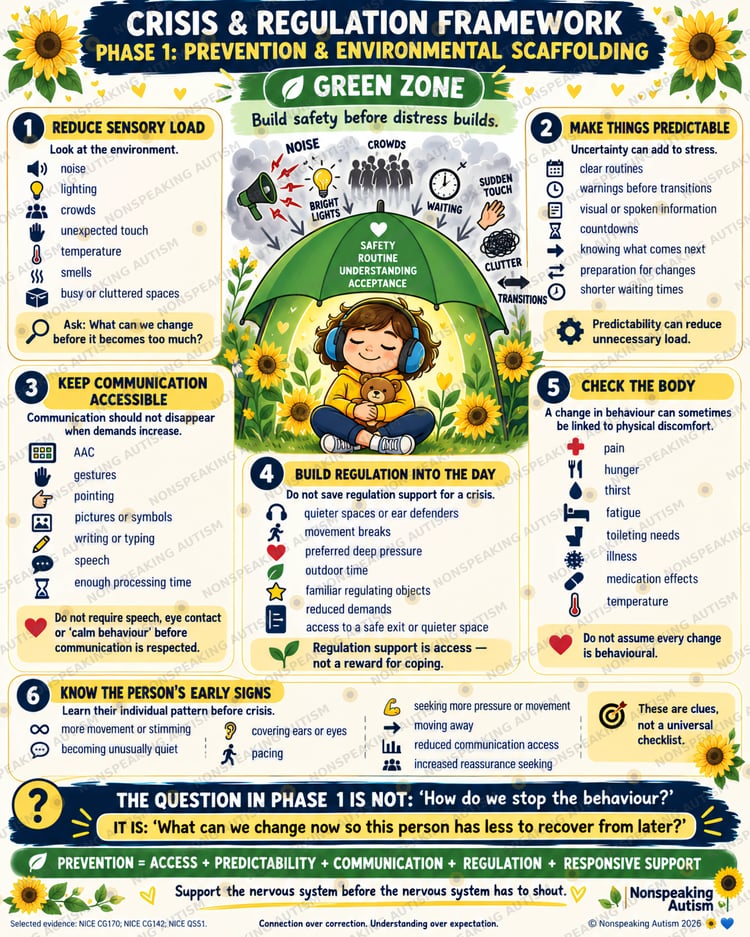
1. Reduce Unnecessary Sensory Input
Where sensory input may be contributing, consider:
- Lowering noise.
- Adjusting lighting.
- Reducing crowding.
- Providing a quieter space.
- Respecting sensory preferences.
- Offering appropriate sensory supports chosen by the child.
2. Reduce Demands
During distress, repeated questions, instructions and expectations may increase pressure.
Use calm, clear communication and allow processing time.
3. Increase Predictability and Safety
Familiar routines, accessible explanations and visual supports may help some children manage uncertainty.
However, no single strategy works for everyone.
4. Check Physical Needs
Consider whether the child may be experiencing:
- Pain or illness.
- Hunger or thirst.
- Constipation or digestive discomfort.
- Fatigue.
- Temperature-related discomfort.
- Other unmet health needs.
Seek medical advice when symptoms are new, persistent, severe or unexplained.
5. Support Communication
Keep familiar AAC, visual supports and other communication methods accessible.
Respect gestures, movement, facial expression, speech and other forms of communication.
Do not assume a child understands less simply because they cannot respond during distress.
6. Allow Recovery
A child may need time to recover after intense sensory or emotional demands.
Offer rest, reduced expectations, preferred movement or other personally helpful supports.
Regulation support should be individualised, voluntary where possible and responsive to the child's needs.
WHAT ADULTS SHOULD AVOID ASSUMING
“All distress is sensory overload.”
Sensory input is only one possible contributing factor.
“If the room is quiet, the child should be regulated.”
Pain, anxiety, fatigue and other internal or accumulated demands may still be present.
“The child is choosing to be difficult.”
Outward distress does not automatically establish deliberate refusal or intent.
“One sensory strategy will solve the problem.”
Different children have different preferences, needs and responses to support.
“If the child looks calm, they must feel comfortable.”
Internal discomfort may not always be visible.
🔬 RESEARCH-INFORMED UNDERSTANDING
Autism research has identified associations between sensory processing differences and emotional or behavioural regulation difficulties.
Studies also suggest that sensory sensitivity and emotional dysregulation may be related, particularly during childhood.
However, association does not establish that sensory overload causes every episode of dysregulation.
Emotional regulation is a broader area of research involving multiple interacting factors.
The terms sensory overload and dysregulation are used in clinical, educational and everyday contexts, but their definitions and measurement can vary between studies.
This poster therefore uses simplified working descriptions to explain their differences and overlap.
It does not claim that every autistic child experiences the same physiological response or that an outward behaviour reveals a specific neurological mechanism.
📚 SELECTED RESEARCH REFERENCES
1. Northrup, J. B., et al. (2024).
Autism Research, 17(12), 2662–2675.
DOI: https://doi.org/10.1002/aur.3264
2. Bernabei, E., et al. (2026).
Journal of Autism and Developmental Disorders.
DOI listed on the poster: https://doi.org/10.1007/s10803-026-07342-z
3. Riquelme, I., et al. (2023).
Frontiers in Neuroscience, 17, 1227173.
DOI: https://doi.org/10.3389/fnins.2023.1227173
Further Resources • National Autistic Society – Sensory differences: https://www.autism.org.uk/advice-and-guidance/topics/sensory-differences • National Autistic Society – Meltdowns: https://www.autism.org.uk/advice-and-guidance/topics/behaviour/meltdowns • Riquelme et al. (2023) – full paper, free to read: https://www.frontiersin.org/journals/neuroscience/articles/10.3389/fnins.2023.1227173/pdf Research & References Research Snapshot / Overload – sensory sensitivity and dysregulation: • Bernabei, E., Scatigna, S., Pecini, C., Balconi, M., Apicella, F., Cagiano, R., Costanzo, V., Frediani, C., Igliozzi, R., Mancini, A., Mazzone, B., Paoli, L., Tancredi, R., & Calderoni, S. (2026). Brief report: Associations between early sensory processing and emotional-behavioral dysregulation in autistic toddlers. Journal of Autism and Developmental Disorders. https://doi.org/10.1007/s10803-026-07342-z • Riquelme, I., et al. (2023). A multidimensional investigation of the relationship between skin-mediated somatosensory signals, emotion regulation and behavior problems in autistic children. Frontiers in Neuroscience, 17, 1227173. https://doi.org/10.3389/fnins.2023.1227173 Dysregulation – emotion dysregulation in autism: • Northrup, J. B., Hartman, A. G., MacKenzie, K. T., Sivathasan, S., Eldeeb, S., & Mazefsky, C. A. (2024). Emotion dysregulation in autism: Severity and correlates in early childhood. Autism Research, 17(12), 2662–2675. https://doi.org/10.1002/aur.3264 Foundational references (printed on the poster): Northrup et al. (2024) • Bernabei et al. (2026) • Riquelme et al. (2023)
📖 IMPORTANT RESEARCH LIMITATION
These references are reproduced from the poster and should receive a final bibliographic check against the original publications before the listing is published.
The poster is a simplified educational comparison, not a validated clinical assessment.
Research findings do not establish that every sensory difference leads to dysregulation or that all emotional and behavioural difficulties in autism are sensory-driven.
Individual context, communication, physical health and personal experience remain essential.
Sources:
👨👩👧 WHO IS THIS RESOURCE FOR?
This educational poster may be useful for:
- Parents and carers of autistic children.
- Families of nonspeaking and minimally speaking children.
- Autistic young people exploring their own experiences.
- Mainstream and specialist school staff.
- SENCOs and SEND teams.
- Teaching assistants and learning support workers.
- Occupational therapists.
- Speech and language therapists.
- Educational psychologists.
- Autism support workers.
- Paediatric and community professionals.
- Parent and carer support groups.
- Staff training and professional development.
It may help support discussions about reasonable adjustments, individual sensory preferences, communication access and approaches to distress.
🏫 HOW THIS POSTER CAN BE USED
At home: To help families consider sensory, emotional and physical factors when a child experiences distress.
In schools: To encourage staff to look beyond behaviour and consider whether environmental adjustments, reduced demands or other support may be needed.
In therapy rooms: As a visual discussion aid for exploring sensory experiences and regulation needs.
During SEND training: To explain why sensory overload and dysregulation should not automatically be treated as identical.
In community settings: To encourage greater understanding of individual needs and reduce misconceptions about autistic distress.
📦 WHAT YOU RECEIVE
1 × The Difference Between Overload and Dysregulation — UK Educational Poster
The poster includes:
- A side-by-side comparison of sensory overload and dysregulation.
- Definitions and common contributing factors.
- Possible outward signs.
- An explanation of where the two concepts overlap.
- Why the distinction matters.
- Practical support considerations.
- A research snapshot.
- Selected references.
- Nonspeaking Autism illustrations and branding.
Edition: UK English.
Format: Printable digital educational poster.
Print size: Please confirm the final PDF dimensions before advertising a specific print size.
Watermarks: The Payhip listing preview contains copyright watermarks. The purchased version should be supplied as a clear, unwatermarked PDF.
Digital download only — no physical product will be shipped.
⚠️ IMPORTANT EDUCATIONAL DISCLAIMER
This resource is intended for educational and informational purposes only.
It is not a diagnostic tool, validated sensory assessment, clinical regulation measure, treatment programme or substitute for individualised professional advice.
Sensory overload and dysregulation are complex experiences that may involve several interacting factors.
No single behaviour can reliably identify the underlying cause of distress.
Sudden, severe, persistent or unexplained changes in behaviour or wellbeing should prompt consideration of medical and other professional assessment.
Support strategies should respect the person's communication, safety, dignity, preferences and individual needs.
©️ COPYRIGHT & PERMITTED USE
Copyright © 2026 Nonspeaking Autism. All rights reserved.
Permitted Use
Purchasers may print and publicly display this poster in:
- Homes and family settings.
- Classrooms and educational settings.
- Therapy rooms and clinical environments.
- Workplaces and professional training spaces.
- Community and support settings.
Printed copies may be used for educational discussion, awareness and staff development.
Not Permitted
Without prior written permission, purchasers may not:
- Resell or redistribute the digital PDF.
- Share the purchased digital file with third parties.
- Upload the poster to public websites or shared download platforms.
- Edit, rebrand or remove copyright information.
- Include the digital artwork in another commercial resource.
- Reproduce the design for resale.
Copyright and ownership remain with Nonspeaking Autism.
💛 THE MESSAGE BEHIND THIS RESOURCE
A child may be overwhelmed by sound, light or movement.
Another child may be distressed because they are tired, anxious, in pain or managing too many demands.
Sometimes both experiences occur together.
And sometimes the child may not be able to explain what is happening internally.
The outward behaviour alone does not tell us the whole story.
Instead of assuming that every difficulty is sensory or every difficulty is behavioural, we can look more carefully.
We can reduce unnecessary demands.
We can consider physical health.
We can protect communication access.
We can offer time, safety and individualised support.
Understanding the difference helps us respond to the person, not just the visible behaviour.
🌻 Connection over correction. Understanding over expectation.
Nonspeaking Autism © 2026
Different needs. Equal belonging.