

The Science Behind: Why Some Autistic Individuals Seek Palm & Forearm Pressure
The Science Behind: Why Some Autistic Individuals Seek Palm & Forearm Pressure
What Sensory Neuroscience Can — and Cannot — Tell Us
A Research-Informed Educational Poster
Pressing the palms together, pushing against a wall, leaning heavily onto a surface or applying pressure through the hands and forearms can provide strong tactile and proprioceptive input.
For some autistic people, self-generated pressure may feel predictable, grounding, organizing or helpful during periods of sensory overload, concentration, waiting or heightened arousal.
But there is an important distinction:
We can describe the sensory input a movement provides without assuming we know exactly why an individual is doing it.
The Science Behind: Why Some Autistic Individuals Seek Palm & Forearm Pressure is a research-informed educational poster from Nonspeaking Autism designed to explain the sensory systems involved while keeping the interpretation individualized and evidence-aware.
The central question is not simply:
“How do I stop it?”
but:
“What might this input be doing for their body and nervous system?”
🖐️ What Is Palm & Forearm Pressure?
Actions such as:
- pressing the palms together
- pushing against a wall
- pressing the hands into a firm surface
- leaning through the arms
- applying sustained pressure through the hands or forearms
can create substantial sensory feedback.
This may involve both:
✋ Tactile Input
Information from receptors associated with touch and pressure.
💪 Proprioceptive Input
Information from muscles, tendons and joints that contributes to awareness of body position, movement and force.
These sensory systems work together with wider nervous-system processes.
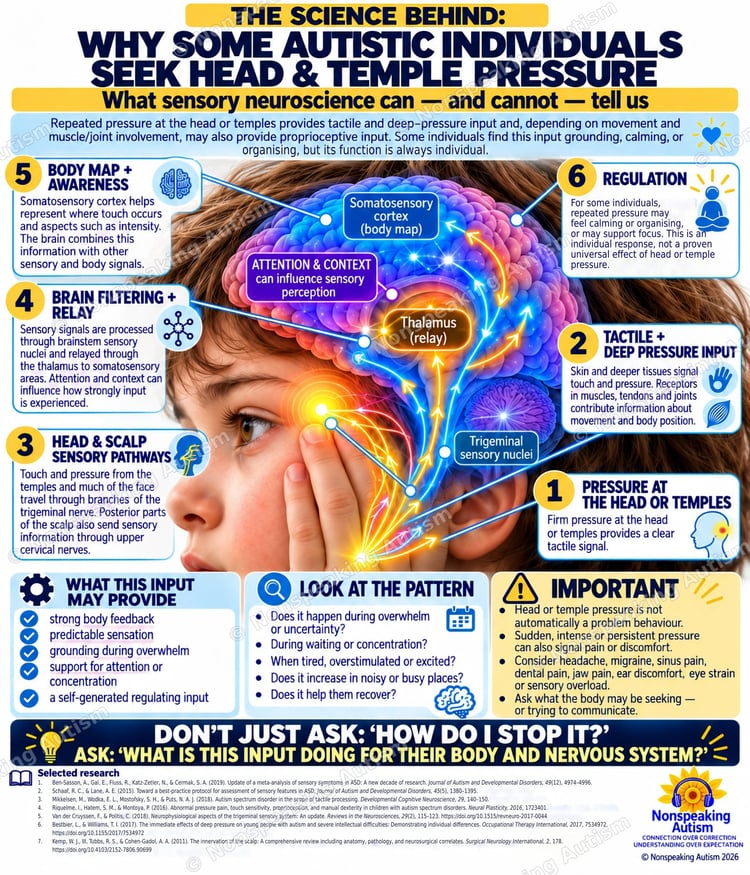
1️⃣ Pressure Through the Palms & Forearms
Firm, self-generated pressure can provide clear tactile and proprioceptive information.
An important feature is that the person is generating the action themselves.
This can make the sensory experience relatively predictable and controllable compared with unexpected touch from somebody else.
That does not mean palm pressure has the same purpose for everyone.
For one person it may feel pleasant.
For another it may accompany concentration.
Another person may use it when overwhelmed.
And sometimes a similar action may occur because something hurts.
The movement alone does not tell us its meaning.
2️⃣ Tactile & Proprioceptive Input
The nervous system receives information about touch, pressure, movement and body position through sensory receptors distributed throughout the body.
Information from the skin contributes to tactile perception, while receptors associated with muscles, tendons and joints contribute to proprioception.
These signals are processed across interconnected sensory and motor systems.
This helps us understand what kind of sensory information an action provides.
It does not prove why a particular autistic person seeks that action.
3️⃣ Arm & Hand Sensory Pathways
Sensory information from the hands and forearms travels through peripheral nerves and the spinal cord towards sensory-processing regions of the brain.
These pathways contribute to awareness of:
touch • pressure • body position • movement • force
The neurological illustration on the poster is intentionally simplified.
The actual nervous system involves complex interacting pathways rather than one single line travelling from the hand to one isolated area of the brain.
4️⃣ Brain Filtering, Relay & Context
The thalamus is involved in relaying and processing much sensory information, while cortical and other brain systems contribute to perception, attention and interpretation.
Context matters too.
The same sensory input may feel different depending on:
- whether it was expected
- whether the person chose it
- current stress or arousal
- competing sensory input
- pain or fatigue
- attention
- previous experiences
- the environment
Sensory experience is not determined by the stimulus alone.
5️⃣ Body Map & Awareness
The somatosensory cortex contributes to the brain's representation and processing of sensory information from different areas of the body.
This includes information relevant to where touch occurs and aspects of its characteristics.
But the experience of touch is not produced by the somatosensory cortex alone.
Perception reflects activity across multiple interacting neural systems.
The brain image in this resource is therefore an educational representation rather than a literal map of what occurs when an autistic person presses their palms together.
6️⃣ Regulation — What Can We Say?
Some individuals report or appear to use repeated self-generated sensory input as part of their regulation.
For a particular person, pressure may be experienced as:
grounding
organizing
focusing
predictable
or simply pleasant.
However, current research does not establish that palm or forearm pressure produces a universal neurological “calming effect” in autistic people.
Responses to pressure and other sensory input are individualized.
What regulates one person may be neutral or uncomfortable for another.
⚙️ What Might This Input Provide?
Depending on the individual, palm or forearm pressure may provide:
- strong body feedback
- predictable sensory input
- an activity used during overwhelm
- support during concentration
- a self-generated sensory experience
- proprioceptive and tactile information
These are possibilities to explore, not meanings to automatically assign.
🔍 Look at the Pattern
Instead of interpreting the movement in isolation, look at when and where it occurs.
Ask:
Does it happen during overwhelm or uncertainty?
Does it happen while waiting or concentrating?
Does it increase when the person is tired, overstimulated or excited?
Is it more common in noisy, crowded or unpredictable environments?
Does the person appear to seek it voluntarily?
Does it seem to help them continue an activity or recover?
Can the person communicate what it feels like or why they do it?
Repeated observations across contexts may be more informative than one isolated incident.
❤️ Don't Forget Pain & Physical Comfort
Not every repeated pressure behaviour is sensory seeking.
Sudden, intense, persistent or significantly changed hand/arm pressure may warrant consideration of physical discomfort.
Possible issues could include:
- wrist pain
- hand pain
- joint discomfort
- muscle soreness
- fatigue
- injury
- other physical or neurological concerns
A new behaviour should not automatically be attributed to autism.
Check the body as well as the sensory environment.
🚫 Should We Stop It?
If a self-generated sensory behaviour is harmless and appears comfortable, there may be no reason to stop it simply because it looks unusual.
Instead, consider:
Is it safe?
Is the person comfortable?
Is it causing injury?
Is it interfering with something the person wants or needs to do?
Is there a physical-health concern?
Is the person choosing the input?
The goal should not be to make an autistic person appear less autistic.
Support should focus on comfort, safety, autonomy and participation.
🧠 Deep Pressure: An Important Evidence Distinction
Deep-pressure interventions are sometimes discussed alongside proprioceptive or tactile regulation.
Research has reported beneficial responses for some autistic people, but results vary substantially between individuals and studies.
For example, a small 2017 study examining deep pressure in young people with autism and severe intellectual disabilities reported immediate benefits for some participants while also emphasizing individual differences.
This evidence should not be used to claim that palm pressing has been proven to calm the autistic nervous system.
Self-generated palm pressure and externally applied deep-pressure interventions are not necessarily equivalent.
Individual response matters.
🔬 Research-Informed
The scientific literature supports several broader principles behind this poster:
Sensory-processing differences are common in autism, but their presentation is highly heterogeneous.
Tactile processing can differ between autistic and non-autistic groups.
Proprioception, touch and motor function interact in complex ways.
And responses to deep-pressure input vary considerably between individuals.
What research cannot currently tell us is that one specific movement — such as pressing the palms together — has one universal neurological purpose in autistic people.
That distinction is central to this resource.
📚 Selected Research & References
Ben-Sasson, A., Gal, E., Fluss, R., Katz-Zetler, N., & Cermak, S. A. (2019). Update of a Meta-analysis of Sensory Symptoms in ASD: A New Decade of Research. Journal of Autism and Developmental Disorders, 49(12), 4974–4996. DOI: 10.1007/s10803-019-04180-0.
Schaaf, R. C., & Lane, A. E. (2015). Toward a Best-Practice Protocol for Assessment of Sensory Features in ASD. Journal of Autism and Developmental Disorders, 45(5), 1380–1395. DOI: 10.1007/s10803-014-2299-z.
Mikkelsen, M., Wodka, E. L., Mostofsky, S. H., & Puts, N. A. J. (2018). Autism spectrum disorder in the scope of tactile processing. Developmental Cognitive Neuroscience, 29, 140–150. DOI: 10.1016/j.dcn.2016.12.005.
Riquelme, I., Hatem, S. M., & Montoya, P. (2016). Abnormal Pressure Pain, Touch Sensitivity, Proprioception, and Manual Dexterity in Children with Autism Spectrum Disorders. Neural Plasticity, 2016, 1723401. DOI: 10.1155/2016/1723401.
Bestbier, L., & Williams, T. I. (2017). The Immediate Effects of Deep Pressure on Young People with Autism and Severe Intellectual Difficulties: Demonstrating Individual Differences. Occupational Therapy International, 2017, 7534972. DOI: 10.1155/2017/7534972.
🔎 Evidence Note
These references support the broader sensory-neuroscience principles presented in this resource.
They do not prove that palm or forearm pressure has a specific regulatory function for every autistic person, nor do they establish the poster's illustrated pathway as a validated mechanism for this particular behaviour.
The brain and nervous-system diagrams are simplified educational illustrations.
This poster deliberately distinguishes between:
what sensory neuroscience can reasonably explain
and
what we cannot infer about an individual from observation alone.
👨👩👧 Who Is This Resource For?
This poster may be useful for:
- autistic people and their families
- parents and carers
- teachers and teaching assistants
- SENCOs and SEND teams
- mainstream and specialist schools
- occupational therapists
- physiotherapists
- speech and language therapists
- psychologists
- healthcare professionals
- support workers
- social-care teams
- autism and disability organisations
It can support parent/carer education, staff training, professional reflection and conversations about individualized sensory support.
📦 What You Receive
Your purchase includes:
1 × The Science Behind: Why Some Autistic Individuals Seek Palm & Forearm Pressure educational poster
1 × high-resolution printable digital PDF
The purchased file is supplied clear and without the promotional preview watermark shown on the Payhip listing image.
Watermarks visible on preview images are used for copyright and listing protection only.
Digital download only — no physical product will be shipped.
⚠️ Important Disclaimer
This is a research-informed educational resource.
It is not medical advice, diagnosis, occupational therapy assessment, sensory assessment, neurological assessment, pain assessment, behaviour assessment or an individualized treatment programme.
The possible functions described are examples for consideration, not established explanations for an individual's behaviour.
Sensory strategies should be individualized, voluntary and safe. Deep pressure or other sensory input should never be forced simply because it is assumed to be regulating.
New, painful, severe, persistent or unexplained changes involving the hands, wrists, arms, movement, strength or sensation should receive appropriate medical or professional assessment where indicated.
©️ Copyright & Permitted Use
Copyright © 2026 Nonspeaking Autism. All rights reserved.
Purchase permits use for personal/home use, your own classroom or educational setting, your own clinic or individual professional educational practice, and direct educational/support work with people you support.
The digital file may not be resold, redistributed, file-shared, uploaded elsewhere, commercially reproduced, altered for resale or incorporated into another product for sale or distribution.
💛 The Message Behind the Resource
When we see a repeated movement, it can be tempting to immediately ask:
“How do we stop it?”
But observation alone cannot tell us whether a movement is providing useful sensory feedback, supporting concentration, accompanying overload, expressing discomfort — or simply feels good.
So first, stay curious.
Look at the pattern.
Listen to the person.
Check the environment.
Check the body.
Respect harmless self-directed regulation.
And seek assessment when something is painful, new or concerning.
Don't just ask: “How do I stop it?”
Ask: “What might this input be doing for their body and nervous system?”
Connection over correction. Understanding over expectation. 💙🌻
© Nonspeaking Autism 2026