
💙 FEELINGS BEFORE WORDS
💙 FEELINGS BEFORE WORDS
Understanding Emotions, Body Signals & Communication in Autism
UK Edition | Research-Informed Autism, Interoception & AAC Educational Poster | Nonspeaking Autism
🌻 A child may feel deeply without being able to tell you how.
A child may experience fear, excitement, sadness, frustration, happiness or discomfort without being able to identify, explain or communicate those feelings through spoken words.
They may notice a racing heartbeat without knowing what it means.
They may feel tension in their body without being able to name the emotion associated with it.
They may understand what is happening but need additional time or support to express themselves.
For some autistic people, differences in interoception, emotional awareness, language processing, motor access or communication can make recognising and expressing feelings more complex.
But difficulty communicating an emotion does not mean the emotion is absent.
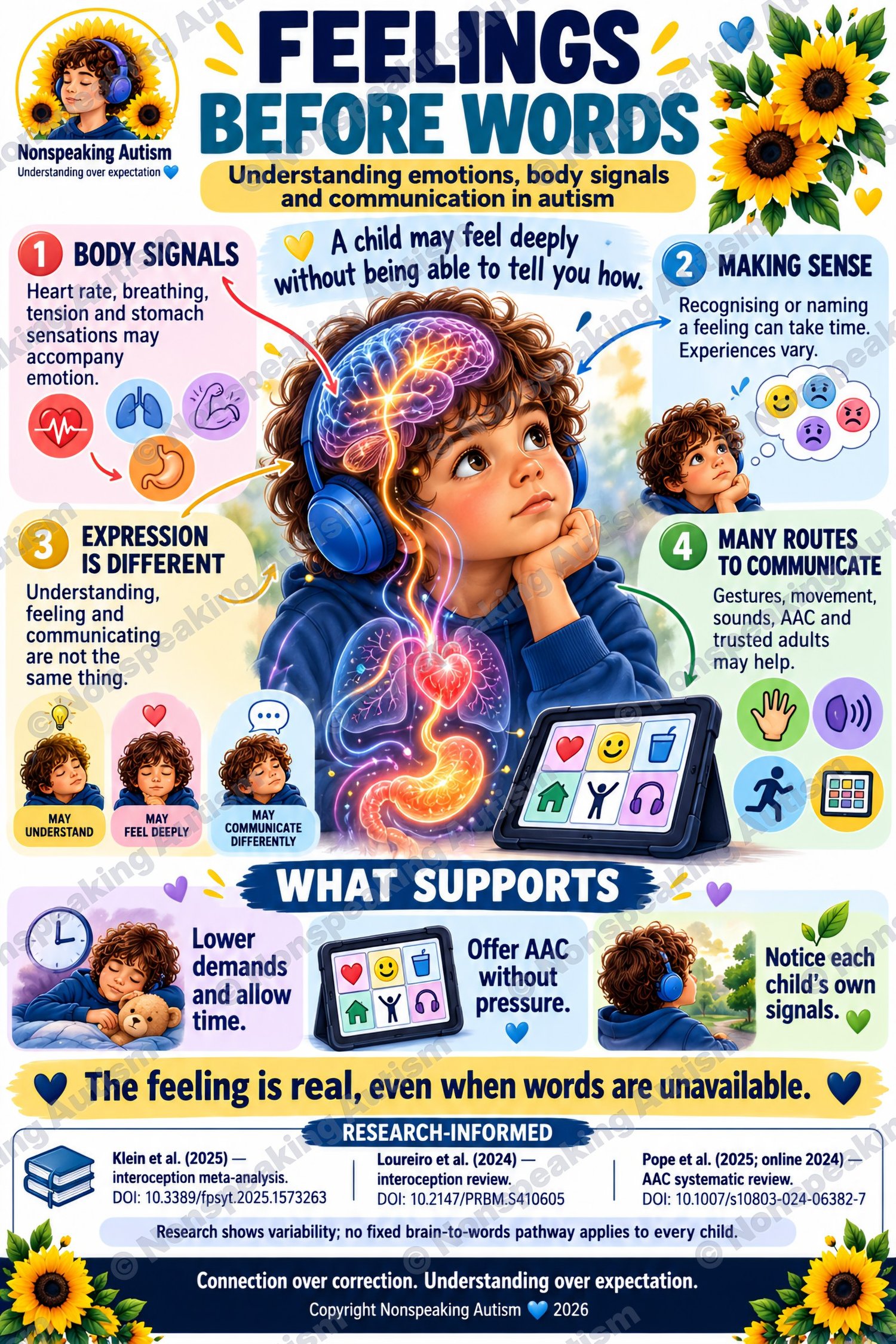
Feelings Before Words is an illustrated, research-informed educational poster designed to help families, teachers and professionals understand the relationship between body signals, emotional awareness and communication in autism.
It encourages adults to recognise individual communication patterns, reduce pressure and provide accessible ways for children to express themselves.
The central message:
The feeling is real, even when words are unavailable.
🧠 UNDERSTANDING EMOTIONS, BODY SIGNALS & COMMUNICATION
Emotions can involve interacting experiences, including:
- Internal bodily sensations
- Thoughts and interpretations
- Changes in attention
- Feelings of comfort or discomfort
- Facial expressions or movements
- Communication and behaviour
For example, anxiety may be accompanied by changes in breathing, heartbeat or muscle tension.
Excitement may also involve a faster heartbeat.
This means that one body signal does not reliably identify one particular emotion.
Some autistic people may notice internal sensations clearly, while others may find them subtle, confusing or difficult to interpret.
Some may recognise how they feel but struggle to express it through speech.
Others may communicate emotions through AAC, gesture, movement, facial expression, writing or other preferred methods.
Emotional experience, emotional awareness and emotional expression are related, but they are not identical.
🌈 WHAT THIS POSTER EXPLORES
1. ❤️ BODY SIGNALS — WHAT THE BODY MAY BE COMMUNICATING
Emotions may be accompanied by physical sensations.
The poster highlights:
Heart rate
A heartbeat may become faster or more noticeable during excitement, fear, exertion or other experiences.
Breathing
Breathing patterns may change with activity, stress or emotional arousal.
Muscle tension
A person may notice tightness, stiffness or changes in physical comfort.
Stomach sensations
Nausea, butterflies, discomfort or changes in appetite may accompany some emotional experiences.
These signals can also reflect physical needs, illness, pain, medication effects or ordinary bodily processes.
They should not automatically be interpreted as emotional symptoms.
Understanding Interoception
Interoception refers to processes involved in sensing and interpreting internal bodily conditions.
Some autistic people experience differences in aspects of interoceptive awareness.
However, research findings vary, and no single interoceptive profile applies to all autistic people.
Body signals provide information, but they do not always tell us exactly what a person is feeling.
2. MAKING SENSE — RECOGNISING AND NAMING FEELINGS
Recognising or naming an emotion may take time.
A child may notice discomfort but not know whether it relates to:
- Anxiety
- Excitement
- Hunger
- Pain
- Tiredness
- Sensory overload
- Uncertainty
- Several experiences happening together
Some people experience difficulty identifying or describing emotions, sometimes discussed in relation to alexithymia.
Alexithymia can occur in autistic and non-autistic people.
It is not synonymous with autism, and it does not mean that someone lacks emotions.
A person can experience an emotion without being able to name it immediately.
3. 💙 EXPRESSION IS DIFFERENT FROM UNDERSTANDING
The poster emphasises an important distinction:
Understanding, feeling and communicating are not the same thing.
A child may:
- Understand a situation
- Experience a strong emotional response
- Have difficulty identifying the feeling
- Know how they feel but struggle to communicate it
- Need additional time to respond
- Use communication methods other than speech
A child who does not answer “How are you feeling?” may still have a clear internal emotional experience.
Silence or an unusual outward response should not automatically be interpreted as a lack of understanding.
At the same time, adults should avoid assuming they know precisely what a child feels without seeking their perspective.
The goal is to make emotional communication accessible, not to demand a particular form of expression.
4. 💬 MANY ROUTES TO COMMUNICATE
The poster recognises that emotions may be communicated in different ways.
These can include:
Gestures
Pointing, reaching, signing or using other familiar movements.
Movement
Moving towards or away from something, changing posture or seeking space.
Sounds
Vocalisations, changes in tone or other sounds that may carry meaning for the individual.
AAC
Communication boards, symbols, tablets, speech-generating devices, typing or other augmentative and alternative communication methods.
Trusted Adults
Responsive adults can help by noticing patterns, offering choices and providing time without assuming the meaning of every response.
A person's preferred communication method should be respected.
Speech is not a requirement for emotional expression, and AAC should never be withheld because a child is distressed.
🌻 WHAT SUPPORTS EMOTIONAL COMMUNICATION?
The poster introduces three practical approaches.
1. LOWER DEMANDS AND ALLOW TIME
When a child is distressed or overwhelmed, repeated questions may increase pressure.
Instead, consider:
- Reducing unnecessary demands
- Using calm, clear communication
- Allowing processing time
- Offering rest or quiet where welcomed
- Avoiding forced explanations
- Checking for physical discomfort
The child may be better able to communicate after they have had time to recover.
2. OFFER AAC WITHOUT PRESSURE
Provide access to meaningful emotional and bodily vocabulary.
Examples may include:
- Happy
- Sad
- Worried
- Angry
- Excited
- Hurt
- Tired
- Hungry
- Too loud
- I need space
- I don't know
- Stop
- Help
- I need a break
Offer AAC as a genuine communication option, not as a test.
Do not require a child to correctly identify an emotion before offering support.
3. NOTICE EACH CHILD'S OWN SIGNALS
Observe individual patterns over time.
Consider:
- What happened before the response?
- Was there a change in sensory input?
- Could the child be tired, hungry or in pain?
- Is communication accessible?
- What has the child communicated previously?
- What support does the child prefer?
- Has anything changed from their usual presentation?
Patterns can provide clues, but they are not proof of a particular emotion.
Where possible, check your interpretation with the person using their preferred communication method.
🔬 THE BRAIN, BODY AND EMOTIONS
The poster includes a conceptual illustration showing the brain and internal organs.
It represents the relationship between bodily sensations, emotional experiences and communication.
In reality, these processes involve complex interactions between:
- The central nervous system
- The autonomic nervous system
- Sensory and interoceptive pathways
- Attention and memory
- Emotional processing
- Language and communication systems
There is no single fixed neurological pathway that transforms a body signal into an emotional word for every person.
The illustration should not be interpreted as a medical scan or an exact anatomical representation.
Research can help explain possible mechanisms, but it cannot tell us what an individual child is feeling from an image or outward behaviour alone.
🏫 USING THIS RESOURCE IN UK SCHOOLS & SEND SETTINGS
This poster may support more accessible approaches to emotional communication in schools and early years settings.
It can help staff consider:
- Providing AAC for emotions and physical needs
- Allowing additional response time
- Reducing demands during distress
- Supporting emotional vocabulary without forcing labels
- Recognising different forms of communication
- Checking for pain, fatigue or sensory discomfort
- Respecting refusal and personal boundaries
- Using individual communication profiles
- Avoiding assumptions based on facial expression or speech alone
- Working collaboratively with families and relevant professionals
A pupil who cannot name an emotion may still be experiencing it intensely.
A child who becomes quiet may need time, accessible communication or additional support.
A pupil who appears calm may still be uncomfortable or distressed.
Where relevant, these needs may inform SEND support planning or an Education, Health and Care Plan (EHCP) in England.
Emotional support should not depend on a child's ability to explain their feelings in spoken words.
📚 RESEARCH & SCIENTIFIC EVIDENCE
The poster refers to research on interoception and augmentative and alternative communication.
Selected Research Printed on the Poster
Klein et al. (2025)
Research described as a meta-analysis concerning interoception in autistic individuals.
DOI: 10.3389/fpsyt.2025.1573263
Loureiro et al. (2024)
Research described as a review of interoception in autism.
DOI: 10.2147/PRBM.S410605
Pope et al. (2025; published online 2024)
Research described as a systematic review of AAC.
DOI: 10.1007/s10803-024-06382-7
- Klein, Witthöft & Jungmann (2025). Interoception in individuals with autism spectrum disorder: A systematic literature review and meta-analysis. Frontiers in Psychiatry, 16, 1573263. https://doi.org/10.3389/fpsyt.2025.1573263
- Loureiro, F., Ringold, S. M., & Aziz-Zadeh, L. (2024). Interoception in autism: A narrative review of behavioral and neurobiological data. Psychology Research and Behavior Management, 17, 1841–1853. https://doi.org/10.2147/PRBM.S410605
- Pope, L., Light, J., & Laubscher, E. (2025). The effect of naturalistic developmental behavioral interventions and aided AAC on the language development of children on the autism spectrum with minimal speech: A systematic review and meta-analysis. Journal of Autism and Developmental Disorders, 55(9), 3078–3099. https://doi.org/10.1007/s10803-024-06382-7
Reference verification note: These details are reproduced from the supplied poster. Their complete bibliographic records and the precise findings supporting individual claims have not been independently checked for this description.
SCIENTIFIC EVIDENCE NOTE
Research suggests that interoceptive experiences and communication needs vary considerably between autistic individuals.
Not all autistic people have difficulty recognising emotions, and not all nonspeaking people have difficulties with emotional awareness.
AAC can provide important communication access, but a person's needs, preferences and suitable access methods should be individually assessed.
This poster is educational and is not a validated measure of interoception, alexithymia, emotional understanding or communication ability.
👨👩👧 WHO IS THIS RESOURCE FOR?
This educational poster may be useful for:
- Parents and carers
- Autistic children, young people and adults
- Families supporting nonspeaking autistic people
- Teachers and teaching assistants
- SENCOs and SEND teams
- Speech and language therapists
- Occupational therapists
- AAC specialists
- Educational psychologists
- Early years practitioners
- Family support workers
- Professionals supporting emotional communication and regulation
It may be displayed in homes, classrooms, SEND support areas, therapy rooms, AAC assessment settings and professional training spaces.
📦 WHAT YOU RECEIVE
PAID DIGITAL DOWNLOAD — INDIVIDUAL POSTER
Your purchase includes:
1 × Feelings Before Words — Understanding Emotions, Body Signals & Communication in Autism
The poster features:
- Body signals that may accompany emotion
- Interoception and internal bodily awareness
- Recognising and naming feelings
- Differences between feeling, understanding and expression
- Alternative ways to communicate
- AAC and emotional vocabulary
- Practical support strategies
- A conceptual brain–body illustration
- Selected research references
- Nonspeaking Autism illustrated design
The product preview contains promotional watermarks.
The final purchased printable file should be supplied without these preview watermarks.
Digital download only — no physical poster will be posted.
Exact print dimensions and resolution should be confirmed against the final downloadable file.
⚠️ IMPORTANT DISCLAIMER
This poster is intended for educational and informational purposes only.
It does not provide a diagnosis, medical assessment, psychological assessment, speech and language therapy assessment or individualised treatment plan.
Body signals such as changes in heart rate, breathing, muscle tension or stomach sensations can have emotional and non-emotional causes.
Do not assume that physical symptoms are caused by anxiety, autism or emotional distress without considering possible health concerns.
Sudden, severe or unexplained physical symptoms should receive appropriate medical attention.
Communication and emotional support should be individualised, respectful and guided by the person's needs and preferences.
©️ COPYRIGHT & PERMITTED USE
Copyright © 2026 Nonspeaking Autism. All rights reserved.
Purchase permits personal, family, classroom, school and individual professional educational use.
You may print the poster for these purposes.
You may not:
- Resell the poster or digital file
- Redistribute the purchased file
- Upload it to another website or digital platform
- Remove branding and claim the artwork as your own
- Reproduce it commercially
- Include it in another product for resale without permission
Please share the original Payhip listing rather than distributing the purchased file.
💛 THE MESSAGE BEHIND THIS RESOURCE
A child may feel frightened without knowing how to explain it.
A child may feel excited without being able to name the sensation.
A child may experience pain, sadness or overwhelm without having access to the words needed to communicate it.
A child may understand far more than they can express through speech.
And a child who appears quiet may still be experiencing powerful emotions.
We can offer time.
We can reduce pressure.
We can provide AAC.
We can notice individual signals.
And we can make space for communication in all its forms.
A feeling does not become less real because it cannot be spoken.
The feeling is real, even when words are unavailable.
🌻 Connection over correction. Understanding over expectation. 💙
Nonspeaking Autism © 2026