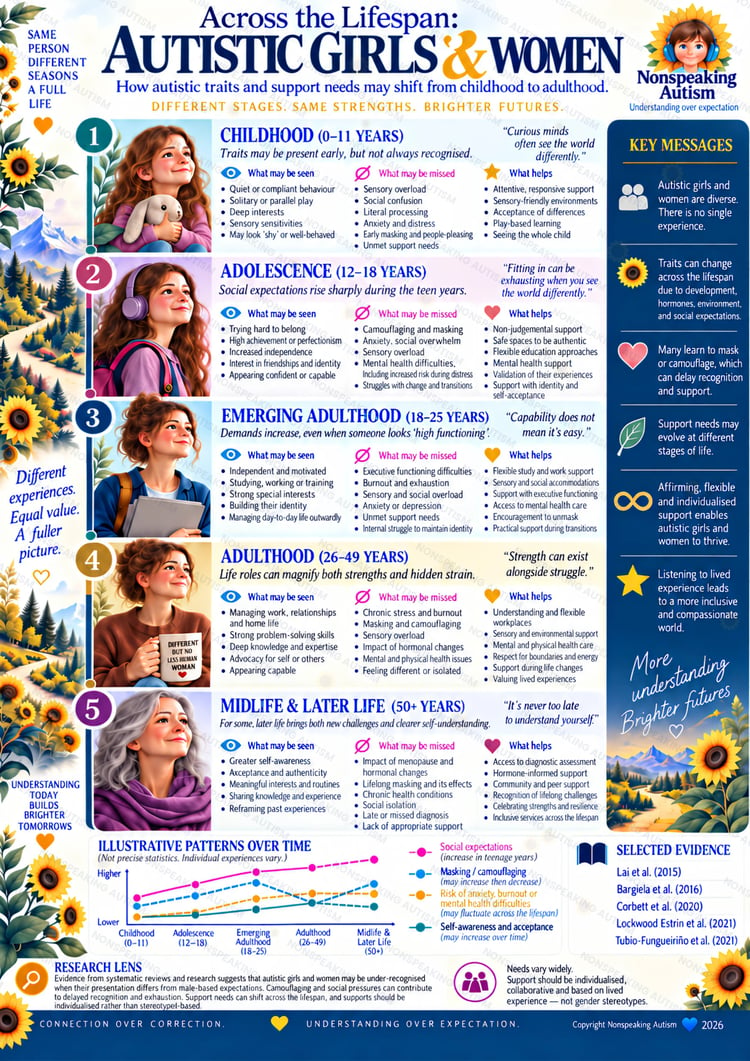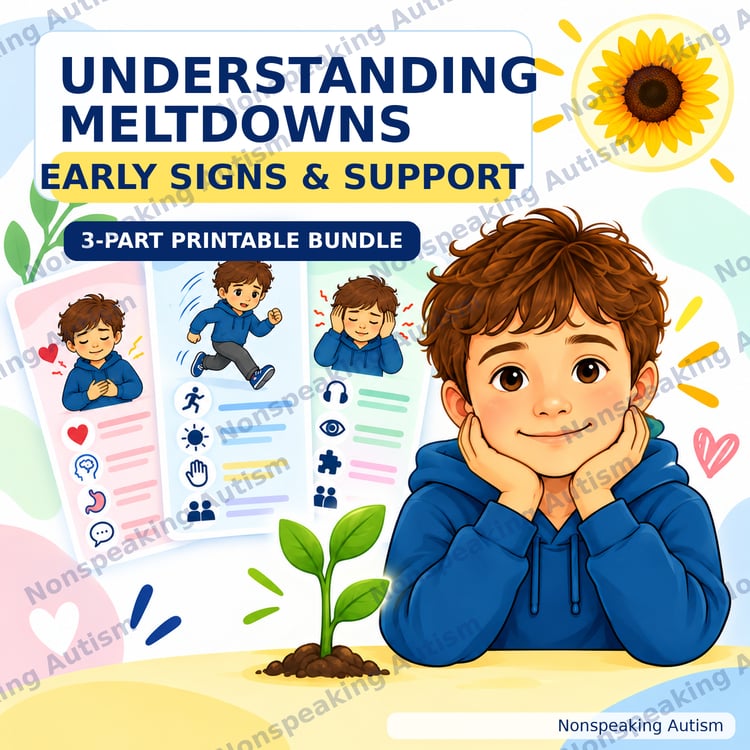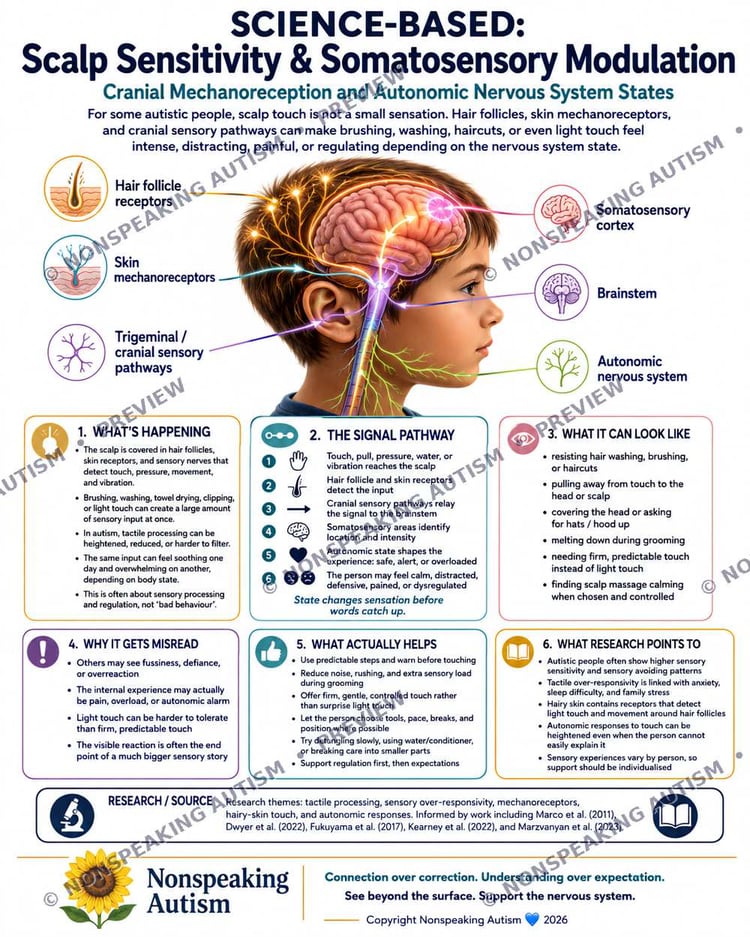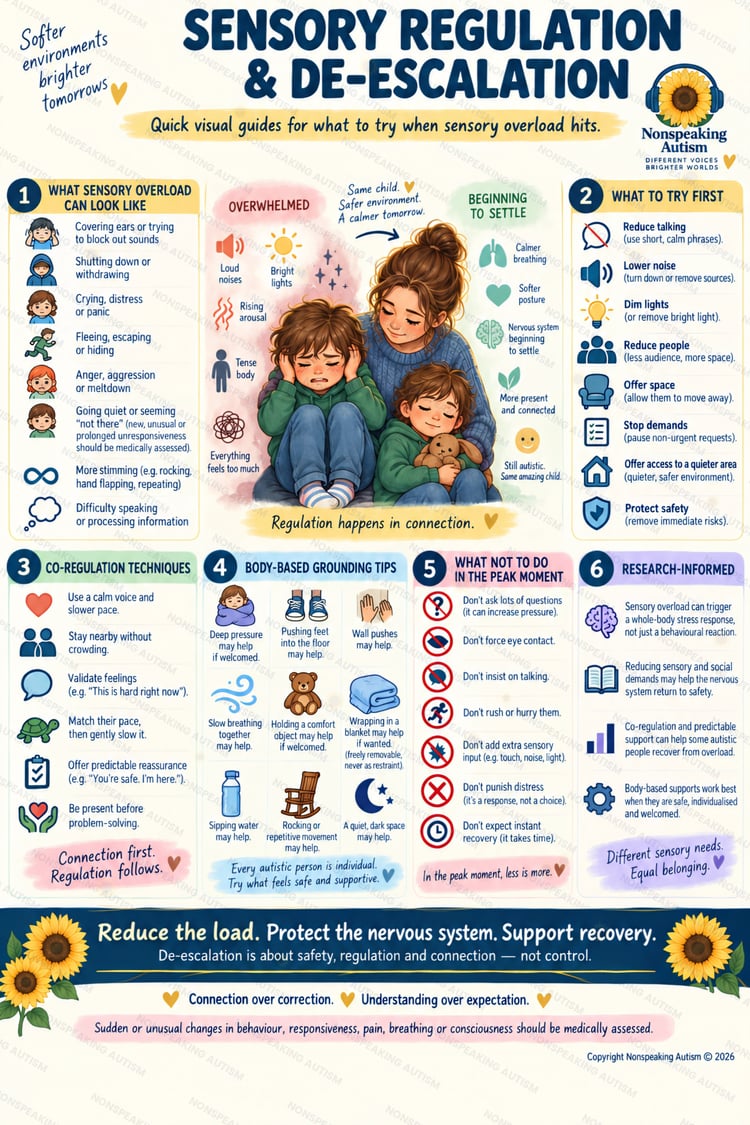

The Science Behind Speech Access Under Stress
The Science Behind Speech Access Under Stress — Part 2: Brain, Body & Speech Under Stress
How stress, overload and communication demands can make speech harder to access — even when understanding may still be present
A person can know what they want to say and still be unable to access the words easily.
They may speak comfortably in one environment but become very quiet somewhere else.
They may normally use full sentences but, during overload, communicate with only one or two words.
They may pause for much longer, repeat familiar phrases, whisper, gesture, type, use AAC — or temporarily stop speaking altogether.
This does not automatically mean understanding has disappeared.
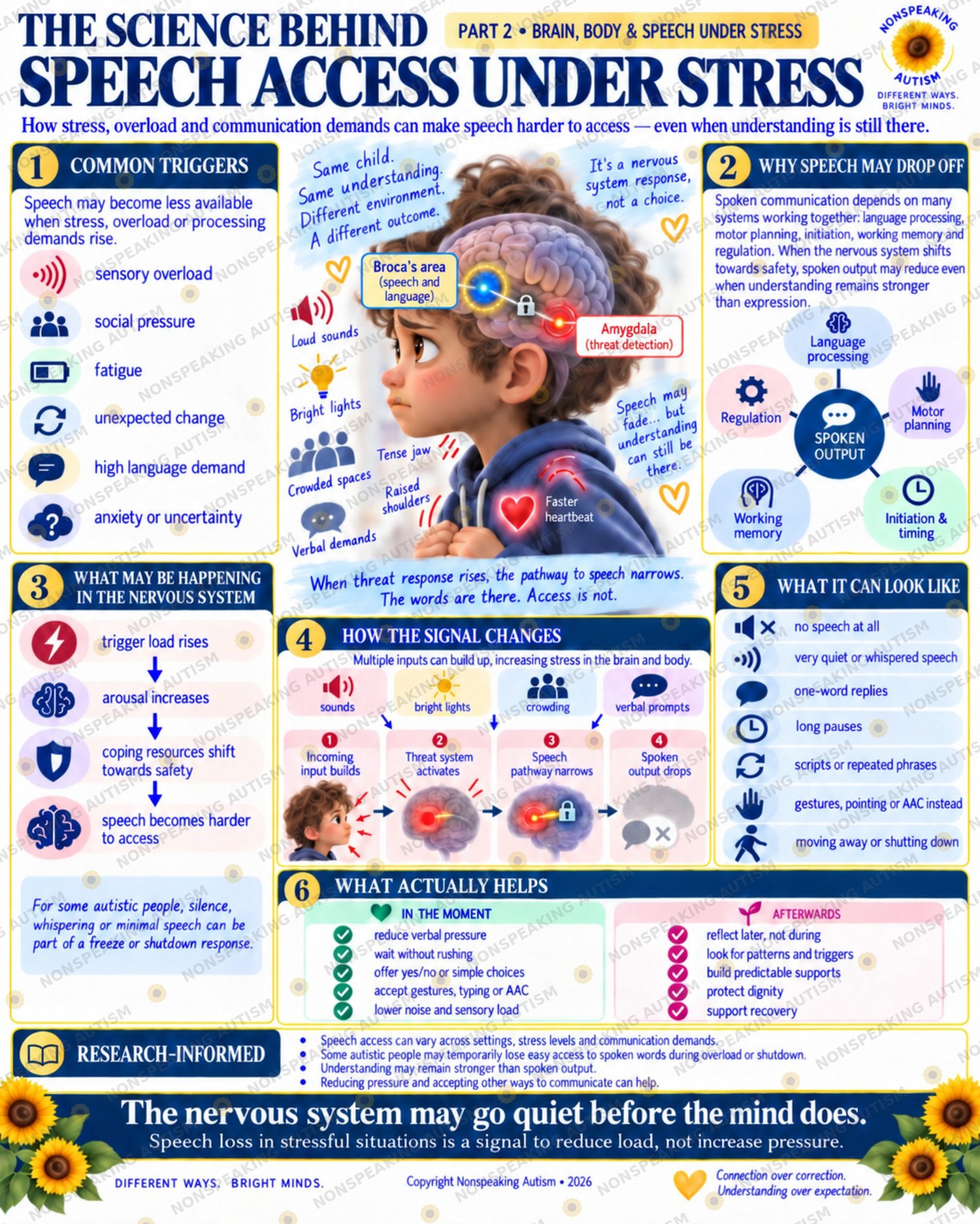
The Science Behind Speech Access Under Stress — Part 2 is a research-informed educational poster exploring how stress, sensory overload, fatigue, uncertainty and communication demands may affect access to spoken communication for some autistic people.
The central message is:
Same child. Same understanding. Different environment. A different outcome.
And when speech becomes difficult:
Reduce load — don't increase pressure.
🧠 What This Poster Explores
This resource looks beneath changes in spoken communication and explores:
1️⃣ Common Triggers
2️⃣ Why Speech May Become Harder to Access
3️⃣ What May Be Happening During Stress
4️⃣ How Increasing Demands Can Affect Communication
5️⃣ What Reduced Speech Can Look Like
6️⃣ What Actually Helps
The aim is not to diagnose a particular communication condition.
It is to help families, educators and professionals understand an important principle:
Communication ability can vary with context, stress and processing demands.
1️⃣ Common Triggers
For some autistic people, speech may become less available when overall demands rise.
Possible contributors include:
sensory overload
social pressure
fatigue
unexpected change
high language demands
anxiety or uncertainty
crowded environments
bright lighting
loud or competing sounds
repeated verbal prompting
Different factors can also accumulate.
A person may manage noise.
They may manage an unexpected change.
They may manage several questions.
But noise + change + fatigue + social pressure + repeated questions may create a very different level of demand.
This is why context matters.
🗣️ 2️⃣ Spoken Communication Requires Multiple Processes
Speech is not simply a matter of “knowing the answer.”
Producing spoken language involves multiple interacting processes, including aspects of:
language processing
attention
working memory
speech-motor planning and execution
initiation
timing
regulation
When someone is highly stressed or overloaded, some of these processes may become more difficult to coordinate efficiently.
For some people, that can mean spoken output becomes slower, shorter, quieter or temporarily unavailable.
It is therefore important not to automatically equate:
less speech = less understanding
or:
no immediate spoken response = nothing to communicate.
❤️ 3️⃣ What May Be Happening Under Stress?
The poster presents a simple educational pathway:
Trigger load rises
⬇️
Arousal increases
⬇️
Available coping and processing resources change
⬇️
Speech may become harder to access
This is an educational simplification, not a universal neurological sequence.
Human communication and stress responses are complex, and different autistic people may experience reduced speech for different reasons.
The useful principle is that when communication becomes harder during distress, adding more pressure may increase rather than solve the problem.
🔊 4️⃣ How Increasing Input Can Affect Communication
Imagine someone is already processing:
loud sounds
bright lights
crowding
uncertainty
and then receives repeated:
questions
instructions
demands
requests to explain
requests to “use your words”
Those verbal demands become additional incoming information that must also be processed.
The poster illustrates one possible pattern:
Incoming demands build
→ stress/arousal increases
→ access to spoken communication becomes more difficult
→ spoken output reduces
This is why reducing communication pressure can sometimes be more helpful than repeatedly asking for a verbal response.
👀 5️⃣ What Reduced Speech Access Can Look Like
Changes in speech may look different from person to person.
Possible presentations include:
no speech
very quiet or whispered speech
one-word responses
shorter-than-usual answers
long pauses
scripts or repeated familiar phrases
gestures or pointing
using AAC
typing or writing
leading someone towards what is needed
moving away
withdrawal or shutdown
None of these behaviours, by themselves, establish why speech has changed.
They are signals to become curious about communication access and the demands of the situation.
💬 Speech Is Only One Form of Communication
When spoken language becomes difficult, the answer should not automatically be to demand more speech.
Communication may remain possible through:
AAC
typing
writing
symbols
pictures
gestures
pointing
signs
body movement
yes/no responses
choice-making
leading a trusted person
or another established communication method.
Alternative communication is not a failure.
If it gives the person reliable access to communication, it is communication.
AAC should not be removed simply because a person can sometimes speak.
🌿 6️⃣ What Can Help in the Moment?
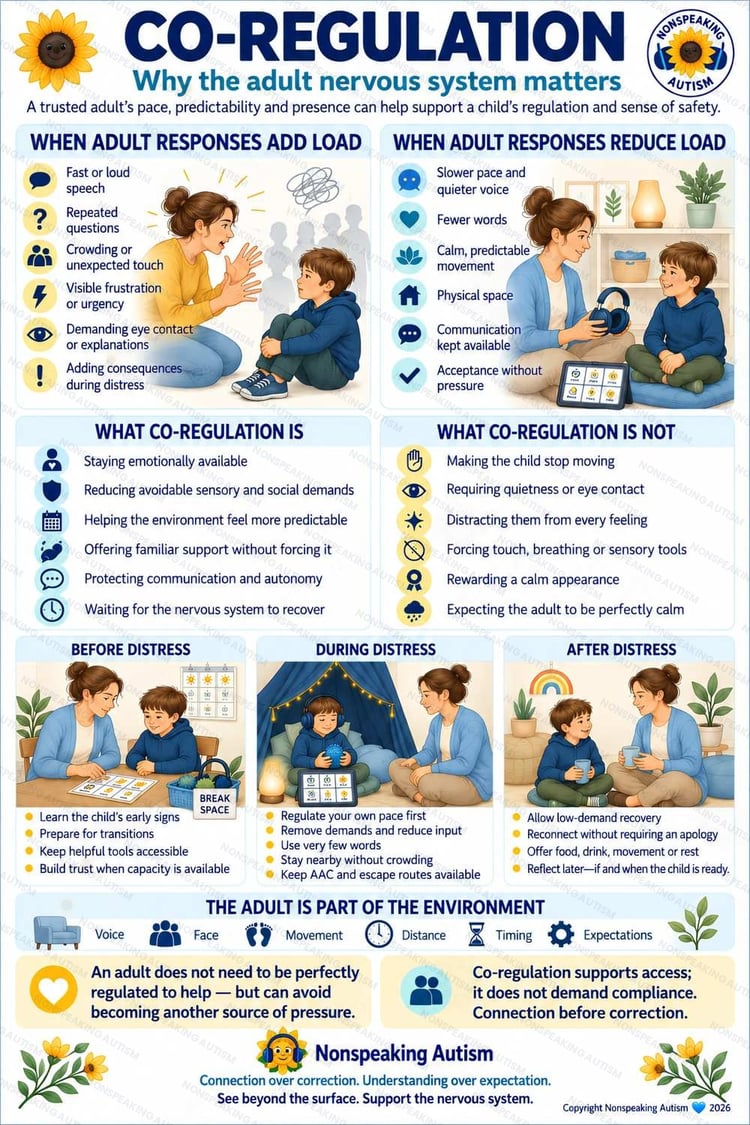
When speech access appears to reduce, consider decreasing the overall communication load.
Helpful approaches may include:
reducing verbal pressure
waiting without rushing
allowing additional processing time
offering yes/no or simple choices where appropriate
accepting gestures
accepting typing or writing
keeping AAC available
lowering unnecessary noise and sensory input
reducing repeated questions
using clear, concise language
allowing silence
The goal is not to extract a spoken answer.
The goal is to keep communication accessible.
⏳ Give Processing Time
Silence does not necessarily mean there is no response coming.
Repeatedly asking:
“What's wrong?”
“Tell me.”
“Use your words.”
“What's wrong?”
“Can you answer me?”
may increase the very processing demands the person is already struggling to manage.
Where safe and appropriate, allowing time can reduce this pressure.
Sometimes the most supportive response is:
fewer words + more time + an accessible alternative.
🌻 Afterwards — Reflect, Don't Interrogate
Once the person has recovered, there may be useful things to learn.
Consider:
What happened before speech changed?
Was the environment particularly loud or busy?
Was the person tired?
Had something unexpected happened?
Were verbal demands unusually high?
Was communication support available?
Which communication method remained accessible?
What helped recovery?
Look for patterns over time rather than drawing conclusions from one event.
And protect dignity.
A person should not be made to repeatedly justify or defend a period in which speech became difficult.
♾️ Speech Access Can Be Context-Dependent
Someone may communicate very differently:
at home
at school
in a clinic
with unfamiliar people
in a crowded environment
when tired
when relaxed
during sensory overload
when anxious
when expectations are unclear
This variation does not necessarily mean the person is deliberately choosing when to communicate.
It tells us that environment and demand can matter.
A communication assessment that considers only one setting may therefore miss important information about how communication changes across contexts.
Understanding May Be Stronger Than Spoken Output Suggests
One of the most important principles in this resource is to avoid assuming that a temporary reduction in speech equals a matching reduction in understanding.
Sometimes a person may understand substantially more than they can express through speech at that moment.
At the same time, we should not assume intact comprehension in every situation either.
Understanding itself can also vary with language complexity, stress, fatigue and individual communication differences.
The safest approach is therefore to:
presume the person has something worth communicating, keep language accessible, provide alternative communication options and avoid judging comprehension solely from spoken output.
🧠 A Note About the Brain Diagram
The poster uses areas such as the amygdala and Broca's area as accessible educational illustrations.
Real speech, language and stress processing are not controlled by isolated brain “buttons.”
Language relies on distributed brain networks, and stress responses involve interacting neural and physiological systems.
The illustration should therefore be understood as a simplified teaching visual, not a literal brain scan or complete model of what happens when an autistic person loses access to speech.
🔬 Research-Informed
Research and clinical literature support several broader principles reflected in this resource:
Communication abilities can vary considerably among autistic people and across contexts.
Stress, anxiety, sensory demands and cognitive load can influence communication and performance.
AAC and other alternative forms of communication can provide meaningful communication access and should not automatically be withheld from people who also use speech.
Autistic people themselves have also described experiences in which communication becomes more difficult during overload, shutdown or intense stress.
However, terms such as “speech loss,” “situational speech loss,” “verbal shutdown” and “speech shutdown” are used inconsistently across communities and are not interchangeable formal diagnoses.
The poster therefore focuses on the observable issue:
access to spoken communication can change — and support should preserve access to communication rather than force a particular communication mode.
📚 Suggested References & Evidence Base
Brignell, A., Chenausky, K. V., Song, H., Zhu, J., Suo, C., & Morgan, A. T. (2018). Communication interventions for autism spectrum disorder in minimally verbal children. Cochrane Database of Systematic Reviews, 2018(11), CD012324.
Walker, V. L., & Snell, M. E. (2013). Effects of augmentative and alternative communication on challenging behavior: A meta-analysis. Augmentative and Alternative Communication, 29(2), 117–131.
National Institute for Health and Care Excellence (NICE). Autism spectrum disorder in under 19s: support and management (CG170). Guidance includes consideration of communication needs, sensory sensitivities, environmental factors and predictability when supporting autistic children and young people.
For the final product, I would keep the reference section focused on research that directly supports communication access, AAC, sensory/environmental demands and stress, rather than claiming that any single study proves a specific “speech pathway shutting down.”
👨👩👧 Who Is This Resource For?
This poster may be useful for:
- autistic children and young people
- autistic adults
- nonspeaking, minimally speaking and intermittently speaking autistic people
- parents and caregivers
- families
- teachers
- teaching assistants
- SENCOs and SEND professionals
- speech and language therapists
- occupational therapists
- psychologists and allied professionals
- support workers
- autism and disability organizations
- communication and AAC training
- professional-development settings
It can be used as a family education resource, classroom visual, staff-training aid or conversation starter about communication access during stress.
📦 What You Receive
Your purchase includes:
1 × The Science Behind Speech Access Under Stress — Part 2: Brain, Body & Speech Under Stress educational poster
1 × high-resolution printable PDF
The purchased file is supplied clear and without the promotional preview watermark shown in the Payhip listing image.
Preview watermarks are used for copyright protection only and will not appear on the purchased resource.
Digital download only — no physical product will be shipped.
⚠️ Important Educational, Communication & Medical Disclaimer
This resource is provided for educational and informational purposes only.
It is not medical advice, diagnosis, speech and language assessment, psychological assessment, neurological assessment, therapy or an individualized communication plan.
A reduction or loss of speech should not automatically be attributed to autism, overload, anxiety, shutdown or nervous-system regulation.
Speech changes can have many possible causes.
A new, sudden, unexplained, severe or persistent change in speech or communication — particularly when accompanied by weakness, facial changes, confusion, altered consciousness, seizure activity, breathing difficulty, injury, severe headache or other acute symptoms — requires appropriate urgent medical assessment.
The neurological diagrams on this poster are educational simplifications. Speech and language rely on distributed brain networks, and the illustrated pathway should not be interpreted as a literal or universally established neurological mechanism for reduced speech during autistic distress.
Strategies should be individualized according to the person's communication profile, established AAC, sensory needs, health, age, abilities, preferences and circumstances.
This resource should never be used to discourage speech when speech is accessible, nor to force speech when another reliable form of communication is more accessible.
💛 The Message Behind the Resource
When a child who usually speaks suddenly becomes quiet, adults may instinctively ask more questions.
“What's wrong?”
“Tell me what happened.”
“Why aren't you answering?”
“Use your words.”
But if the person's communication system is already under substantial demand, more verbal pressure may simply add another task.
There is another approach:
Reduce the noise.
Reduce the questions.
Give time.
Keep AAC available.
Accept pointing.
Accept gestures.
Accept typing.
Accept a one-word answer.
Accept silence while keeping communication available.
Then look at what the environment may be telling you.
Because the most important goal is not:
speech at all costs.
It is:
communication access.
The nervous system may go quiet before the mind does.
Speech becoming difficult in a stressful situation is a signal to reduce load, not increase pressure.
Connection over correction. Understanding over expectation.
Different Ways. Bright Minds.
© Nonspeaking Autism 2026 🌻💙