

🌻 School Anxiety & Avoidance
🌻 School Anxiety & Avoidance
Autism Awareness Poster | A2 Printable | UK Edition
When school feels too much, avoidance can be a sign of anxiety, not a lack of effort.
For many autistic children, school places a high demand on the nervous system. Noise, crowds, change, social expectations and a reduced sense of control can build up across the day, until simply getting through the school gate feels impossible.
This is often described as emotionally based school avoidance (EBSA) or school-related anxiety. It is a stress-based response, not a lack of motivation, poor parenting or a refusal to learn.
School Anxiety & Avoidance is an illustrated A2 poster that helps families and school staff understand what is really happening and how to respond with compassion.
It's not just about school – it's about how school feels.
🧠 WHAT THIS POSTER COVERS
❓ What is school anxiety avoidance?
A stress-based response where a child finds it extremely difficult, overwhelming or impossible to go to school, attend for the full day or manage parts of the school environment.
⚡ Why it happens
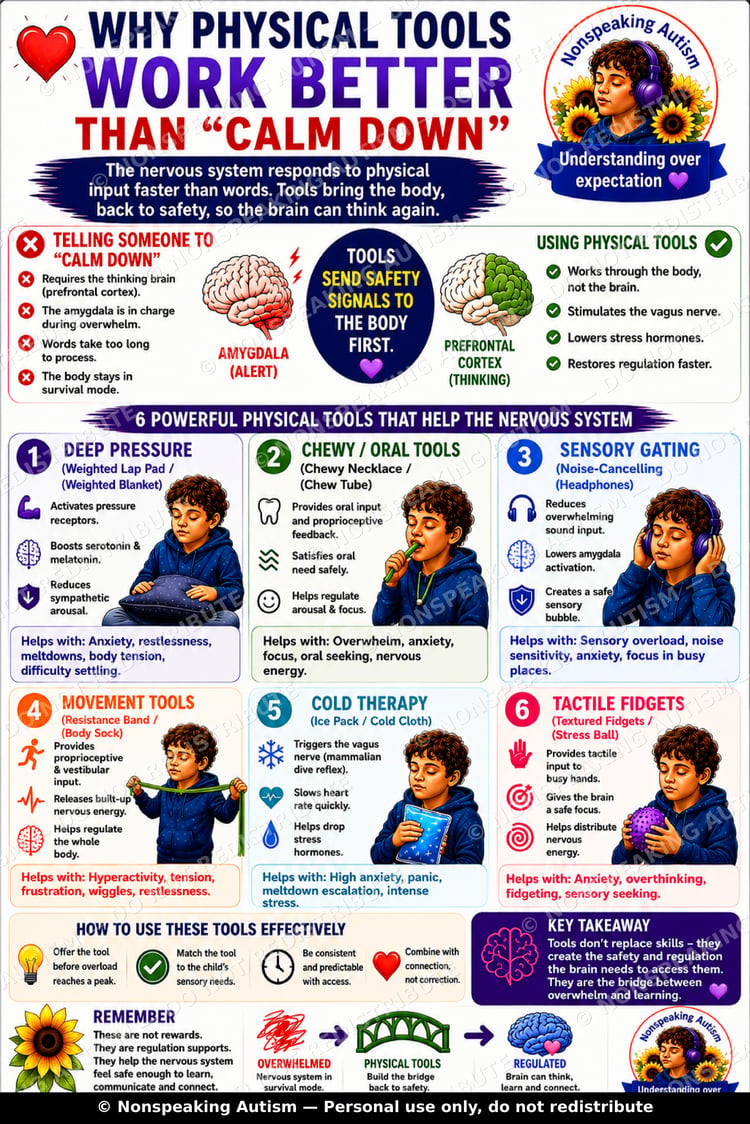
- Sensory overload (e.g. noise, lighting, busy spaces, crowds)
- Cognitive and social demands (e.g. change, expectations, interactions, uncertainty)
- A reduced sense of control or autonomy (e.g. rigid rules, time pressure, feeling unable to cope)
- The build-up of stress and anxiety, which can lead to avoidance as a way to protect against further overload
🔍 How it can look
- Refusing to get ready for school (e.g. dressing, eating or leaving home)
- Becoming highly distressed at the school gate or on arrival
- Physical signs of anxiety (e.g. stomach ache, headaches, feeling sick or unwell)
- Shutting down, going quiet or withdrawing
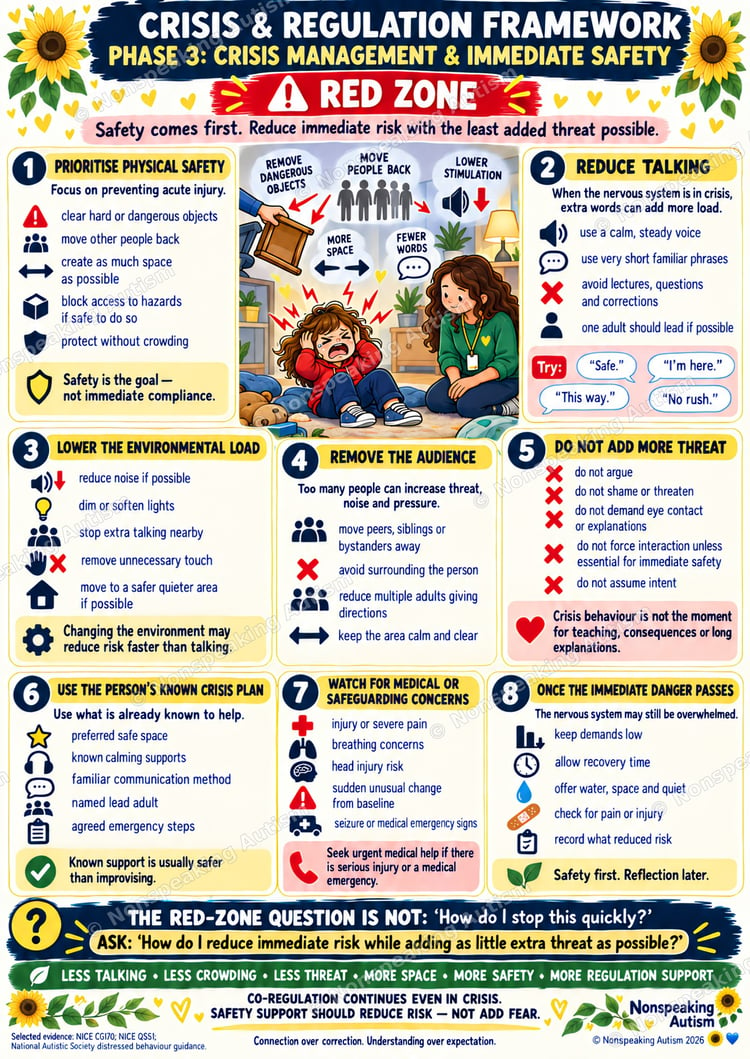
- Meltdowns, high anxiety or becoming dysregulated
💛 What helps
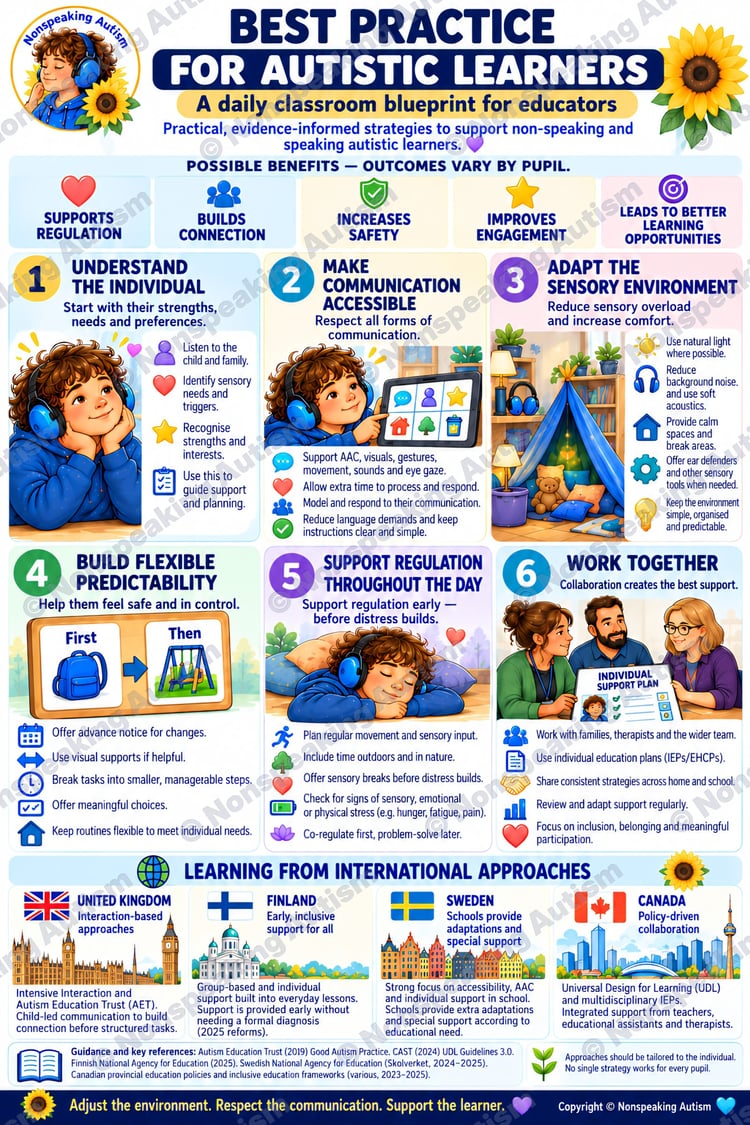
- Build predictability with clear, visual routines
- Reduce sensory stress (e.g. ear defenders, a quiet space, lighting, seating)
- Offer choice and a sense of control
- Keep connection and regulation a priority (e.g. co-regulation, a trusted adult, time to settle)
- Consider a gradual, flexible approach (e.g. shorter days, part-time or a phased return)
- Work together with the child, school and other professionals to find an individual, realistic plan
💙 WHY THIS MATTERS
A child who copes at school is not always a child who is comfortable at school. Some children hold it together all day and become distressed at home; others cannot get through the door at all.
When avoidance is seen as defiance, children can be pushed harder at the very moment they need more safety. When it is seen as anxiety, adults can work together to reduce demands, rebuild trust and find a realistic way forward.
School avoidance is often a sign that a child is feeling overwhelmed, anxious or unsafe, not a lack of motivation or a refusal to learn.
👨👩👧 WHO IS THIS POSTER FOR?
- Parents, carers and families
- Teachers and teaching assistants
- SENCOs and inclusion leads
- Pastoral, wellbeing and attendance staff
- Educational psychologists
- Speech and language therapists and occupational therapists
- Anyone supporting autistic children, including nonspeaking children
It also makes a helpful starting point for conversations between home and school.
📦 WHAT YOU RECEIVE
- A2 print-ready PDF (420 x 594 mm)
- A2 high-resolution image (300 DPI)
Instant digital download. No physical product will be posted.
The downloadable files are provided without a watermark.
🔗 FURTHER RESOURCES
National Autistic Society – What can I do if my child won't go to school?
https://www.autism.org.uk/advice-and-guidance/education/attendance-problems/parents
National Autistic Society – Attendance problems
https://www.autism.org.uk/advice-and-guidance/education/attendance-problems
Department for Education – Mental health issues affecting a pupil's attendance: guidance for schools
https://www.gov.uk/government/publications/mental-health-issues-affecting-a-pupils-attendance-guidance-for-schools
NICE CG170 – Autism spectrum disorder in under 19s: support and management
https://www.nice.org.uk/guidance/cg170
📚 RESEARCH & REFERENCES
Mapped to poster sections:
- What is school anxiety avoidance? and How it can look: National Autistic Society, What can I do if my child won't go to school?; Department for Education (2023), Mental health issues affecting a pupil's attendance: guidance for schools.
- Why it happens: NICE CG170, recommendations 1.1.9 (the sensory environment) and 1.4.1 (communication, sensory, health and changes in routine as possible triggers of distress).
- What helps: Department for Education (2023), Mental health issues affecting a pupil's attendance (working together with families and putting individual support in place); NICE CG170, 1.1.9 and 1.4.4 (adjusting the environment); National Autistic Society, Attendance problems.
Foundational references (printed on the poster):
1. National Autistic Society. What can I do if my child won't go to school?
2. National Institute for Health and Care Excellence (2013, updated 2021). Autism spectrum disorder in under 19s: support and management (CG170).
3. Department for Education (2023). Mental health issues affecting a pupil's attendance: guidance for schools.
Sources:
- NAS – What can I do if my child won’t go to school?
- NAS – Attendance problems
- DfE – Mental health issues affecting a pupil’s attendance
- DfE – Effective practice examples (PDF)
- Schools Week – Evidence not needed for short mental health absence, says DfE
⚠️ IMPORTANT DISCLAIMER
This resource is for educational and information purposes only.
It is not a diagnostic tool, a medical or mental health assessment, or legal advice about school attendance, and it does not replace advice from a qualified professional.
School avoidance may have sensory, emotional, social, medical, environmental or communication-related causes. Seek professional advice for new, persistent or worrying changes, ideally from someone who knows the child. If you are concerned about a child's mental health, contact your GP or NHS 111. In an emergency, call 999.
All support should respect the child's communication, dignity, preferences, safety and wellbeing.
©️ COPYRIGHT & PERMITTED USE
© 2026 Nonspeaking Autism. All rights reserved.
For personal use in one home, classroom or setting only.
Please keep the original branding and copyright notice intact. The digital file must not be resold, modified, redistributed, uploaded to other websites or included in commercial products without permission.
💛 PLEASE LEAVE US FEEDBACK
If you find this poster helpful, please consider leaving a review on Payhip. We would love to hear how you used it and what you would like us to create next.
Thank you for supporting Nonspeaking Autism! 🌻
Connection over correction. Understanding over expectation.
Nonspeaking Autism © 2026
nonspeaking-autism.com