
💙 BEST PRACTICE FOR AUTISTIC LEARNERS
💙 BEST PRACTICE FOR AUTISTIC LEARNERS
A Daily Classroom Blueprint for Educators
Evidence-Informed Autism Educational Poster | UK Edition | Nonspeaking Autism
🌻 Adjust the environment. Respect the communication. Support the learner.
Every autistic learner deserves an educational environment where their communication is respected, their sensory needs are understood and their strengths are recognised.
Yet many autistic children and young people, particularly those who are nonspeaking or use limited spoken language, encounter barriers that can make everyday classroom experiences unnecessarily difficult.
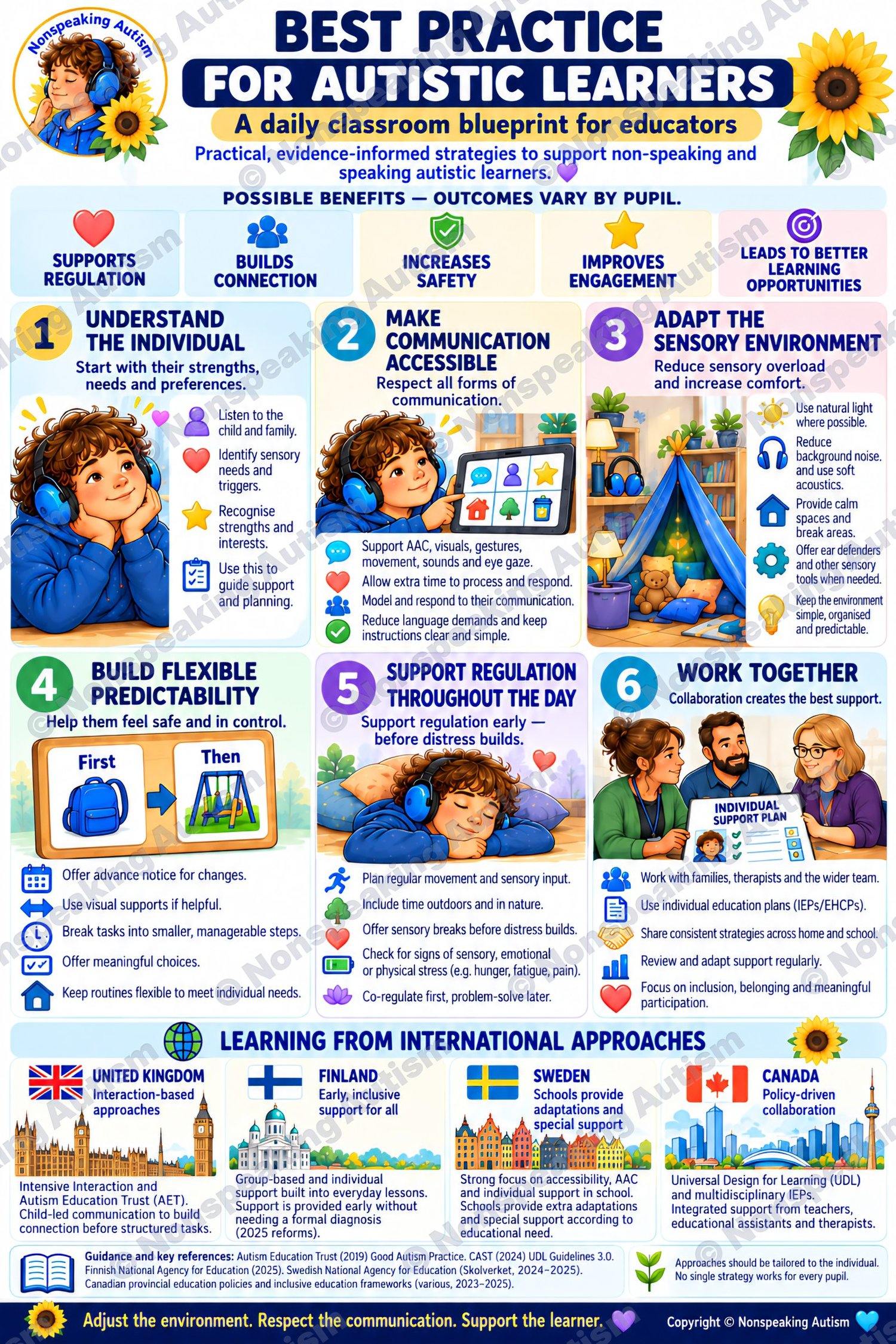
Best Practice for Autistic Learners is a colourful, practical educational poster designed to help teachers, teaching assistants, SENCOs and other education professionals create more accessible, supportive and inclusive learning environments.
It brings together six key areas of classroom practice, alongside examples of approaches from the United Kingdom, Finland, Sweden and Canada.
The central message is simple:
Support should adapt to the learner — not require the learner to fit an inflexible environment.
🧠 WHAT THIS POSTER EXPLORES
1. 💛 Understand the Individual
Start with the learner's strengths, needs and preferences.
No two autistic learners are the same.
Some children may experience sensory sensitivities, communication differences, motor difficulties or challenges with transitions. Others may have different strengths, interests and support needs.
Effective classroom support begins with understanding the individual rather than making assumptions based on a diagnosis.
The poster encourages educators to:
- Listen to the child and their family.
- Identify individual sensory needs and potential triggers.
- Recognise strengths, interests and preferred activities.
- Use this understanding to guide planning and support.
A child's preferences, communication and lived experience should help shape the support they receive.
Individual understanding comes before individualised teaching.
2. 💬 Make Communication Accessible
Respect all forms of communication.
Communication is not limited to speech.
Autistic learners may communicate through spoken words, AAC devices, communication boards, symbols, gestures, facial expressions, body movements, writing or other methods.
Some children understand considerably more than they can reliably express.
This poster encourages educators to:
- Support augmentative and alternative communication (AAC).
- Make visual and other communication supports available when useful.
- Allow additional time for processing and responding.
- Model and respond to the learner's preferred communication methods.
- Reduce unnecessary language demands.
- Use clear, accessible instructions.
Eye gaze and body movements may also convey information, but their meaning should not be assumed without understanding the individual.
Communication access is a right, not a reward for compliance.
3. 🌿 Adapt the Sensory Environment
Reduce unwanted sensory input and increase comfort.
Classrooms can be demanding sensory environments.
Background conversations, fluorescent lighting, movement, visual clutter, unpredictable sounds and crowded spaces may create difficulties for some autistic learners.
The poster highlights possible adjustments such as:
- Using natural or softer lighting where appropriate.
- Reducing unnecessary background noise.
- Providing quieter spaces and opportunities for breaks.
- Offering ear defenders or preferred sensory tools.
- Keeping classroom environments organised and predictable.
- Considering individual sensory preferences.
Sensory adjustments should be based on what helps the learner, rather than assuming that one approach benefits everyone.
An accessible environment can reduce barriers before distress develops.
4. 📅 Build Flexible Predictability
Help learners understand what is happening while preserving choice and flexibility.
Predictability may reduce uncertainty for some autistic children.
However, predictable routines should not become rigid systems that prevent meaningful choice or necessary adjustments.
Helpful approaches may include:
- Giving advance notice of changes where possible.
- Using visual schedules or first–then supports when beneficial.
- Breaking complex tasks into manageable steps.
- Providing clear information about transitions.
- Offering meaningful choices.
- Adjusting routines according to the learner's needs.
The aim is not to control every moment of the school day.
It is to help the learner access information, understand expectations and participate with greater confidence.
5. 💙 Support Regulation Throughout the Day
Provide support before distress becomes overwhelming.
Regulation support should be proactive rather than reserved for moments of crisis.
Some autistic learners may benefit from opportunities for movement, sensory breaks, rest, outdoor activities or access to familiar comforts.
The poster encourages educators to:
- Plan regular opportunities for movement where helpful.
- Include outdoor and nature-based activities.
- Offer sensory breaks before distress escalates.
- Watch for signs of fatigue, hunger, pain or emotional distress.
- Use calm, responsive co-regulation.
- Prioritise safety and connection before problem-solving.
These strategies are not universal treatments, and no single sensory activity is guaranteed to improve regulation.
A learner should not have to reach meltdown or shutdown before support becomes available.
6. 🤝 Work Together
Collaboration helps create consistent, individualised support.
Effective educational planning benefits from listening to the learner and involving the people who know them well.
This may include:
- Parents and carers
- Classroom teachers and teaching assistants
- SENCOs and inclusion staff
- Speech and language therapists
- Occupational therapists
- Educational psychologists
- Other relevant professionals
The poster promotes individual support planning, communication between home and school, regular reviews and a shared focus on meaningful participation.
For England, support may form part of SEN provision or an Education, Health and Care Plan (EHCP), where applicable.
The wider UK has different statutory systems and terminology, so planning should follow the requirements of the relevant nation.
The goal is not simply attendance or task completion. It is meaningful access, inclusion and belonging.
🌍 LEARNING FROM INTERNATIONAL APPROACHES
The poster also introduces four examples of educational approaches that may inform inclusive practice.
🇬🇧 United Kingdom — Interaction-Based Approaches
Highlights the importance of connection, communication, responsive interaction and child-led engagement.
The poster references approaches associated with Intensive Interaction and the Autism Education Trust.
🇫🇮 Finland — Early, Inclusive Support
Introduces the principle of providing support early and embedding appropriate adjustments within everyday education.
The Finnish education system has undergone reforms, so individual policies and implementation should be checked against current official guidance.
🇸🇪 Sweden — Accessibility and Individual Support
Highlights accessibility, educational adjustments and support designed around individual learning needs.
🇨🇦 Canada — Collaboration and Universal Design for Learning
Introduces Universal Design for Learning (UDL), flexible access to teaching and multidisciplinary collaboration.
Canadian education policies vary by province and territory.
These examples are broad educational illustrations, not a formal comparison proving that one country's system is more effective than another.
The shared principle is that support should respond to individual learners and remove unnecessary barriers.
💛 POSSIBLE BENEFITS OF SUPPORTIVE CLASSROOM PRACTICE
When approaches are well matched to an individual learner, they may help:
❤️ Support emotional regulation and comfort.
💙 Strengthen connection and trust.
🛡️ Improve safety and reduce avoidable distress.
⭐ Increase opportunities for engagement.
🎯 Improve access to learning and participation.
Outcomes vary between pupils, settings and strategies.
No single classroom blueprint guarantees these results for every autistic learner.
🔬 RESEARCH & GUIDANCE-INFORMED
This educational resource draws on established principles of inclusive education, communication accessibility, individualised support and reasonable adjustments.
📚 SELECTED GUIDANCE & REFERENCES
Autism Education Trust (2019). Good Autism Practice.
A framework exploring approaches to supporting autistic children and young people in educational settings.
CAST (2024). Universal Design for Learning Guidelines, Version 3.0.
https://udlguidelines.cast.org/
National Institute for Health and Care Excellence (NICE). Autism spectrum disorder in under 19s: support and management (CG170).
https://www.nice.org.uk/guidance/cg170
Autism Education Trust. Educational resources and professional development guidance.
https://www.autismeducationtrust.org.uk/
The poster additionally mentions Finnish and Swedish education guidance and Canadian provincial inclusive education frameworks. These are broad references; the specific documents and policy claims should be checked against current national or provincial sources before describing them as fully verified.
Evidence Note
This poster is a practical educational overview rather than a validated classroom intervention programme.
The effectiveness of particular strategies depends on the learner, implementation, environment and outcomes being considered.
Individual preferences, communication access, safety, wellbeing and meaningful participation should guide decisions.
Research & References Section 1 – Understand the Individual: - Consoli, C., Turriziani, L., Antoci, M., Lo Monaco, M., Ceraolo, G., Spoto, G., Nicotera, A. G., & Di Rosa, G. (2026). Sensory phenotypes in autism spectrum disorder associated with distinct patterns of social communication, repetitive and restrictive behaviors or interests, and comorbidities: a state-of-the-art review. Brain Sciences, 16(1), 53. https://doi.org/10.3390/brainsci16010053 Sections 3 & 5 – Sensory Environment and Regulation: - Song, C., Ma, R., Ni, W., Peng, X., Li, X., Shi, R., Zhang, Y., & Li, Y. (2024). Pupillometry reveals hyper-arousal in response to auditory stimuli in autistic children. Journal of Zhejiang University SCIENCE B, 25(11), 996–1008. https://doi.org/10.1631/jzus.B2300462 - Schaaf, R. C., Ridgway, E. M., Jones, E. A., Dumont, R. L., Foxe, J., Conly, T., Sancimino, C., Yi, M., Mailloux, Z., Hunt, J. M., Kirschner, L., Leiby, B. E., & Molholm, S. (2025). A comparative trial of occupational therapy using Ayres Sensory Integration and applied behavior analysis interventions for autistic children. Autism Research, 18(10), 2120–2134. https://doi.org/10.1002/aur.70099 International Approaches – Canada (UDL): - CAST (2024). Universal Design for Learning Guidelines version 3.0. https://udlguidelines.cast.org/ Foundational references (printed on the poster): - Guldberg, K., Bradley, R., Wittemeyer, K., Briscombe, J., Phillips, C., & Jones, G. (2019). Good Autism Practice: Full Report. London: Autism Education Trust. - CAST (2024). UDL Guidelines 3.0. - Finnish National Agency for Education (2025). Reform of learning support in basic education (in force from 1 August 2025). - Swedish National Agency for Education – Skolverket (2024–2025). Guidance on extra adaptations and special support. - Canadian provincial education policies and inclusive education frameworks (various, 2023–2025).
Sources:
- AET Good Autism Practice report
- CAST UDL Guidelines
- Espoo – learning support reform
- NAS – Sensory processing
👨👩👧 WHO IS THIS RESOURCE FOR?
This poster is suitable for:
- Primary and secondary school teachers
- Teaching assistants and learning support assistants
- SENCOs and SEND coordinators
- Mainstream and specialist school staff
- Early years practitioners
- School inclusion and pastoral teams
- Speech and language therapists
- Occupational therapists
- Educational psychologists
- Parents and carers
- Autism support organisations
- Professionals supporting nonspeaking and minimally speaking autistic learners
It can be displayed in classrooms, staff rooms, SEND resource areas, professional development spaces and home learning environments.
📦 WHAT YOU RECEIVE
💙 PAID DIGITAL DOWNLOAD
1 × Best Practice for Autistic Learners — A Daily Classroom Blueprint for Educators
An illustrated educational poster covering:
- Six areas of inclusive classroom practice
- Communication and AAC accessibility
- Sensory adjustments
- Predictability and meaningful choice
- Proactive regulation support
- Collaborative individual planning
- International examples of inclusive educational approaches
- Selected guidance and references
Digital download only. No physical product will be shipped.
The product preview contains promotional watermarks. The final purchaser file should be supplied without preview watermarks.
Please confirm the uploaded PDF's page size and print resolution before advertising it as A2 or 300 DPI.
⚠️ IMPORTANT DISCLAIMER
This resource is intended for educational and informational use.
It does not replace an individual educational assessment, speech and language therapy assessment, occupational therapy assessment, statutory SEND guidance or professional advice.
Not all autistic learners experience the same needs or benefit from the same strategies.
Support should be developed collaboratively, reviewed regularly and adjusted in response to the learner's preferences, communication and wellbeing.
National education policies and statutory frameworks vary across the four UK nations.
©️ COPYRIGHT & PERMITTED USE
Copyright © 2026 Nonspeaking Autism. All rights reserved.
This resource may be used for personal, home, classroom, school and individual professional educational purposes.
The purchased digital file must not be resold, redistributed, publicly uploaded, shared through file-sharing services or incorporated into other commercial products without written permission.
Please share the Payhip product link rather than distributing the digital file.
🌻 THE MESSAGE BEHIND THE RESOURCE
An autistic learner should not have to communicate in one particular way to be heard.
They should not have to endure overwhelming environments to prove that they can cope.
They should not have to reach crisis before adjustments are considered.
Good practice begins with listening, understanding and adapting.
Understand the individual.
Make communication accessible.
Adapt the sensory environment.
Build flexible predictability.
Support regulation throughout the day.
Work together.
💙 Adjust the environment. Respect the communication. Support the learner.
Connection over correction. Understanding over expectation.
Nonspeaking Autism © 2026