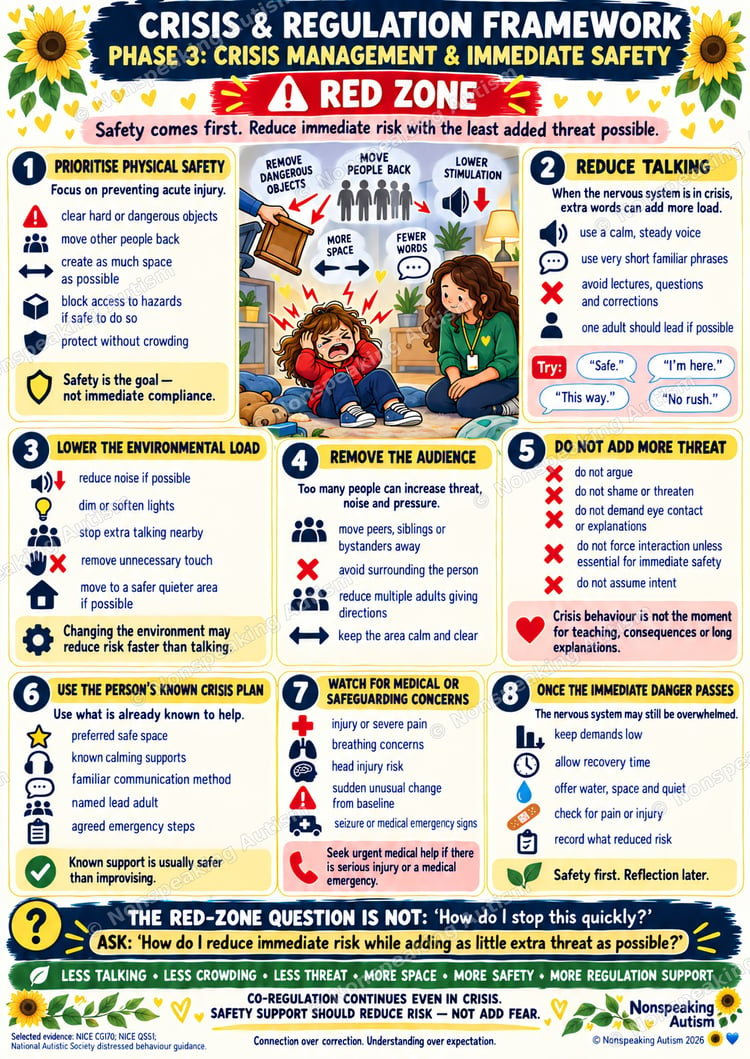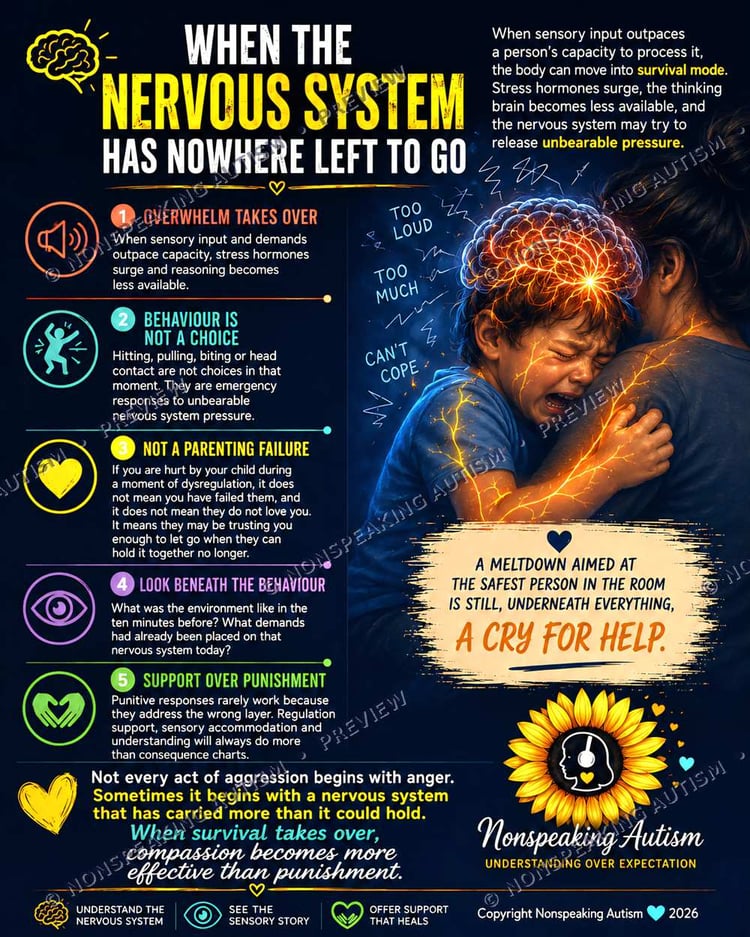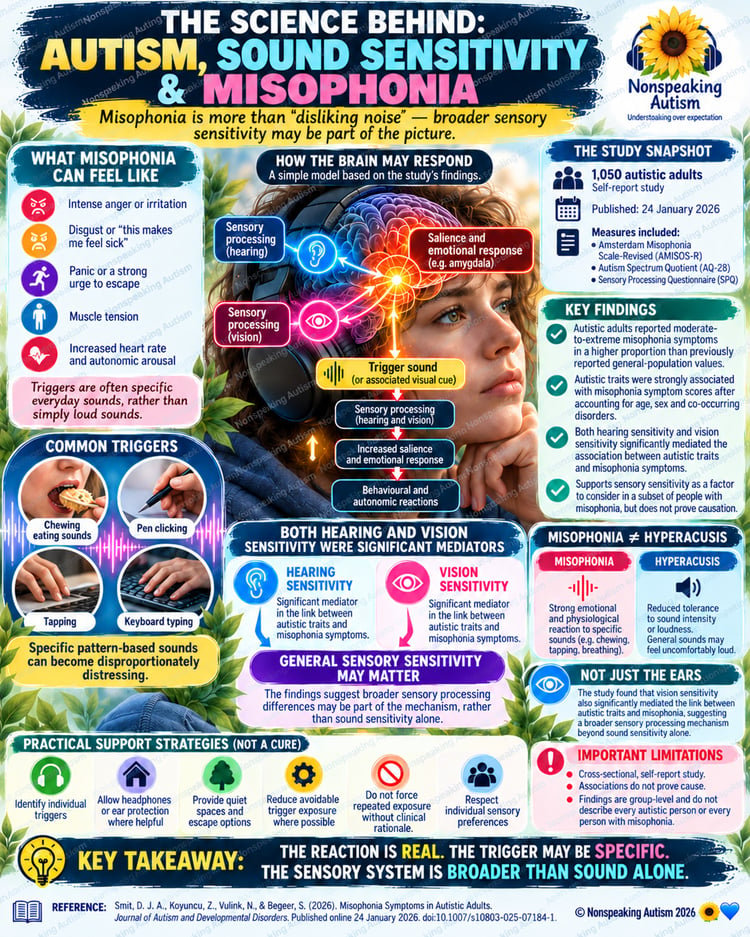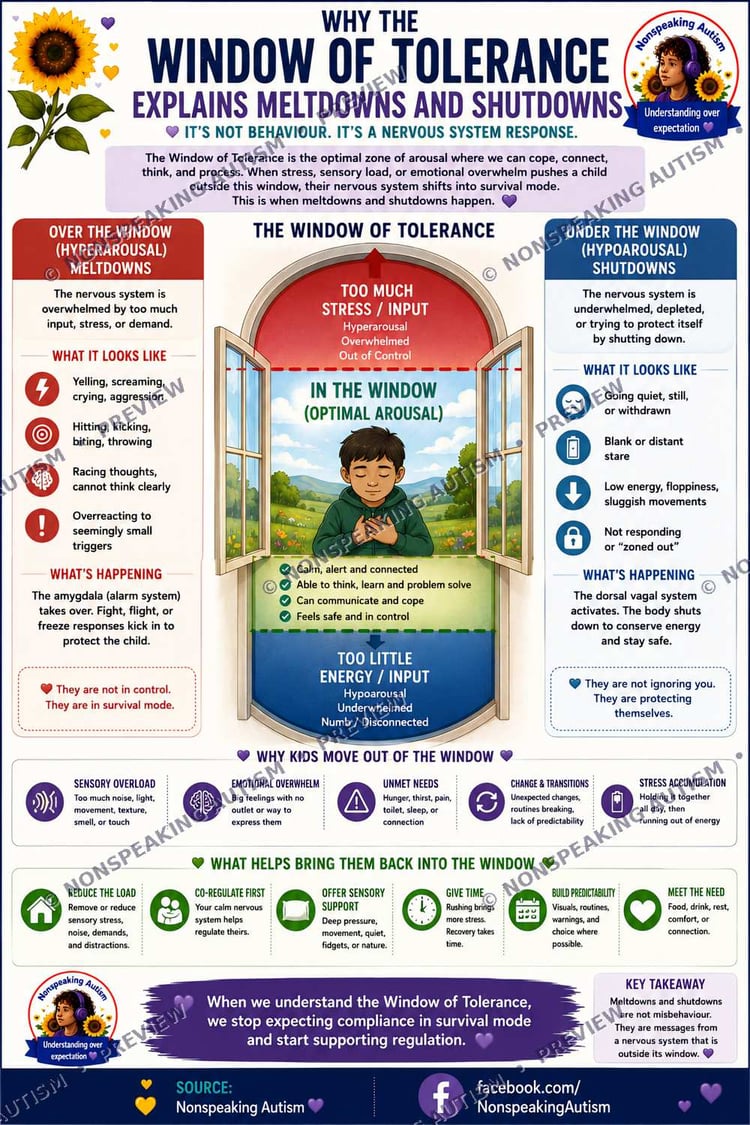

Crisis & Regulation Framework Phase 2: De-Escalation & Co-Regulation — Yellow Zone
Crisis & Regulation Framework
Phase 2: De-Escalation & Co-Regulation — Yellow Zone
Distress Is Rising • Reduce Pressure Before It Becomes a Crisis
When an autistic person begins showing signs of increasing distress, the goal is not to push through, demand calmness or increase compliance.
It is to notice what is changing and ask:
“What can I remove, reduce or change so their nervous system has less to manage?”
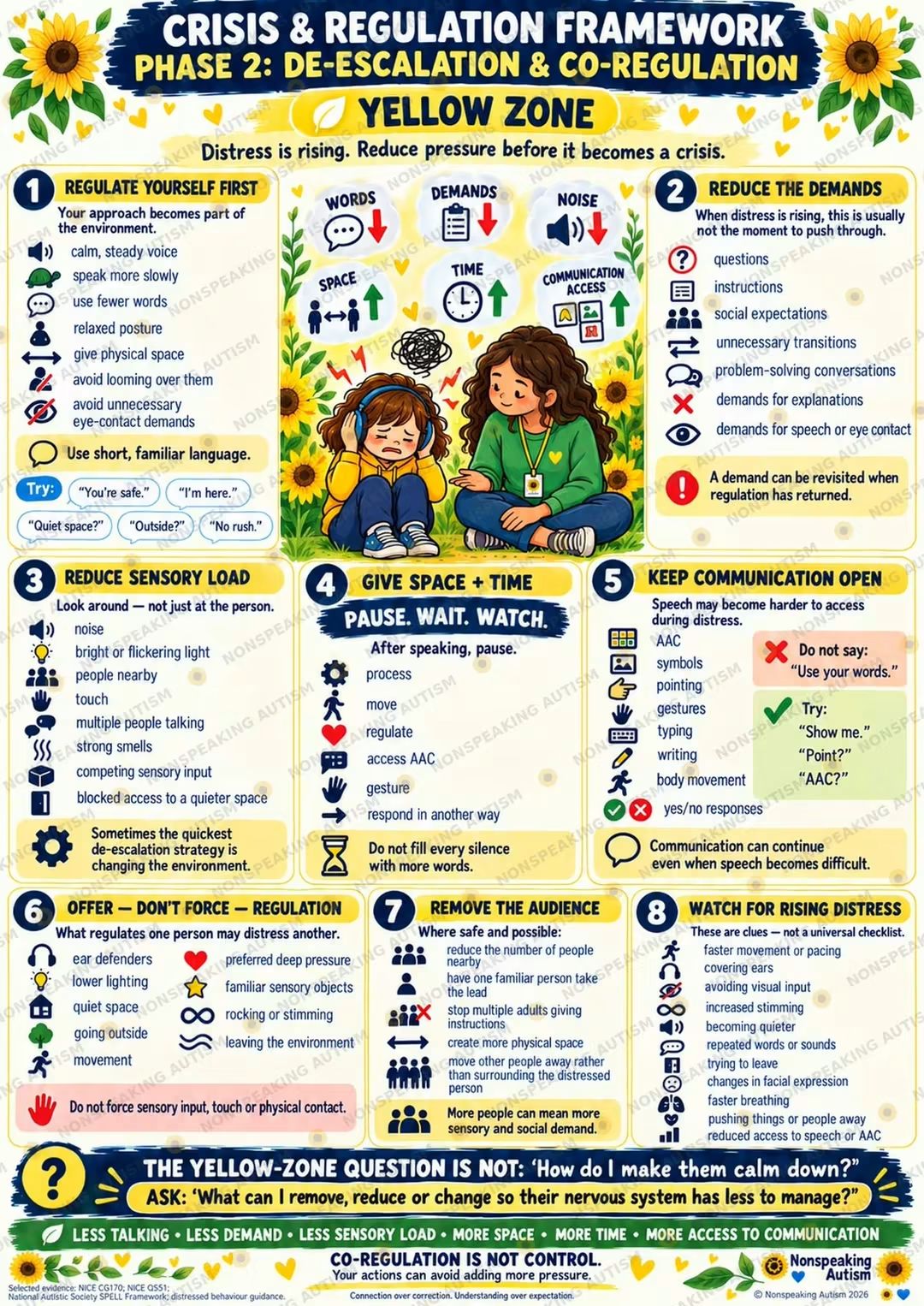
Phase 2: De-Escalation & Co-Regulation — Yellow Zone is a practical, research- and guidance-informed educational poster from Nonspeaking Autism, designed to help parents, carers, educators and professionals respond to rising distress with less pressure, less sensory load, more processing time and continued access to communication.
The emphasis is on responding before distress becomes a crisis.
🟡 What Does “Yellow Zone” Mean?
In this resource, Yellow Zone is an educational way of describing a period when a person's distress or regulatory load appears to be increasing.
It is not a diagnosis, validated clinical stage or universal sequence.
People show rising distress differently. One person may become louder or move more; another may become very quiet, withdraw, lose access to speech, seek repetitive movement or attempt to leave.
The person's individual pattern matters more than the label.
1️⃣ Regulate Yourself First
Your approach becomes part of the environment.
When distress is increasing, supporters can consider:
- using a calm, steady voice
- speaking more slowly
- using fewer words
- maintaining a relaxed posture
- giving physical space
- avoiding looming over the person
- reducing unnecessary eye-contact demands
- using short, familiar language
Simple phrases might include:
“You're safe.”
“I'm here.”
“Quiet space?”
“Outside?”
“No rush.”
The aim is not to make the person perform calmness.
It is to avoid unnecessarily adding to the pressure they are already managing.
2️⃣ Reduce the Demands
When distress is rising, this is often not the best time to push through.
Where safely possible, consider temporarily reducing:
- questions
- instructions
- social expectations
- unnecessary transitions
- problem-solving conversations
- demands for explanations
- demands for speech
- demands for eye contact
Reducing a demand during significant distress does not mean the demand can never be revisited.
A demand can be revisited when regulation has returned.
The immediate priority is helping reduce the amount the person has to process.
3️⃣ Reduce Sensory Load
Look around — not just at the person.
Consider whether the environment contains:
- excessive noise
- bright or flickering lights
- too many people nearby
- unexpected or unwanted touch
- multiple people talking
- strong smells
- competing sensory input
- crowds
- blocked access to a quieter area
Sometimes one of the quickest ways to reduce pressure is to change the environment rather than asking the person to change their behaviour.
4️⃣ Give Space + Time
PAUSE. WAIT. WATCH.
After speaking, pause.
Give the person time to:
- process
- move
- regulate
- access AAC
- gesture
- communicate
- respond in another way
- simply have a period without additional demands
Repeatedly filling silence with more instructions or questions can create additional processing load.
Do not fill every silence with more words.
5️⃣ Keep Communication Open
Speech can become harder to access during distress for some autistic people.
Communication should therefore expand rather than disappear.
Continue to respect:
- AAC
- symbols
- pointing
- gestures
- typing
- writing
- body movement
- speech
- familiar yes/no responses
- other individualized communication methods
Instead of:
“Use your words.”
Consider:
“Show me.”
“Point?”
“AAC?”
Reduced access to speech should not automatically be interpreted as refusal, defiance or lack of understanding.
Communication can continue even when speech becomes difficult.
6️⃣ Offer — Don't Force — Regulation
What regulates one person may distress another.
Possible supports might include:
- ear defenders
- lower lighting
- a quiet space
- going outside
- movement
- preferred deep pressure
- familiar sensory objects
- rocking or stimming
- leaving an overwhelming environment
But sensory input should be individualized, preferred and safe.
Do not assume deep pressure, touch, movement or another sensory strategy will help simply because it helps somebody else.
Never force sensory input, touch or physical contact as a regulation strategy.
7️⃣ Remove the Audience
More people can mean more:
noise • movement • language • social demand • unpredictability
Where safe and possible:
- reduce the number of people nearby
- allow one familiar person to take the lead
- stop multiple adults giving instructions
- create more physical space
- move other people away rather than surrounding the distressed person
A crowd of people trying to help can unintentionally become another source of overload.
More support does not always mean more people.
8️⃣ Watch for Rising Distress
Early signs are highly individual.
Possible clues might include:
- faster movement or pacing
- covering ears or eyes
- avoiding visual input
- increased stimming
- becoming quieter
- repeated words or sounds
- attempting to leave
- changes in facial expression
- faster breathing
- pushing objects or people away
- reduced access to speech or AAC
- seeking additional movement or pressure
These are clues, not a universal checklist.
The same behaviour can have different meanings for different people — or even for the same person in different situations.
Look for changes from that individual's usual pattern.
❤️ Co-Regulation Is Not Control
Co-regulation is not about one person controlling another person's nervous system.
It is about recognising that our actions can increase or decrease the amount of pressure in an interaction.
A calm supporter cannot guarantee that distress will disappear.
But supporters can consider whether their:
- voice
- language
- proximity
- demands
- movements
- expectations
- timing
- touch
- environment
are adding unnecessary load.
Your actions can avoid adding more pressure.
🧠 Regulation Does Not Mean “Looking Calm”
An autistic person may regulate through:
- movement
- pacing
- rocking
- stimming
- withdrawing
- reduced speech
- repetitive sounds
- seeking pressure
- leaving an environment
- using AAC
- sitting quietly
The aim should not automatically be to stop harmless regulatory behaviour because it looks unusual.
Ask instead:
“Is this helping the person cope safely?”
🩺 Don't Forget Pain and Physical Health
Rising distress is not always sensory or emotional.
Consider possible:
- pain
- illness
- headache
- dental pain
- gastrointestinal discomfort
- hunger
- thirst
- fatigue
- toileting needs
- medication effects
- temperature discomfort
- sleep disruption
Sudden, severe, unusual or persistent changes should not automatically be attributed to autism.
Appropriate medical assessment may be needed.
🔬 Research & Guidance-Informed
This poster draws on broader autism and distress-support principles that emphasise understanding communication, sensory differences, physical and mental health, environmental factors, predictability and individualized patterns.
NICE autism guidance recommends considering factors that may contribute to behaviour that challenges, including communication difficulties, physical or mental-health conditions, sensory environments, changes in routine and the social environment.
NICE guidance on behaviour that challenges also emphasises proactive and preventative strategies, environmental modification and understanding the function and context surrounding behaviour.
These principles support an individualized approach rather than assuming that one de-escalation strategy will work for every autistic person.
📚 Selected References & Guidance
National Institute for Health and Care Excellence (NICE). (2013, updated). Autism spectrum disorder in under 19s: support and management (CG170).
Relevant to communication, sensory sensitivities, environmental adjustments and understanding factors contributing to behaviour that challenges.
National Institute for Health and Care Excellence (NICE). Autism (QS51).
Quality standard addressing individualized, coordinated and appropriate support for autistic people.
National Institute for Health and Care Excellence (NICE). (2015). Challenging behaviour and learning disabilities: prevention and interventions for people with learning disabilities whose behaviour challenges (NG11).
Includes guidance concerning assessment of behaviour, environmental factors, communication, proactive strategies and reactive approaches.
National Autistic Society. Guidance on distressed behaviour, meltdowns and supporting autistic people, including consideration of sensory environments, communication, triggers and individualized support.
🔬 Up-to-date research (2024–2026) Multimethod examination of change in autistic preschoolers' emotion dysregulation in the context of parenting stress intervention. (2026). Journal of Child Psychology and Psychiatry. [Author list and DOI to be confirmed.] → Supports: 1 Regulate Yourself First; "Co-regulation is not control" Differential relations between parenting and emotion regulation in children with ASD across dyadic and independent contexts. (2025, published online 16 January 2025). [Peer-reviewed journal article; author list and journal details to be confirmed.] → Supports: 1 Regulate Yourself First; co-regulation Luo, H., et al., & Schwarzlose, R. (2026). Specific, replicable behavioral and neural correlates of sensory over-responsivity in childhood. Journal of the American Academy of Child & Adolescent Psychiatry. Published online 13 August 2026. → Supports: 3 Reduce Sensory Load Tavassoli, T., Marco, E. J., & Puts, N. A. J. (2026). Sensory reactivity in autism: Integrating behavioural, affective, physiological, and neural dimensions. Current Psychiatry Reports, 28, Article 36. → Supports: 3 Reduce Sensory Load; 8 Watch for Rising Distress Bird, S., Moid, L. A. E., Jones, C. A., & Surtees, A. D. R. (2024). The relationships between restrictive/repetitive behaviours, intolerance of uncertainty, and anxiety in autism: A systematic review and meta-analysis. Research in Autism Spectrum Disorders, 117, 102428. → Supports: 2 Reduce the Demands (unnecessary transitions; uncertainty) Chen, Y., Xi, Z., Saunders, R., Simmons, D., Totsika, V., & Mandy, W. (2024). A systematic review and meta-analysis of the relationship between sensory processing differences and internalising/externalising problems in autism. Clinical Psychology Review, 114, 102516. https://doi.org/10.1016/j.cpr.2024.102516 → Supports: 3 Reduce Sensory Load; 7 Remove the Audience Therrien, M. C. S., Whalon, K., Nunes, D., Marti, P., & Sellers, A. (2025). A systematic review of AAC interventions using speech generating devices for autistic preschoolers. Augmentative and Alternative Communication, 41(2). https://doi.org/10.1080/07434618.2025.2479768 → Supports: 4 Give Space + Time; 5 Keep Communication Open Piller, A., McHugh Conlin, J., Glennon, T. J., Andelin, L., Auld-Wright, K., Teng, K., & Tarver, T. (2025). Systematic review of sensory-based interventions for children and youth (2015–2024). Frontiers in Pediatrics, 13, 1720179. https://doi.org/10.3389/fped.2025.1720179 → Supports: 6 Offer — Don't Force — Regulation ("What regulates one person may distress another") Morris, I. F., Sykes, J. R., Paulus, E. R., Dameh, A., Razzaque, A., Vander Esch, L., Gruenig, J., & Zelazo, P. D. (2025). Beyond self-regulation: Autistic experiences and perceptions of stimming. Neurodiversity, 3. https://doi.org/10.1177/27546330241311096 → Supports: 6 "rocking or stimming"; 8 "increased stimming" Paris, K., Lodestone, A. Z., Houser, M., & Lewis, L. F. (2025). "Shutdowns are like you're stuck on the blue screen of death": A metaphor analysis of autistic shutdowns. Autism in Adulthood, 8(4), 687–697. https://doi.org/10.1089/aut.2024.0193 → Supports: 8 Watch for Rising Distress ("becoming quieter"; "reduced access to speech or AAC") Kumar, J., Hartzell, C., Abelson, E., Jastrowski Mano, K., & Chidambaran, V. (2026). Prevalence, expression, assessment, mechanisms, and management of pain in autistic children: A scoping review. A&A Practice, 20(4), e02178. https://doi.org/10.1213/XAA.0000000000002178 → Supports: 8 Watch for Rising Distress (distress may reflect pain or physical discomfort)
📖 Evidence Note
The references above support the broader principles behind this educational resource.
They should not be interpreted as evidence that every strategy on the poster will de-escalate every situation.
The Yellow Zone, eight sections and specific framework presented here are educational organizing tools created by Nonspeaking Autism. They are not a validated clinical de-escalation scale or universal neurological sequence.
Individual preferences, communication, medical needs, sensory profiles, history and safety circumstances should guide support.
👨👩👧 Who Is This Resource For?
This poster may be useful for:
- parents and carers
- autistic people and their supporters
- teachers and teaching assistants
- SENCOs and SEND teams
- mainstream and specialist schools
- support workers
- respite services
- occupational therapists
- speech and language therapists
- healthcare professionals
- social-care professionals
- psychologists and behavioural professionals
- multidisciplinary teams
- autism and disability organisations
Ideal for home, classrooms, staff rooms, professional training, support planning and reflective discussions.
📦 What You Receive
Your purchase includes:
1 × Crisis & Regulation Framework — Phase 2: De-Escalation & Co-Regulation — Yellow Zone educational poster
1 × high-resolution printable digital PDF
The purchased file is supplied clear and without the promotional preview watermark shown in the Payhip listing images.
Watermarks visible on promotional images are for preview and copyright protection only.
Digital download only — no physical product will be shipped.
⚠️ Important Safety & Professional Disclaimer
This resource is for educational and informational purposes only.
It is not a medical assessment, diagnosis, psychological assessment, behavioural assessment, Functional Behaviour Assessment, risk assessment, safeguarding plan, individualized crisis plan, restraint protocol, treatment plan or substitute for individualized professional advice.
The Yellow Zone is an educational concept and is not a validated clinical stage.
Strategies should be individualized. A sensory input that helps one person may be neutral, unpleasant or distressing to another. Touch and deep pressure should never be assumed to be wanted.
This resource does not provide instructions for restraint, seclusion or restrictive intervention.
Where behaviour presents a foreseeable significant risk of harm, seek appropriately qualified professional support and individualized safety planning.
Sudden, severe, unusual or unexplained changes in behaviour, communication, consciousness or physical functioning may have a medical cause and warrant appropriate assessment.
For a serious injury or medical emergency, contact the appropriate emergency service.
©️ Copyright & Permitted Use
Copyright © 2026 Nonspeaking Autism. All rights reserved.
Purchase permits use for personal and family use, your own classroom or educational setting, your own clinic or individual professional educational practice, and direct support work with people you support.
The file may not be resold, redistributed, file-shared, uploaded elsewhere, commercially reproduced, altered for resale or incorporated into another product for sale or distribution.
Please direct others who require their own copy to the original Nonspeaking Autism listing.
💛 The Message Behind the Resource
When distress begins to rise, the answer is not always to add another instruction.
Sometimes support means removing something.
Fewer words.
Fewer demands.
Less sensory load.
More space.
More processing time.
More access to communication.
More individualized support.
Instead of asking:
“How do I make them calm down?”
Ask:
“What can I remove, reduce or change so their nervous system has less to manage?”
LESS TALKING • LESS DEMAND • LESS SENSORY LOAD • MORE SPACE • MORE TIME • MORE ACCESS TO COMMUNICATION
Co-regulation is not control.
Connection over correction. Understanding over expectation. 💛🌻
© Nonspeaking Autism 2026