
Autistic Girls & Women
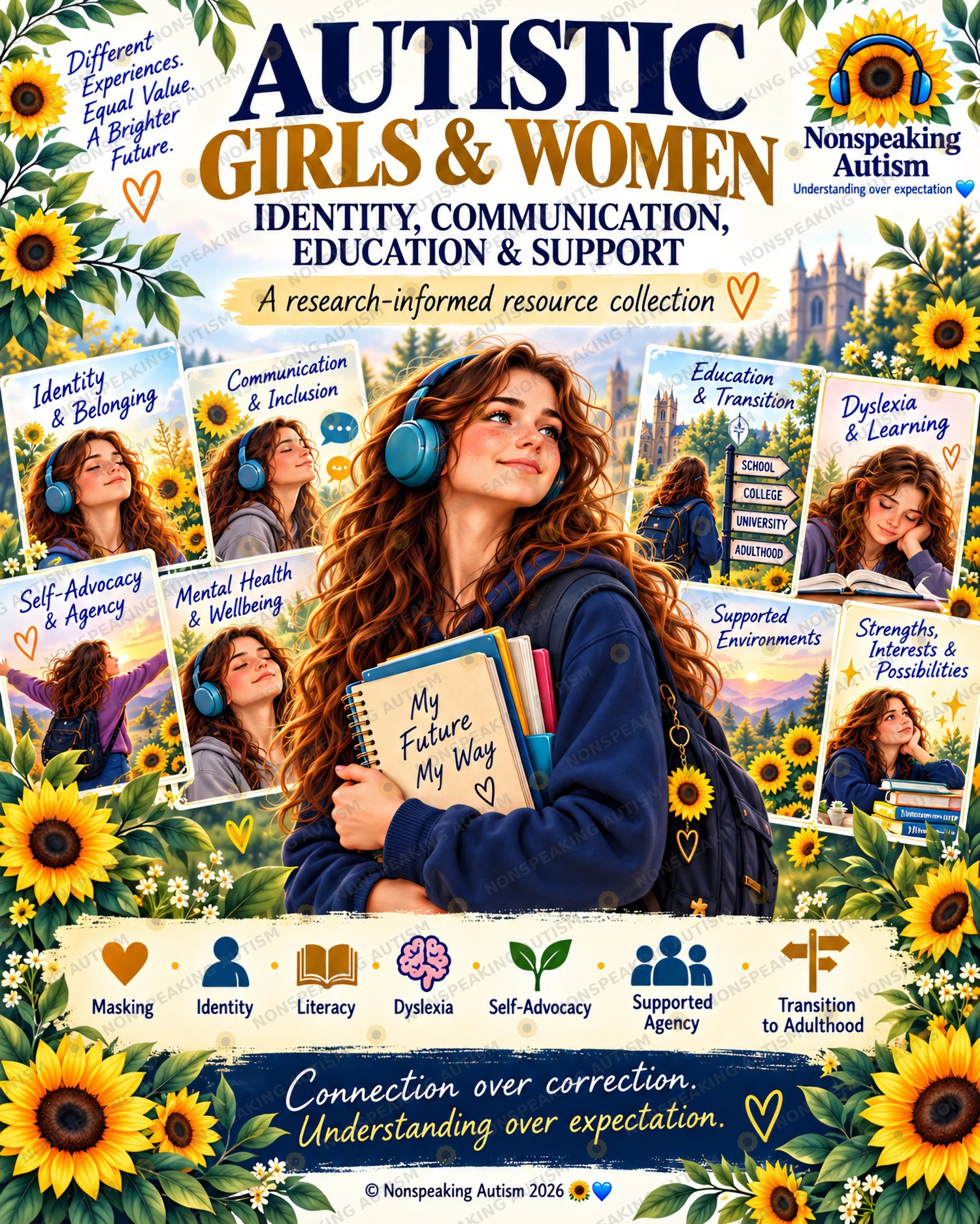
Autistic Girls & Women
Identity, Communication, Education & Support
A Research-Informed Resource Collection
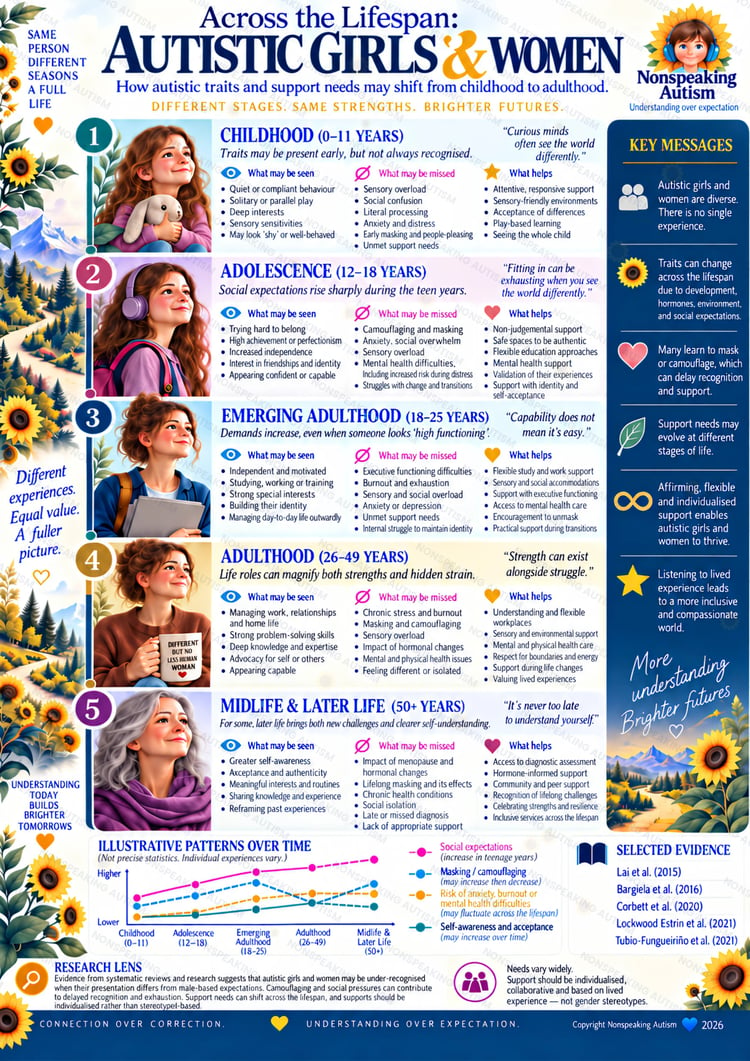
Autistic girls and women are not one single group with one single presentation.
Their experiences, communication, sensory profiles, strengths, support needs, identities and life paths can be very different.
Yet historically, autism research and recognition have often been shaped by presentations more commonly identified in boys and men. This can contribute to some autistic girls and women being overlooked, misunderstood, identified later, or expected to cope without appropriate support.
Autistic Girls & Women: Identity, Communication, Education & Support is a comprehensive educational resource collection created to explore these experiences across childhood, adolescence, education and the transition towards adulthood.
Rather than asking autistic girls and women to become less visibly autistic, the collection focuses on:
Understanding • Communication • Belonging • Autonomy • Access • Wellbeing • Possibility
The message running throughout the collection is:
Different experiences. Equal value. A brighter future. 💛
🌻 What This Collection Explores
This collection brings together interconnected areas that can have a significant influence on the lives of autistic girls and women:
💛 Masking & Camouflaging
👤 Identity & Belonging
💬 Communication & Inclusion
📖 Literacy & Learning
🧠 Dyslexia & Learning Differences
🌱 Self-Advocacy & Agency
💗 Mental Health & Wellbeing
🏡 Supported Environments
✨ Strengths, Interests & Possibilities
🪧 Education & Transition to Adulthood
Together, the resources encourage families, educators and professionals to look beyond stereotypes and consider the whole person.
💛 Identity & Belonging
Autism is only one part of a person's identity.
Autistic girls and women may have their own:
personalities
interests
communication styles
sensory experiences
relationships
cultures
learning profiles
strengths
support needs
and ambitions.
This collection encourages support that allows autistic people to develop a positive understanding of themselves without being taught that their natural differences make them less valuable.
Belonging should not depend on successfully appearing non-autistic.
Different does not mean less.
🎭 Masking & Camouflaging
Some autistic people consciously or unconsciously change, hide or suppress aspects of themselves in social situations.
This may include:
rehearsing conversations
copying other people's social behaviour
forcing or monitoring eye contact
suppressing visible stimming
hiding sensory discomfort
carefully controlling facial expression or body language
following learned social scripts
or trying not to appear confused or overwhelmed.
Camouflaging is not exclusive to autistic girls and women, and not every autistic girl or woman masks.
However, research has identified camouflaging as an important consideration when understanding why autism may be less obvious in some people and why outward appearance does not always reflect internal effort.
A person appearing socially capable does not automatically mean that the situation is easy, comfortable or sustainable.
💬 Communication & Inclusion
Communication is broader than speech.
Depending on the person and situation, communication may involve:
spoken language
AAC
typing
writing
gesture
sign
symbols
facial expression
body movement
or combinations of different methods.
Communication access may also vary with:
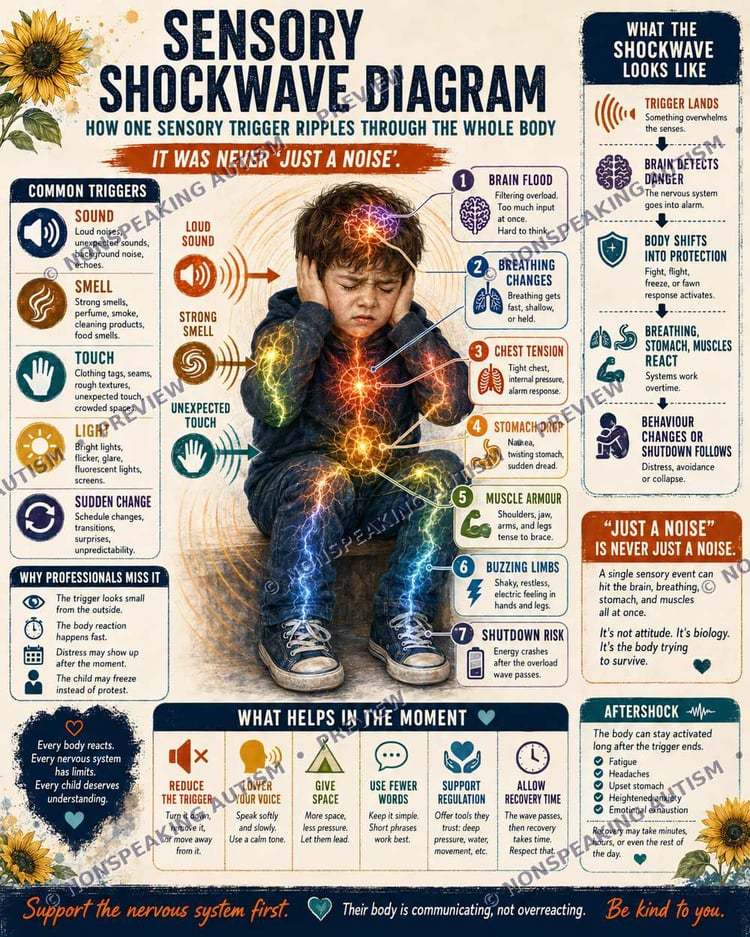
sensory load
stress
fatigue
environment
processing demands
familiarity
and feelings of safety.
The collection encourages adults to respond to the person's communication rather than judging competence solely through fluent speech, eye contact or conventional social behaviour.
Communication should create access — not become another test the person has to pass.
📚 Education & Learning
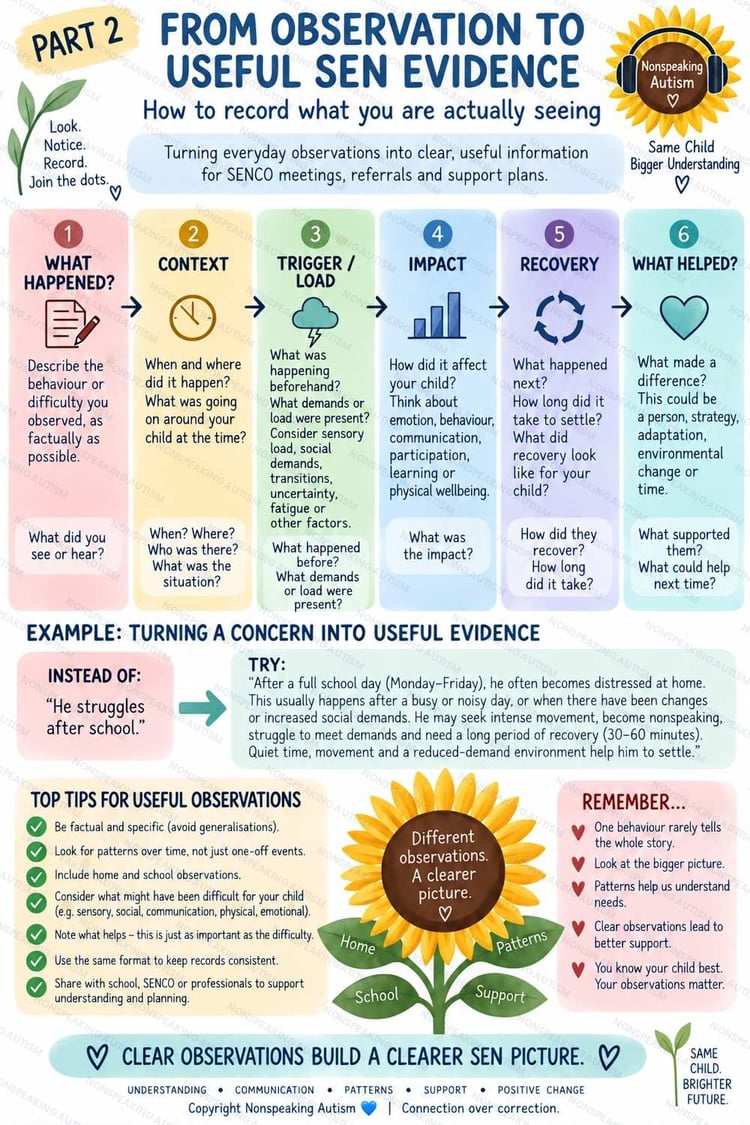
An autistic student's educational experience cannot be understood from academic attainment alone.
A student may achieve highly while simultaneously experiencing substantial difficulties with:
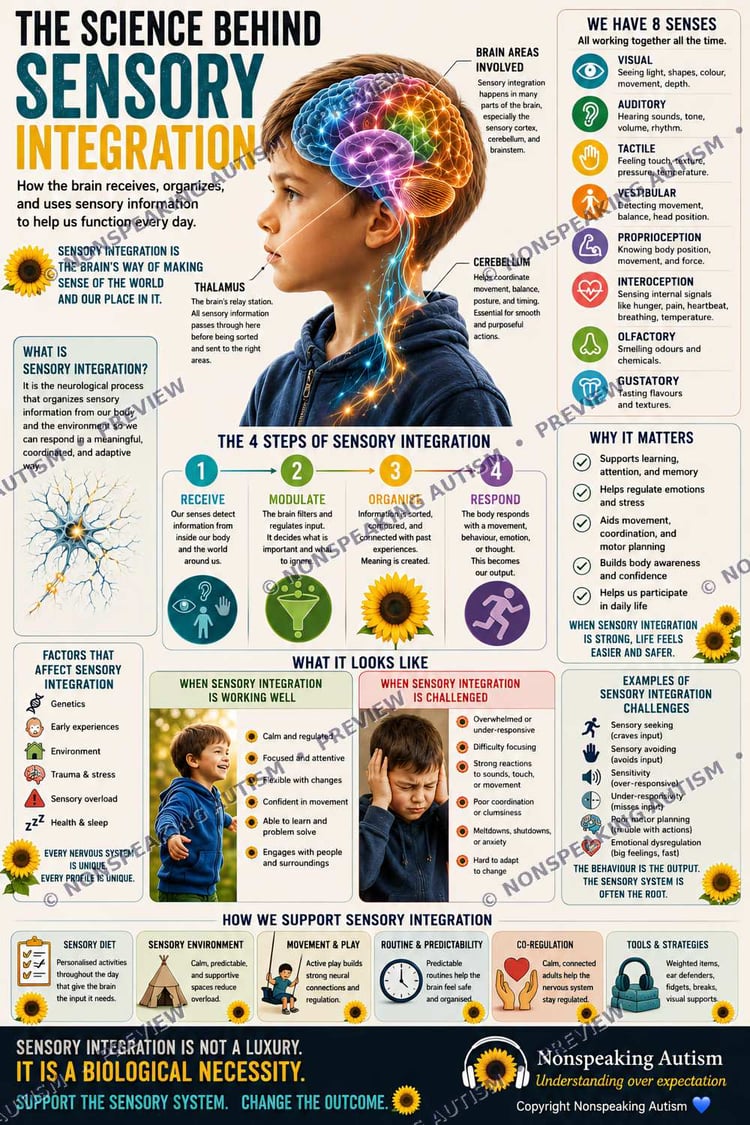
sensory environments
executive functioning
transitions
social demands
communication
uncertainty
fatigue
masking
or recovery after the school day.
Others may have significant learning or communication support needs that are immediately visible.
Both experiences matter.
Support should consider access, participation and wellbeing, not simply grades or outward classroom behaviour.
🧠 Dyslexia & Learning Differences
Autism does not determine one particular learning profile.
An autistic person may also experience dyslexia or other learning differences.
Someone may have significant strengths in one area while finding another much more difficult.
The collection encourages adults to avoid assumptions such as:
“She's too intelligent to need support.”
or
“If she can do this, she should be able to do that.”
Ability can be uneven.
Support needs can coexist with significant strengths.
Competence does not eliminate the need for accommodation.
🌱 Self-Advocacy & Agency
One of the most important long-term goals of support is not simply independence.
It is agency.
Agency includes having meaningful opportunities to:
make choices
communicate preferences
say no
ask for help
set boundaries
request accommodations
identify what works
participate in decisions
and influence what happens in one's own life.
For nonspeaking and minimally speaking people, self-advocacy must not be defined only through spoken language.
AAC and other reliable communication methods can be central to agency.
Support the person's voice — whatever form that voice takes.
💗 Mental Health & Wellbeing
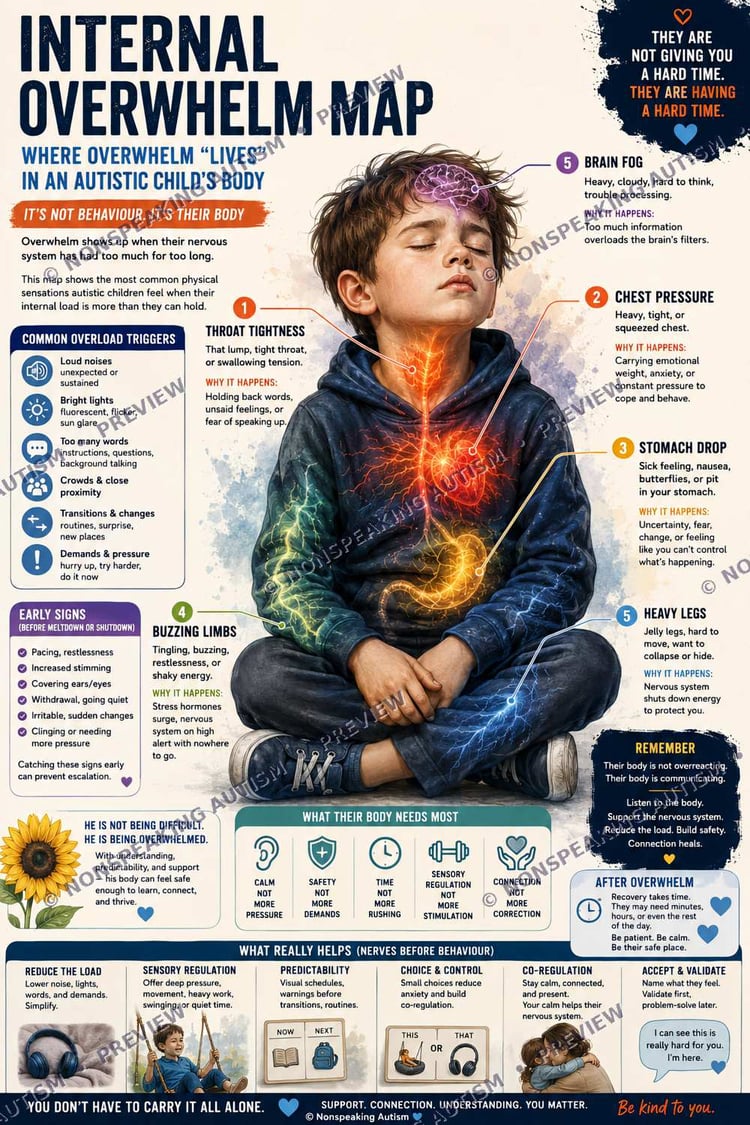
Wellbeing should never be measured only by how successfully someone appears to cope.
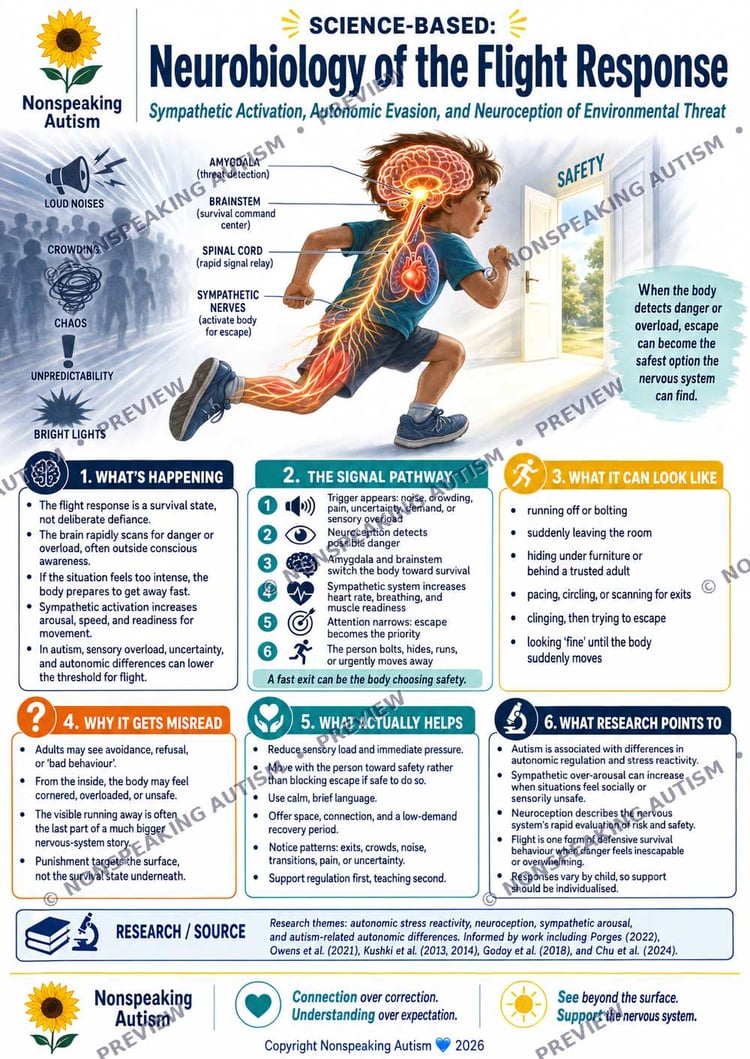
A person can look composed while experiencing significant internal stress.
When considering wellbeing, it may be useful to look at:
sensory load
social demands
masking
sleep
recovery
uncertainty
communication access
belonging
relationships
physical health
and whether the person's environment allows them to be themselves safely.
Mental-health concerns deserve appropriate professional assessment and should not automatically be attributed to autism.
🏡 Supported Environments
Sometimes the most effective intervention is not changing the autistic person.
It is changing what surrounds them.
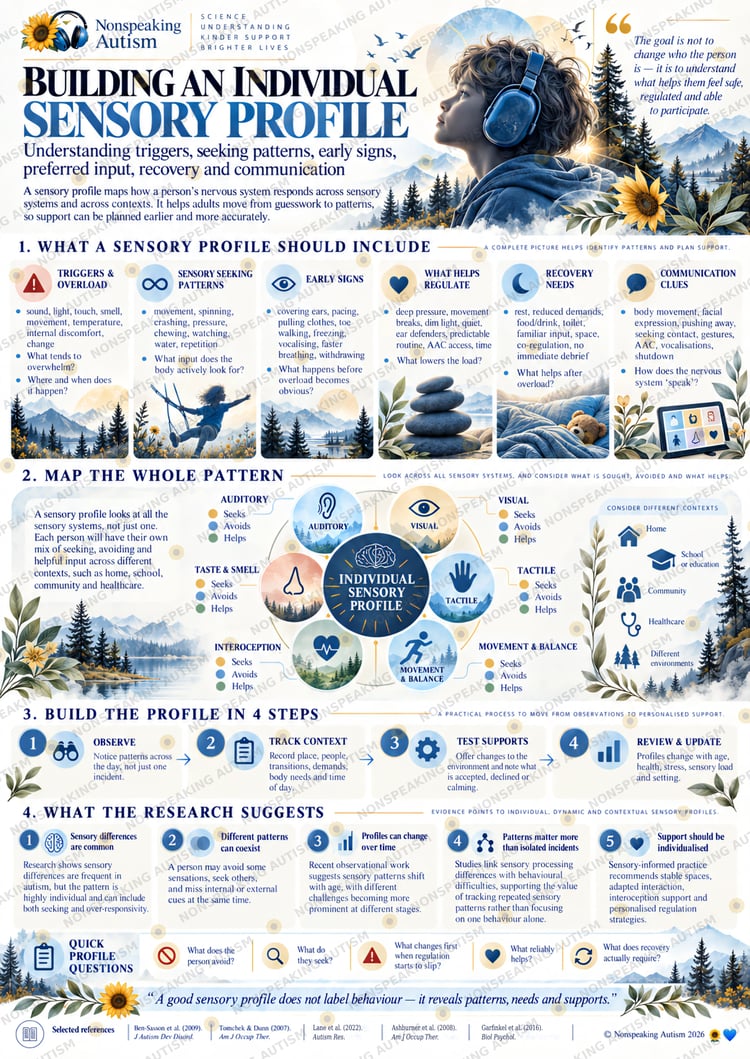
Supportive environments may involve:
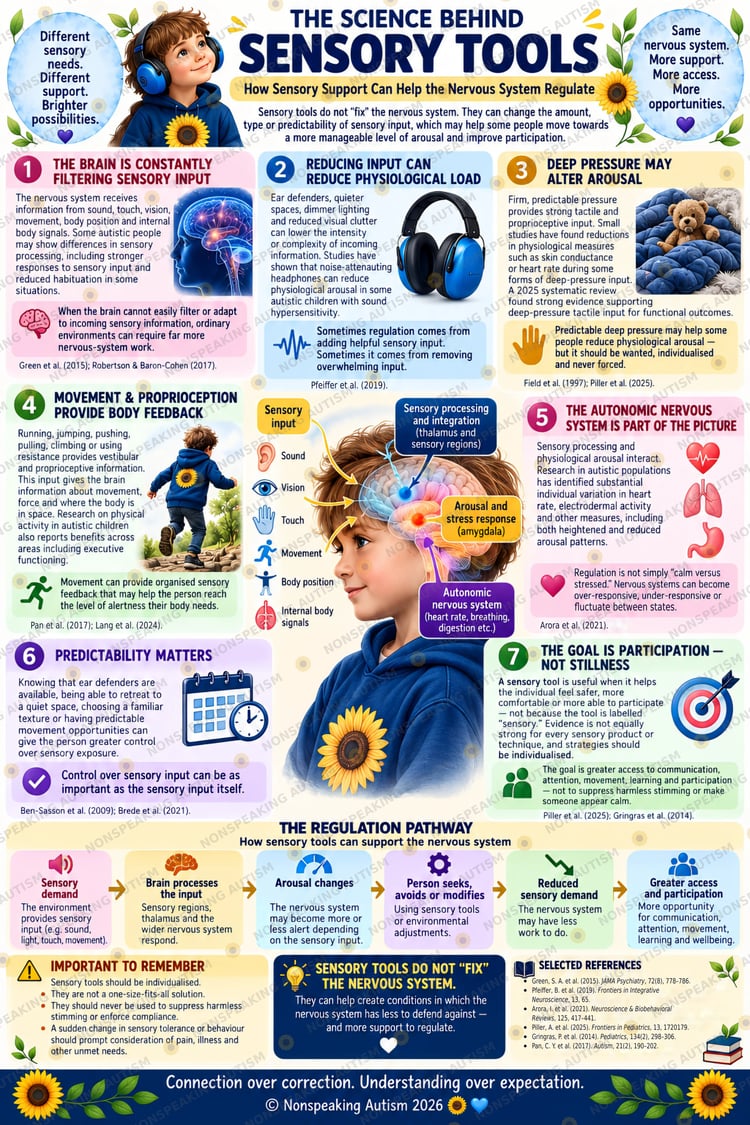
reduced unnecessary sensory load
clearer communication
greater predictability
accessible information
additional processing time
flexibility
sensory supports
AAC access
quiet or recovery spaces
reasonable adjustments
and adults who are willing to listen.
Accommodation is not about lowering a person's worth or potential. It is about reducing unnecessary barriers to access.
✨ Strengths, Interests & Possibilities
Autistic girls and women should not be described only through difficulty.
Interests, abilities and strengths deserve space too.
A strong interest may provide:
enjoyment
knowledge
identity
connection
regulation
learning
community
and even future educational or employment opportunities.
Strengths-based support does not mean ignoring genuine disability or support needs.
It means seeing both.
A person can need substantial support and still have enormous strengths, interests and possibilities.
🪧 Education & Transition to Adulthood
Leaving school is not simply an academic transition.
It can involve significant changes in:
routine
environment
relationships
expectations
support systems
transport
communication demands
independence
healthcare
and identity.
Transitions to college, university, employment, supported living or other adult pathways should therefore be considered individually.
There is no single successful adult outcome.
The goal is not to force everyone towards the same definition of independence.
A good future is one that works for the individual.
🌻 There Is No Single “Female Autism Profile”
This is particularly important throughout this collection.
There is no single way autistic girls or women look, communicate, socialize, learn or behave.
An autistic girl may:
have friends,
enjoy imaginative play,
make eye contact,
speak fluently,
achieve highly at school,
have intense interests that appear socially typical,
or appear socially confident.
None of these characteristics independently rules autism in or out.
Likewise, being shy, anxious, socially uncomfortable or having sensory differences does not by itself establish autism.
Individual assessment matters more than stereotypes.
🔬 Research-Informed & Neurodiversity-Affirming
The collection is informed by research concerning autistic girls and women, camouflaging, late recognition, communication, sensory experiences, mental health, education and autistic lived experience.
Research increasingly recognizes that traditional assumptions about autistic presentation can fail to capture the full diversity of autistic people.
At the same time, findings about autistic girls and women are group-level observations.
They should never be turned into a new stereotype.
Not every autistic girl masks.
Not every autistic woman is diagnosed late.
Not every autistic person experiences social situations, sensory input, communication or identity in the same way.
The resources therefore use language such as may, can, for some people and individual experiences vary wherever appropriate.
👨👩👧 Who Is This Collection For?
This resource collection may be useful for:
- autistic girls and women
- autistic young people approaching adulthood
- nonspeaking and minimally speaking autistic people
- AAC users
- parents and carers
- teachers and teaching assistants
- SENCOs and SEND teams
- colleges and universities
- occupational therapists
- speech and language therapists
- psychologists and other professionals
- support workers
- youth and community organizations
- autism and disability organizations
- anyone wanting a more individualized understanding of autistic girls and women
📦 What You Receive
Your purchase includes the Autistic Girls & Women — Identity, Communication, Education & Support resource collection.
The collection covers interconnected themes including:
Identity & Belonging
Communication & Inclusion
Education & Transition
Dyslexia & Learning
Self-Advocacy & Agency
Mental Health & Wellbeing
Supported Environments
Strengths, Interests & Possibilities
alongside wider themes including masking, identity, literacy, learning, autonomy and transition to adulthood.
All purchased resources are supplied as high-resolution digital files, clear and without the promotional preview watermarks visible on Payhip listing images.
Preview watermarks are used for copyright protection only.
This is a paid digital resource collection.
No physical product will be shipped.
⚠️ Important Educational, Medical & Professional Disclaimer
This collection is provided for educational, informational and support-planning purposes only.
It is not a diagnostic or screening tool and does not replace an individualized autism assessment, medical assessment, psychological assessment, educational assessment, occupational therapy assessment, speech and language assessment, mental-health assessment or advice from an appropriately qualified professional.
The characteristics, experiences and support approaches discussed throughout the collection are examples and possibilities, not criteria that apply to every autistic girl or woman.
No individual behaviour, communication style, sensory characteristic, friendship pattern, interest, masking behaviour or learning difference can establish or exclude an autism diagnosis by itself.
Mental-health symptoms, sudden changes in behaviour, communication changes, pain, significant distress or other health concerns should not automatically be attributed to autism. Appropriate medical or professional assessment should be sought where indicated.
Educational and support decisions should be individualized according to the person's circumstances, communication, preferences, strengths, needs and applicable professional guidance.
©️ Copyright & Permitted Use
Copyright © 2026 Nonspeaking Autism. All rights reserved.
Your purchase permits use of these resources for:
personal and family use
your own classroom or educational setting
your own clinic or individual professional practice
and direct educational/support work with the people you support.
The digital resources may not be resold, redistributed, file-shared, uploaded elsewhere, commercially reproduced, altered for resale or incorporated into another product for sale or distribution.
Please direct other individuals,
Nonspeaking Autism product listing schools or organizations wishing to obtain their own digital copy to the original.
💛 The Message Behind the Collection
Autistic girls and women do not need another set of expectations telling them how they are supposed to look, communicate, socialize, learn or succeed.
They need environments willing to understand the person who is actually there.
A girl who speaks fluently may still need support.
A woman who has learned to mask may still be exhausted.
A nonspeaking person still has a voice.
Someone who achieves academically can still be disabled.
Someone who requires substantial support still deserves agency.
And someone's future should never be defined solely by what other people believe autistic people can or cannot do.
The goal is not:
“How do we make her fit?”
It is:
“How do we create the understanding, communication access, education, support and opportunities that allow her to build a life that works for her?”
My Future. My Way. 💛
Different Experiences. Equal Value. A Brighter Future.
Connection over correction. Understanding over expectation.
© Nonspeaking Autism 2026 🌻💙