

Affirming Support for Autistic Girls & Women
Affirming Support for Autistic Girls & Women
Shifting from compliance and masking toward genuine understanding
An autistic girl can be polite, quiet, cooperative, achieving at school and meeting expectations — and still be struggling underneath.
An autistic woman can appear capable at work, maintain relationships and keep other people comfortable — while using enormous amounts of energy to manage sensory demands, social expectations, anxiety and masking.
Affirming Support for Autistic Girls & Women is a research-informed educational poster designed to help shift the focus from appearance and compliance toward genuine understanding, accessibility and individualised support.
Rather than asking, “How can we make her look less autistic?”, this resource encourages a more useful question:
“What does she need to feel safe, understood, supported and able to be herself?”
The central message is:
The goal is not to make autism less visible.
The goal is to make support more accessible.
🧠 What This Poster Explores
This visual resource explores the difference between appearing to cope and actually having the support and capacity to cope.
It covers:
- Why compliance may sometimes be mistaken for wellbeing
- Masking and camouflaging
- Hidden sensory overload
- Anxiety and mental fatigue
- Social pressure and hidden struggles
- The possible impact of continually suppressing needs
- Looking beyond outward appearance
- Reducing pressure to perform socially
- Flexible and accessible communication
- Sensory accommodations
- Autonomy, choice and boundaries
- Understanding behaviour as information
- Recovery and decompression
- Providing support before visible crisis
- Why affirming support must remain individualised
The resource does not assume that every autistic girl or woman experiences masking or hidden distress.
Instead, it encourages us to look beyond what is immediately visible and remain curious about the individual's actual experience.
🌻 When Compliance May Look Like Coping
Sometimes the person who looks easiest to support is working the hardest to appear that way.
An autistic girl or woman may appear:
- Polite
- Quiet
- Cooperative
- Able to meet expectations
- Capable at school or work
- Focused on keeping others comfortable
- Skilled at hiding difficulties
- Socially competent from the outside
These characteristics do not automatically indicate distress or masking.
But neither do they prove that somebody is comfortable.
Behind an outwardly capable presentation, there may be sensory overload, anxiety, mental fatigue, social pressure, masking or difficulties that other people cannot immediately see.
This is why support should not depend entirely on visible behaviour.
Looking fine on the outside does not tell us everything happening underneath.
💛 From Compliance to Affirming Support
Affirming support does not mean removing every challenge or expectation.
It means creating conditions in which an autistic person can participate without being unnecessarily required to hide, suppress or override their needs in order to be accepted.
The aim is to help someone feel:
Authentic.
Supported.
Understood.
Accepted.
Able to be herself.
It may mean reducing unnecessary pressure, improving communication access, adapting sensory environments, respecting boundaries and recognising the need for recovery.
When the environment becomes more accessible, the person has more opportunity to use their energy for learning, relationships, interests, participation and everyday life.
People flourish when pressure to mask is replaced with understanding.
👁️ 1. Look Beyond Appearance
Support should respond to need — not simply to how capable or socially fluent somebody appears.
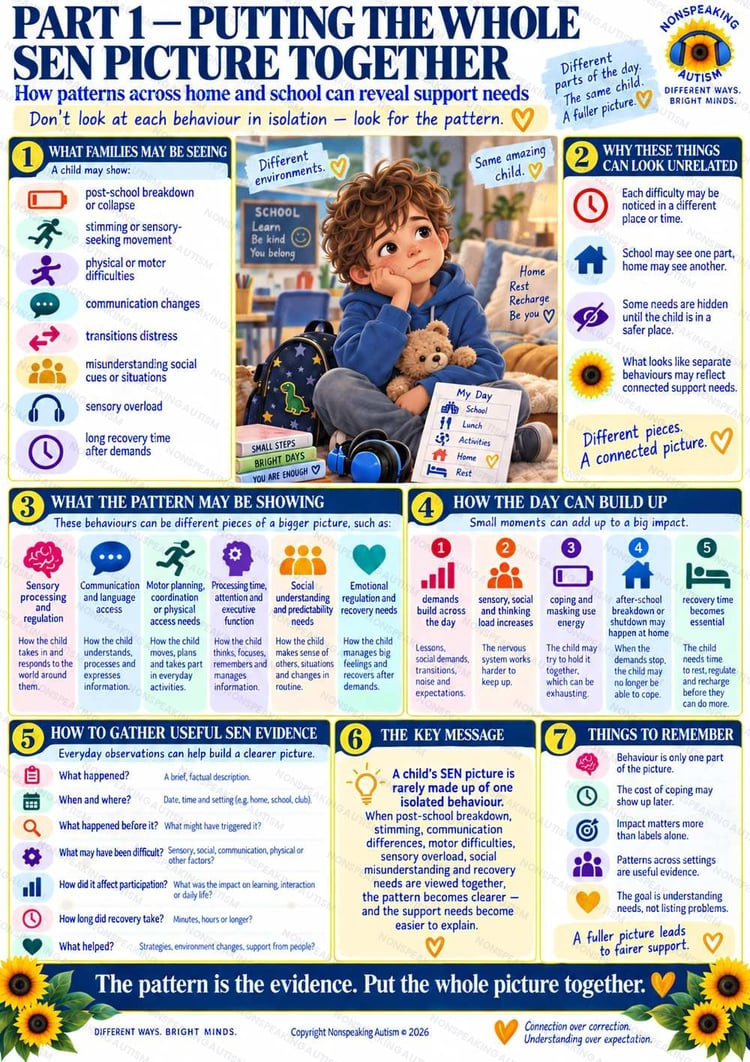
Some autistic people may camouflage distress or differences so effectively that their support needs become less visible.
A person can appear socially comfortable while experiencing considerable uncertainty.
A student can achieve academically while struggling with sensory overload or exhaustion.
An employee can perform well while finding the environment extremely demanding.
A child can remain quiet in school and release accumulated distress when she reaches a safer environment.
There is often more than meets the eye.
💬 2. Reduce Pressure to Perform
Eye contact, small talk, facial expression, body language and other conventional social behaviours should not automatically be treated as reliable measures of:
attention, engagement, effort, understanding or respect.
An autistic person may listen better while looking away.
She may need additional processing time before answering.
Her facial expression may not communicate her internal emotional state in the way other people expect.
Reducing unnecessary performance demands can free cognitive and emotional resources for the interaction that actually matters.
Different does not mean disinterested.
🗣️ 3. Make Communication Flexible
Communication access should not depend on somebody being able to communicate in one particular way.
Depending on the individual, helpful options may include:
- Speech
- AAC
- Text or typing
- Writing
- Gestures
- Visual communication
- Additional processing time
- Silence or pauses
- Other preferred communication methods
Speech ability can also fluctuate with stress, sensory load, fatigue, environment and processing demands.
The goal should be successful communication — not forcing one communication method.
Different ways to communicate. Same value.
🎧 4. Design for Sensory Access
An environment can create barriers before an activity has even begun.
Bright or fluorescent lighting, background noise, crowded rooms, uncomfortable clothing, unpredictable sensory input or lack of movement opportunities can significantly increase demand for some autistic people.
Sensory-aware support may include:
- Quieter spaces
- Reduced or adjustable lighting
- Comfortable clothing options
- Movement opportunities
- Regular breaks
- Sensory tools where helpful
- Greater environmental predictability
- Respect for individual sensory preferences
Sensory support should always be based on the person's own needs rather than assuming that every autistic person requires the same accommodations.
A calmer environment can make learning, working and belonging more accessible.
🧭 5. Support Autonomy
Autistic people should be active participants in decisions about their own support wherever possible.
This can mean:
Offering meaningful choices.
Explaining what will happen.
Involving the person in decisions.
Respecting boundaries.
Taking “no” seriously.
Asking what actually helps.
For children, autonomy should be supported in developmentally appropriate ways while adults continue to meet their responsibilities for safety and care.
Support should aim to work with the person rather than simply achieving compliance from them.
Choice builds safety and trust.
6. Understand Behaviour as Information
A change in behaviour can communicate something important.
Withdrawal, shutdown, reduced speech, repetitive movement, leaving a situation or changes in expression may occur alongside:
- Sensory overload
- Fatigue
- Uncertainty
- Communication difficulty
- Emotional overwhelm
- Pain or discomfort
- A need for regulation
- A need to escape an unsustainable demand
Behaviour alone cannot tell us exactly what is happening.
But instead of immediately asking, “How do we stop this behaviour?”, it can be more useful to ask:
“What might this behaviour be communicating?”
Behaviour communicates. Listen with curiosity.
🔋 7. Support Recovery Without Judgement
Recovery is not laziness.
After school, work, social events, appointments or demanding environments, an autistic person may need significant time to decompress.
Helpful recovery might involve:
- Solitude
- Reduced conversation
- Familiar activities
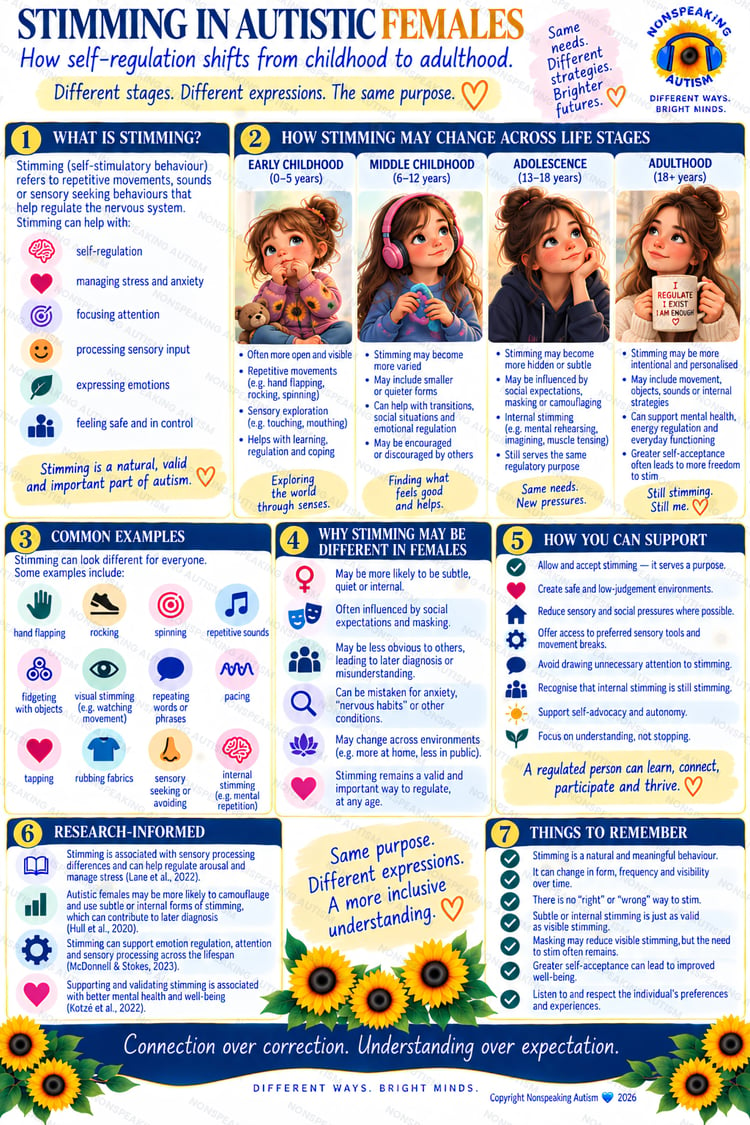
- Stimming
- Movement
- Rest
- Reduced sensory input
- Special interests
- Predictable routines
- Fewer immediate demands
A person coping successfully in public does not necessarily mean there was no cost afterwards.
Building recovery into everyday life can help reduce cumulative demand.
Rest is productive. Recovery enables more tomorrows.
🤝 8. Accommodate Without Requiring Proof of Distress
Support should not begin only after somebody reaches crisis.
Requiring visible distress before providing a reasonable accommodation can mean waiting until a person's capacity has already been exceeded.
Where appropriate, preventative accommodations may reduce cumulative sensory, cognitive and emotional load.
That could mean offering a quieter environment before overload occurs, allowing communication alternatives before speech becomes difficult, providing breaks before exhaustion or allowing predictability before uncertainty becomes overwhelming.
Support early. Support consistently.
🌱 What Affirming Support Can Look Like
Affirming support is not a single technique.
It is an approach built around the individual.
It may involve accepting autistic communication and movement, adapting environments, reducing unnecessary social-performance demands, recognising sensory needs, respecting autonomy, supporting recovery and listening carefully to lived experience.
Most importantly, it does not measure success by how non-autistic somebody can appear.
The aim is not better masking.
The aim is greater access, participation, safety, autonomy and wellbeing.
🔬 Research-Informed
This resource is informed by research examining autistic females, camouflaging, recognition, lived experience and the potential consequences of trying to meet neurotypical social expectations.
The poster draws on selected peer-reviewed work including:
Lai et al. (2015) — research contributing to understanding sex/gender differences in autism and the importance of recognising diversity in autistic presentation.
Lockwood Estrin et al. (2021) — work contributing to understanding sex/gender-related differences in autism and pathways to recognition.
Tubío-Fungueiriño et al. (2021) — a systematic review of social camouflaging in autistic females.
Pearson & Rose (2021) — work exploring autistic masking and the relationship between identity, stigma and social context.
Research on camouflaging suggests that some autistic people use strategies to conceal, compensate for or adapt aspects of their autistic presentation. However, camouflaging is not exclusive to girls and women, not every autistic female masks, and experiences vary considerably between individuals.
The research therefore supports a broader principle reflected throughout this resource:
Needs should be understood individually rather than inferred from appearance or gender stereotypes alone.
👩👧 Who Is This Resource For?
This poster may be particularly useful for:
- Autistic girls and women
- Parents and carers
- Families and partners
- Teachers and teaching assistants
- SENCOs and SEND teams
- Mainstream and specialist schools
- Colleges and universities
- Autism and inclusion teams
- Occupational therapists
- Speech and language professionals
- Psychologists and other relevant professionals
- Healthcare and social-care professionals
- Support workers
- Employers and workplace-support teams
- Family-support organisations
- Autism training and professional-development settings
It can be used at home, in classrooms, SEND spaces, colleges, workplaces, clinics, therapy settings and professional training as a visual starting point for conversations about masking, autonomy, accessibility and affirming support.
📦 What You Receive
Your purchase includes:
1 × Affirming Support for Autistic Girls & Women — Educational Poster
1 × high-resolution PDF
This is a digital educational resource from Nonspeaking Autism.
The purchased version is supplied clear and without the promotional preview watermark. Watermarks visible on Payhip listing images are used for preview and copyright-protection purposes only.
Digital download only — no physical product will be shipped.
⚠️ Important Disclaimer
This resource is provided for educational and informational purposes only.
It is not medical advice, a diagnostic tool, therapy, psychological treatment or a substitute for individual assessment or professional guidance.
The experiences described are examples and do not apply to every autistic girl or woman.
Being quiet, polite, cooperative, high-achieving or socially capable does not itself mean somebody is masking or experiencing hidden distress. Likewise, a person does not need to mask or appear outwardly capable for their autistic identity or support needs to be valid.
Masking and camouflaging can occur across genders.
Behaviour can have many possible causes. New, severe or unusual changes in behaviour, communication, functioning or wellbeing should not automatically be attributed to autism, sensory processing or emotional regulation; appropriate medical or professional assessment may be needed.
Communication and sensory accommodations should be individualised to the person's abilities, preferences, circumstances and needs.
Affirming practice should respect autonomy while recognising that safeguarding and appropriate support remain important.
💛 The Message Behind the Resource
A person should not have to reach crisis before we believe that something is difficult.
She should not have to make eye contact to prove that she is listening.
She should not have to speak when another communication method works better.
She should not have to suppress harmless movement to appear acceptable.
She should not have to exhaust herself performing capability before support becomes available.
And she should not have to become less visibly autistic in order for support to be considered successful.
Affirming support asks us to see beyond performance and become curious about the person underneath.
Because the goal is not compliance.
It is not better masking.
And it is not making autism disappear.
The goal is not to make autism less visible.
The goal is to make support more accessible.
See beyond the surface.
More understanding. Brighter futures.
Connection over correction.
Understanding over expectation.
Shifting from compliance and masking toward genuine understanding
An autistic girl can be polite, quiet, cooperative, achieving at school and meeting expectations — and still be struggling underneath.
An autistic woman can appear capable at work, maintain relationships and keep other people comfortable — while using enormous amounts of energy to manage sensory demands, social expectations, anxiety and masking.
Affirming Support for Autistic Girls & Women is a research-informed educational poster designed to help shift the focus from appearance and compliance toward genuine understanding, accessibility and individualised support.
Rather than asking, “How can we make her look less autistic?”, this resource encourages a more useful question:
“What does she need to feel safe, understood, supported and able to be herself?”
The central message is:
The goal is not to make autism less visible.
The goal is to make support more accessible.
🧠 What This Poster Explores
This visual resource explores the difference between appearing to cope and actually having the support and capacity to cope.
It covers:
- Why compliance may sometimes be mistaken for wellbeing
- Masking and camouflaging
- Hidden sensory overload
- Anxiety and mental fatigue
- Social pressure and hidden struggles
- The possible impact of continually suppressing needs
- Looking beyond outward appearance
- Reducing pressure to perform socially
- Flexible and accessible communication
- Sensory accommodations
- Autonomy, choice and boundaries
- Understanding behaviour as information
- Recovery and decompression
- Providing support before visible crisis
- Why affirming support must remain individualised
The resource does not assume that every autistic girl or woman experiences masking or hidden distress.
Instead, it encourages us to look beyond what is immediately visible and remain curious about the individual's actual experience.
🌻 When Compliance May Look Like Coping
Sometimes the person who looks easiest to support is working the hardest to appear that way.
An autistic girl or woman may appear:
- Polite
- Quiet
- Cooperative
- Able to meet expectations
- Capable at school or work
- Focused on keeping others comfortable
- Skilled at hiding difficulties
- Socially competent from the outside
These characteristics do not automatically indicate distress or masking.
But neither do they prove that somebody is comfortable.
Behind an outwardly capable presentation, there may be sensory overload, anxiety, mental fatigue, social pressure, masking or difficulties that other people cannot immediately see.
This is why support should not depend entirely on visible behaviour.
Looking fine on the outside does not tell us everything happening underneath.
💛 From Compliance to Affirming Support
Affirming support does not mean removing every challenge or expectation.
It means creating conditions in which an autistic person can participate without being unnecessarily required to hide, suppress or override their needs in order to be accepted.
The aim is to help someone feel:
Authentic.
Supported.
Understood.
Accepted.
Able to be herself.
It may mean reducing unnecessary pressure, improving communication access, adapting sensory environments, respecting boundaries and recognising the need for recovery.
When the environment becomes more accessible, the person has more opportunity to use their energy for learning, relationships, interests, participation and everyday life.
People flourish when pressure to mask is replaced with understanding.
👁️ 1. Look Beyond Appearance
Support should respond to need — not simply to how capable or socially fluent somebody appears.
Some autistic people may camouflage distress or differences so effectively that their support needs become less visible.
A person can appear socially comfortable while experiencing considerable uncertainty.
A student can achieve academically while struggling with sensory overload or exhaustion.
An employee can perform well while finding the environment extremely demanding.
A child can remain quiet in school and release accumulated distress when she reaches a safer environment.
There is often more than meets the eye.
💬 2. Reduce Pressure to Perform
Eye contact, small talk, facial expression, body language and other conventional social behaviours should not automatically be treated as reliable measures of:
attention, engagement, effort, understanding or respect.
An autistic person may listen better while looking away.
She may need additional processing time before answering.
Her facial expression may not communicate her internal emotional state in the way other people expect.
Reducing unnecessary performance demands can free cognitive and emotional resources for the interaction that actually matters.
Different does not mean disinterested.
🗣️ 3. Make Communication Flexible
Communication access should not depend on somebody being able to communicate in one particular way.
Depending on the individual, helpful options may include:
- Speech
- AAC
- Text or typing
- Writing
- Gestures
- Visual communication
- Additional processing time
- Silence or pauses
- Other preferred communication methods
Speech ability can also fluctuate with stress, sensory load, fatigue, environment and processing demands.
The goal should be successful communication — not forcing one communication method.
Different ways to communicate. Same value.
🎧 4. Design for Sensory Access
An environment can create barriers before an activity has even begun.
Bright or fluorescent lighting, background noise, crowded rooms, uncomfortable clothing, unpredictable sensory input or lack of movement opportunities can significantly increase demand for some autistic people.
Sensory-aware support may include:
- Quieter spaces
- Reduced or adjustable lighting
- Comfortable clothing options
- Movement opportunities
- Regular breaks
- Sensory tools where helpful
- Greater environmental predictability
- Respect for individual sensory preferences
Sensory support should always be based on the person's own needs rather than assuming that every autistic person requires the same accommodations.
A calmer environment can make learning, working and belonging more accessible.
🧭 5. Support Autonomy
Autistic people should be active participants in decisions about their own support wherever possible.
This can mean:
Offering meaningful choices.
Explaining what will happen.
Involving the person in decisions.
Respecting boundaries.
Taking “no” seriously.
Asking what actually helps.
For children, autonomy should be supported in developmentally appropriate ways while adults continue to meet their responsibilities for safety and care.
Support should aim to work with the person rather than simply achieving compliance from them.
Choice builds safety and trust.
6. Understand Behaviour as Information
A change in behaviour can communicate something important.
Withdrawal, shutdown, reduced speech, repetitive movement, leaving a situation or changes in expression may occur alongside:
- Sensory overload
- Fatigue
- Uncertainty
- Communication difficulty
- Emotional overwhelm
- Pain or discomfort
- A need for regulation
- A need to escape an unsustainable demand
Behaviour alone cannot tell us exactly what is happening.
But instead of immediately asking, “How do we stop this behaviour?”, it can be more useful to ask:
“What might this behaviour be communicating?”
Behaviour communicates. Listen with curiosity.
🔋 7. Support Recovery Without Judgement
Recovery is not laziness.
After school, work, social events, appointments or demanding environments, an autistic person may need significant time to decompress.
Helpful recovery might involve:
- Solitude
- Reduced conversation
- Familiar activities
- Stimming
- Movement
- Rest
- Reduced sensory input
- Special interests
- Predictable routines
- Fewer immediate demands
A person coping successfully in public does not necessarily mean there was no cost afterwards.
Building recovery into everyday life can help reduce cumulative demand.
Rest is productive. Recovery enables more tomorrows.
🤝 8. Accommodate Without Requiring Proof of Distress
Support should not begin only after somebody reaches crisis.
Requiring visible distress before providing a reasonable accommodation can mean waiting until a person's capacity has already been exceeded.
Where appropriate, preventative accommodations may reduce cumulative sensory, cognitive and emotional load.
That could mean offering a quieter environment before overload occurs, allowing communication alternatives before speech becomes difficult, providing breaks before exhaustion or allowing predictability before uncertainty becomes overwhelming.
Support early. Support consistently.
🌱 What Affirming Support Can Look Like
Affirming support is not a single technique.
It is an approach built around the individual.
It may involve accepting autistic communication and movement, adapting environments, reducing unnecessary social-performance demands, recognising sensory needs, respecting autonomy, supporting recovery and listening carefully to lived experience.
Most importantly, it does not measure success by how non-autistic somebody can appear.
The aim is not better masking.
The aim is greater access, participation, safety, autonomy and wellbeing.
🔬 Research-Informed
This resource is informed by research examining autistic females, camouflaging, recognition, lived experience and the potential consequences of trying to meet neurotypical social expectations.
The poster draws on selected peer-reviewed work including:
Lai et al. (2015) — research contributing to understanding sex/gender differences in autism and the importance of recognising diversity in autistic presentation.
Lockwood Estrin et al. (2021) — work contributing to understanding sex/gender-related differences in autism and pathways to recognition.
Tubío-Fungueiriño et al. (2021) — a systematic review of social camouflaging in autistic females.
Pearson & Rose (2021) — work exploring autistic masking and the relationship between identity, stigma and social context.
Research on camouflaging suggests that some autistic people use strategies to conceal, compensate for or adapt aspects of their autistic presentation. However, camouflaging is not exclusive to girls and women, not every autistic female masks, and experiences vary considerably between individuals.
The research therefore supports a broader principle reflected throughout this resource:
Needs should be understood individually rather than inferred from appearance or gender stereotypes alone.
👩👧 Who Is This Resource For?
This poster may be particularly useful for:
- Autistic girls and women
- Parents and carers
- Families and partners
- Teachers and teaching assistants
- SENCOs and SEND teams
- Mainstream and specialist schools
- Colleges and universities
- Autism and inclusion teams
- Occupational therapists
- Speech and language professionals
- Psychologists and other relevant professionals
- Healthcare and social-care professionals
- Support workers
- Employers and workplace-support teams
- Family-support organisations
- Autism training and professional-development settings
It can be used at home, in classrooms, SEND spaces, colleges, workplaces, clinics, therapy settings and professional training as a visual starting point for conversations about masking, autonomy, accessibility and affirming support.
📦 What You Receive
Your purchase includes:
1 × Affirming Support for Autistic Girls & Women — Educational Poster
1 × high-resolution PDF
This is a digital educational resource from Nonspeaking Autism.
The purchased version is supplied clear and without the promotional preview watermark. Watermarks visible on Payhip listing images are used for preview and copyright-protection purposes only.
Digital download only — no physical product will be shipped.
⚠️ Important Disclaimer
This resource is provided for educational and informational purposes only.
It is not medical advice, a diagnostic tool, therapy, psychological treatment or a substitute for individual assessment or professional guidance.
The experiences described are examples and do not apply to every autistic girl or woman.
Being quiet, polite, cooperative, high-achieving or socially capable does not itself mean somebody is masking or experiencing hidden distress. Likewise, a person does not need to mask or appear outwardly capable for their autistic identity or support needs to be valid.
Masking and camouflaging can occur across genders.
Behaviour can have many possible causes. New, severe or unusual changes in behaviour, communication, functioning or wellbeing should not automatically be attributed to autism, sensory processing or emotional regulation; appropriate medical or professional assessment may be needed.
Communication and sensory accommodations should be individualised to the person's abilities, preferences, circumstances and needs.
Affirming practice should respect autonomy while recognising that safeguarding and appropriate support remain important.
💛 The Message Behind the Resource
A person should not have to reach crisis before we believe that something is difficult.
She should not have to make eye contact to prove that she is listening.
She should not have to speak when another communication method works better.
She should not have to suppress harmless movement to appear acceptable.
She should not have to exhaust herself performing capability before support becomes available.
And she should not have to become less visibly autistic in order for support to be considered successful.
Affirming support asks us to see beyond performance and become curious about the person underneath.
Because the goal is not compliance.
It is not better masking.
And it is not making autism disappear.
The goal is not to make autism less visible.
The goal is to make support more accessible.
See beyond the surface.
More understanding. Brighter futures.
Connection over correction.
Understanding over expectation.
© Nonspeaking Autism 2026. All rights reserved.