
💙 UNDERSTANDING AUTISTIC TIME PERCEPTION
💙 UNDERSTANDING AUTISTIC TIME PERCEPTION
Why Waiting, Transitions and Uncertainty May Feel Different
Research-Informed Autism Educational Poster | UK Edition | Nonspeaking Autism
🌻 Make time more understandable, not more demanding.
For some autistic children, time can feel difficult to understand, estimate or manage.
Five minutes might feel endless. A favourite activity may absorb so much attention that time seems to pass unnoticed. Being told something will happen “soon” can create uncertainty rather than reassurance.
Transitions between activities may feel particularly challenging when a child does not know exactly what is happening, when something will end or how much time they have to prepare.
These experiences are not necessarily about impatience, refusing to cooperate or deliberately delaying an activity.
They may involve differences in attention, planning, memory, uncertainty, sensory demands or emotional regulation.
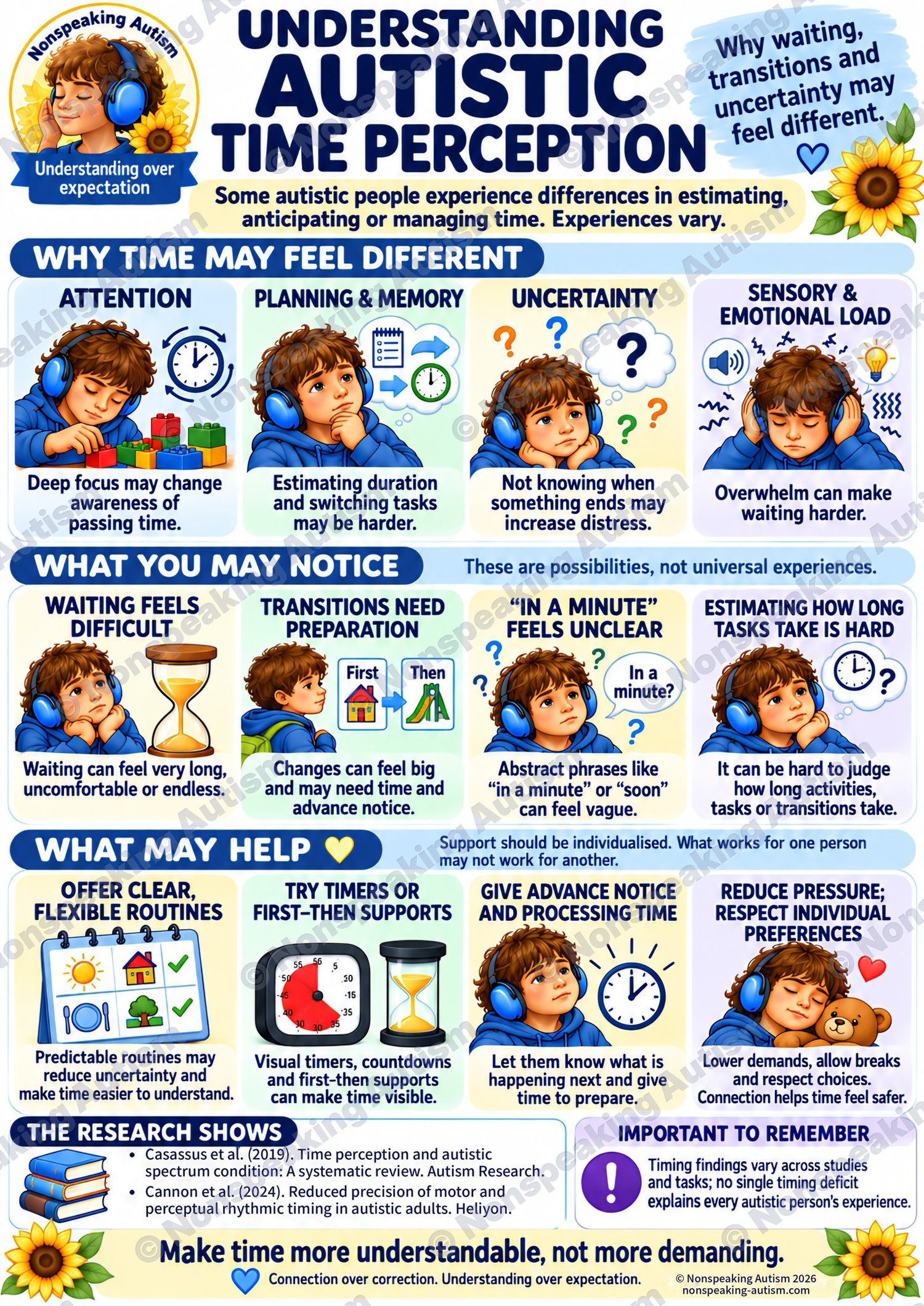
Understanding Autistic Time Perception is a compassionate, research-informed educational poster designed to help families, teachers and professionals understand why waiting, transitions and time-related expectations may feel different for some autistic people.
It explores possible contributing factors, everyday examples and practical adjustments that can make time easier to understand.
💛 The central message: Make time more understandable, not more demanding.
🧠 WHAT THIS POSTER EXPLORES
1. Why Time May Feel Different
Time perception involves several abilities, including estimating how long something lasts, anticipating future events, noticing time passing and managing activities within a period of time.
These abilities can vary considerably between individuals and situations.
The poster explores four possible contributing factors.
💙 Attention and Deep Focus
Becoming deeply absorbed in an enjoyable or meaningful activity may change someone's awareness of passing time.
A child may find it difficult to notice when an activity is nearly finished or when it is time to move on.
💚 Planning and Memory
Estimating how long a task will take, remembering the next step and switching between activities may require considerable effort.
A child may understand what they need to do but still need support organising the sequence or managing the transition.
💛 Uncertainty
Not knowing when something will start or end may increase distress.
Phrases such as “later”, “soon” and “in a minute” can be difficult when there is no clear indication of what they mean.
💜 Sensory and Emotional Load
Busy environments, fatigue, anxiety and sensory overload may make waiting or changing activities harder.
Time-related difficulties should therefore be considered alongside the person's wider sensory, emotional and communication needs.
⏳ WHAT YOU MAY NOTICE
💙 Waiting Feels Difficult
Waiting may feel uncomfortable, frustrating or unusually long.
A child may repeatedly ask when something will happen, seek reassurance, become restless or find it difficult to remain in an unfamiliar waiting environment.
Sometimes the difficulty may be related to uncertainty, discomfort or sensory demands rather than time perception alone.
🌻 Transitions Need Preparation
Moving from one activity to another may require additional processing time.
A child might benefit from knowing:
- What is happening now.
- What will happen next.
- When the current activity will finish.
- Whether they can return to the activity later.
- What choices they have during the transition.
🕒 “In a Minute” Feels Unclear
Abstract time phrases may be difficult to interpret.
For example, “We'll go soon” does not tell a child whether they need to prepare immediately or whether they have more time.
Clearer language may reduce uncertainty.
Estimating Task Duration Is Hard
Some children may find it difficult to judge how long dressing, completing schoolwork, travelling or tidying up will take.
They may need support breaking tasks into manageable steps or understanding the time available.
These are possibilities, not universal autistic experiences.
💛 WHAT MAY HELP
1. Offer Clear, Flexible Routines
Predictable routines can make everyday activities easier to anticipate.
Visual schedules, familiar sequences and advance information may help some children understand what is happening throughout the day.
However, routines should remain flexible enough to accommodate individual needs, changes and meaningful choices.
2. Try Visual Timers and First–Then Supports
Visual timers, countdowns, clocks, sand timers and first–then boards may help make time and activity sequences more concrete.
Examples include:
- “First lunch, then the playground.”
- “When the timer finishes, we'll get ready to leave.”
- “There are two activities before home time.”
Not every child finds countdowns reassuring. For some, they may increase anxiety or pressure.
Offer timing tools as support, not as a way to force compliance.
3. Give Advance Notice and Processing Time
Prepare the child for upcoming transitions where possible.
Use clear, accessible communication and allow time to process what is changing.
Advance notice may be provided through spoken language, AAC, pictures, written schedules, gestures or other preferred communication methods.
4. Reduce Pressure and Respect Individual Preferences
If a child is struggling with waiting or a transition, consider whether the demands can be reduced.
Helpful adjustments may include:
- Offering a quieter waiting area.
- Allowing movement or sensory breaks.
- Providing a meaningful activity during waiting.
- Offering choices about the order of tasks.
- Allowing extra transition time.
- Reducing unnecessary verbal reminders.
- Checking for hunger, pain, fatigue or other discomfort.
- Supporting recovery after a demanding activity.
A child who needs additional time is not necessarily being deliberately difficult.
🏫 SUPPORTING TIME-RELATED NEEDS IN SCHOOL
Time-related expectations occur throughout the school day, including morning routines, lesson changes, group activities, break times, assemblies and home-time transitions.
Supportive classroom approaches may include:
- Visual timetables and accessible daily schedules.
- Clear starting and finishing points.
- Advance notice of changes where practical.
- Flexible task completion times.
- Shorter or more manageable activity sequences.
- Predictable opportunities for breaks.
- Accessible AAC and communication choices.
- Support with planning and organisation.
- Collaborative planning with parents, carers and the child.
Teachers, teaching assistants and SENCOs can use observations and individual preferences to identify reasonable adjustments that support participation.
The goal is not to make every child follow exactly the same timetable in exactly the same way.
It is to make learning, transitions and everyday expectations more accessible.
🔬 RESEARCH-INFORMED: WHAT THE SCIENCE SUGGESTS
Research into time perception and timing in autism has examined areas including duration estimation, temporal processing, rhythmic timing and related cognitive abilities.
Some studies have identified group-level differences in particular timing tasks.
However, findings vary according to the task, participants, age, research methods and the specific aspect of timing being measured.
There is no single established timing deficit that explains every autistic person's experience.
It is also important to distinguish differences in laboratory timing tasks from everyday experiences such as waiting, transitioning between activities or understanding verbal time instructions.
Those experiences may involve additional factors, including anxiety, attention, communication, sensory demands and environmental predictability.
📚 SELECTED RESEARCH
Casassus, M., et al. (2019). Time perception and autistic spectrum condition: A systematic review. Autism Research.
Cannon, L., et al. (2024). Reduced precision of motor and perceptual rhythmic timing in autistic adults. Heliyon.
Research & References Why Time May Feel Different – overview of the evidence: - Casassus, M., et al. (2019). Time perception and autistic spectrum condition: a systematic review. Autism Research, 12, 1440–1462. https://doi.org/10.1002/aur.2170 What You May Notice – estimating duration and timing: - Cannon, J., Cardinaux, A., Bungert, L., Li, C., & Sinha, P. (2024). Reduced precision of motor and perceptual rhythmic timing in autistic adults. Heliyon, 10(14), e34261. https://doi.org/10.1016/j.heliyon.2024.e34261 Important to Remember – findings vary: - Poole, D., Casassus, M., Gowen, E., Poliakoff, E., & Jones, L. A. (2022). Time perception in autistic adults: interval and event timing judgments do not differ from nonautistics. Journal of Experimental Psychology: General. https://doi.org/10.1037/xge0001203 Foundational references (printed on the poster): Casassus et al. (2019) • Cannon et al. (2024)
Evidence Note
The research listed on the poster provides context for understanding timing differences in autism. The full bibliographic details should be independently verified before publication.
Research findings do not establish that every autistic child experiences altered time perception or that a particular behaviour has one neurological explanation.
This poster is an educational overview, not a validated time-perception assessment.
Sources:
- Cannon et al. 2024 (DOAJ)
- Cannon et al. 2024 (McMaster University)
- Casassus et al. 2019 (summary record)
- Poole et al. 2022 (repository record)
👨👩👧 WHO IS THIS RESOURCE FOR?
This resource is suitable for:
- Parents and carers of autistic children.
- Autistic children, young people and their support networks.
- Teachers and teaching assistants.
- SENCOs and SEND teams.
- Mainstream and specialist schools.
- Educational psychologists.
- Occupational therapists.
- Speech and language therapists.
- Autism support workers.
- Professionals supporting transitions, anxiety and emotional regulation.
It may be especially helpful for understanding difficulties involving waiting, uncertainty, activity changes and everyday time-related expectations.
📦 WHAT YOU RECEIVE
1 × Understanding Autistic Time Perception educational poster
The poster includes:
- Four factors that may influence experiences of time.
- Everyday signs and examples.
- Waiting and transition difficulties.
- Why vague time phrases may be challenging.
- Practical strategies using routines, timers and visual supports.
- Ways to reduce pressure and respect individual preferences.
- Selected research and an important evidence reminder.
Digital download only — no physical product will be shipped.
The uploaded image is a watermarked promotional preview. The final customer download should be supplied as a clean, print-ready PDF without promotional preview watermarks.
The final print size and resolution should be confirmed before listing.
⚠️ IMPORTANT DISCLAIMER
This educational resource is not a diagnostic tool, clinical assessment, individualised intervention plan or substitute for professional advice.
Differences in waiting, transitions and task management may have several explanations, including communication access, anxiety, attention, executive functioning, sensory experiences, physical discomfort and environmental demands.
Support should be tailored to the individual rather than based on assumptions about autism.
Where difficulties are persistent or significantly affect daily life, consider advice from an appropriately qualified professional.
©️ COPYRIGHT & PERMITTED USE
Copyright © 2026 Nonspeaking Autism. All rights reserved.
Permitted use includes personal, home, classroom, school and individual professional educational purposes.
You may print and display the resource for these purposes.
Reselling, redistributing, sharing the digital file, removing copyright information, uploading the artwork elsewhere or including it in commercial products is not permitted.
Please share the original Payhip listing link instead of distributing the file.
💛 THE MESSAGE BEHIND THIS RESOURCE
A child who struggles to wait may need more clarity.
A child who finds transitions difficult may need more preparation.
A child who loses track of time may need accessible supports rather than criticism.
And a child who becomes overwhelmed by an unexpected change may need reassurance, flexibility and time to process.
Understanding these possibilities helps adults move away from assumptions about behaviour and towards support that respects the person's experience.
Make time more understandable, not more demanding.
🌻 Support the individual. Reduce uncertainty. Respect different ways of experiencing time.
💙 Connection over correction. Understanding over expectation.
Nonspeaking Autism © 2026