
The Science Behind: Selective Mutism & Autonomic Freeze
The Science Behind: Selective Mutism & Autonomic Freeze
Selective Mutism, Anxiety & Access to Speech
How threat, anxiety and body-based stress responses can interfere with speech in certain situations
A child may speak freely, confidently and naturally in one environment — yet be unable to access speech in another.
They may talk at home but become silent at school.
They may speak with close family but struggle around unfamiliar adults or peers.
They may know exactly what they want to say, yet experience the words as inaccessible when social pressure or anxiety rises.
This is an important distinction:
Being able to speak is not always the same as being able to access speech in every situation.
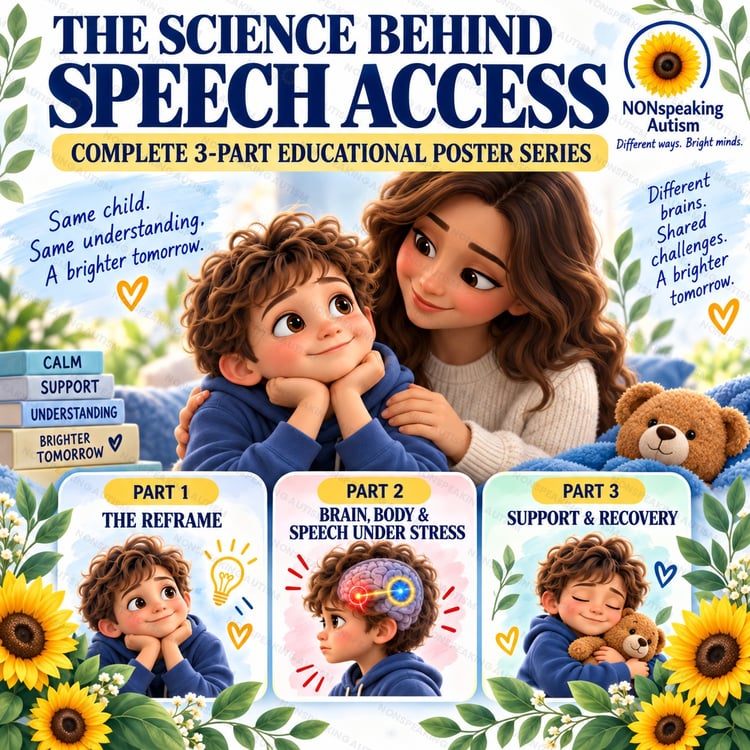
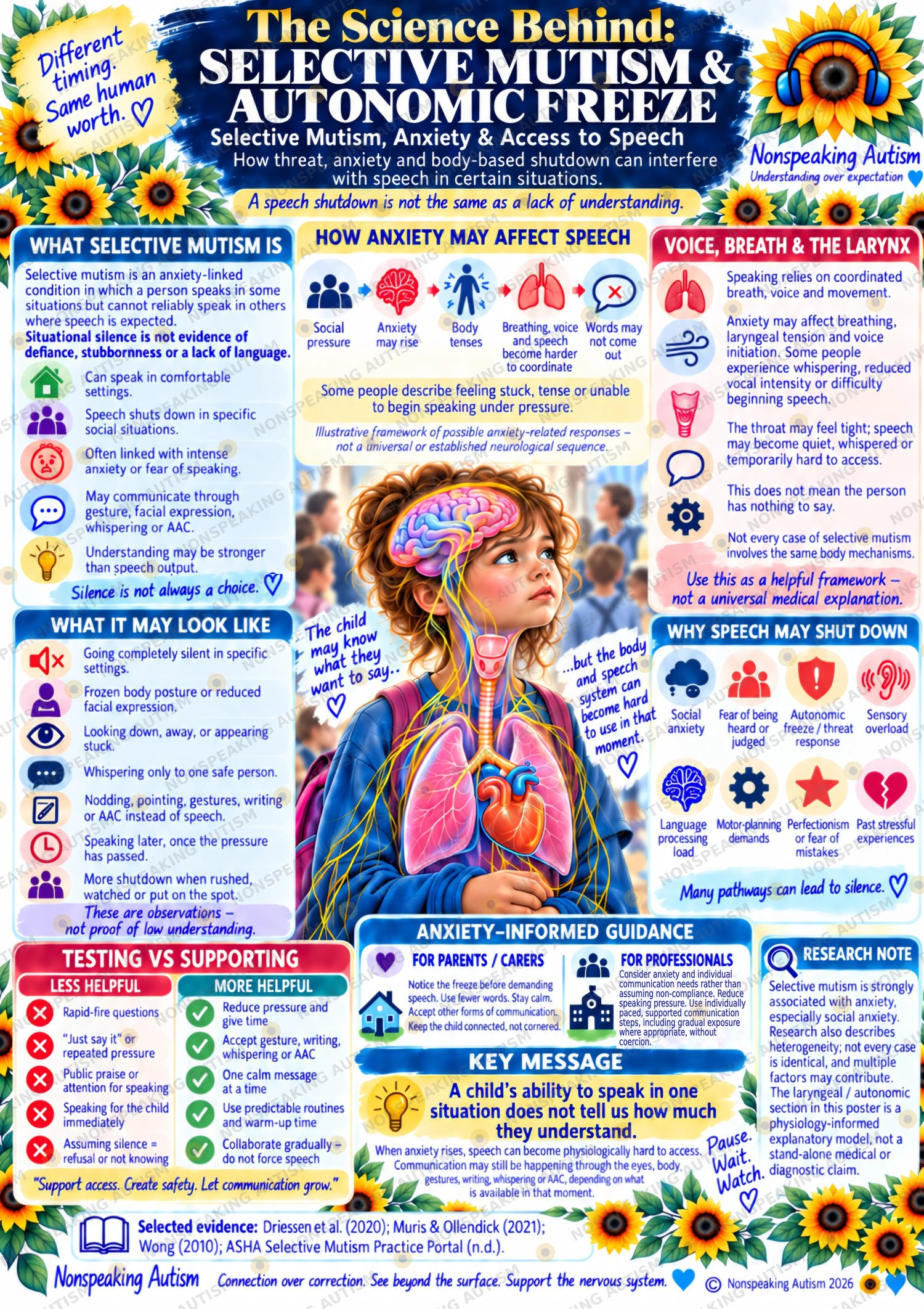
The Science Behind: Selective Mutism & Autonomic Freeze is a research-informed educational poster exploring selective mutism, anxiety, situational access to speech and the possible physical experiences that can accompany intense anxiety.
It is designed to move adults away from interpreting silence as defiance, stubbornness or lack of knowledge, and towards creating conditions in which communication feels safer and more accessible.
The central message is:
A child's ability to speak in one situation does not tell us how much they understand.
🧠 What Is Selective Mutism?
Selective mutism is an anxiety disorder characterized by a consistent difficulty speaking in particular social situations where speaking is expected, despite being able to speak in other situations.
For example, a child may:
speak comfortably at home
but
consistently struggle to speak at school.
The difficulty is not adequately explained simply by not knowing the language required in the situation, and diagnosis requires careful consideration of other communication or developmental conditions.
Most importantly:
Situational silence is not evidence of defiance, stubbornness or deliberately refusing to cooperate.
A child may genuinely be experiencing substantial anxiety around speaking.
🏠 “But They Talk at Home”
One of the most confusing aspects of selective mutism for families and professionals can be the dramatic difference between environments.
Adults may say:
“They never stop talking at home!”
That does not invalidate what happens elsewhere.
The person, their knowledge and their worth have not changed.
The conditions surrounding communication have changed.
This is why observing speech in one comfortable environment cannot tell us everything about a child's ability to access speech under anxiety or social pressure elsewhere.
❤️ How Anxiety May Affect Speech
Speaking is not produced by knowledge alone.
It requires coordinated processes involving language, attention, breathing, voice, movement and speech production.
Under intense anxiety, people can experience physical changes such as:
increased muscle tension
changes in breathing
increased heart rate
feeling physically “frozen”
difficulty initiating an action
a tight-feeling throat
reduced vocal intensity
difficulty beginning speech
For some people, the experience may feel like:
“I know what I want to say, but I can't get it out.”
The poster illustrates this as:
Social pressure → Anxiety rises → Body tenses → Breath, voice and speech become harder to coordinate → Words may not come out
This is a teaching framework, not a proven universal neurological sequence.
🫁 Voice, Breath & the Larynx
Speech involves coordinated breathing, phonation and movement of the speech structures.
Anxiety can produce noticeable physical sensations throughout the body.
Some people experiencing intense speaking anxiety describe:
tightness
difficulty initiating speech
whispering
reduced vocal intensity
feeling physically unable to get the words started
These experiences are real and deserve to be taken seriously.
However, it is important not to oversimplify the physiology.
Selective mutism cannot currently be explained as simply “the larynx shutting down” or by one established autonomic mechanism.
The poster's larynx and autonomic illustrations should therefore be understood as an accessible explanatory model of possible body experiences, rather than a literal medical explanation of selective mutism.
🧊 What Does “Autonomic Freeze” Mean Here?
The term freeze is sometimes used to describe an involuntary defensive response during perceived threat or intense stress.
Some people experiencing severe anxiety describe becoming:
very still
unable to initiate movement easily
quiet
tense
disconnected from their usual responses
or feeling physically “stuck.”
These descriptions can provide a helpful way of understanding why demanding immediate speech may be ineffective.
But there is an important scientific distinction:
Selective mutism should not be reduced to an autonomic-freeze response.
Selective mutism is strongly associated with anxiety, particularly social anxiety, but individuals are heterogeneous and several interacting factors may contribute.
“Freeze” is therefore best used here as a possible descriptive framework, not a separate diagnosis or universal biological explanation.
👀 What Selective Mutism May Look Like
Depending on the individual and situation, adults may observe:
complete silence in particular settings
a frozen or tense posture
reduced facial expression
looking down or away
appearing stuck
whispering to one trusted person
nodding or pointing
gesturing
writing or typing
using AAC
speaking once the pressure has passed
increased difficulty when watched, rushed or put on the spot
These observations do not prove low understanding.
They tell us what the person's communication looks like under those particular conditions.
🔍 Why Might Speech Become Difficult?
There is no single cause that explains every person's selective mutism.
Factors that may be relevant include:
social anxiety
fear of being heard or judged
heightened stress responses
sensory demands
language-processing demands
speech or language differences
motor-planning demands
perfectionism or fear of making mistakes
previous stressful experiences
other co-occurring developmental or mental-health factors
Not every person will experience all of these.
Many pathways can contribute to silence.
Individual assessment matters.
🚫 Testing vs Supporting
When adults are worried about speech, it can be tempting to repeatedly test whether the child will talk.
That can unintentionally increase the very pressure surrounding speaking.
❌ Less Helpful
rapid-fire questions
“Just say it”
repeated requests to speak
drawing public attention to speech
excessive praise that makes speaking highly noticeable
immediately speaking for the child without allowing another communication route
assuming silence means refusal
assuming silence means the child does not know
✅ More Supportive
reduce pressure
allow time
accept gesture, writing, typing or AAC
use one calm message at a time
provide predictable routines
use warm-up time
allow gradual participation
collaborate on individualized support
avoid forcing speech
The aim is:
Support access. Create safety. Let communication grow.
⏳ Pause. Wait. Watch.
Silence often makes adults uncomfortable.
We instinctively fill it.
We ask another question.
Then another.
Then simplify the question.
Then ask the child to repeat after us.
But each new prompt can add another layer of attention and expectation.
Sometimes a better response is:
Pause. Wait. Watch.
Give the person enough time to process what has been said and use whatever communication method is currently accessible.
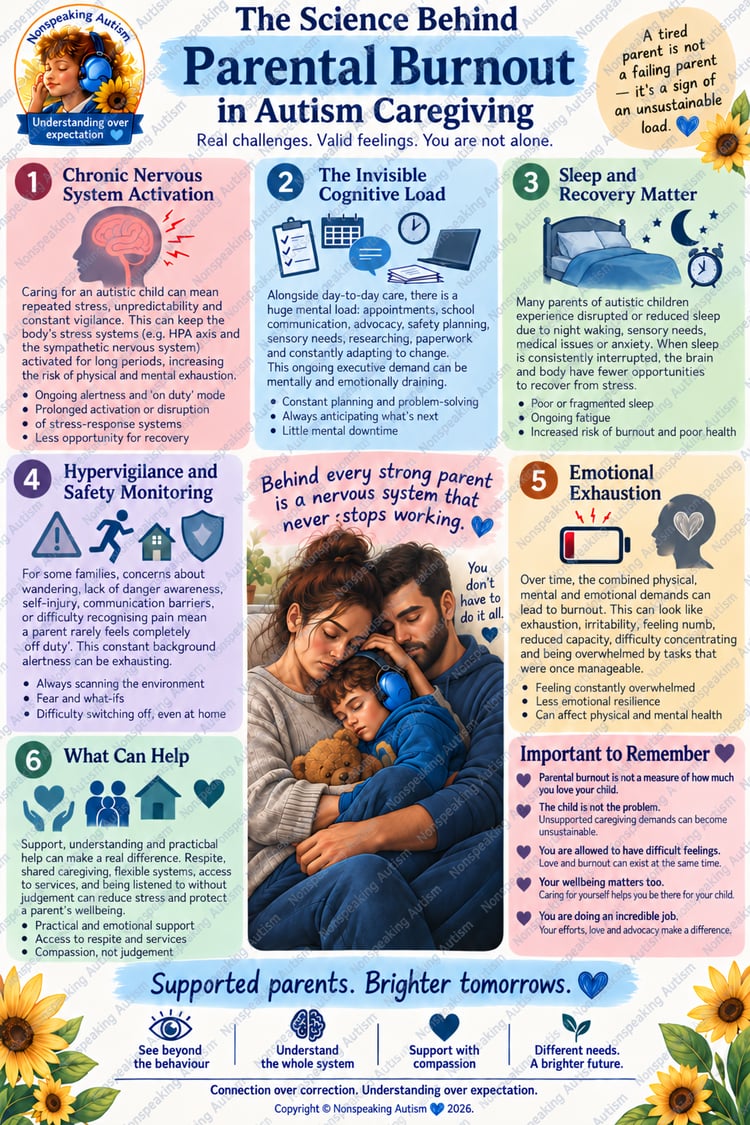
🏡 Guidance for Parents & Caregivers
Parents can support a child by noticing patterns before speech becomes difficult.
Consider:
Where does speech feel easiest?
Where does it become harder?
Who is present?
What happens immediately beforehand?
What increases pressure?
What reduces it?
Which alternative communication methods remain available?
Helpful approaches may include:
using fewer words when the child is overwhelmed
remaining calm
accepting communication in different forms
keeping the child connected rather than cornered
avoiding interrogating them afterwards
and working collaboratively with professionals where additional support is needed.
🏫 Guidance for Schools & Professionals
Schools and professionals should consider the child's anxiety and individual communication profile, rather than assuming deliberate non-compliance.
Useful approaches may include:
reducing direct speaking pressure
avoiding public demands to answer
allowing processing time
using gradual, individualized exposure approaches where clinically appropriate
providing alternative response methods
supporting communication without coercion
coordinating strategies across home and school
The objective is not simply:
“Get the child to speak.”
It is to help communication become increasingly accessible while supporting the child's wellbeing.
💬 Alternative Communication Still Counts
If speech is not accessible in a particular moment, communication does not have to stop.
Depending on the person, they may communicate through:
gesture
pointing
nodding
writing
typing
symbols
AAC
facial expression
body movement
a trusted communication partner
Alternative communication should not automatically be withheld in an attempt to force speech.
Communication access comes first.
♾️ Selective Mutism & Autism
Selective mutism and autism are distinct conditions, but they can co-occur.
An autistic person experiencing situational difficulty speaking may also have other factors affecting communication, including:
sensory processing differences
language-processing differences
motor-speech differences
fatigue
overload
communication demands
or anxiety.
This makes individualized assessment particularly important.
Not every autistic person's situational loss of speech is selective mutism, and not every person with selective mutism is autistic.
🔬 Research-Informed
The research literature strongly associates selective mutism with anxiety, particularly social anxiety.
Research also demonstrates considerable heterogeneity, meaning there is unlikely to be one simple explanation for every individual.
Evidence supports approaches that reduce unhelpful speaking pressure and use carefully planned, gradual, individualized intervention, rather than punishment or coercion.
The autonomic/laryngeal illustrations on this poster should be interpreted cautiously.
They help visualize how anxiety may feel physically and how speech can become harder to access, but they do not establish that every episode of selective mutism results from a specific freeze mechanism.
📚 Selected Evidence & Guidance
Driessen, J., Blom, J. D., Muris, P., Blashfield, R. K., & Molendijk, M. L. (2020). Anxiety in children with selective mutism: A meta-analysis. Child Psychiatry & Human Development, 51, 330–341.
Muris, P., & Ollendick, T. H. (2021). Selective mutism and its relations to social anxiety disorder and autism spectrum disorder. Clinical Child and Family Psychology Review, 24, 294–325.
Wong, P. (2010). Selective mutism: A review of etiology, comorbidities, and treatment. Psychiatry (Edgmont), 7(3), 23–31.
American Speech-Language-Hearing Association (ASHA). Selective Mutism — Practice Portal. Clinical guidance regarding assessment and intervention for selective mutism.
Research Note
The evidence base supports a strong relationship between selective mutism and anxiety, especially social anxiety.
Research also demonstrates that selective mutism is heterogeneous. The body-based, autonomic and laryngeal explanations illustrated in this resource are therefore educational models of possible experiences rather than stand-alone diagnostic or medical claims.
👨👩👧 Who Is This Resource For?
This educational resource may be useful for:
- children and young people with selective mutism
- autistic children with co-occurring communication anxiety
- parents and caregivers
- families
- teachers
- teaching assistants
- SENCOs and SEND professionals
- speech and language therapists
- psychologists
- mental-health professionals
- occupational therapists
- early-years practitioners
- support workers
- multidisciplinary teams
- autism and selective-mutism organizations
It may be particularly useful where a child's ability to speak in one environment is being used to assume that they should be able to speak equally easily everywhere else.
📦 What You Receive
This download includes:
1 × The Science Behind: Selective Mutism & Autonomic Freeze educational poster
1 × high-resolution printable PDF
The downloaded resource is supplied clear and without the promotional preview watermark shown in the Payhip listing image.
Watermarks visible on listing images are used for preview and copyright protection only and will not appear on the downloadable file.
This educational resource is provided to help families, educators and professionals access clear, supportive information about selective mutism, anxiety and communication.
Digital download only — no physical product will be shipped.
⚠️ Important Educational, Clinical & Medical Disclaimer
This resource is provided for educational and informational purposes only.
It is not medical advice, diagnosis, a selective-mutism assessment, speech and language assessment, neurological assessment, psychological assessment, mental-health treatment, therapy or an individualized intervention plan.
Selective mutism is a recognized mental-health condition requiring consideration of established diagnostic criteria and appropriate differential assessment. Silence or reduced speech in a particular situation does not by itself establish selective mutism.
The terms “freeze,” “autonomic freeze” and “speech shutdown” within this resource are descriptive educational concepts. They should not be interpreted as proven universal neurological mechanisms underlying selective mutism.
The brain, larynx and autonomic illustrations are simplified teaching visuals and are not anatomical or physiological demonstrations of what occurs in every person with selective mutism.
A new, sudden, significant or unexplained loss of previously established speech should not automatically be attributed to selective mutism, autism, anxiety or a freeze response and warrants appropriate professional or medical consideration.
Where there is sudden loss of speech accompanied by facial weakness, limb weakness, confusion, seizure activity, altered consciousness or other acute neurological symptoms, seek urgent medical assistance.
Support and intervention should be individualized with appropriately qualified professionals according to the person's circumstances.
💛 The Message Behind the Resource
A child can know the answer.
They can understand the question.
They can desperately want to respond.
And still find speech extraordinarily difficult in that moment.
From the outside, silence can be misinterpreted as:
“They're refusing.”
“They're being stubborn.”
“They spoke yesterday, so they can speak now.”
But communication is not simply a switch that another person can demand be turned on.
Instead of testing:
Reduce the pressure.
Allow time.
Accept other communication.
Build predictability.
Work gradually.
Protect dignity.
And understand the person before judging the silence.
Different timing. Same human worth. 💛
A speech shutdown is not the same as a lack of understanding.
Support access. Create safety. Let communication grow.
Connection over correction. See beyond the surface. Support the nervous system.
© Nonspeaking Autism 2026 🌻💙