

💙 UNDERSTANDING AUTISTIC SHUTDOWN
💙 UNDERSTANDING AUTISTIC SHUTDOWN
Recognising the Signs, Reducing Overload & Supporting Recovery
UK Edition | Research-Informed Autism Educational Poster | Nonspeaking Autism
🌻 When overload builds, an autistic person may become quieter, less responsive or less able to communicate.
From the outside, this can be misunderstood.
A child who stops speaking may be seen as refusing to answer.
A young person who withdraws may be described as disengaged.
Someone who becomes still, exhausted or unable to continue an activity may be assumed to be uncooperative.
But what appears to be withdrawal or refusal may reflect significant distress, exhaustion, reduced capacity or an overwhelmed nervous system.
Autistic shutdown is a term commonly used to describe an experience of withdrawal, reduced responsiveness or reduced ability to engage during periods of overwhelm.
It is not deliberate misbehaviour.
It is not necessarily a choice.
And it should not automatically be interpreted as laziness, defiance or manipulation.
This illustrated, research-informed educational poster explores what may contribute to autistic shutdown, what it can look like, possible warning signs and ways to provide compassionate support.
Designed for parents, carers, teachers, SENCOs, therapists and other professionals, it encourages a more informed response to overload and recovery.
The central message:
See the signs early. Reduce the load. Protect recovery.
🧠 WHAT IS AUTISTIC SHUTDOWN?
Autistic shutdown is a community-used descriptive term rather than a formally defined medical diagnosis.
It is often used to describe a period in which an autistic person experiences reduced communication, responsiveness, movement or engagement when demands, stress or sensory experiences become overwhelming.
Shutdown may involve:
- Becoming unusually quiet or still
- Finding speech difficult or temporarily unavailable
- Reduced ability to process spoken information
- Withdrawing from people or activities
- Slower movement or responses
- Needing to sit, lie down or rest
- Feeling mentally or physically exhausted
- Reduced capacity to make decisions or complete tasks
Not every autistic person experiences shutdown.
Those who do may experience it differently, and outward appearance does not always reflect the intensity of internal distress.
A person may be experiencing significant difficulty even when they appear calm or silent.
🌈 WHAT THIS POSTER EXPLORES
1. What May Build Up Before Shutdown?
Shutdown may be associated with an accumulation of stressors or demands.
The poster explores several possible contributing factors.
Sensory overload
Sound, lighting, touch, smells, movement or competing sensory information may become difficult to manage.
Stress and uncertainty
Unpredictable situations, emotional stress or uncertainty may increase the demands placed on a person.
Sudden changes
Unexpected transitions, disrupted routines or unfamiliar expectations may contribute to distress.
Unmet physical needs
Pain, illness, hunger, thirst or other physical discomfort may affect coping and participation.
Fatigue and poor sleep
Physical exhaustion and insufficient recovery may reduce the person's ability to manage further demands.
Too much language or demand
Repeated instructions, questions, social expectations or tasks may become difficult to process during periods of overload.
These factors can overlap.
No single trigger explains every shutdown.
2. What May Happen During Shutdown?
During a shutdown-like experience, a person may find it harder to think clearly, communicate, move or respond.
They may:
- Struggle to process instructions
- Have difficulty making decisions
- Experience reduced access to spoken language
- Communicate less than usual
- Move more slowly
- Withdraw from further sensory or social input
- Need a significant reduction in demands
The poster uses a simplified illustration of the brain and nervous system to explain how overwhelming experiences may affect functioning.
Important scientific distinction: The illustration is educational, not a medical scan or a proven neurological sequence. The precise mechanisms underlying experiences described as autistic shutdown remain incompletely understood.
The experience should not be reduced to one assumed brain process.
3. What Autistic Shutdown Can Look Like
The poster identifies several possible outward signs:
- Going quiet or still
- Withdrawing from people or activities
- Giving one-word answers or becoming unable to speak
- Appearing very fatigued or physically slowed
- Showing changes in responsiveness or interaction
- Needing to lie down, hide or spend time alone
Some individuals may continue communicating through AAC, typing, gesture or other methods even when speech is difficult.
Others may find all forms of communication temporarily demanding.
Reduced speech does not mean reduced understanding, and silence should not be treated as consent.
It is important to respect the person's communication preferences and avoid assuming that they can respond immediately.
⚠️ POSSIBLE WARNING SIGNS
The poster highlights experiences that may occur before or during a shutdown-like episode.
These include:
- Confusion
- Feeling disconnected or dissociated
- Sudden fatigue
- Tension or headaches
- Irritability
- Feeling emotionally numb
Not everyone experiences these signs.
Some people may recognise their own early warning patterns, while others may only realise they were overwhelmed afterwards.
These signs are also not specific to autism or shutdown.
For example, sudden confusion, reduced responsiveness, severe headache or marked changes in consciousness may require medical assessment.
Never assume that a new or unusual physical or neurological symptom is simply an autistic shutdown.
💙 WHAT HELPS IN THE MOMENT?
The most appropriate response depends on the individual, their environment and their immediate safety.
The poster introduces several supportive approaches.
Reduce Input and Demands
Where possible, reduce unnecessary noise, bright lighting, conversation, instructions and social expectations.
Avoid adding further tasks when the person is already struggling.
Offer a Calm, Low-Stimulation Space
Provide access to a familiar, quieter environment if the person wants or needs one.
A safe space should not be used as punishment or isolation.
Use Calm, Accessible Communication
Speak gently and use fewer words when appropriate.
Allow additional processing time.
Avoid repeatedly asking questions or demanding an immediate explanation.
Do Not Pressure Speech
If speech becomes difficult or unavailable, respect this.
Keep AAC devices, visual supports, typing options, gestures or other communication methods accessible.
Do not insist that the person speaks to demonstrate understanding or cooperation.
Respect Personal Space and Touch Preferences
Some people may welcome familiar comfort.
Others may find touch or proximity overwhelming.
Ask where possible, observe communication and do not force physical contact.
Offer Familiar Supports
Preferred comfort items, quiet activities, movement or other individual supports may help some people.
The aim is to reduce distress and demands, not to force a particular outward appearance of calm.
🌙 RECOVERY MATTERS
Recovery from an overwhelming experience may take time.
The person may continue to feel tired, less communicative or sensitive to demands after the immediate situation has changed.
Support may include:
- Allowing rest without pressure
- Reducing unnecessary expectations
- Providing a calm environment
- Keeping preferred communication methods available
- Offering food, drinks or comfort when appropriate
- Respecting preferred quiet activities or harmless stimming
- Avoiding an immediate return to demanding situations
- Reviewing possible triggers later, when the person is ready
Recovery needs vary.
There is no universal timetable.
A person should not have to prove they are struggling before being allowed to rest.
SHUTDOWN, MELTDOWN AND AUTISTIC BURNOUT: IMPORTANT DIFFERENCES
These terms are sometimes used together, but they should not be treated as interchangeable.
Autistic Shutdown
Often describes a period of reduced communication, responsiveness or engagement associated with overwhelm.
Autistic Meltdown
Often describes an intense outward expression of distress or loss of regulatory capacity.
This may involve crying, movement, vocalisation or other visible responses.
Autistic Burnout
Describes a broader experience that may involve prolonged exhaustion, reduced functioning and increased difficulty managing everyday demands.
Burnout is generally discussed in relation to sustained or cumulative pressures rather than one brief episode.
An autistic person may experience shutdown, meltdown, burnout, combinations of these or none of them.
One outward response cannot reveal one certain cause.
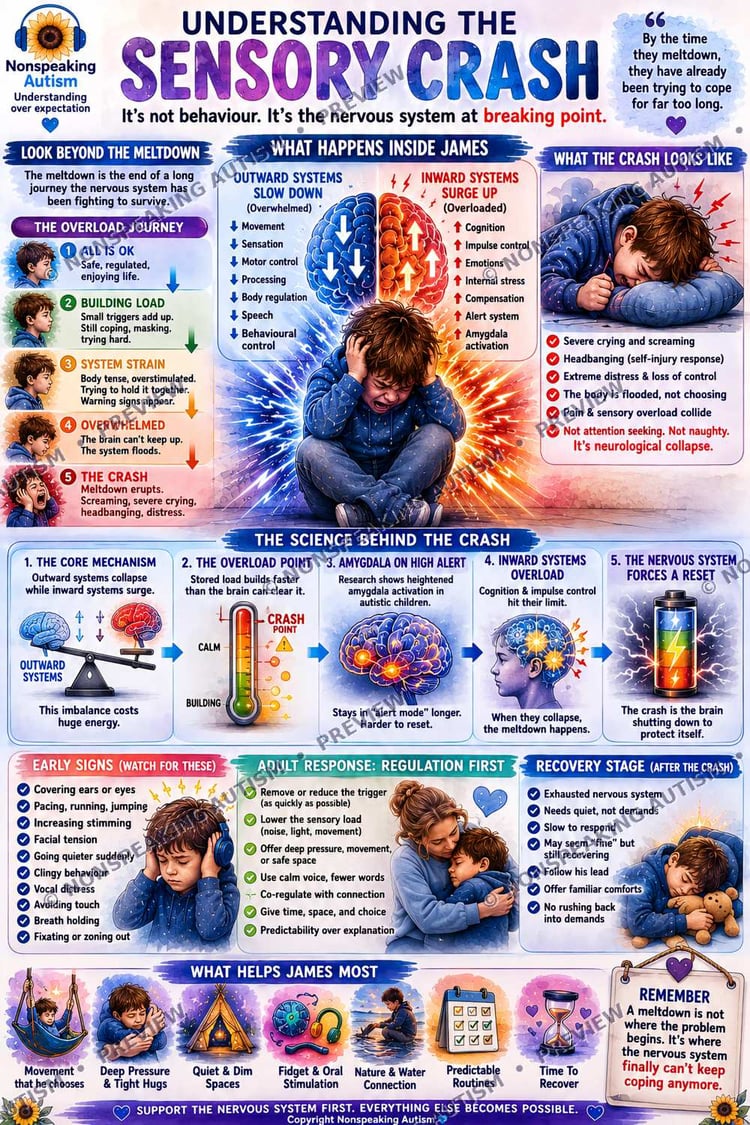
💛 INDIVIDUAL SUPPORT: WHAT HELPS JAMES MOST
The poster includes an illustrated example titled “What Helps James Most”, showing how individual preferences can guide support.
The example includes:
Quiet, dim spaces — reducing environmental stimulation.
Deep pressure — only when personally welcomed, safe and appropriate.
Movement he chooses — allowing access to preferred movement without pressure.
Nature and water — spending time in calming environments when accessible.
Predictable routines — reducing avoidable uncertainty.
Time to recover — allowing rest without rushing back into demands.
These are examples of one person's possible preferences, not a universal shutdown treatment plan.
What helps James may not help another autistic person.
The most useful support begins with the individual's own communication, preferences and experiences.
🏫 USING THIS RESOURCE IN UK SCHOOLS & SEND SETTINGS
This poster may help school staff recognise when a pupil's reduced communication, withdrawal or difficulty participating could reflect overwhelm rather than deliberate non-compliance.
It can support discussions about:
- Sensory accessibility in classrooms
- Reducing unnecessary demands
- Predictable routines and transitions
- Communication access and AAC
- Quiet spaces and recovery opportunities
- Staff responses to distress
- Reasonable adjustments
- Recognising individual warning signs
- Home–school communication
- Supporting a pupil's return to activities after distress
It may be useful for teachers, teaching assistants, SENCOs, SEND teams, occupational therapists, speech and language therapists and educational psychologists.
The resource can also inform individual support discussions and, where relevant, planning associated with an Education, Health and Care Plan (EHCP) in England.
Support should prioritise safety, communication, dignity and access — not compliance at the expense of wellbeing.
🔬 RESEARCH & GUIDANCE-INFORMED
The concept of autistic shutdown is widely discussed within autistic communities and emerging research, but it is not yet supported by one universally accepted clinical definition or a single established neurological explanation.
Research on autistic burnout, sensory processing differences and stress can provide useful related context.
However, findings about autistic burnout should not automatically be treated as direct evidence about short-term shutdown episodes.
📚 Selected Research & Guidance
Raymaker, D. M., et al. (2020).
“Having All of Your Internal Resources Exhausted Beyond Measure and Being Left with No Clean-Up Crew”: Defining Autistic Burnout.
Autism in Adulthood, 2(2), 132–143.
https://doi.org/10.1089/aut.2019.0079
This qualitative study explores autistic burnout, including prolonged exhaustion and reduced functioning. It is relevant background research but does not validate a specific shutdown mechanism.
National Institute for Health and Care Excellence (NICE).
Autism spectrum disorder in under 19s: Support and management (CG170).
https://www.nice.org.uk/guidance/cg170
Relevant guidance for considering environmental, communication, sensory and other factors that may contribute to distress.
National Institute for Health and Care Excellence (NICE).
Autism spectrum disorder in adults: Diagnosis and management (CG142).
https://www.nice.org.uk/guidance/cg142
Relevant guidance concerning individualised support and consideration of physical, mental health and environmental needs.
Evidence Note
The poster also names Reframing Autism (2024) and Paris et al. (2025/2026) as research-informed sources.
Their complete bibliographic details have not been independently confirmed for this listing, so they are not presented here as verified academic citations.
The poster's nervous-system illustration and descriptions are educational representations, not evidence of a confirmed neurological shutdown pathway.
This resource is not a validated diagnostic, screening or assessment tool.
- Reframing Autism. (2024, 26 February). All about autistic shutdowns: A guide for allies. https://reframingautism.org.au/?p=3947
- Raymaker, D. M., Teo, A. R., Steckler, N. A., Lentz, B., Scharer, M., Delos Santos, A., Kapp, S. K., Hunter, M., Joyce, A., & Nicolaidis, C. (2020). "Having all of your internal resources exhausted beyond measure and being left with no clean-up crew": Defining autistic burnout. Autism in Adulthood, 2(2), 132–143. https://doi.org/10.1089/aut.2019.0079
- Paris, Lodestone, Houser & Lewis (2025). "Shutdowns are like you're stuck on the blue screen of death": A metaphor analysis of autistic shutdowns. Autism in Adulthood, 8(4), 687–697. https://doi.org/10.1089/aut.2024.0193
Sources:
👨👩👧 WHO IS THIS RESOURCE FOR?
This poster may be useful for:
- Parents and carers of autistic children
- Autistic young people and adults
- Teachers and teaching assistants
- SENCOs and SEND professionals
- Occupational therapists
- Speech and language therapists
- Educational psychologists
- Paediatric and healthcare professionals
- Family support workers
- Professionals supporting autistic people in education, health or community settings
- Anyone wanting to better understand shutdown-like experiences
It may be displayed in classrooms, SEN support areas, therapy rooms, staff rooms, family spaces and other educational environments.
📦 WHAT YOU RECEIVE
PAID DIGITAL DOWNLOAD — INDIVIDUAL POSTER
Your purchase includes:
1 × Understanding Autistic Shutdown — Educational Poster
Featuring:
- Possible factors contributing to overload
- Changes in communication and responsiveness
- What shutdown may look like
- Possible warning signs
- Immediate support strategies
- Recovery guidance
- Important distinctions between shutdown and meltdown
- Individualised examples of preferred support
- Research-informed explanations and references
- Nonspeaking Autism illustrated design
The poster is intended as a high-quality printable educational resource.
Please refer to the downloadable file details for its exact page size and resolution.
The image shown in the product listing is a watermarked promotional preview. The purchased printable version should be supplied without the promotional watermark.
Digital download only. No physical poster will be posted.
⚠️ IMPORTANT DISCLAIMER
This poster is provided for educational and informational purposes only.
It does not constitute medical advice, psychological assessment, neurological diagnosis, occupational therapy assessment or an individualised clinical support plan.
Reduced responsiveness, confusion, weakness, changes in speech, severe headache, collapse or altered consciousness can have medical causes.
Sudden, unexplained or severe changes should not automatically be attributed to autistic shutdown.
Seek urgent medical assistance when appropriate. In the UK, call 999 or 112 for a medical emergency.
Do not use this resource to replace professional assessment or to dismiss signs of pain, illness, mental health difficulties or other health concerns.
Any sensory support, including deep pressure, should be safe, voluntary and responsive to the individual's preferences.
©️ COPYRIGHT & PERMITTED USE
Copyright © 2026 Nonspeaking Autism. All rights reserved.
Purchase permits personal, home, classroom, school and individual professional educational use.
You may print the poster for these purposes.
You may not:
- Resell the poster or digital file
- Redistribute or publicly share the purchased file
- Upload it to another website or digital platform
- Remove the branding and claim the artwork as your own
- Reproduce it for commercial use
- Include it in another product or resource for resale without permission
Please share the original Payhip listing rather than distributing the digital file.
💛 THE MESSAGE BEHIND THIS RESOURCE
A child who stops speaking may not be refusing to answer.
A young person who withdraws may not be choosing to disengage.
Someone who becomes still or exhausted may not be deliberately avoiding an activity.
Sometimes, the demands placed on a person exceed what they can manage in that moment.
They may need less noise.
Fewer words.
More time.
Access to communication.
Space to recover.
And adults who recognise that silence does not necessarily mean everything is fine.
Do not mistake reduced communication for reduced need.
Do not confuse exhaustion with defiance.
Do not rush recovery simply because the distress is less visible.
The question is not only:
“How do we get them participating again?”
It is also:
“What made this experience overwhelming, and what would help them feel safer?”
See the signs early. Reduce the load. Protect recovery.
🌻 Connection over correction. Understanding over expectation. 💙
Nonspeaking Autism © 2026