
Outside vs. Underneath in Autistic Females
Outside vs. Underneath in Autistic Females
How autistic girls and women may look socially capable on the outside while carrying hidden sensory, cognitive and emotional load underneath
“She seems fine.”
“She has friends.”
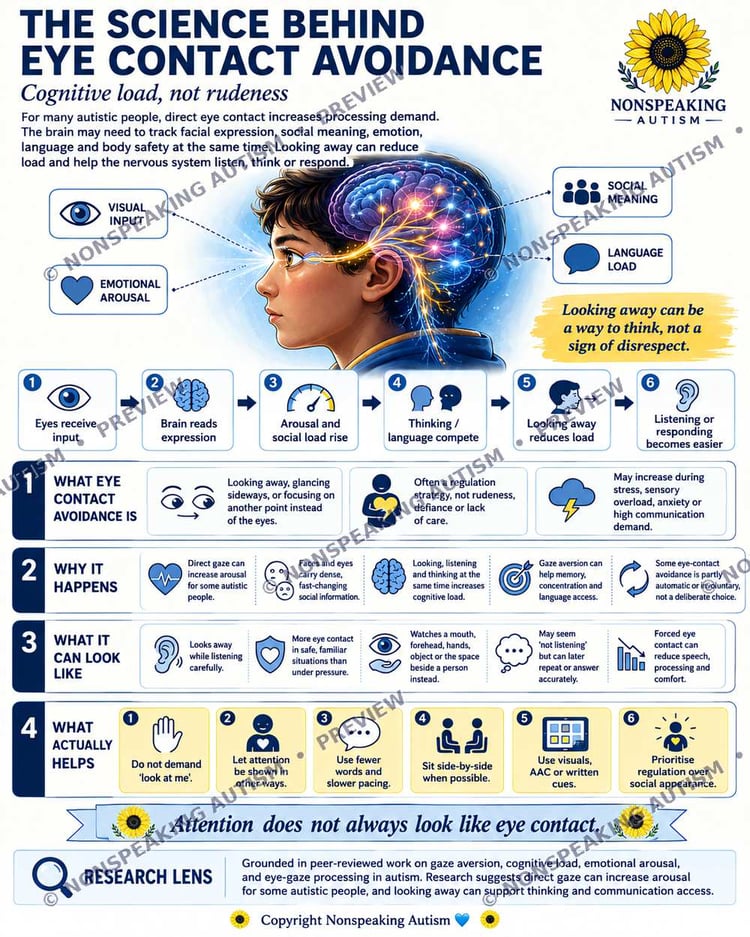
“She makes eye contact.”
“She does well at school.”
“She is polite, sociable and capable.”
All of these observations can be true — while still revealing only part of an autistic person's experience.
For some autistic girls and women, what other people see externally can differ considerably from the effort, sensory load, anxiety, monitoring and emotional processing happening underneath.
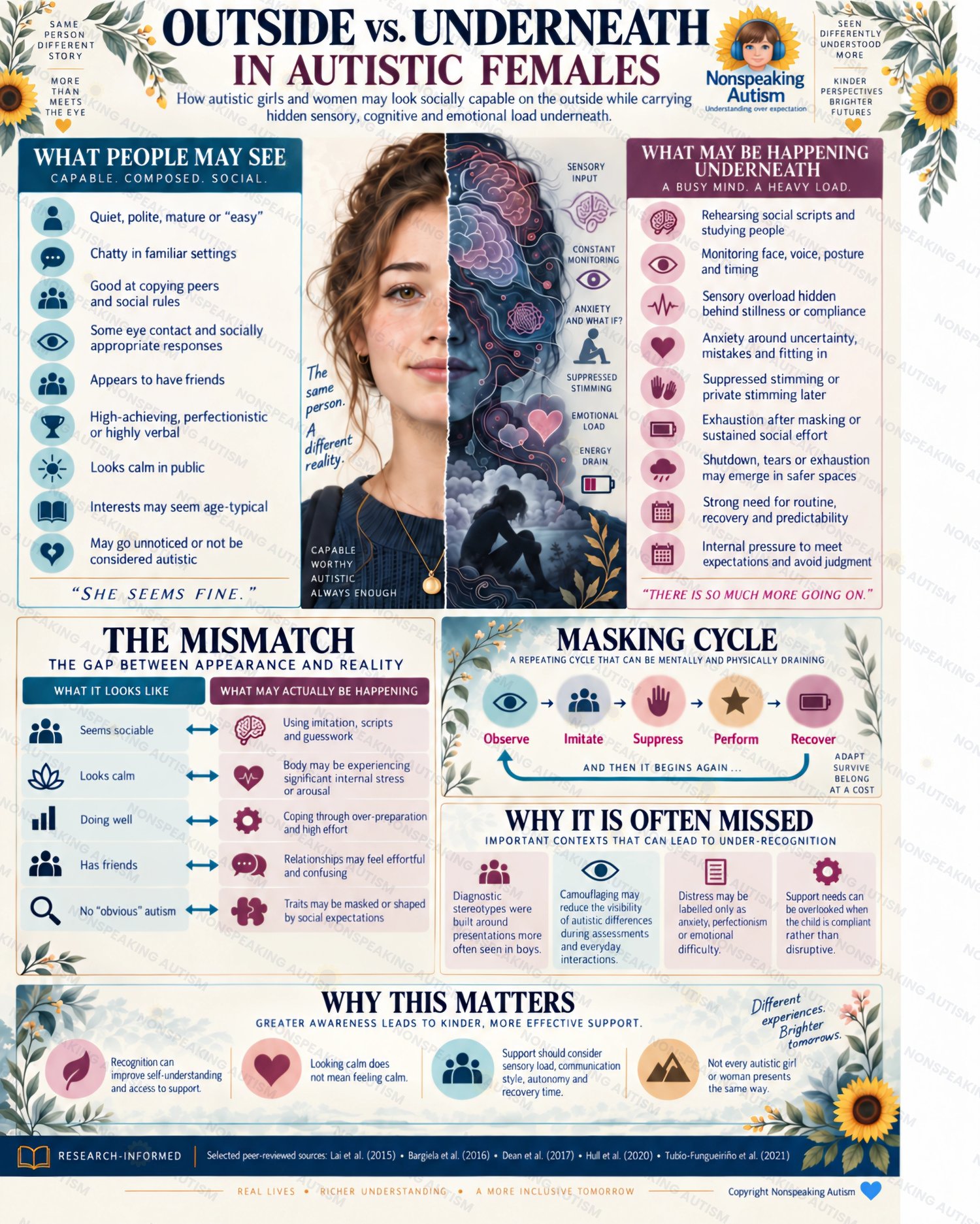
Outside vs. Underneath in Autistic Females is a research-informed educational poster designed to help families, educators and professionals recognise this possible mismatch between outward appearance and internal experience.
It explores masking and camouflaging, sensory overload, suppressed stimming, social rehearsal, exhaustion and recovery — while emphasising that appearing capable does not automatically mean that support is unnecessary.
The central message is:
The same person. A different reality.
Looking calm does not necessarily mean feeling calm.
🧠 What This Poster Explores
This visual resource looks beyond observable behaviour to explore:
- What other people may see on the outside
- What may simultaneously be happening internally
- The gap between apparent capability and actual effort
- Social scripts, imitation and monitoring
- Masking and camouflaging
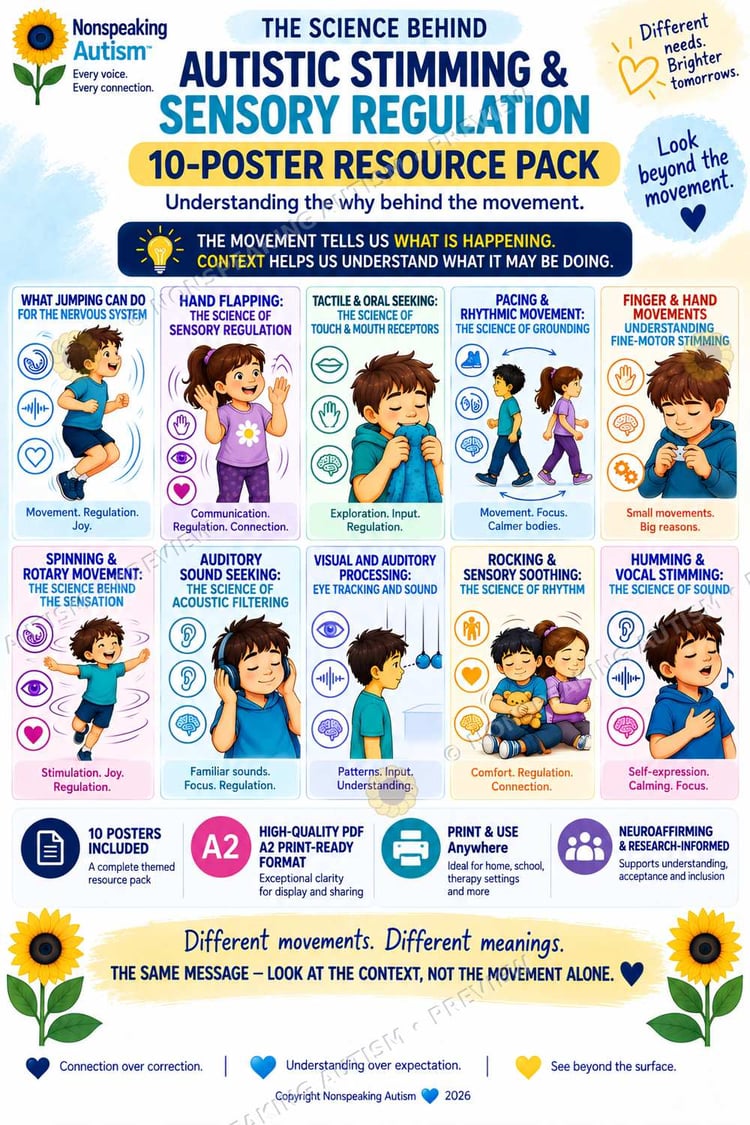
- Suppression or postponement of stimming
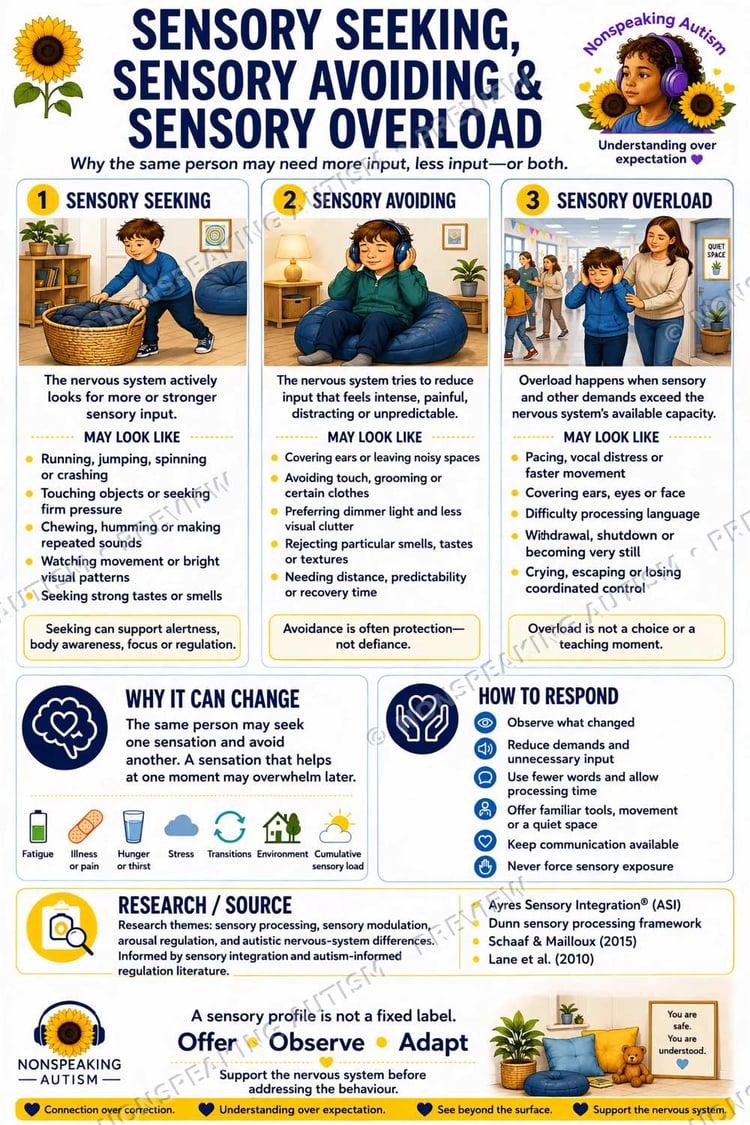
- Hidden sensory overload
- Anxiety and uncertainty
- Emotional and cognitive load
- Exhaustion following sustained social effort
- Shutdown or distress appearing later in safer environments
- The need for routine, predictability and recovery
- Why autistic girls and women may sometimes be overlooked
- Why support should consider internal experience as well as outward behaviour
The poster does not suggest that every autistic female experiences masking or hidden overload.
Instead, it illustrates one important pattern that can occur and may otherwise be missed.
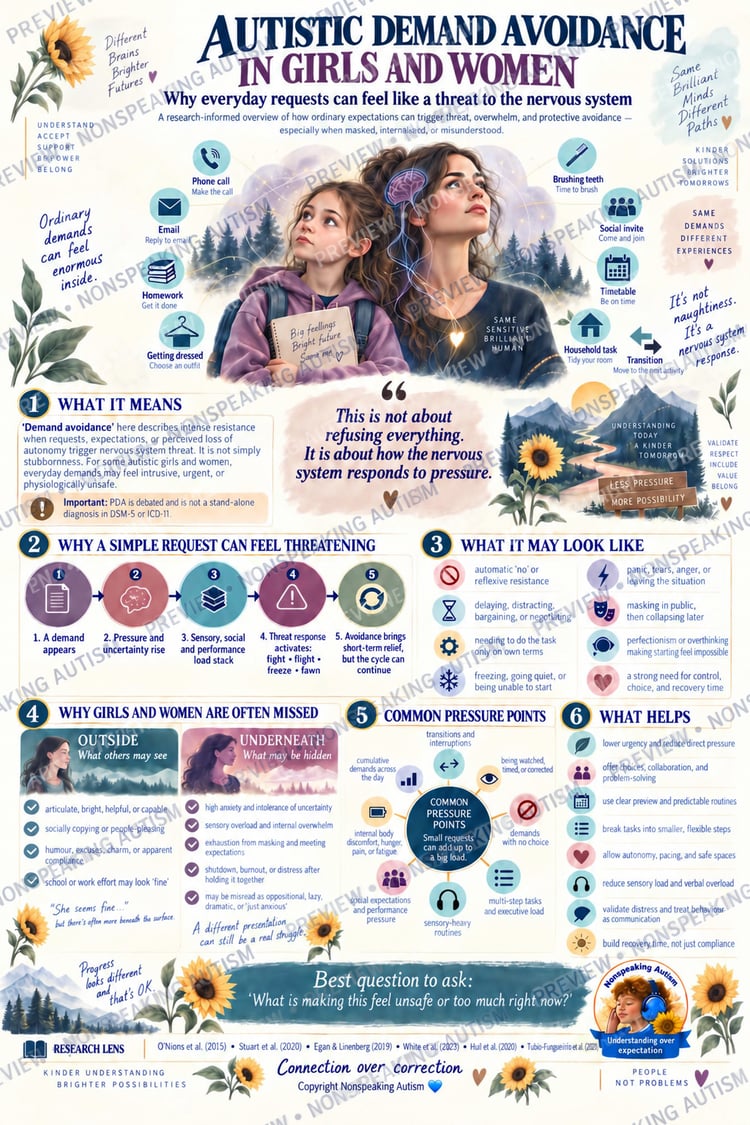
👁️ What People May See on the Outside
An autistic girl or woman may appear:
- Quiet, polite, mature or “easy”
- Chatty in familiar environments
- Skilled at copying peers or following social conventions
- Comfortable with some eye contact
- Socially appropriate in conversation
- To have friendships
- High-achieving or perfectionistic
- Highly verbal
- Calm in public
- To have interests that appear typical for her age
Because these characteristics may not match stereotypical expectations of autism, her autistic differences or support needs may be overlooked.
But outward behaviour cannot tell us everything about the amount of effort required to maintain it.
“She seems fine” is an observation — not a complete picture of her internal experience.
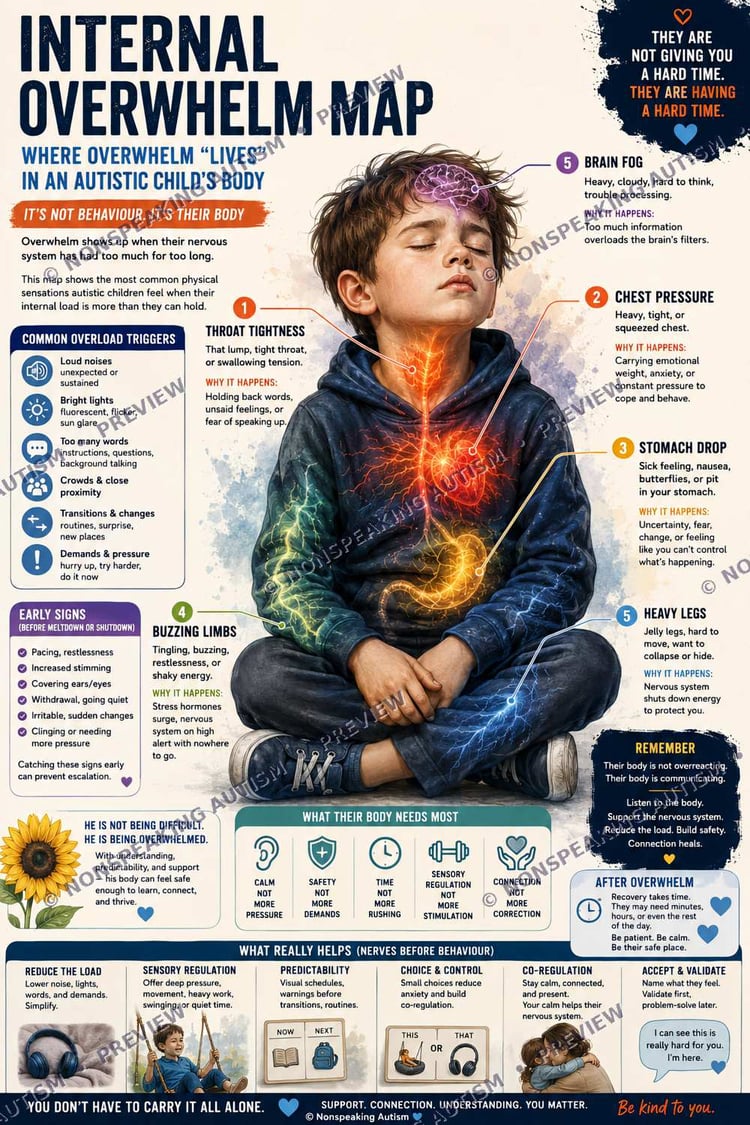
💭 What May Be Happening Underneath
Behind an apparently composed social presentation, some autistic people may be working extremely hard.
This can involve:
Rehearsing social scripts
Preparing conversations, studying other people or mentally working out what to say next.
Constant self-monitoring
Consciously monitoring facial expression, voice, posture, timing or other aspects of social behaviour.
Hidden sensory overload
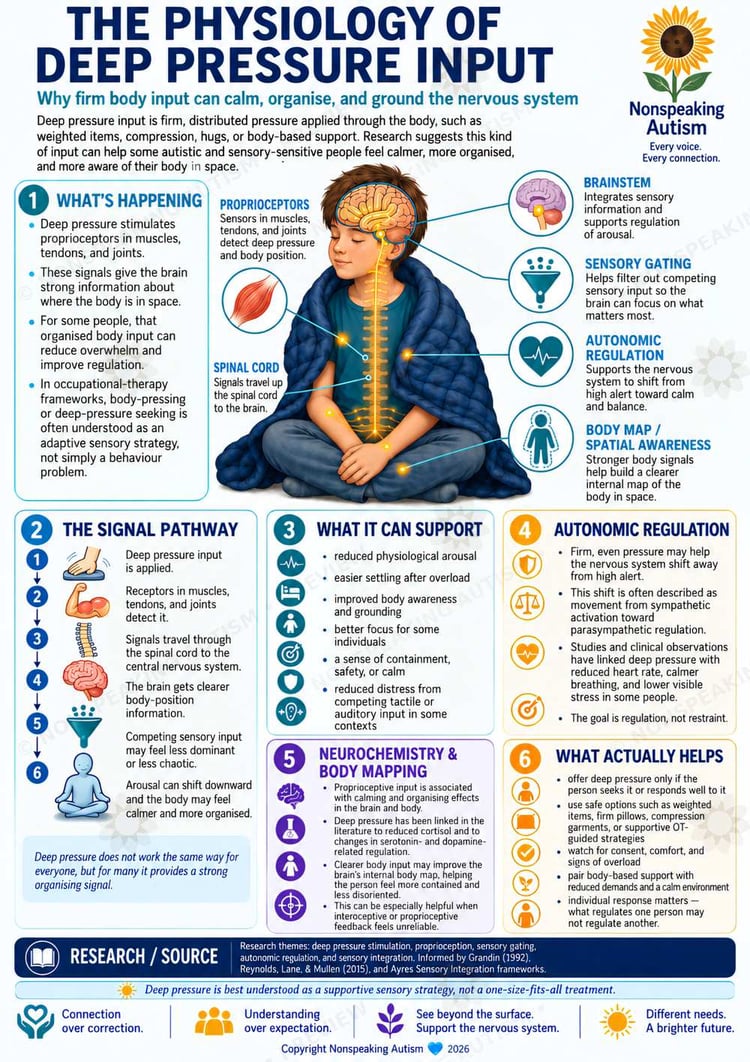
Remaining still or compliant does not necessarily mean that sounds, lights, crowds, touch or other sensory input are comfortable.
Anxiety and uncertainty
Considerable mental energy may be spent worrying about mistakes, expectations or fitting in.
Suppressing stimming
A person may reduce visible stimming in public or wait until they reach a safer environment.
Emotional load
Maintaining outward composure can coexist with significant internal emotional strain.
Energy drain
Sustained social performance and monitoring can be exhausting.
Delayed distress
Tears, shutdown or exhaustion may appear only after the person reaches somewhere they feel safer.
A strong need for recovery and predictability
Time alone, familiar routines or reduced sensory and social demands may be needed afterwards.
There may be much more going on than observers can see.
↔️ The Mismatch: Appearance vs. Reality
One of the central features of this poster is a visual comparison between what something looks like and what may actually be happening.
“Seems sociable”
This may coexist with extensive use of imitation, learnt scripts, rehearsal or guesswork.
“Looks calm”
The body may still be experiencing considerable sensory or physiological arousal.
“Doing well”
Achievement may sometimes be maintained through intense preparation, perfectionism or unsustainable effort.
“Has friends”
Relationships may still involve uncertainty, confusion or substantial social processing.
“No obvious autism”
Autistic characteristics may be less visible because they are camouflaged, suppressed or expressed differently from common stereotypes.
This is why observable performance should not be the only measure of support need.
🎭 The Masking Cycle
The poster illustrates masking as a possible repeating process:
Observe → Imitate → Suppress → Perform → Recover → Adapt/Survive at a Cost
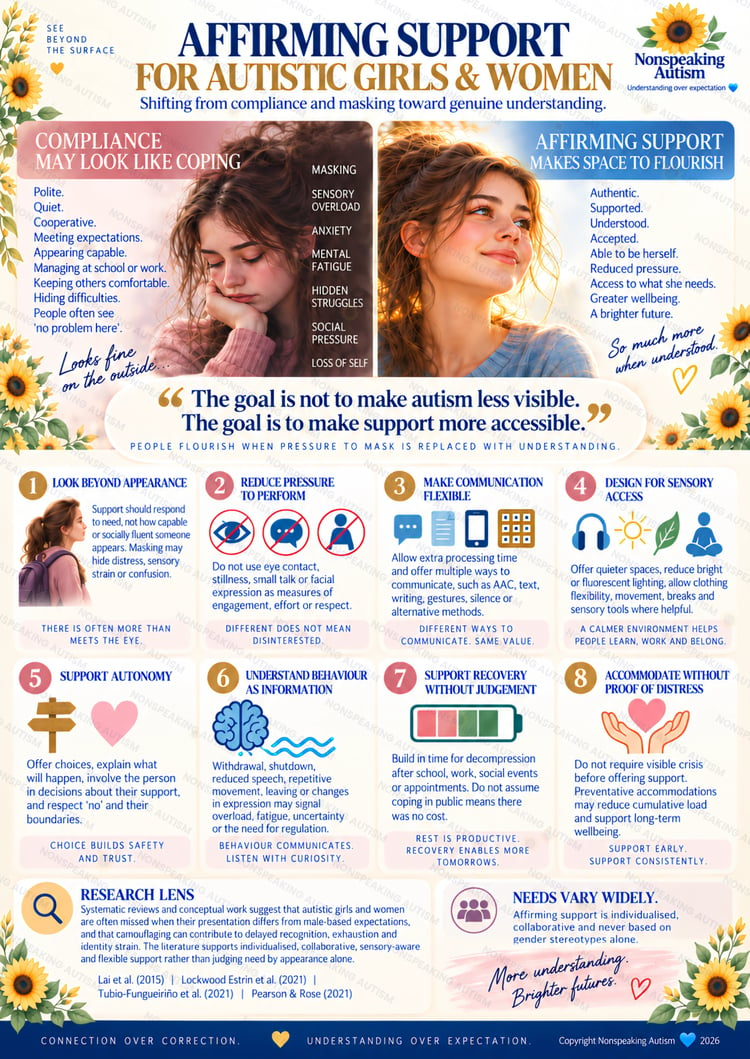
Camouflaging is a broad term used in autism research for strategies that may involve hiding, compensating for or adapting aspects of autistic presentation in social environments. Systematic reviews describe substantial variation in how camouflaging is experienced and measured, so it should not be assumed to operate identically for every autistic person.
For some people, strategies may include:
- Watching how other people behave
- Imitating expected social behaviour
- Rehearsing conversations
- Suppressing visible stimming
- Monitoring facial expressions or tone
- Forcing themselves through uncomfortable situations
- Performing socially expected responses
- Recovering privately afterwards
Camouflaging can sometimes help a person navigate particular situations, but research has also associated greater self-reported camouflaging with poorer mental-health outcomes. The relationship is complex and should not be interpreted as proof that camouflaging alone causes those outcomes.
🔎 Why It Can Be Missed
Traditional understandings of autism have not always captured the full range of autistic presentations.
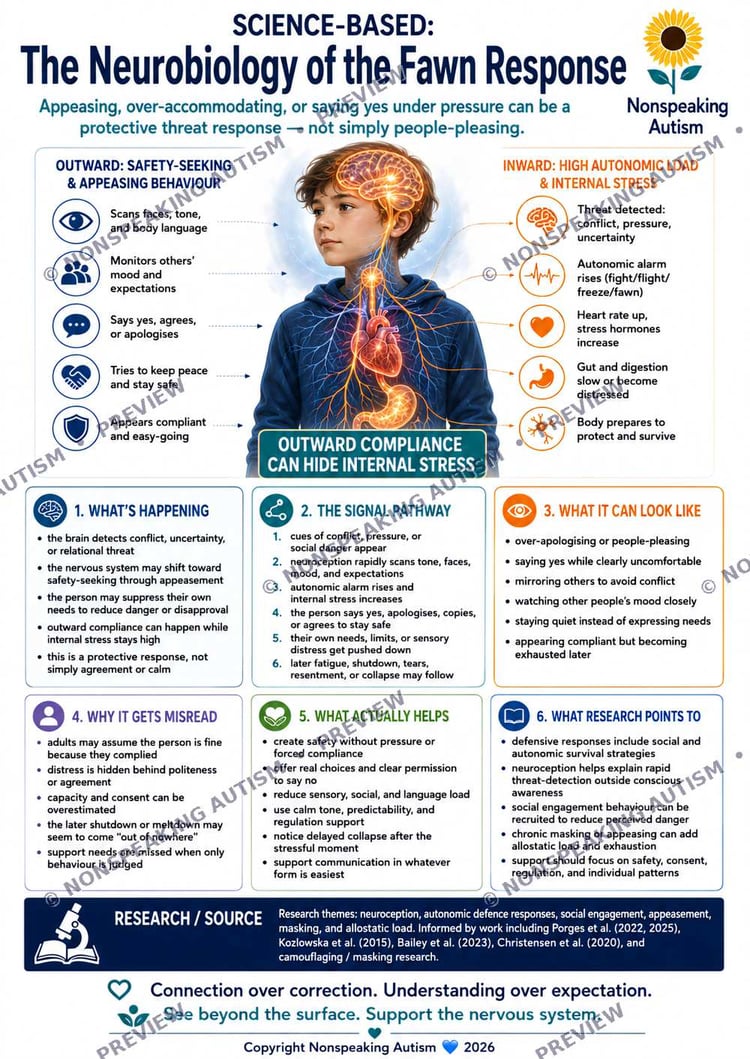
This can matter particularly when a child is compliant rather than disruptive, socially motivated, verbally able or skilled at adapting to expectations.
The poster highlights several reasons support needs may be overlooked:
Diagnostic expectations
Stereotypical ideas about what autism “looks like” may fail to capture less expected presentations.
Camouflaging
Observable behaviour during an assessment or everyday interaction may not reveal the effort behind it.
Distress may be labelled differently
Anxiety, perfectionism or emotional difficulties may become more visible than the underlying autistic experience.
Compliance can hide need
A child who follows instructions and causes little disruption can still be struggling considerably.
A 2024 review of diagnostic procedures for autistic girls and women similarly concluded that some are diagnosed later or missed and recommended considering broader behavioural presentations, camouflaging and co-occurring mental-health conditions during assessment.
💙 Why This Matters
Recognition is not about finding something “wrong” with an autistic girl or woman.
It is about developing a more accurate understanding of her experience so that support does not depend solely on how distressed she looks from the outside.
Greater awareness can:
Improve self-understanding
Having language for one's experiences can help previously confusing patterns make more sense.
Prevent calm appearance being mistaken for calm experience
Stillness, compliance or successful performance do not necessarily reveal nervous-system state.
Encourage whole-person support
Sensory needs, communication style, autonomy, recovery time and environmental demands all matter.
Challenge narrow stereotypes
There is no single way to look autistic.
Create kinder environments
Understanding hidden effort can shift the focus away from demanding better performance and towards reducing unnecessary load.
🔬 Research-Informed
This poster draws on research concerning autistic females, camouflaging, social presentation and under-recognition.
Selected peer-reviewed research represented on the poster includes work by:
Lai et al. (2015) — research contributing to understanding sex/gender and autistic presentation.
Bargiela et al. (2016) — qualitative research exploring the experiences of women diagnosed with autism in adulthood.
Dean et al. (2017) — research examining social behaviour and how autistic girls may differ in their social presentation.
Hull et al. (2020) — research contributing to understanding gender differences and camouflaging in autistic adults.
Tubío-Fungueiriño et al. (2021) — a systematic review specifically examining social camouflaging in autistic females; the review found evidence supporting camouflaging in autistic females while also noting negative implications in daily life.
More recent research reinforces the need for nuance. A 2026 meta-analysis found an association between autistic traits and camouflaging across sexes, while a recent critical review highlighted continuing limitations in how camouflaging is defined, measured and generalised across the autistic population.
The evidence therefore supports taking camouflaging seriously without turning it into another stereotype of autistic females.
👩👧 Who Is This Resource For?
This poster may be useful for:
- Autistic girls and women
- Autistic people exploring their own masking experiences
- Parents and carers
- Partners and family members
- Teachers and teaching assistants
- SENCOs and SEND teams
- Mainstream and specialist schools
- Colleges and universities
- Autism and inclusion teams
- Occupational therapists
- Speech and language professionals
- Psychologists and other relevant professionals
- Healthcare and social-care professionals
- Support workers
- Family-support organisations
- Autism training and professional-development settings
It can be displayed at home, in educational settings, SEND spaces, clinics, therapy rooms or professional environments, or used as a visual starting point for conversations about masking, hidden support needs and autistic female presentation.
📦 What You Receive
Your purchase includes:
1 × Outside vs. Underneath in Autistic Females — Educational Poster
1 × high-quality digital PDF
This is a digital educational resource from Nonspeaking Autism.
The purchased PDF is supplied clear and without the promotional preview watermark. Watermarks visible on Payhip listing images are used for preview and copyright-protection purposes only.
Digital download only — no physical product will be shipped.
⚠️ Important Disclaimer
This resource is provided for educational and informational purposes only.
It is not medical advice, a diagnostic tool, psychological treatment or a substitute for individual assessment or guidance from an appropriately qualified healthcare, educational or other professional.
The examples shown describe possible experiences and patterns rather than characteristics that apply to every autistic girl or woman.
Not every autistic female masks or camouflages. Autistic males and people of other genders may also camouflage, experience hidden sensory or emotional load, or have a significant mismatch between outward appearance and internal experience.
Appearing calm, sociable or capable does not itself demonstrate that somebody is masking, just as visible distress is not required for a person's support needs to be genuine.
Support should be individualised, collaborative and informed by the person's communication, sensory experiences, autonomy, preferences and lived experience.
💛 The Message Behind the Resource
Sometimes the person who appears to be coping is using an extraordinary amount of energy to do so.
A successful school day may be followed by exhaustion at home.
A conversation that appears effortless may have involved rehearsing, monitoring and analysing every response.
Stillness may exist alongside sensory overload.
Friendships may exist alongside social confusion.
Capability can exist alongside significant support needs.
Recognising this does not mean assuming that every autistic girl or woman is secretly struggling.
It means remembering that we cannot measure somebody's entire internal experience from their outward appearance.
The same person. A different reality.
Looking calm does not mean feeling calm.
Seen differently. Understood more.
Kinder perspectives. Brighter futures.
Connection over correction.
Understanding over expectation.
© Nonspeaking Autism 2026. All rights reserved.