
Science-Based: Masking and Camouflaging in Dual Profiles
Science-Based: Masking and Camouflaging in Dual Profiles — Educational Infographic (Printable, A2)
You will receive the printable unwatermarked version of this infographic
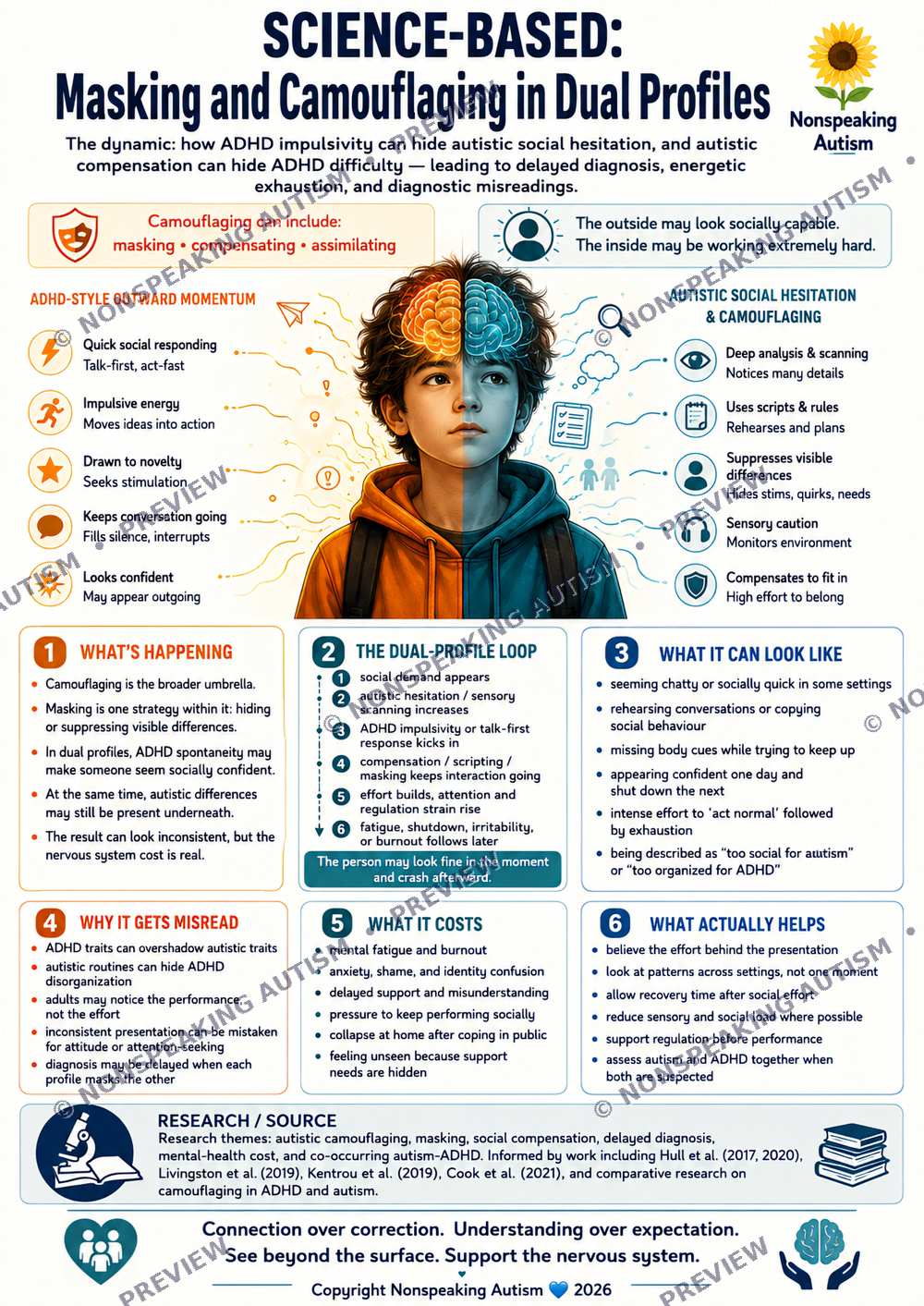
A detailed, research-grounded visual explaining how ADHD impulsivity can hide autistic social hesitation, and autistic compensation can hide ADHD difficulty — leading to delayed diagnosis, energetic exhaustion, and diagnostic misreadings.
This infographic covers:
- ADHD-style outward momentum (quick social responding, impulsive energy, drawn to novelty, keeps conversation going, looks confident) vs. autistic social hesitation & camouflaging (deep analysis and scanning, uses scripts and rules, suppresses visible differences, sensory caution, compensates to fit in)
- The dual-profile loop: social demand appears → autistic hesitation/sensory scanning increases → ADHD impulsivity or talk-first response kicks in → compensation/scripting/masking keeps interaction going → effort builds → fatigue, shutdown, irritability, or burnout follows later
- What it can look like: seeming chatty in some settings, rehearsing conversations, missing body cues while trying to keep up, appearing confident one day and shut down the next
- Why it gets misread: ADHD traits can overshadow autistic traits and vice versa; inconsistent presentation can be mistaken for attitude; diagnosis may be delayed when each profile masks the other
- What it costs: mental fatigue and burnout, anxiety and shame, delayed support, collapse at home after coping in public
- What actually helps: believe the effort behind the presentation, look at patterns across settings not one moment, allow recovery time after social effort, assess autism and ADHD together when both are suspected
- Grounded in peer-reviewed research (Hull et al. 2017, 2020; Livingston et al. 2019; Kentrou et al. 2019; Cook et al. 2021)
What you get:
- High-resolution PDF, print-ready and scalable up to A2 (420 × 594mm)
- Instant digital download
Perfect for: SEND and clinical training, therapy rooms, staff CPD, parent carer forums, and personal understanding.
For personal, classroom, and professional educational use. Not for resale or redistribution.
© Nonspeaking Autism
Disclaimer:
This resource is intended for educational and informational purposes only. It is designed to support understanding of autism, sensory processing, nervous system regulation, and behaviour from a neurodevelopmental perspective.
The information provided is not medical, psychological, therapeutic, or legal advice and should not be used as a substitute for assessment, diagnosis, or treatment by a qualified healthcare professional.
Every autistic person is unique. Strategies and supports should always be tailored to the individual's needs, strengths, and circumstances.
If a child displays a sudden change in behaviour, severe distress, signs of illness, injury, or behaviours that place themselves or others at risk, seek appropriate medical advice or emergency assistance where necessary.
While every effort has been made to ensure the information is accurate and reflects current understanding, knowledge in autism and neuroscience continues to evolve.
This resource is for the purchaser's personal, educational, or professional use only. It may not be copied, redistributed, resold, edited, shared publicly, or reproduced in whole or in part without prior written permission.
© Nonspeaking Autism 💙