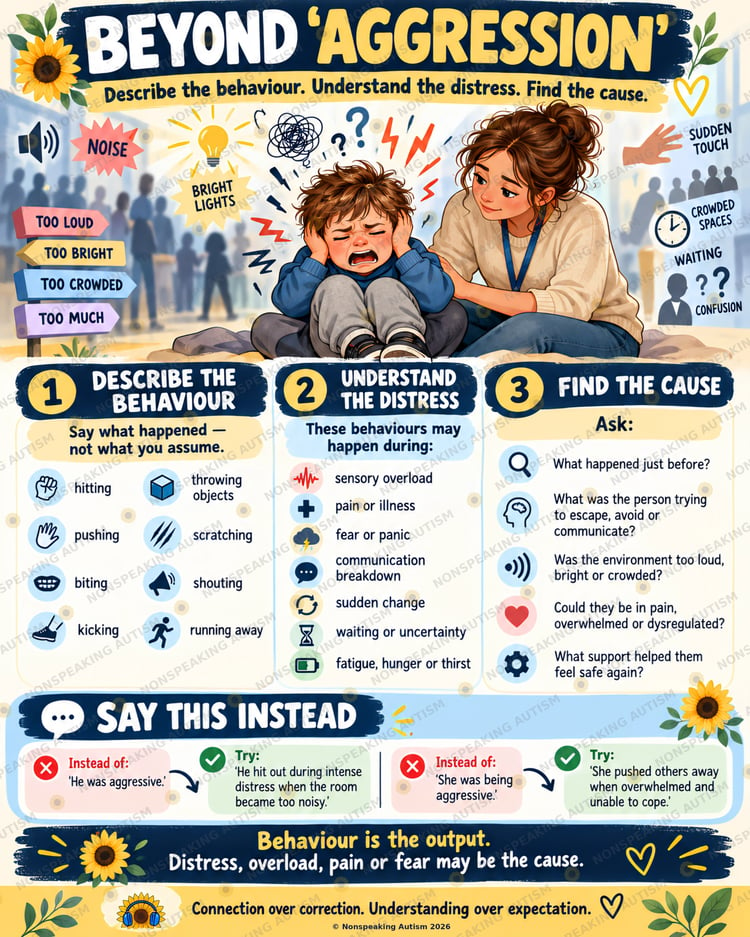

Beyond ‘Aggression’ Describe the Behaviour. Understand the Distress. Find the Cause.
Beyond ‘Aggression’
Describe the Behaviour. Understand the Distress. Find the Cause.
A compassionate, practical and research-informed autism support poster
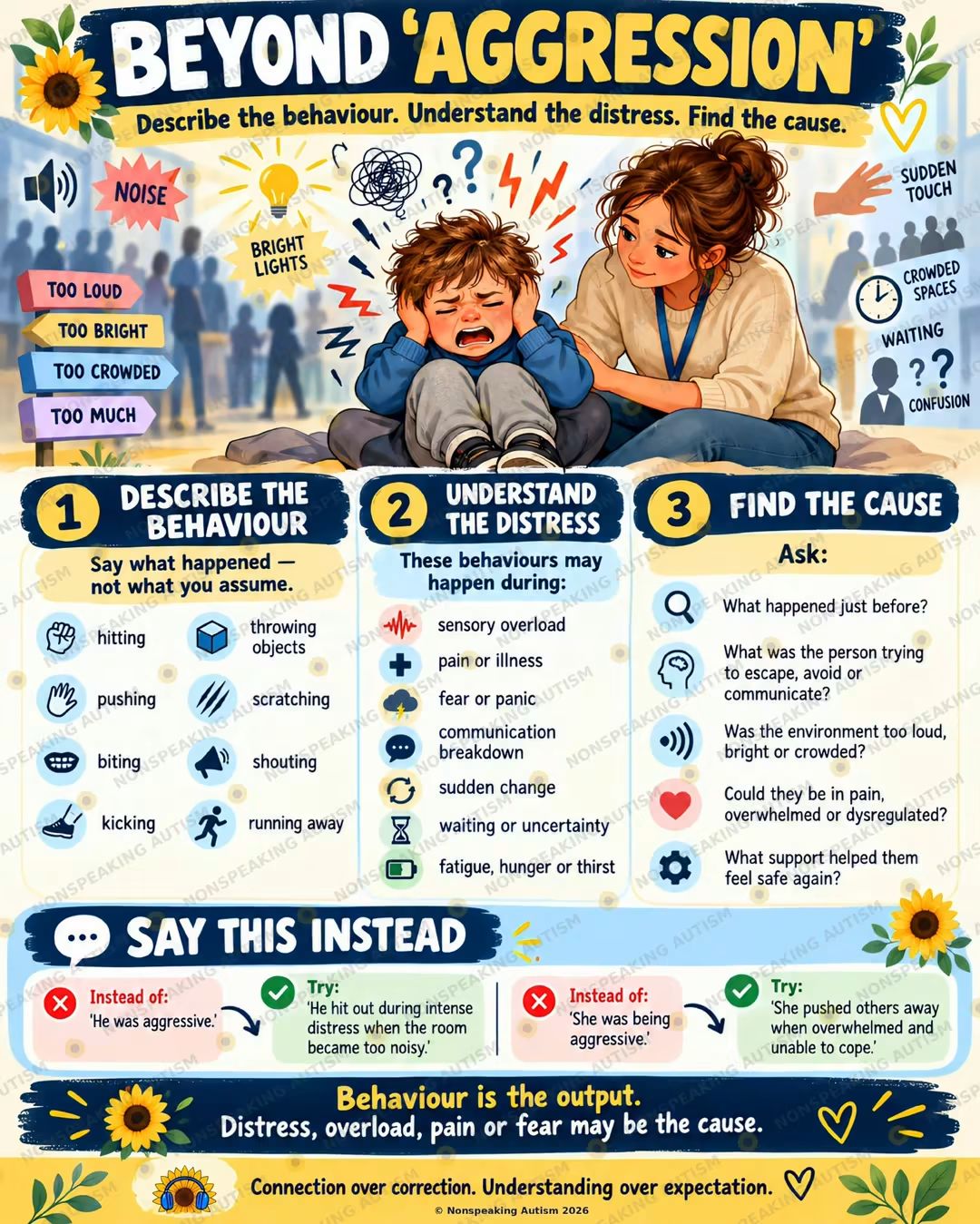
When an autistic person hits, pushes, bites, kicks, scratches, shouts, throws something or runs away, the word “aggressive” can tell us very little about what actually happened — or why.
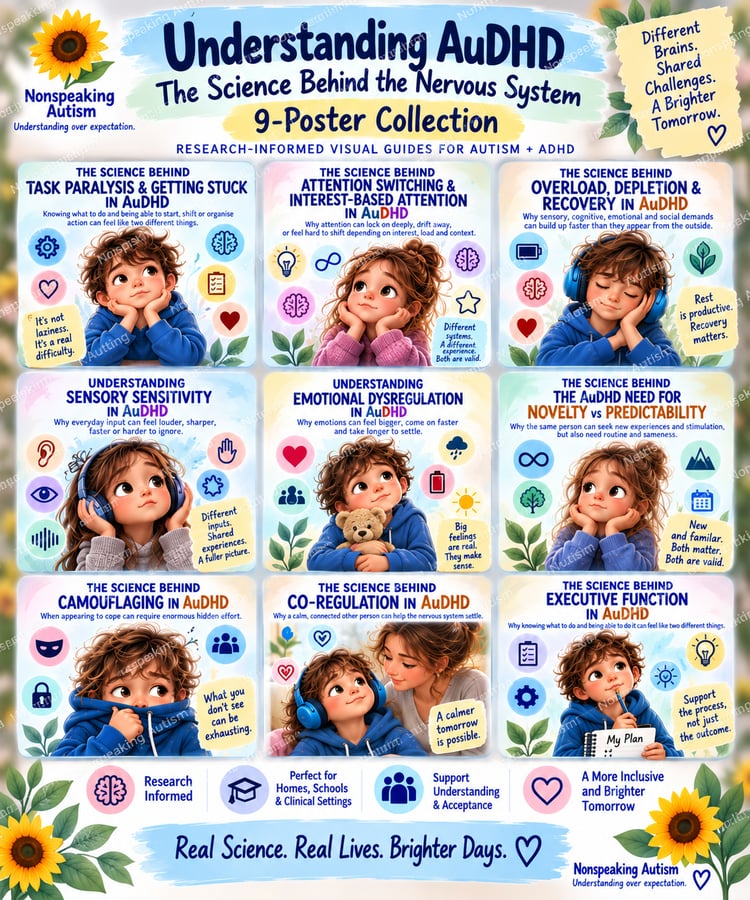
This educational poster from Nonspeaking Autism encourages parents, carers, educators and professionals to move beyond broad behavioural labels and look more carefully at the observable behaviour, the surrounding context and possible sources of distress.
The aim is not to excuse harm or minimise safety concerns.
It is to replace assumptions with better questions:
What actually happened?
What happened immediately beforehand?
What might the person have been experiencing or communicating?
What could we change to reduce the likelihood of this happening again?
💛 Behaviour Is the Output
Behaviour does not automatically tell us its cause.
The same outward behaviour can occur in very different circumstances.
Hitting, for example, could occur alongside sensory overload, acute pain, panic, an attempt to escape, communication difficulty, unexpected touch or another source of distress.
That is why this resource encourages a simple shift:
Describe first. Investigate second. Avoid assuming third.
1️⃣ Describe the Behaviour
Start with what was actually observable rather than immediately assigning intention.
Examples may include:
- hitting
- pushing
- biting
- kicking
- throwing objects
- scratching
- shouting
- running away
Instead of:
“He was aggressive.”
Try:
“He hit out during intense distress when the room became too noisy.”
Instead of:
“She was being aggressive.”
Try:
“She pushed others away when overwhelmed and unable to cope.”
More precise descriptions can provide much more useful information for understanding patterns and planning support.
Importantly, describing behaviour objectively does not minimise its seriousness. Injury and immediate risk still need an appropriate safety response.
2️⃣ Understand the Distress
The poster highlights several possible contributors that may be worth considering.
These include:
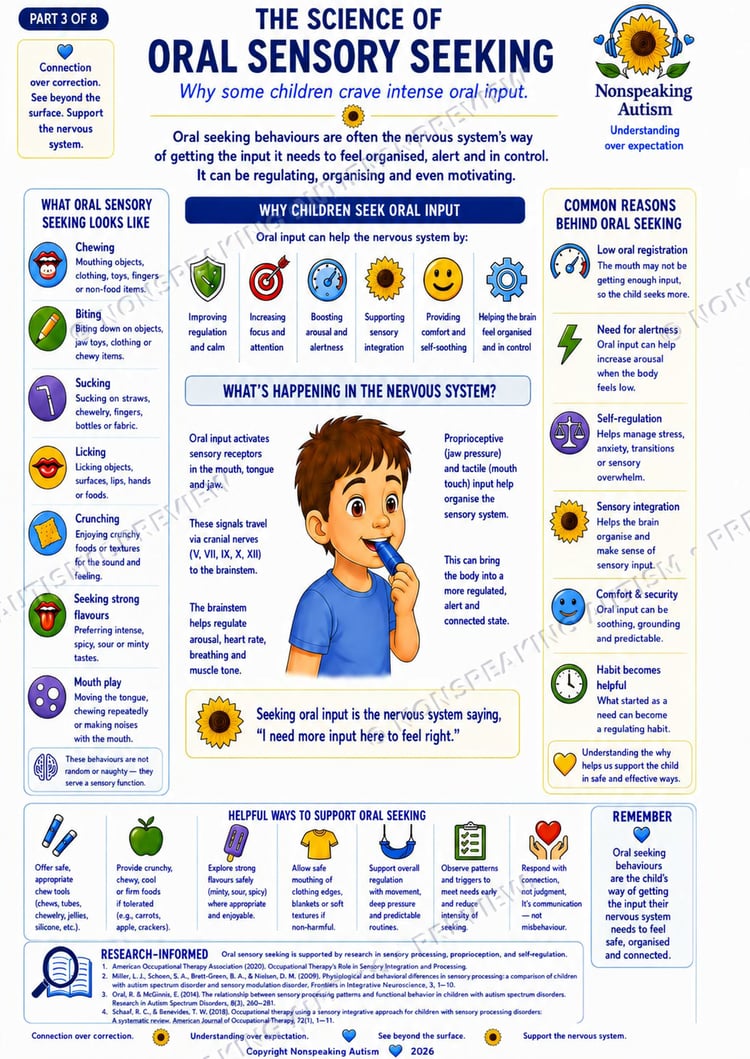
🔊 Sensory overload
Noise, bright lighting, crowds, unexpected touch, smells, temperature or competing sensory information may become overwhelming.
🩺 Pain or illness
Pain can sometimes appear through changes in behaviour, movement, communication, sleep, eating or regulation — particularly when communicating the location or intensity of pain is difficult.
😟 Fear or panic
Behaviour may occur when a person feels frightened, trapped, uncertain or unable to predict what will happen.
💬 Communication breakdown
A person may not have an effective or immediately accessible way to communicate:
Stop • No • Help • Break • Pain • Too loud • Don't touch me • I need space
Speech access may also change during intense distress.
🔄 Sudden change
Unexpected transitions, disrupted routines or rapidly changing expectations can increase load for some autistic people.
⏳ Waiting or uncertainty
Not knowing when, where, how long or what happens next can add significant stress for some people.
🔋 Fatigue, hunger or thirst
Physical and physiological needs can affect the person's available capacity to cope.
These are possibilities to investigate — not automatic explanations.
3️⃣ Find the Cause — Without Assuming It
Rather than deciding what a behaviour “means” from one incident, look for context and patterns.
Useful questions include:
What happened just before?
What was the person trying to escape, avoid, access or communicate?
Was the environment too loud, bright, crowded or unpredictable?
Was there unexpected touch?
Could the person be experiencing pain or illness?
Had demands accumulated?
Was communication accessible?
Was the person tired, hungry or thirsty?
What appeared to help them feel safer or recover?
Repeated observations across different situations can be more informative than interpreting one isolated event.
🗣️ Communication Before Compliance
When someone is distressed, communication should remain available.
That may include:
AAC • symbols • gestures • pointing • writing • typing • speech • familiar yes/no systems • body movement
Reduced speech during distress should not automatically be interpreted as refusal, defiance or lack of understanding.
Where possible, reduce unnecessary communication pressure and give adequate processing time.
Communication access should not have to be earned through calm behaviour.
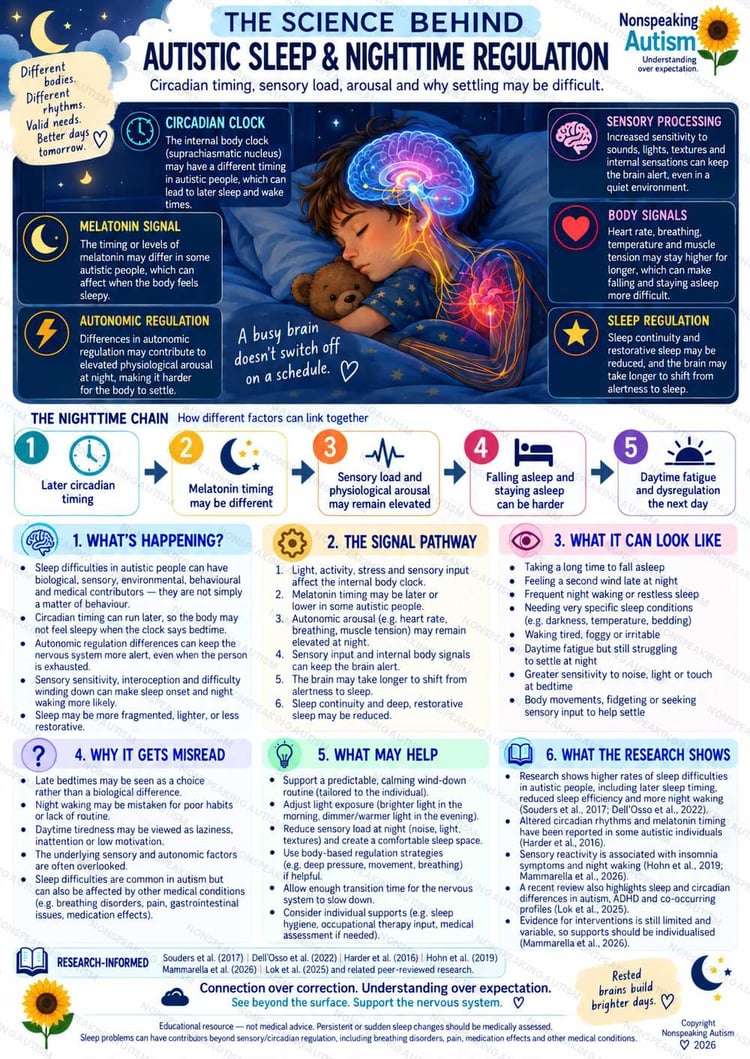
🩺 Always Consider the Body
A significant change in behaviour should not automatically be attributed to autism.
Consider whether there could be:
- dental pain
- ear pain
- headache
- gastrointestinal discomfort
- constipation
- injury
- infection or illness
- menstrual pain
- hunger or thirst
- fatigue
- sleep disruption
- medication effects
- another physical-health concern
New, severe, persistent, unusual or unexplained changes warrant appropriate professional or medical assessment.
“Behaviour” can sometimes be the first visible sign that something is wrong.
🛡️ Understanding the Cause Does Not Mean Ignoring Safety
Looking beneath behaviour does not mean that hitting, biting or other potentially harmful behaviour should simply be ignored.
Immediate safety still matters.
Where there is risk:
- protect the person and others
- reduce environmental hazards where possible
- reduce unnecessary stimulation and demands
- maintain access to communication
- follow individualized safety plans
- seek appropriately qualified support when risk is significant or recurring
Compassion and safety are not opposites.
Understanding context can help make future support safer and more preventative, rather than relying only on what happens after distress has escalated.
🌻 Look for Patterns, Not Blame
One incident rarely tells the whole story.
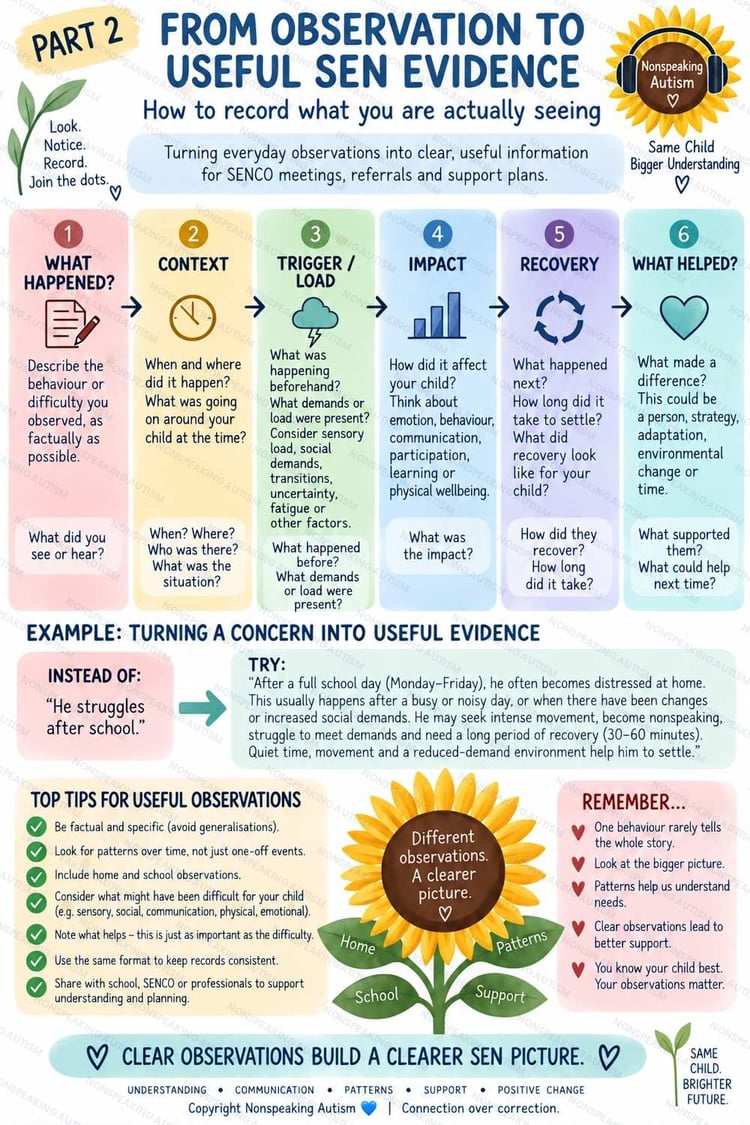
Patterns may become clearer when supporters record:
What happened before → What the person did → What happened afterwards → What appeared to help
Look across:
- different environments
- people
- sensory conditions
- demands
- transitions
- communication access
- sleep and fatigue
- physical health
- waiting and uncertainty
- recovery needs
The goal is not to find someone to blame.
The goal is to understand what can be changed, accommodated, communicated or supported.
🔬 Research & Guidance-Informed
The principles behind this resource are consistent with autism and behaviour-support guidance that recommends considering the wider context surrounding behaviour rather than assuming a single cause.
Relevant areas include:
- communication needs
- sensory differences
- physical and mental health
- environmental factors
- changes to routines
- predictability
- reinforcement and consequences
- functional assessment
- individual strengths and needs
NICE guidance for autistic children and young people recommends assessing potential factors that may increase the likelihood of behaviour that challenges, including communication difficulties, physical disorders, anxiety or other mental-health difficulties, sensory environment, changes to routines and the social environment.
The poster's examples should therefore be treated as possible contributors to investigate, rather than fixed explanations for a particular behaviour.
📚 Selected References & Guidance
National Institute for Health and Care Excellence (NICE). (2013, updated). Autism spectrum disorder in under 19s: support and management (CG170).
Guidance includes consideration of communication, physical and mental health, sensory factors, routines, environmental factors and individualized assessment when behaviour becomes challenging.
National Institute for Health and Care Excellence (NICE). (2015). Challenging behaviour and learning disabilities: prevention and interventions for people with learning disabilities whose behaviour challenges (NG11).
Emphasises understanding the function of behaviour and considering communication, physical and mental health, medication, environment, relationships and other contextual factors.
National Institute for Health and Care Excellence (NICE). Autism (QS51).
Quality standard supporting individualized and coordinated care and support for autistic people.
National Autistic Society. Guidance on distressed behaviour and meltdowns in autistic people, including sensory, communication, environmental and physical-health considerations.
🔗 FURTHER RESOURCES National Autistic Society — Distressed behaviour: a guide for all audiences Strategies for understanding distressed behaviour, including keeping a behaviour diary of what happens before, during and after, and considering pain. https://www.autism.org.uk/advice-and-guidance/behaviour/distressed-behaviour/all-audiences National Autistic Society — Meltdowns What meltdowns are, their causes, and how to anticipate them and reduce how often they happen. https://www.autism.org.uk/advice-and-guidance/behaviour/meltdowns National Autistic Society — Sensory differences and mental health A summary of research on how sensory reactivity, uncertainty and anxiety connect in autistic children. https://www.autism.org.uk/advice-and-guidance/professional-practice/sensory-mental-health Autistica — Supporting autistic people who are overwhelmed or having a meltdown Practical guidance from a UK autism research charity. https://www.autistica.org.uk/what-is-autism/supporting-meltdowns Challenging Behaviour Foundation A UK charity supporting families and professionals to understand and respond to behaviours of distress. https://www.challengingbehaviour.org.uk/
🔬 Up-to-date research (2024–2026) Luo, H., et al., & Schwarzlose, R. (2026). Specific, replicable behavioral and neural correlates of sensory over-responsivity in childhood. Journal of the American Academy of Child & Adolescent Psychiatry. Published online 13 August 2026. → Supports: 2 Understand the Distress (sensory overload); "Too loud, too bright, too crowded, too much" Johns Hopkins University research team. (2025, in press). Intolerance of uncertainty and sensory overreactivity: Potential targets to reduce aggression in young autistic children? [Peer-reviewed journal article; full author and journal details to be confirmed on publication.] → Supports: 2 Understand the Distress (sensory overload; waiting or uncertainty); 3 Find the Cause Chen, Y., Xi, Z., Saunders, R., Simmons, D., Totsika, V., & Mandy, W. (2024). A systematic review and meta-analysis of the relationship between sensory processing differences and internalising/externalising problems in autism. Clinical Psychology Review, 114, 102516. https://doi.org/10.1016/j.cpr.2024.102516 → Supports: 2 Understand the Distress; "Behaviour is the output" Bird, S., Moid, L. A. E., Jones, C. A., & Surtees, A. D. R. (2024). The relationships between restrictive/repetitive behaviours, intolerance of uncertainty, and anxiety in autism: A systematic review and meta-analysis. Research in Autism Spectrum Disorders, 117, 102428. → Supports: 2 Understand the Distress (sudden change; waiting or uncertainty; fear or panic) Ong, C. S. Y., Rodgers, J., Cooper, M. N., Dempsey, Z., Eaton, R., Haines, K., Kuzminski, R., Magiati, I., Maybery, M. T., Uljarević, M., Wray, J., Whitehouse, A. J. O., & Alvares, G. A. (2025). Targeting intolerance of uncertainty in young children diagnosed with autism: A randomized controlled trial of a parent-mediated group intervention. JCPP Advances. → Supports: 2 Understand the Distress (waiting or uncertainty); 3 "What support helped them feel safe again?" Therrien, M. C. S., Whalon, K., Nunes, D., Marti, P., & Sellers, A. (2025). A systematic review of AAC interventions using speech generating devices for autistic preschoolers. Augmentative and Alternative Communication, 41(2). https://doi.org/10.1080/07434618.2025.2479768 → Supports: 2 Understand the Distress (communication breakdown); 3 "What was the person trying to communicate?" Kumar, J., Hartzell, C., Abelson, E., Jastrowski Mano, K., & Chidambaran, V. (2026). Prevalence, expression, assessment, mechanisms, and management of pain in autistic children: A scoping review. A&A Practice, 20(4), e02178. https://doi.org/10.1213/XAA.0000000000002178 → Supports: 2 Understand the Distress (pain or illness); 3 "Could they be in pain?"
📖 Evidence Note
This is a research- and guidance-informed educational resource, not a validated behaviour-assessment instrument.
The possible causes shown on the poster — including sensory overload, pain, fear, communication breakdown, change, uncertainty and fatigue — cannot be inferred from behaviour alone.
For example, hitting does not prove sensory overload, and running away does not by itself establish fear or avoidance.
Individual assessment and repeated observation of context are important.
👨👩👧 Who Is This Resource For?
This poster may be useful for:
- parents and carers
- autistic people and their supporters
- teachers and teaching assistants
- SENCOs and SEND teams
- mainstream and specialist schools
- support workers
- respite services
- occupational therapists
- speech and language therapists
- healthcare professionals
- social-care professionals
- psychologists and behavioural professionals
- multidisciplinary teams
- autism and disability organisations
It can be used to support staff training, family discussions, reflective practice and individualized support planning.
📦 What You Receive
Your purchase includes:
1 × Beyond ‘Aggression’ — Describe the Behaviour. Understand the Distress. Find the Cause. educational poster
1 × high-resolution printable digital PDF
The purchased file is supplied clear and without the promotional preview watermark shown on the Payhip listing image.
Watermarks visible on listing images are used for preview and copyright protection only.
Digital download only — no physical product will be shipped.
⚠️ Important Disclaimer
This resource is provided for educational and informational purposes only.
It is not a diagnostic tool, medical assessment, psychological assessment, behavioural assessment, Functional Behaviour Assessment (FBA), risk assessment, safeguarding plan, crisis plan or treatment plan, and it does not replace individualized assessment or advice from appropriately qualified professionals.
The behaviours and possible contributors shown are examples. No single behaviour proves its cause or function.
Distress and behavioural changes can have multiple or overlapping causes, including pain, illness, fatigue, sleep difficulties, medication effects, communication barriers, sensory factors, anxiety and environmental circumstances.
Where behaviour presents a foreseeable significant risk of harm, appropriate individualized professional assessment, risk management, safeguarding and safety planning should be sought.
Sudden, severe, persistent, unusual or unexplained changes in behaviour or communication may require medical assessment.
In a medical emergency or where there is immediate serious danger, contact the appropriate emergency service.
©️ Copyright & Permitted Use
Copyright © 2026 Nonspeaking Autism. All rights reserved.
Purchase permits use for personal and family use, your own classroom or educational setting, your own clinic or individual professional educational practice, and direct support work with people you support.
The digital file may not be resold, redistributed, file-shared, uploaded elsewhere, commercially reproduced, altered for resale or incorporated into another product for sale or distribution.
Please direct others who require their own copy to the original Nonspeaking Autism listing.
💛 The Message Behind the Resource
Words shape the way we respond.
When we stop at “aggressive,” we risk describing the person instead of understanding what happened.
A more useful approach is:
Describe what happened.
Check safety.
Look at what came before.
Keep communication accessible.
Consider sensory load.
Consider pain and physical health.
Look for patterns.
Ask what support could change next time.
The aim is not to excuse harmful behaviour.
It is to understand enough to support the person more safely, compassionately and effectively.
Behaviour is the output.
Distress, overload, pain or fear may be the cause.
Connection over correction. Understanding over expectation. 💛🌻
© Nonspeaking Autism 2026