
The Science Behind Transition Distress
The Science Behind Transition Distress — Part 1: The Reframe
What happens when the nervous system has to disengage, predict and reorganize
Moving from one activity to another can look simple from the outside.
“Put that away.”
“Time to leave.”
“Come inside.”
“Turn it off.”
“Now we're going to school.”
But for some autistic and neurodivergent people, a transition can involve much more than simply stopping one thing and starting another.
The brain may need to disengage attention, understand what is ending, predict what is coming next, reorganize actions, process changing sensory and social information, and manage uncertainty — sometimes all at once.
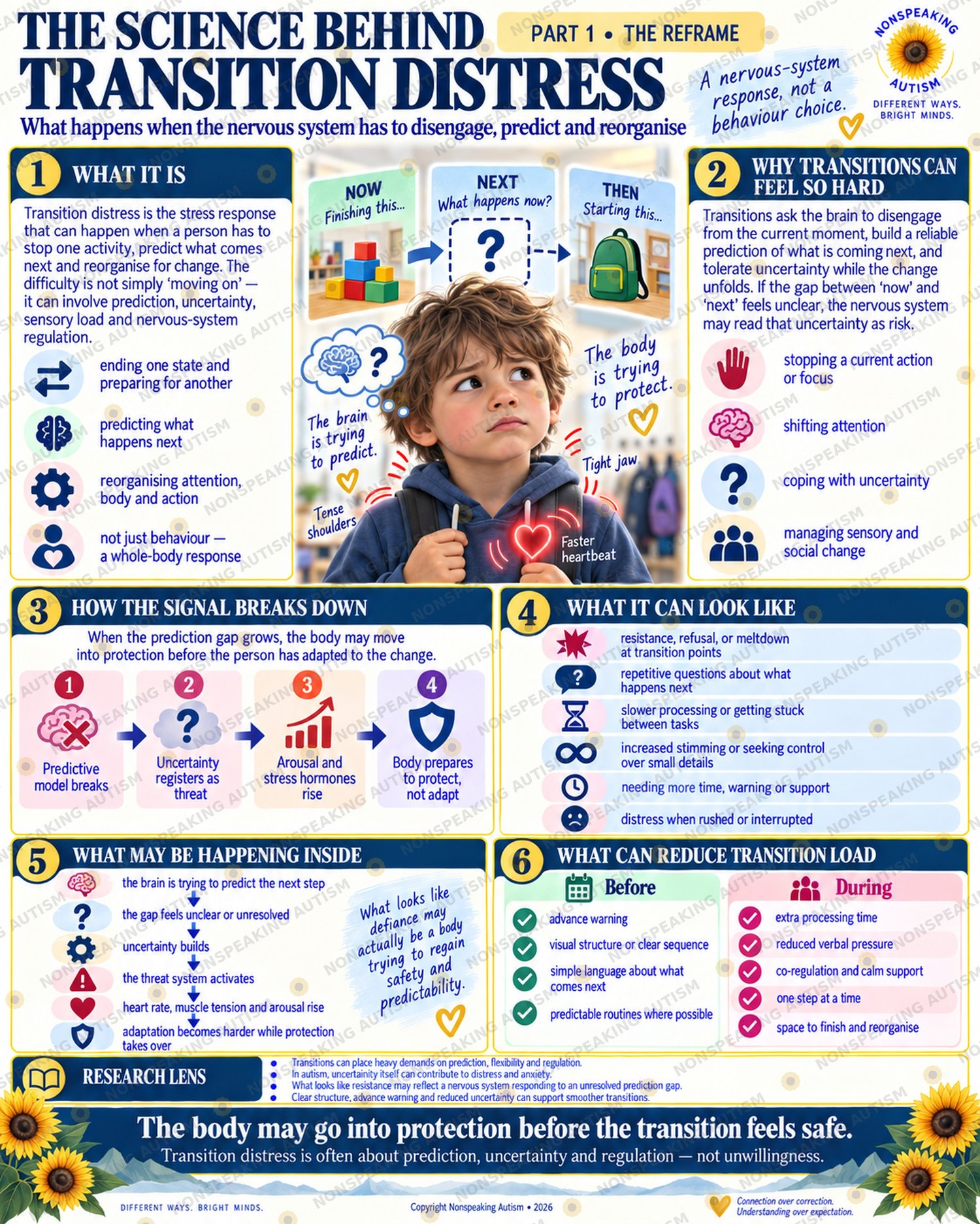
The Science Behind Transition Distress — Part 1: The Reframe is a research-informed educational poster designed to help families, caregivers, educators and professionals look beneath behaviours that can otherwise be interpreted as refusal, resistance or defiance.
The central reframe is:
Transition distress can be a stress response — not simply a behaviour choice.
And sometimes:
The body may move into protection before the transition feels safe.
🧠 What Is Transition Distress?
Transition distress describes distress that may arise when a person needs to stop one activity, shift attention, predict what comes next and reorganize for change.
For some people, the difficulty is not simply “moving on.”
A transition can involve:
ending one state and preparing for another
disengaging from a current focus
shifting attention
predicting what will happen next
managing uncertainty
reorganizing actions
processing sensory changes
adjusting to new social demands
regulating the body's response to change
The amount of difficulty can vary enormously depending on the person, environment and situation.
A child may transition comfortably at one time and struggle significantly at another.
That difference does not necessarily mean they are “choosing” when to cooperate.
The demands placed on their nervous system may have changed.
🔄 Why Can Transitions Feel So Hard?
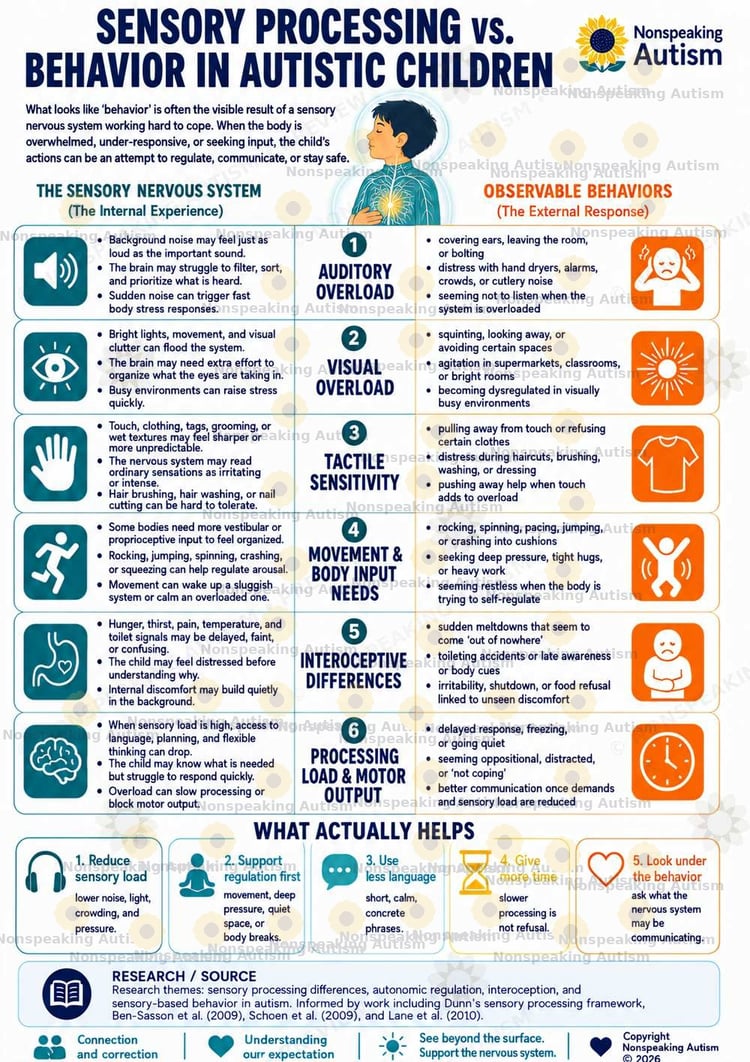
Transitions ask the brain to perform several tasks at once.
The person may need to:
✋ Stop a Current Action or Focus
Stopping something meaningful, enjoyable, regulating or highly absorbing can itself require substantial cognitive effort.
🧠 Shift Attention
Attention needs to move away from what is happening now and towards something different.
❓ Cope With Uncertainty
If the next activity is unclear, unpredictable or unfamiliar, the person may have fewer reliable cues about what is about to happen.
👥 Manage Sensory and Social Change
A transition may also involve changes in:
noise
lighting
people
location
expectations
communication
movement
sensory input
So “time to go” may represent far more than walking through a doorway.
🔮 Prediction & Uncertainty
Prediction helps people prepare for what happens next.
For some autistic people, uncertainty and unexpected change can be particularly demanding.
If the gap between:
NOW — what I understand
and
NEXT — what I need to prepare for
becomes unclear, distress may increase.
Research has identified relationships between intolerance of uncertainty and anxiety in autistic people, although these relationships are complex and vary between individuals.
This does not mean uncertainty automatically causes every difficult transition.
It means that predictability can be an important part of understanding transition demands.
⚙️ How the Signal Can Break Down
The poster uses a simple educational pathway to illustrate one possible experience:
1️⃣ The Predictive Model Breaks
The person no longer has a clear expectation of what comes next.
⬇️
2️⃣ Uncertainty Increases
The transition becomes harder to anticipate.
⬇️
3️⃣ Arousal & Stress May Increase
The body may become more activated as uncertainty and demands increase.
⬇️
4️⃣ The Body Prepares to Protect
Once distress becomes sufficiently high, adapting to the transition may become even harder.
This is an educational model, not a literal neurological sequence that occurs identically in every autistic person.
Its purpose is to encourage a different interpretation:
What appears to be resistance may sometimes reflect a person who is struggling to reorganize under increasing stress.
👀 What Transition Distress Can Look Like
Transition difficulty will not look the same for everyone.
Possible signs may include:
resistance or refusal at transition points
distress or meltdown
repeated questions about what happens next
slower processing
becoming “stuck” between activities
increased stimming
seeking control over small details
needing additional warning
needing more processing time
distress when rushed
difficulty when interrupted
withdrawal or shutdown
repeatedly returning to the previous activity
These behaviours do not prove a particular neurological mechanism.
They are clues that can prompt us to ask:
“What is making this transition difficult?”
rather than immediately:
“How do we make them comply?”
❤️ What May Be Happening Underneath?
A useful way to think about some difficult transitions is:
The brain is trying to predict the next step.
⬇️
The next step remains unclear or unresolved.
⬇️
Uncertainty increases.
⬇️
Arousal and stress may rise.
⬇️
Adapting becomes harder as the person moves towards protection.
From the outside, this may be interpreted as stubbornness or defiance.
From the person's perspective, the experience may be closer to:
“I don't know what happens next.”
“I'm not finished.”
“I need more time.”
“This change feels too fast.”
“I don't know what the next place will be like.”
“I can't reorganize yet.”
That distinction can completely change the support that follows.
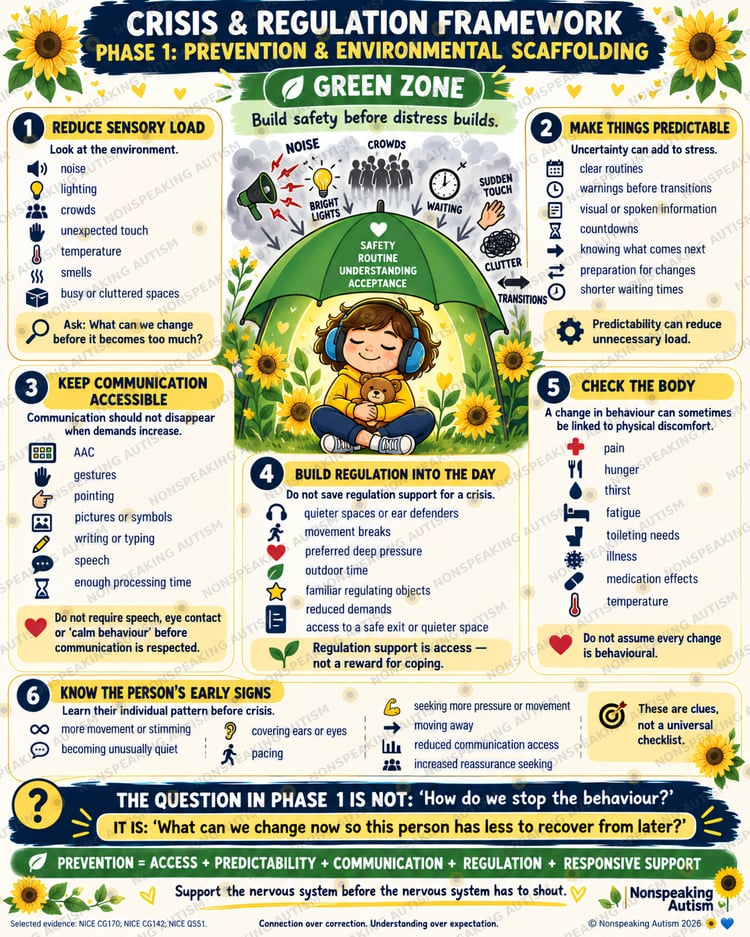
🌿 What Can Reduce Transition Load?
The aim is not to eliminate every transition.
Transitions are unavoidable parts of everyday life.
Instead, support can focus on making necessary changes more understandable, predictable and manageable.
🗓️ Before the Transition
Helpful strategies may include:
advance warning
visual structure
a clear sequence
simple information about what happens next
predictable routines where possible
First–Then supports where appropriate
countdowns if the person finds them helpful
The important point is not simply giving “more warnings.”
It is making the upcoming change meaningful and understandable to the individual.
💜 During the Transition
Once a transition is happening, support may include:
additional processing time
reduced verbal pressure
co-regulation and calm support
one step at a time
space to finish and reorganize where possible
continued access to communication
reducing unnecessary sensory demands
allowing familiar regulation strategies
Repeated verbal prompting can sometimes add more processing demands to an already overloaded situation.
Sometimes fewer words and more time are more useful.
⏳ Processing Time Is Support
A delayed response does not necessarily mean a person has ignored an instruction.
They may still be:
processing what was said
disengaging from the current activity
reorganizing attention
working out the sequence
managing uncertainty
preparing their body to move
Allowing processing time can therefore be an important accommodation rather than an unnecessary delay.
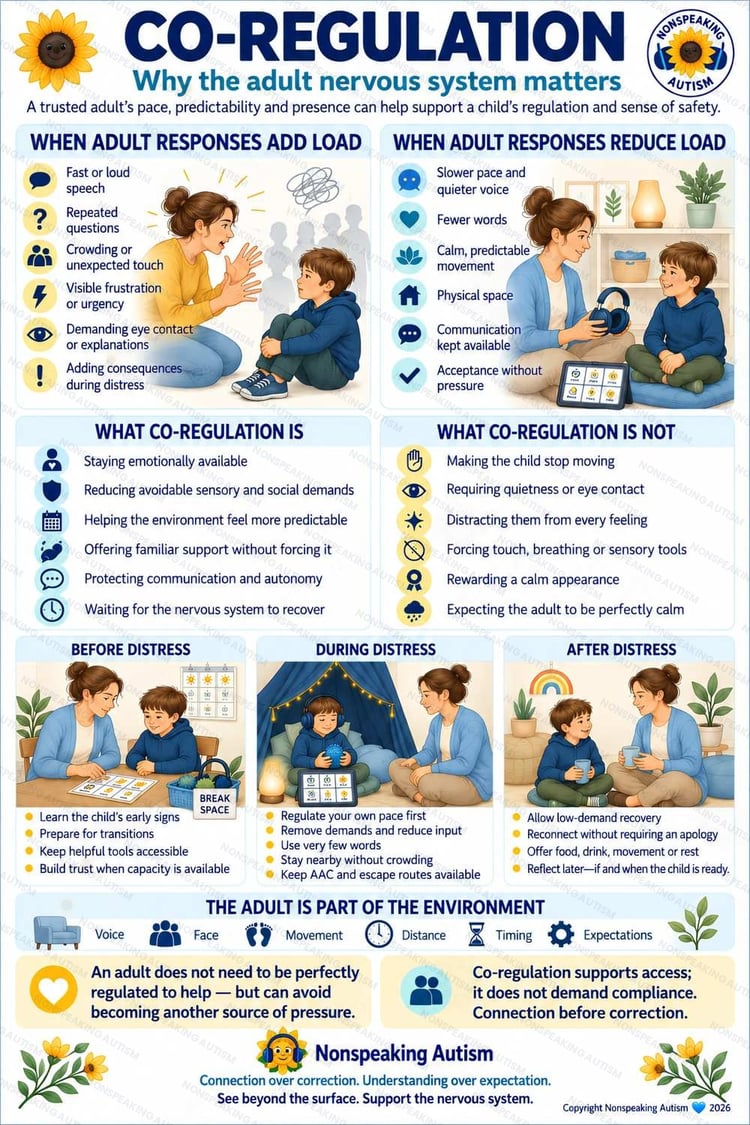
🤝 Co-Regulation Over Confrontation
When a person is already distressed, increasing pressure may make adaptation more difficult.
Supportive co-regulation can involve:
a calm presence
clear and limited language
predictability
reduced demands
acknowledging difficulty
allowing communication in the person's accessible form
helping make the next step understandable
The aim is not to “win” the transition.
It is to help the person move through it with as much safety, dignity and access as possible.
♾️ Transition Needs Are Individual
There is no single autistic response to transitions.
Some autistic people manage most everyday transitions easily.
Others may struggle primarily with unexpected changes.
Some may find stopping a highly focused activity particularly difficult.
Others may struggle when a transition introduces a new sensory environment, unfamiliar people or unclear expectations.
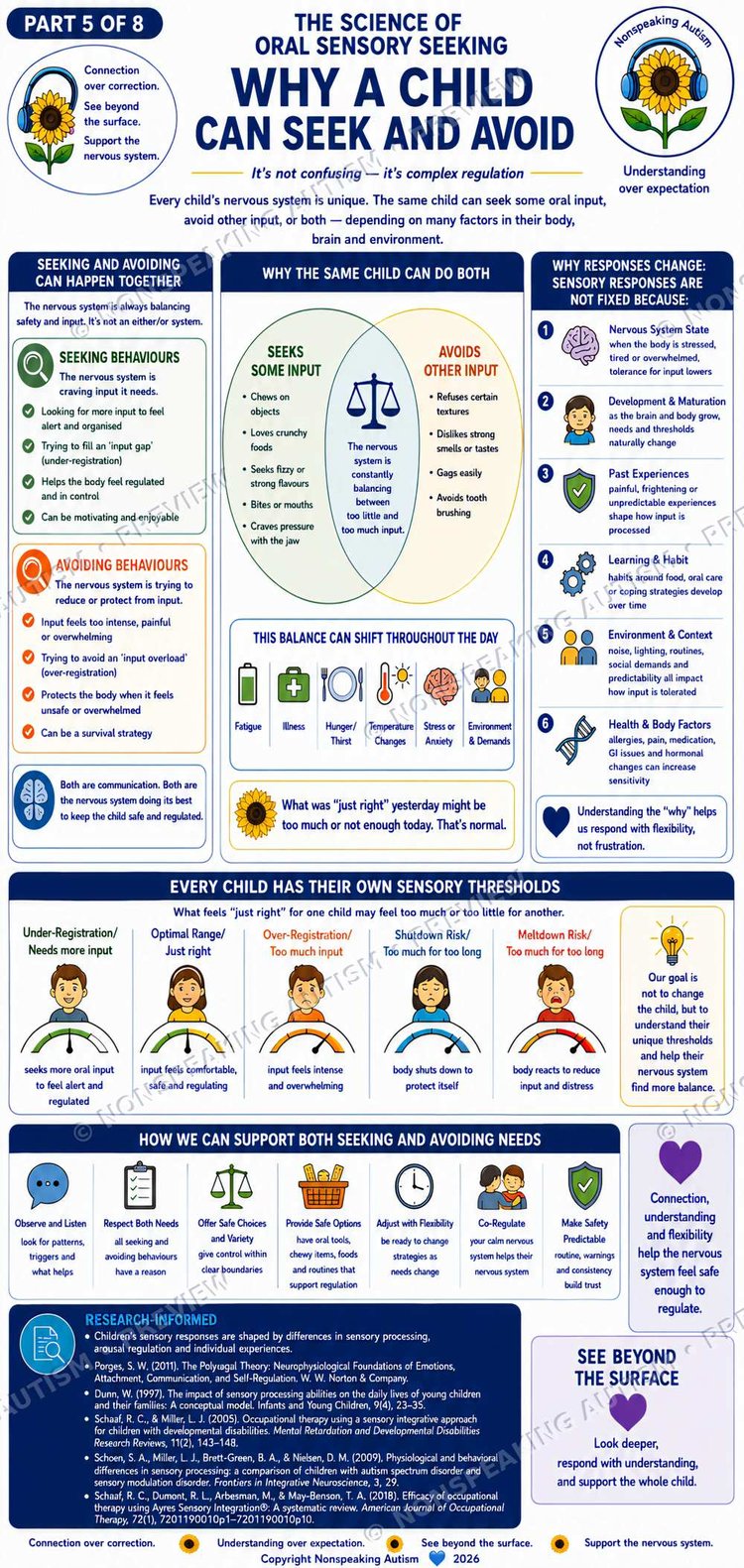
Needs may also change according to:
fatigue
sleep
hunger
pain
sensory load
anxiety
communication demands
previous stress
how meaningful the current activity is
how predictable the next activity feels
This is why transition support should be individualized rather than based on diagnosis alone.
🔬 The Research Lens
Research provides several useful perspectives for understanding transition distress.
Autism research has examined differences in prediction, responses to uncertainty, cognitive flexibility, executive functioning, anxiety and sensory processing.
Evidence also suggests an association between intolerance of uncertainty and anxiety in autistic populations.
These findings can help explain why clear structure, advance information and reduced uncertainty may be useful for some people.
However, there is no single established neurological pathway that explains every instance of transition distress.
The poster therefore uses a research-informed explanatory framework rather than claiming a universal biological mechanism.
The safest interpretation is:
Transitions can place demands on prediction, flexibility, attention and regulation. Uncertainty itself can contribute to distress and anxiety, and support that increases clarity and predictability may help some individuals.
📚 Suggested References & Evidence Base
Jenkinson, R., Milne, E., & Thompson, A. (2020). The relationship between intolerance of uncertainty and anxiety in autism: A systematic literature review and meta-analysis. Autism, 24(8), 1933–1944.
Boulter, C., Freeston, M., South, M., & Rodgers, J. (2014). Intolerance of uncertainty as a framework for understanding anxiety in children and adolescents with autism spectrum disorders. Journal of Autism and Developmental Disorders, 44, 1391–1402.
Pellicano, E., & Burr, D. (2012). When the world becomes “too real”: A Bayesian explanation of autistic perception. Trends in Cognitive Sciences, 16(10), 504–510.
Van de Cruys, S., Evers, K., Van der Hallen, R., Van Eylen, L., Boets, B., de-Wit, L., & Wagemans, J. (2014). Precise minds in uncertain worlds: Predictive coding in autism. Psychological Review, 121(4), 649–675.
Demetriou, E. A., et al. (2018). Autism spectrum disorders: A meta-analysis of executive function. Molecular Psychiatry, 23, 1198–1204.
National Institute for Health and Care Excellence (NICE). Autism spectrum disorder in under 19s: support and management (CG170). NICE guidance emphasizes consideration of communication needs, environment, sensory factors, changes to routines and predictability when understanding behaviours that challenge.
Evidence Note
These references support the broader concepts explored by the poster. Predictive-processing theories of autism remain theoretical frameworks and should not be presented as proven explanations for every autistic person's transition difficulties.
👨👩👧 Who Is This Resource For?
This educational poster may be useful for:
- autistic children and young people
- autistic adults
- parents and caregivers
- families
- teachers
- teaching assistants
- SENCOs and SEND professionals
- occupational therapists
- speech and language therapists
- psychologists and allied professionals
- early-years practitioners
- support workers
- autism and disability organizations
- professional-development and staff-training settings
It may be particularly useful where transitions are frequently interpreted as refusal, non-compliance or “difficult behaviour.”
📦 What You Receive
Your purchase includes:
1 × The Science Behind Transition Distress — Part 1: The Reframe educational poster
1 × high-resolution printable PDF
The purchased resource is supplied clear and without the promotional preview watermark shown on listing images.
Preview watermarks are used for copyright protection only and will not appear on the purchased file.
Digital download only — no physical product will be shipped.
⚠️ Important Educational & Medical Disclaimer
This resource is provided for educational and informational purposes only.
It is not medical advice, diagnosis, psychological assessment, behavioural treatment, occupational therapy, mental-health treatment or an individualized support plan.
Transition distress can have many causes. Difficulty transitioning should not automatically be assumed to result from autism, anxiety, intolerance of uncertainty or nervous-system dysregulation.
Sudden, significant, severe or unusual changes in behaviour, communication, responsiveness or ability to manage previously tolerated transitions may warrant consideration of pain, illness, medication effects, sleep difficulties, environmental changes, emotional wellbeing and other unmet needs, with appropriate professional or medical assessment where necessary.
The diagrams describing prediction, arousal and protective responses are educational simplifications. Predictive-processing accounts of autism are active areas of scientific research and should not be interpreted as established explanations of every autistic person's experience.
Strategies within this resource are examples only and should be adapted according to the person's communication, preferences, age, abilities, sensory profile, health, circumstances and support needs.
💛 The Message Behind the Resource
When a child struggles every time the tablet is turned off, play ends, the classroom changes, it is time to leave the house or an expected plan suddenly changes, it is easy for adults to see:
“They won't transition.”
But there may be a more useful question:
“What does this transition require from them?”
They may need to stop something that feels safe or regulating.
Shift attention.
Process instructions.
Predict what happens next.
Leave a familiar sensory environment.
Enter a different one.
Manage uncertainty.
Reorganize their body and actions.
And do all of that quickly enough to meet somebody else's timetable.
Support does not mean avoiding every transition.
It means recognizing when a transition is placing more demands on a person than we can see from the outside.
Give information.
Build predictability.
Allow processing.
Reduce unnecessary pressure.
Keep communication accessible.
Support regulation.
And look beneath what can easily be labelled as defiance.
The body may go into protection before the transition feels safe.
Transition distress is often about prediction, uncertainty and regulation — not unwillingness.
Connection over correction. Understanding over expectation.
Different Ways. Bright Minds.
© Nonspeaking Autism 2026