

💙 UNDERSTANDING FIGHT, FLIGHT, FREEZE & FAWN
💙 UNDERSTANDING FIGHT, FLIGHT, FREEZE & FAWN
Why Protective Stress Responses Can Be Mistaken for ‘Bad Behaviour’
UK Edition | Research-Informed Autism, Stress Responses & Emotional Regulation Educational Poster |
Nonspeaking Autism
🌻 See the response. Support the nervous system. Reduce the threat.
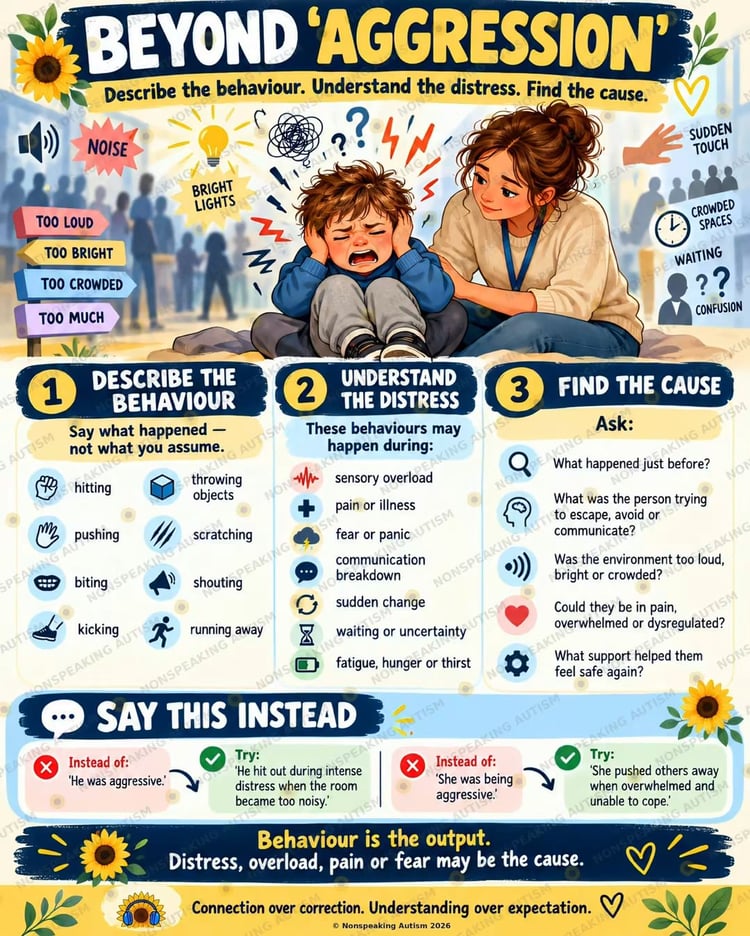
A child may shout, push away, run from a situation, become very still or appear unusually compliant when overwhelmed.
From the outside, these responses may be misunderstood as aggression, defiance, avoidance, ignoring instructions or simply being difficult.
But outward behaviour does not always reveal what a person is experiencing internally.
For some autistic children and adults, sensory overload, pain, uncertainty, communication barriers or overwhelming demands may contribute to protective stress responses.
Understanding Fight, Flight, Freeze & Fawn is a detailed, illustrated educational poster designed to help parents, carers, teachers and professionals consider what may be happening beneath an outward response.
It explores four commonly discussed patterns, possible triggers, reasons distress may be misinterpreted and practical approaches to providing compassionate support.
The central message:
A response that looks intentional may reflect distress, reduced coping capacity or an attempt to feel safer.
🧠 UNDERSTANDING PROTECTIVE STRESS RESPONSES
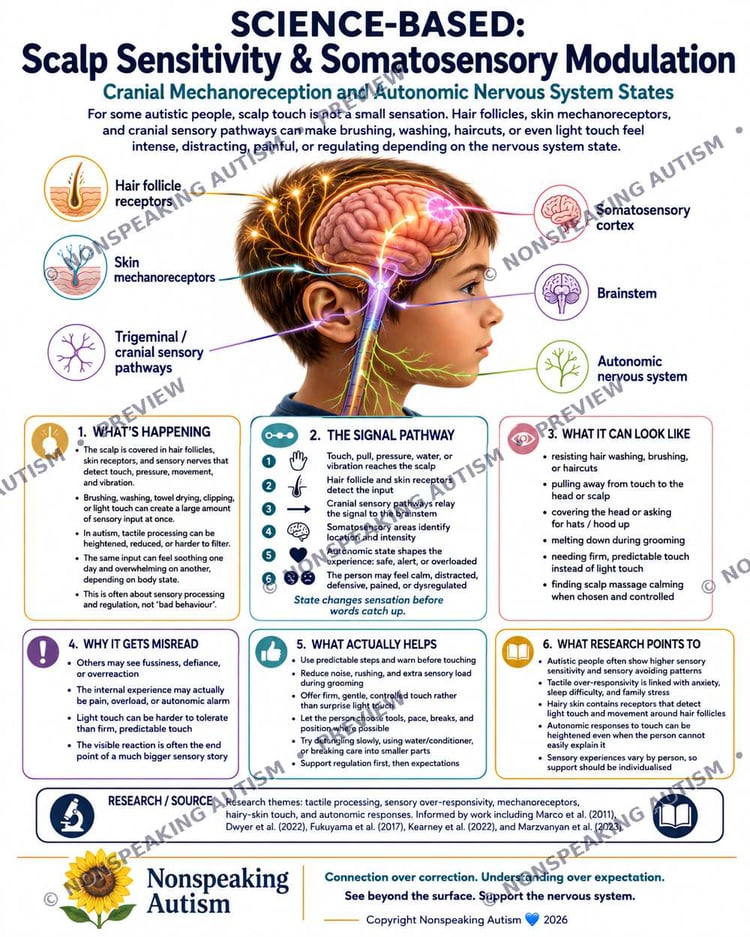
When someone experiences a situation as threatening, overwhelming or difficult to manage, the nervous system may respond with changes in arousal, attention, movement and behaviour.
These responses can involve interacting brain, body and autonomic processes.
They are not necessarily conscious decisions.
A person may experience:
- Increased physical tension
- Changes in breathing or heart rate
- An urge to escape
- Difficulty speaking or processing language
- Reduced movement or responsiveness
- Heightened vigilance
- Distress or emotional overwhelm
However, not every instance of shouting, leaving, becoming still or agreeing with someone is a defensive stress response.
The same behaviour may have several explanations.
Understanding requires attention to context, communication, health, environment and the person's own account wherever possible.
🌈 WHAT THIS POSTER EXPLORES
1. 🔴 FIGHT — WHEN DISTRESS MAY LOOK LIKE RESISTANCE
Fight responses are commonly associated with defensive mobilisation when a person perceives a threat.
Possible outward responses may include:
- Shouting
- Pushing away
- Physical resistance
- Sudden intense reactions
- Hitting or biting
- Trying to stop an unwanted interaction
These behaviours may sometimes occur when a person is frightened, overwhelmed, in pain or struggling to communicate.
However, they are not proof that a fight response is occurring.
What May Help?
- Prioritise immediate safety
- Reduce unnecessary demands
- Avoid escalating confrontations
- Use calm, clear communication
- Consider pain, sensory discomfort or unmet needs
- Allow appropriate space
- Seek individualised professional support for recurring safety concerns
Safety matters for everyone involved, including the person experiencing distress.
2. 🔵 FLIGHT — WHEN THE BODY MAY TRY TO ESCAPE
A flight response involves moving away from something experienced as threatening or overwhelming.
Possible outward signs include:
- Running away
- Leaving a room
- Hiding
- Pacing
- Restlessness
- Avoiding an activity or environment
- Seeking distance from people or demands
A child leaving a noisy classroom may be attempting to escape uncomfortable sensory input.
Another may move away because of uncertainty, anxiety, pain or another concern.
What May Help?
- Identify possible environmental triggers
- Provide accessible, safe places to take breaks
- Reduce unwanted sensory input
- Prepare for transitions
- Offer choices and predictable support
- Make communication accessible
- Plan for safety where a child may run into danger
Moving away is not automatically defiance. It may be a clue that something needs attention.
3. 🟣 FREEZE — WHEN SOMEONE BECOMES STILL OR LESS RESPONSIVE
Freeze is commonly discussed as a defensive response involving changes in movement and responsiveness.
Possible experiences may include:
- Becoming unusually still
- Difficulty initiating movement
- Reduced speech
- Delayed responses
- Appearing unable to act
- Difficulty processing instructions
Some autistic people may also experience shutdown-like withdrawal during overwhelm.
However, freeze and autistic shutdown are not interchangeable clinical terms, and the presence of one cannot be established simply by observing stillness.
What May Help?
- Reduce demands
- Allow processing time
- Avoid pressuring speech
- Offer accessible communication
- Respect personal space
- Reduce sensory input where helpful
- Check for physical or medical concerns
Sudden or unexplained unresponsiveness should never automatically be attributed to autism or stress.
4. 🟢 FAWN — WHEN SOMEONE APPEARS COMPLIANT DESPITE DISTRESS
Fawn is a term commonly used in trauma-informed discussions to describe appeasing or people-pleasing responses that may occur when someone feels unsafe.
Possible patterns include:
- Agreeing quickly despite discomfort
- Saying yes when they would prefer to say no
- Appearing compliant while distressed
- Masking discomfort
- Trying to avoid disagreement
- Prioritising another person's reaction over personal needs
These experiences may be relevant to some autistic people, particularly where communication barriers, previous experiences or pressure to comply affect their ability to express preferences.
However, fawn is not a formally established autism-specific neurological response or diagnosis.
Agreement, politeness and compliance should not automatically be interpreted as fawning.
What May Help?
- Offer genuine choices
- Respect refusal
- Make it safe to say no
- Avoid forced compliance
- Check for signs of discomfort
- Support communication and self-advocacy
- Respect boundaries and consent
Apparent compliance does not always mean someone is comfortable or consenting.
⚠️ WHY THESE RESPONSES CAN BE MISUNDERSTOOD
The poster highlights four important considerations.
We See the Action, Not the Internal Experience
Adults may observe shouting, running, silence or agreement without knowing what the person feels.
Protective Responses Can Look Intentional
A behaviour may appear deliberate even when distress is influencing the person's ability to respond.
Stress Can Affect Thinking and Communication
High stress may make it harder for some people to process information, communicate or adapt to changing demands.
Punishment May Miss the Underlying Need
Punishing an outward response without considering its context may leave pain, sensory overload, fear or communication barriers unaddressed.
Understanding the reason for a response does not mean ignoring safety. It means responding in ways that address both safety and the person's needs.
🌻 COMMON TRIGGERS AND CONTRIBUTING FACTORS
The poster identifies eight possible factors:
Sensory overload: Noise, bright lights, touch, crowded spaces or other unwanted sensory experiences.
Pain or illness: Headaches, gastrointestinal discomfort, injury, illness or other physical concerns.
Unexpected change: Uncertainty, disrupted routines or unfamiliar situations.
Communication strain: Difficulty understanding, expressing needs or accessing AAC.
Social pressure: Demands, expectations, interpersonal uncertainty or unwanted interactions.
Fatigue: Poor sleep, exhaustion or reduced capacity to manage demands.
Hunger and thirst: Unmet physical needs that may affect comfort and wellbeing.
Loss of control: Limited choice, unwanted restrictions or feeling unable to influence what happens.
These factors may overlap.
A person may be tired, hungry and sensory overloaded at the same time.
No single trigger or outward behaviour establishes which stress response, if any, is occurring.
💛 WHAT ACTUALLY HELPS?
The poster introduces six practical support principles.
1. SUPPORT REGULATION BEFORE REASONING
During intense distress, lengthy explanations or repeated questioning may be difficult to process.
Prioritise comfort, safety and accessible support before discussing what happened.
2. REDUCE SENSORY LOAD
Where helpful, consider:
- Lowering unwanted noise
- Reducing visual demands
- Offering a quieter space
- Respecting touch preferences
- Providing sensory breaks
3. USE LESS LANGUAGE
Some people benefit from short, clear communication during distress.
Others may prefer written information, symbols, AAC or additional processing time.
Do not demand spoken responses.
4. LOWER DEMANDS TEMPORARILY
Consider whether non-essential tasks can wait until the person is more comfortable and able to participate.
5. OFFER PREFERRED SUPPORT
Some people may welcome movement, familiar sensory tools, quiet, space or reassuring company.
Support should follow the person's preferences.
Never force touch, movement, deep pressure or sensory input.
6. REPAIR AFTERWARDS, NOT DURING PEAK DISTRESS
Once the person has recovered sufficiently, supportive reflection may help identify:
- What happened beforehand
- What felt difficult
- What support helped
- What could change next time
- Whether additional communication or environmental adjustments are needed
Avoid forcing immediate explanations or apologies while the person remains distressed.
💬 COMMUNICATION, AAC AND STRESS RESPONSES
Communication barriers can make stressful situations harder to manage.
A nonspeaking autistic child may have difficulty communicating:
- Stop
- No
- Too loud
- I am scared
- I need space
- I am in pain
- I need a break
- I don't understand
- I want to leave
- Please help
Communication support should include more than basic requests.
AAC systems should allow people to express discomfort, refusal, feelings, boundaries and preferences.
During distress, access to AAC should be preserved wherever safe and practical.
A person should not have to use speech to have their distress recognised.
🏫 USING THIS RESOURCE IN UK SCHOOLS & SEND SETTINGS
This poster can support discussions about how distress is understood in educational environments.
It may help teachers, teaching assistants, SENCOs and other professionals consider:
- Sensory accessibility
- Reasonable adjustments
- Communication and AAC access
- Safe break spaces
- Predictable transitions
- Reduced language demands during distress
- Individualised support plans
- Positive relationships and emotional safety
- Post-incident reflection
- The difference between immediate safety and longer-term support
A pupil who runs from a classroom may need a safe, supported way to leave an overwhelming environment.
A pupil who becomes quiet may need processing time, communication support or medical assessment depending on the circumstances.
A pupil who repeatedly agrees with adults may need reassurance that they can express disagreement or refusal.
Where relevant, these needs may be included in SEND support planning or an Education, Health and Care Plan (EHCP) in England.
The goal is not simply to stop a visible behaviour. It is to understand what support makes participation safer and more accessible.
📚 RESEARCH & GUIDANCE-INFORMED
The poster draws on commonly discussed defensive stress responses and UK autism guidance.
UK Guidance Highlighted on the Poster
Leicestershire Partnership NHS Trust — Autism Space
Educational guidance on understanding autistic meltdowns and shutdowns.
NHS autism resources commonly discuss the possibility that sensory or emotional overwhelm may contribute to meltdowns or shutdowns.
However, these terms describe complex experiences and do not establish one specific neurological mechanism.
Important Scientific Distinctions
Fight, flight and freeze: Commonly discussed patterns in research and education concerning defensive responses to threat.
Fawn: A trauma-informed descriptive term, not an established autism-specific neurological state.
Autistic meltdown: A commonly used description of an episode of intense overwhelm or distress. It is not a single, universally defined neurological event.
Autistic shutdown: A commonly used description of withdrawal or reduced responsiveness during overwhelm. It is not automatically identical to a freeze response.
The four labels are useful for discussing possible experiences, but they are not a validated system for classifying every autist- Leicestershire Partnership NHS Trust. Understanding autistic meltdowns and shutdowns. Autism Space. https://leicspart.nhs.uk/autism-space/
- Soden, P. A., Bhat, A., Anderson, A. K., & Friston, K. J. (2025). The meltdown pathway: A multidisciplinary account of autistic meltdowns. Psychological Review, 132(5), 1209–1240. https://doi.org/10.1037/rev0000543
- Paris, Lodestone, Houser & Lewis (2025). "Shutdowns are like you're stuck on the blue screen of death": A metaphor analysis of autistic shutdowns. Autism in Adulthood, 8(4), 687–697. https://doi.org/10.1089/aut.2024.0193ic response.
EVIDENCE NOTE
This poster is a research- and guidance-informed educational resource.
It does not provide a validated assessment of autonomic nervous system activity or determine a person's internal emotional state from their behaviour.
The nervous system illustration is conceptual and does not depict a clinically established pathway for all four responses.
👨👩👧 WHO IS THIS RESOURCE FOR?
This educational poster may be useful for:
- Parents and carers of autistic children
- Autistic young people and adults
- Families supporting nonspeaking autistic people
- Teachers and teaching assistants
- SENCOs and SEND teams
- Occupational therapists
- Speech and language therapists
- Educational psychologists
- Early years practitioners
- Family support workers
- Professionals supporting emotional regulation and communication
- Anyone wanting to understand distress responses more compassionately
It may be displayed in homes, classrooms, SEND support areas, therapy rooms, staff training spaces and other educational settings.
📦 WHAT YOU RECEIVE
PAID DIGITAL DOWNLOAD — INDIVIDUAL POSTER
Your purchase includes:
1 × Understanding Fight, Flight, Freeze & Fawn — Educational Poster
The poster features:
- Four commonly discussed protective response patterns
- Possible outward signs associated with each
- Why distress can be misread as behaviour
- Eight common triggers and contributing factors
- Six practical support principles
- Research-informed scientific cautions
- UK NHS guidance reference
- Nonspeaking Autism illustrated design
The listing image contains promotional preview watermarks.
The final purchased printable file should be supplied without these promotional watermarks.
Digital download only — no physical poster will be posted.
Exact print dimensions and resolution should be confirmed against the final downloadable file.
⚠️ IMPORTANT DISCLAIMER
This resource is intended for educational and informational purposes only.
It does not provide a medical diagnosis, trauma assessment, psychological assessment, behavioural assessment or individualised treatment plan.
Outward behaviours can have many possible causes.
A person who becomes still or unresponsive may be experiencing distress, but medical causes must also be considered.
Sudden or unexplained unresponsiveness, collapse, breathing difficulties or other urgent symptoms require appropriate emergency assessment.
For a life-threatening emergency in the UK, call 999 or 112.
Support should be individualised, safe, respectful and responsive to the person's communication, autonomy and needs.
©️ COPYRIGHT & PERMITTED USE
Copyright © 2026 Nonspeaking Autism. All rights reserved.
Purchase permits personal, family, classroom, school and individual professional educational use.
You may print the poster for these purposes.
You may not:
- Resell the poster or digital file
- Redistribute the purchased file
- Upload it to another website or platform
- Remove branding and claim the artwork as your own
- Reproduce it commercially
- Include it in another product for resale without permission
Please share the original Payhip listing rather than distributing the purchased file.
💛 THE MESSAGE BEHIND THIS RESOURCE
A child who shouts may be overwhelmed.
A child who runs away may be trying to escape something distressing.
A child who becomes still may be struggling to respond.
A child who agrees with everything may not necessarily feel comfortable.
These responses should not automatically be treated as deliberate misbehaviour.
They are invitations to look more closely at what the person may need.
We can consider sensory input.
We can check for pain or illness.
We can reduce unnecessary demands.
We can provide accessible communication.
We can respect refusal.
And we can create environments where people feel safer expressing their needs.
The aim is not to label every behaviour as fight, flight, freeze or fawn.
The aim is to respond to distress with curiosity, safety and compassion.
See the response. Support the nervous system. Reduce the threat.
🌻 Connection over correction. Understanding over expectation. 💙
Nonspeaking Autism © 2026