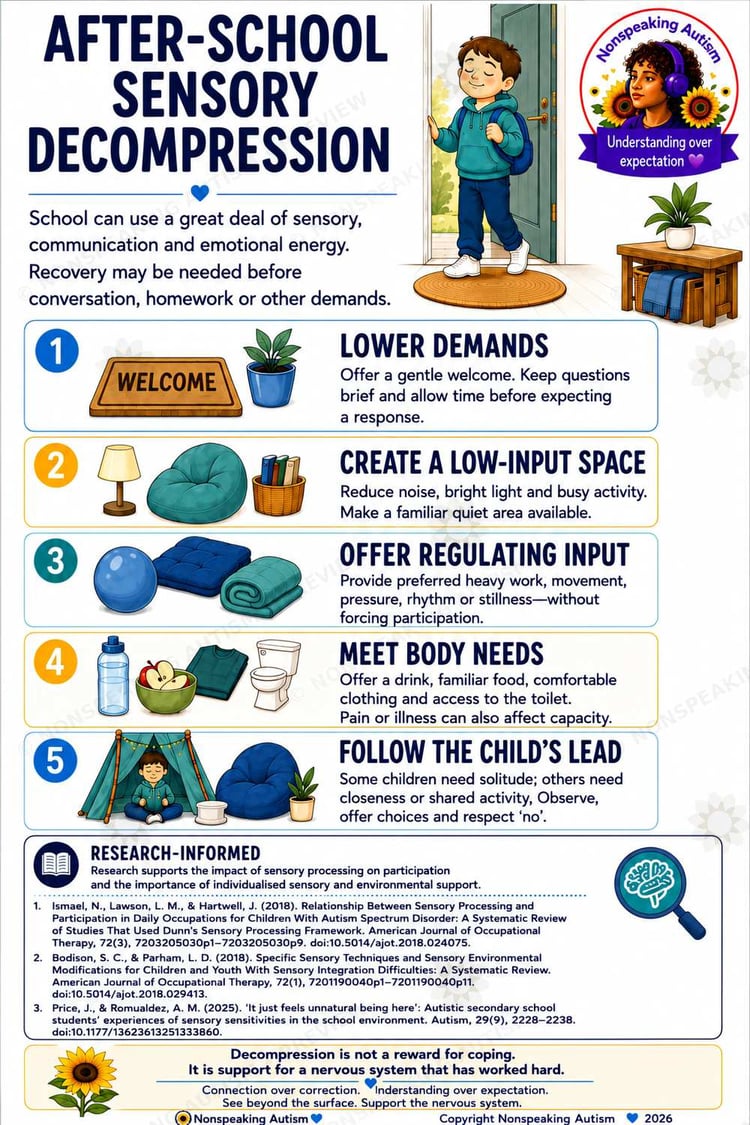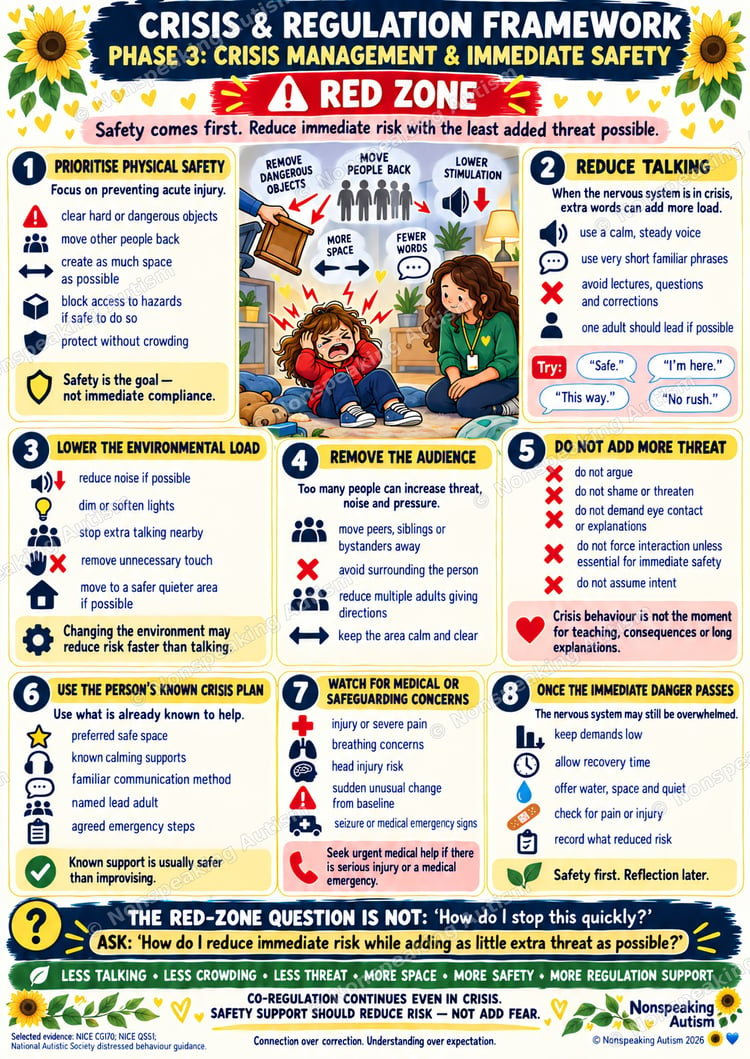

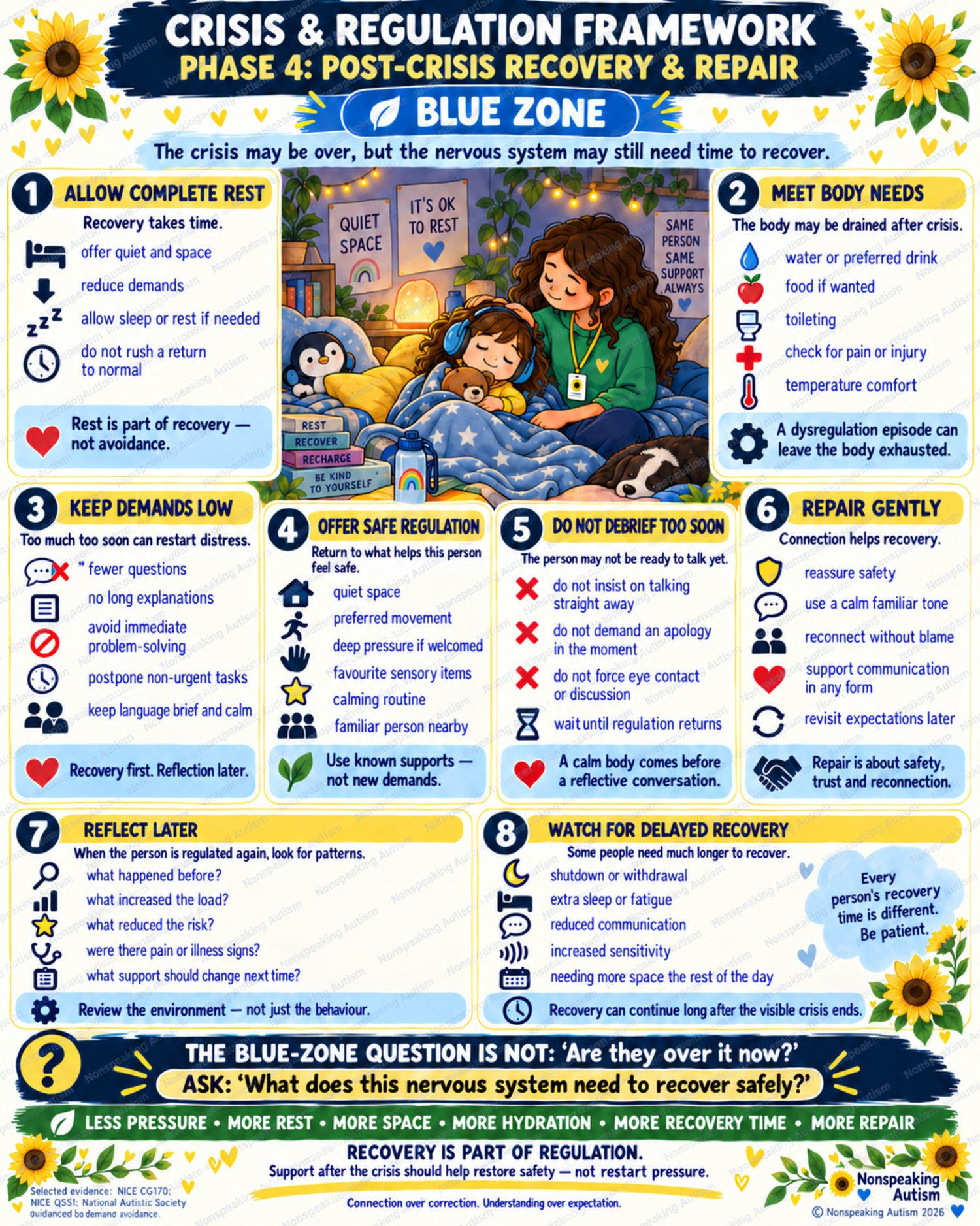
Crisis & Regulation Framework Phase 4: Post-Crisis Recovery & Repair — Blue Zone
Crisis & Regulation Framework
Phase 4: Post-Crisis Recovery & Repair — Blue Zone
Rest • Recovery • Regulation • Reconnection • Reflection
The visible crisis may have ended, but that does not necessarily mean the person’s body and nervous system have fully recovered.
After intense distress, some autistic people may need significantly more rest, space, reduced demands, familiar regulation supports and recovery time before they are ready to return to everyday expectations.
Phase 4: Post-Crisis Recovery & Repair — Blue Zone is a practical, neurodiversity-affirming educational resource from Nonspeaking Autism, designed to help parents, carers, educators and professionals think beyond the end of the visible crisis.
Instead of immediately asking:
“Are they over it now?”
this resource encourages a more useful question:
“What does this person need to recover safely?”
🔵 What Is the “Blue Zone”?
In this resource, Blue Zone is an educational term for the period following an episode of significant distress or crisis.
It is not a diagnosis, validated clinical stage or universal neurological sequence.
Recovery may look very different from person to person.
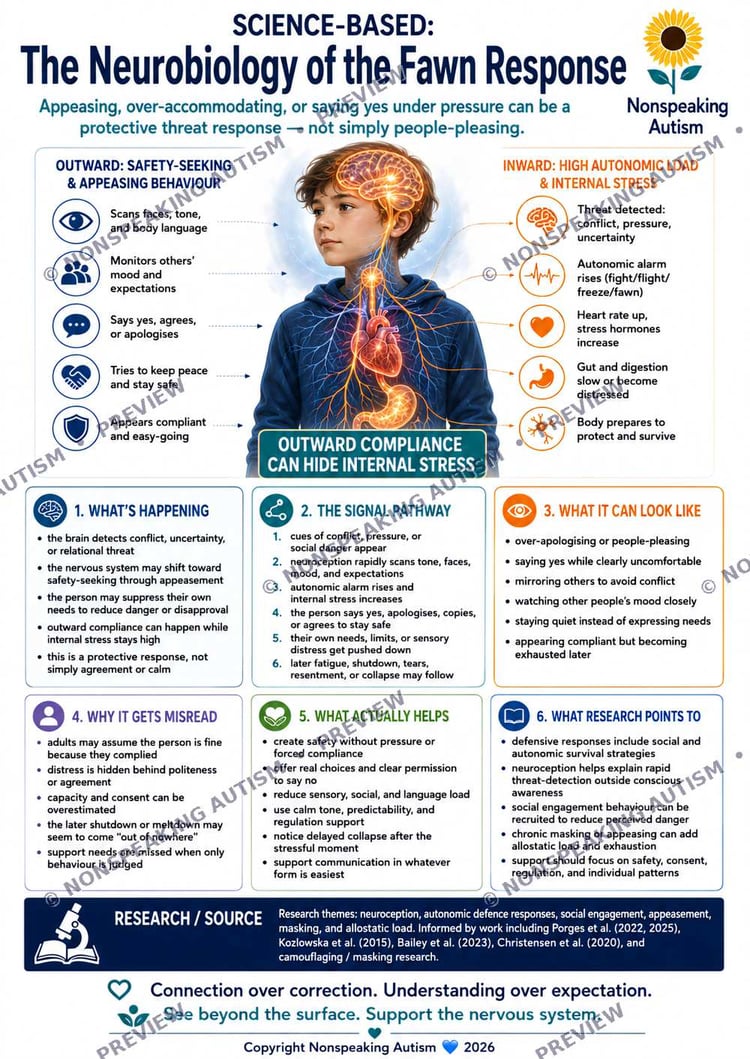
Someone may appear calm while still experiencing:
- exhaustion
- heightened sensory sensitivity
- reduced communication access
- withdrawal
- increased need for sleep
- reduced tolerance for demands
- a greater need for familiar routines
- a longer period of recovery
The end of visible distress is not necessarily the end of recovery.
1️⃣ Allow Complete Rest
Recovery takes time.
After significant distress, consider whether the person needs:
- quiet
- physical space
- reduced demands
- sleep or rest
- fewer social expectations
- additional processing time
- a slower return to normal routines
There does not need to be an immediate return to productivity simply because the most visible distress has passed.
❤️ Rest is part of recovery.
2️⃣ Meet Body Needs
An intense episode of distress can be physically tiring.
Consider basic body needs such as:
- water or a preferred drink
- food if wanted
- toileting
- temperature comfort
- rest
- checking for pain or injury
- other individualized physical needs
Physical discomfort can also contribute to distress in the first place, so unexplained or concerning changes should not automatically be attributed to autism.
Check the body as well as the behaviour.
3️⃣ Keep Demands Low
Too much, too soon may restart distress.
During early recovery, consider:
- asking fewer questions
- avoiding long explanations
- postponing non-urgent tasks
- avoiding immediate problem-solving
- keeping language brief and calm
- reducing unnecessary expectations
This does not mean expectations can never return.
It means recognizing that timing matters.
Recovery first. Reflection later.
4️⃣ Offer Safe Regulation
Return to what is already known to help the individual feel safe and regulated.
This might include:
- a quiet space
- preferred movement
- deep pressure if genuinely welcomed
- favourite sensory items
- a familiar calming routine
- access to AAC or other communication
- a trusted familiar person nearby
- reduced sensory input
- preferred repetitive movement or stimming
Regulation support should be individualized.
A strategy that helps one person may be neutral or distressing to another.
🌱 Use known supports — not new demands.
5️⃣ Do Not Debrief Too Soon
Immediately after a crisis may not be the right time to ask:
“Why did you do that?”
“What happened?”
“What should you have done instead?”
The person may not yet have sufficient regulatory, language or processing capacity for a reflective conversation.
Avoid:
- insisting on talking immediately
- demanding an apology in the moment
- forcing eye contact
- requiring explanations
- beginning a lengthy discussion
- turning recovery into a lesson
Wait until the person has genuinely recovered enough to participate.
❤️ A calmer-looking body does not automatically mean someone is ready for a reflective conversation.
6️⃣ Repair Gently
Post-crisis repair should focus on safety, trust and reconnection, not blame.
Supporters can:
- reassure safety
- use a calm, familiar tone
- reconnect without shame
- keep communication accessible
- acknowledge distress
- respect the person's communication method
- revisit expectations later
- restore predictability
Repair is not about pretending that harm did not occur.
Where someone has been hurt or something important needs addressing, this can still be discussed — but when the people involved are safe and sufficiently regulated to do so constructively.
🤝 Repair is about safety, trust and reconnection.
7️⃣ Reflect Later
Once regulation has returned, reflection can help supporters understand patterns and improve future support.
Useful questions include:
- What happened beforehand?
- What increased the person's load?
- Were there early signs that were missed?
- What reduced the risk?
- Were there signs of pain or illness?
- Was communication accessible?
- Were demands too high?
- Was the environment overwhelming?
- What helped recovery?
- What could be changed next time?
The purpose is not to search for someone to blame.
It is to learn.
Review the environment — not just the behaviour.
8️⃣ Watch for Delayed Recovery
Some people need much longer to recover than their outward appearance suggests.
Possible post-crisis changes might include:
- shutdown or withdrawal
- additional sleep
- fatigue
- reduced communication
- increased sensory sensitivity
- needing more space
- reduced tolerance for demands
- changes in appetite
- increased reliance on familiar routines or regulation strategies
These should be understood as possible patterns, not a universal checklist.
⏳ Every person's recovery time is different.
🧠 Recovery Is Part of Regulation
Crisis support should not end the moment visible behaviour stops.
The period afterwards can be an important part of the overall support process.
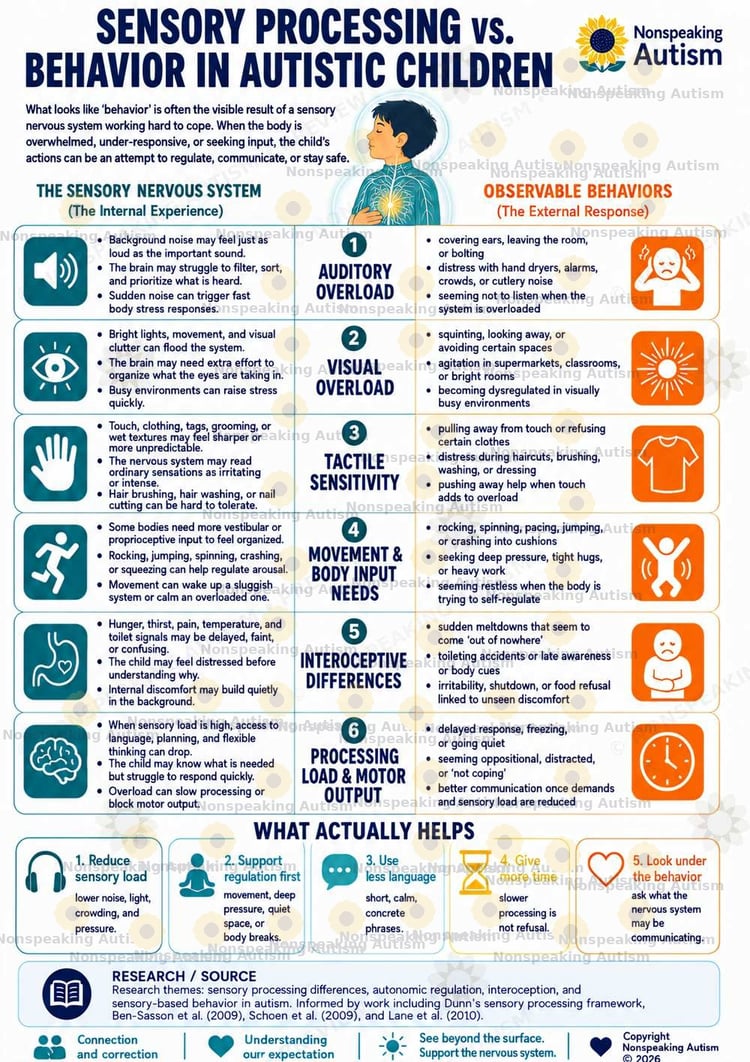
A useful sequence is:
Safety → Reduced Pressure → Rest → Regulation → Reconnection → Reflection
Not every person will follow this sequence, and stages may overlap.
The central principle is simple:
Support after the crisis should help restore safety — not immediately restart pressure.
💬 Keep Communication Accessible
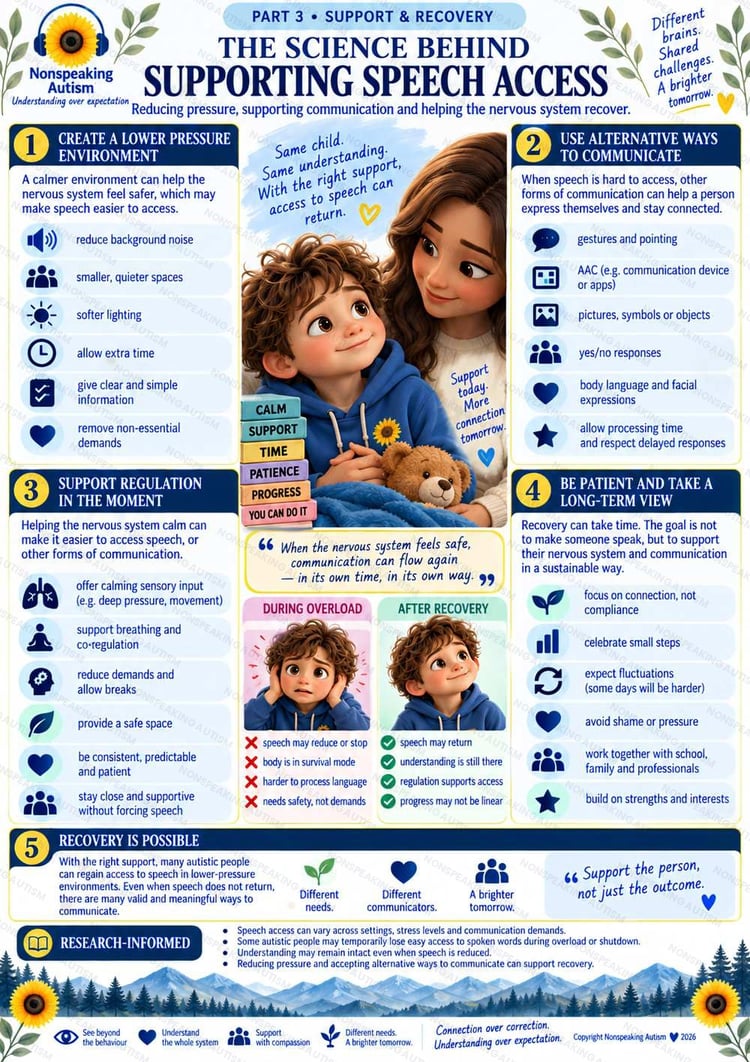
Some autistic people may experience reduced access to speech or other forms of communication during and after intense distress.
Continue to make available the person's established communication methods, which might include:
- speech
- AAC
- typing
- writing
- symbols
- pointing
- gestures
- yes/no responses
- body movement
- familiar communication systems
Do not assume that reduced speech means the person has nothing to communicate.
Communication access remains important during recovery.
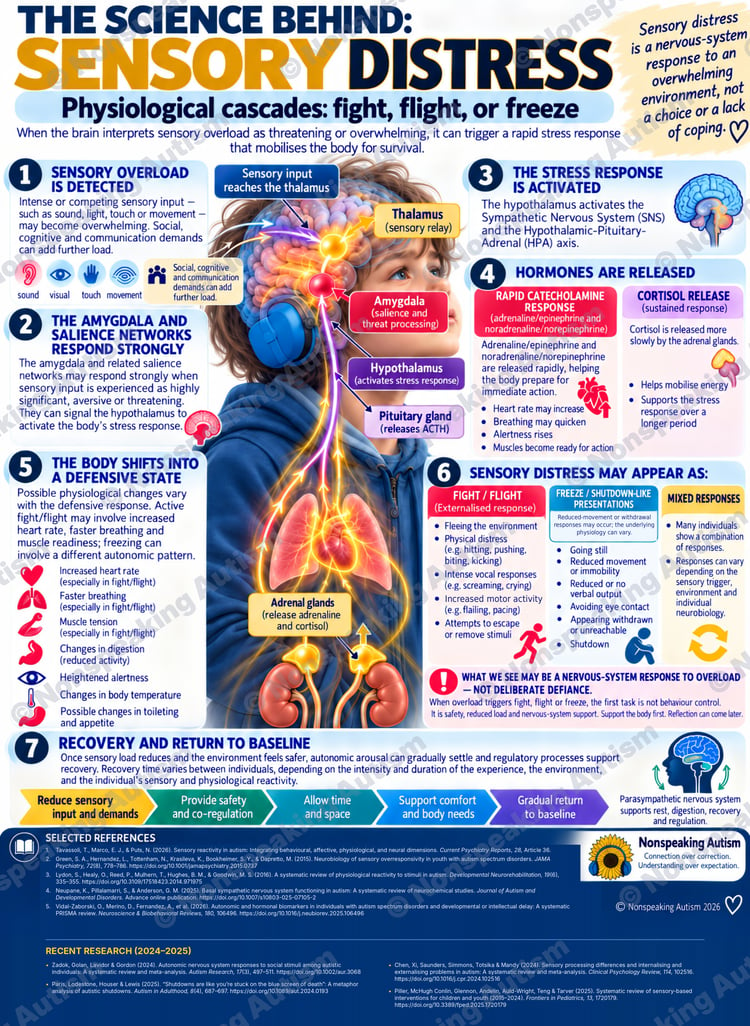
🩺 Check for Pain, Injury and Medical Causes
A crisis should not automatically be assumed to be “just autism” or purely behavioural.
Consider whether there could be:
- injury
- headache
- dental pain
- gastrointestinal discomfort
- illness
- dehydration
- hunger
- fatigue
- medication effects
- toileting difficulties
- sleep disruption
- another source of physical discomfort
Sudden, severe, unusual or unexplained changes deserve appropriate assessment.
🔬 Research & Guidance-Informed
This resource is informed by broader autism and distressed-behaviour guidance emphasizing individualized assessment, communication needs, environmental factors, sensory differences, physical and mental health, prevention and understanding what happens before and after episodes of distress.
NICE guidance for autistic children and young people recommends assessing factors that may contribute to behaviour that challenges, including communication difficulties, physical or mental-health conditions, sensory factors, changes to routines and the social and physical environment.
Guidance on behaviour that challenges also supports understanding the context and function of behaviour and using proactive, individualized approaches rather than relying only on reactive responses.
📚 Selected References & Guidance
National Institute for Health and Care Excellence (NICE). (2013, updated). Autism spectrum disorder in under 19s: support and management (CG170).
Supports individualized consideration of communication, sensory sensitivities, physical/mental health, environmental factors and contributors to behaviour that challenges.
National Institute for Health and Care Excellence (NICE). Autism (QS51).
Quality standard covering individualized, coordinated and appropriate support for autistic people.
National Institute for Health and Care Excellence (NICE). (2015). Challenging behaviour and learning disabilities: prevention and interventions for people with learning disabilities whose behaviour challenges (NG11).
Relevant to understanding behaviour in context, assessment, environmental factors, proactive support and review.
National Autistic Society. Guidance concerning distressed behaviour and meltdowns in autistic people, including prevention, reducing triggers, maintaining calm approaches and allowing recovery time.
🔬 Up-to-date research (2024–2026) Ali, D., Bougoure, M., Cooper, B., Quinton, A. M. G., Tan, D., Brett, J., Mandy, W., Maybery, M., Magiati, I., & Happé, F. (2025). Burnout as experienced by autistic people: A systematic review. Clinical Psychology Review, 122, 102669. https://doi.org/10.1016/j.cpr.2025.102669 → Supports: 1 Allow Complete Rest; 3 Keep Demands Low; 8 Watch for Delayed Recovery Beyond exhaustion: Shame, identity disruption, and functional collapse in autistic burnout. (2026). Autism. https://doi.org/10.1177/13623613261444797 [Author list to be confirmed.] → Supports: 6 Repair Gently ("reconnect without blame"); 8 Watch for Delayed Recovery Paris, K., Lodestone, A. Z., Houser, M., & Lewis, L. F. (2025). "Shutdowns are like you're stuck on the blue screen of death": A metaphor analysis of autistic shutdowns. Autism in Adulthood, 8(4), 687–697. https://doi.org/10.1089/aut.2024.0193 → Supports: 5 Do Not Debrief Too Soon; 8 Watch for Delayed Recovery (shutdown or withdrawal; reduced communication) Kumar, J., Hartzell, C., Abelson, E., Jastrowski Mano, K., & Chidambaran, V. (2026). Prevalence, expression, assessment, mechanisms, and management of pain in autistic children: A scoping review. A&A Practice, 20(4), e02178. https://doi.org/10.1213/XAA.0000000000002178 → Supports: 2 Meet Body Needs ("check for pain or injury"); 7 "Were there pain or illness signs?" Loureiro, F., Ringold, S. M., & Aziz-Zadeh, L. (2024). Interoception in autism: A narrative review of behavioral and neurobiological data. Psychology Research and Behavior Management, 17, 1841–1853. https://doi.org/10.2147/PRBM.S410605 → Supports: 2 Meet Body Needs (hunger, thirst, toileting, temperature) Multimethod examination of change in autistic preschoolers' emotion dysregulation in the context of parenting stress intervention. (2026). Journal of Child Psychology and Psychiatry. [Author list and DOI to be confirmed.] → Supports: 6 Repair Gently (co-regulation and connection) Piller, A., McHugh Conlin, J., Glennon, T. J., Andelin, L., Auld-Wright, K., Teng, K., & Tarver, T. (2025). Systematic review of sensory-based interventions for children and youth (2015–2024). Frontiers in Pediatrics, 13, 1720179. https://doi.org/10.3389/fped.2025.1720179 → Supports: 4 Offer Safe Regulation ("deep pressure if welcomed") Morris, I. F., Sykes, J. R., Paulus, E. R., Dameh, A., Razzaque, A., Vander Esch, L., Gruenig, J., & Zelazo, P. D. (2025). Beyond self-regulation: Autistic experiences and perceptions of stimming. Neurodiversity, 3. https://doi.org/10.1177/27546330241311096 → Supports: 4 Offer Safe Regulation (preferred movement; sensory items) Chen, Y., Xi, Z., Saunders, R., Simmons, D., Totsika, V., & Mandy, W. (2024). A systematic review and meta-analysis of the relationship between sensory processing differences and internalising/externalising problems in autism. Clinical Psychology Review, 114, 102516. https://doi.org/10.1016/j.cpr.2024.102516 → Supports: 7 Reflect Later ("What increased the load?"; "Review the environment") Luo, H., et al., & Schwarzlose, R. (2026). Specific, replicable behavioral and neural correlates of sensory over-responsivity in childhood. Journal of the American Academy of Child & Adolescent Psychiatry. Published online 13 August 2026. → Supports: 8 Watch for Delayed Recovery ("increased sensitivity")
📖 Evidence Note
The references and professional guidance above support the broader principles used in this poster.
They do not validate the Blue Zone as a clinical state, nor do they establish a fixed post-crisis sequence or prove that every listed recovery strategy will help every autistic person.
Blue Zone and the eight-part framework are educational organizing tools created for this resource.
Recovery is individual and should be considered alongside the person's communication, health, sensory profile, preferences, environment, history and individualized support or safety plans.
👨👩👧 Who Is This Resource For?
Suitable for:
- parents and carers
- autistic people and their supporters
- teachers and teaching assistants
- SENCOs and SEND teams
- mainstream and specialist schools
- support workers
- respite services
- occupational therapists
- speech and language therapists
- healthcare professionals
- social-care professionals
- psychologists and behavioural professionals
- multidisciplinary teams
- autism and disability organisations
It can be used for home support, staff training, classroom reflection, professional discussion and individualized support planning.
📦 What You Receive
Your purchase includes:
1 × Crisis & Regulation Framework — Phase 4: Post-Crisis Recovery & Repair — Blue Zone educational poster
1 × high-resolution printable digital PDF
The purchased file is supplied clear and without the promotional preview watermark shown in the Payhip listing images.
Watermarks visible in listing images are for preview and copyright protection only.
Digital download only — no physical product will be shipped.
⚠️ Important Safety & Professional Disclaimer
This is a research- and guidance-informed educational resource.
It is not a diagnostic tool, medical assessment, psychological assessment, behavioural assessment, Functional Behaviour Assessment, safeguarding plan, risk assessment, individualized crisis plan, restraint protocol, treatment plan or substitute for professional assessment and advice.
The Blue Zone is an educational framework and not a validated clinical stage or universal description of post-crisis physiology.
Strategies must be individualized. Never force touch, deep pressure, sensory input, communication, eye contact or interaction as a regulation strategy.
Where there is ongoing or foreseeable significant risk of harm, appropriate professional assessment, safeguarding procedures and individualized safety planning may be required.
Serious injury, breathing difficulties, seizure, loss of consciousness, suspected head injury or other medical emergencies require appropriate urgent medical assistance.
©️ Copyright & Permitted Use
Copyright © 2026 Nonspeaking Autism. All rights reserved.
Purchase permits use for personal/family use, your own classroom or educational setting, your own clinic or individual professional educational practice, and direct support work.
This resource may not be resold, redistributed, file-shared, uploaded elsewhere, commercially reproduced, altered for resale or incorporated into another product for sale or distribution.
Please direct others who would like their own copy to the original Nonspeaking Autism listing.
💛 The Message Behind the Resource
The visible crisis ending does not mean support should immediately end with it.
Sometimes the most supportive thing we can offer afterwards is:
Less pressure.
More rest.
More space.
More hydration.
More recovery time.
More communication access.
More gentle reconnection.
Don't begin with:
“Are they over it now?”
Ask:
“What does this person need to recover safely?”
🌱 RECOVERY IS PART OF REGULATION.
Support after the crisis should help restore safety — not restart pressure.
Connection over correction. Understanding over expectation. 💛🌻
© Nonspeaking Autism 2026