
The Science Behind Sensory Tools
The Science Behind Sensory Tools
How sensory support can help make sensory demands more manageable and improve access to regulation, communication, learning and participation
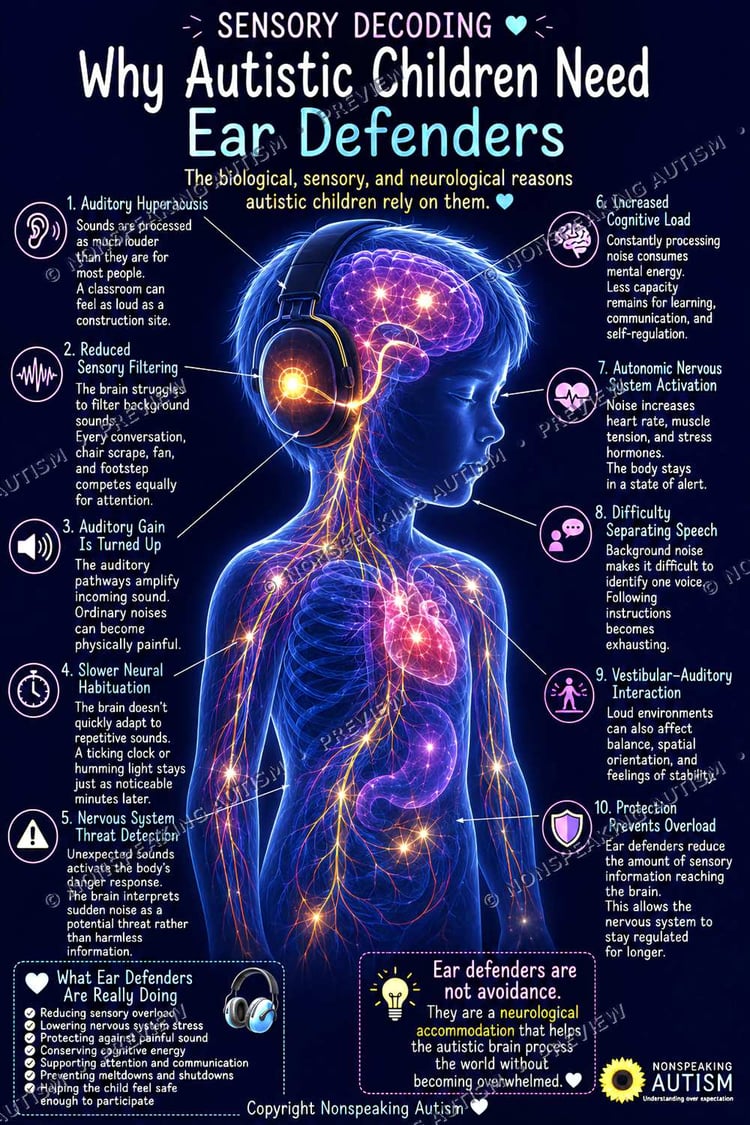
Why might ear defenders help someone stay in a busy environment?
Why can movement feel organizing for one autistic person but overwhelming for another?
Why might predictable pressure, a familiar sensory tool or access to a quieter space help?
And why should the goal of sensory support be participation — not simply appearing calm?
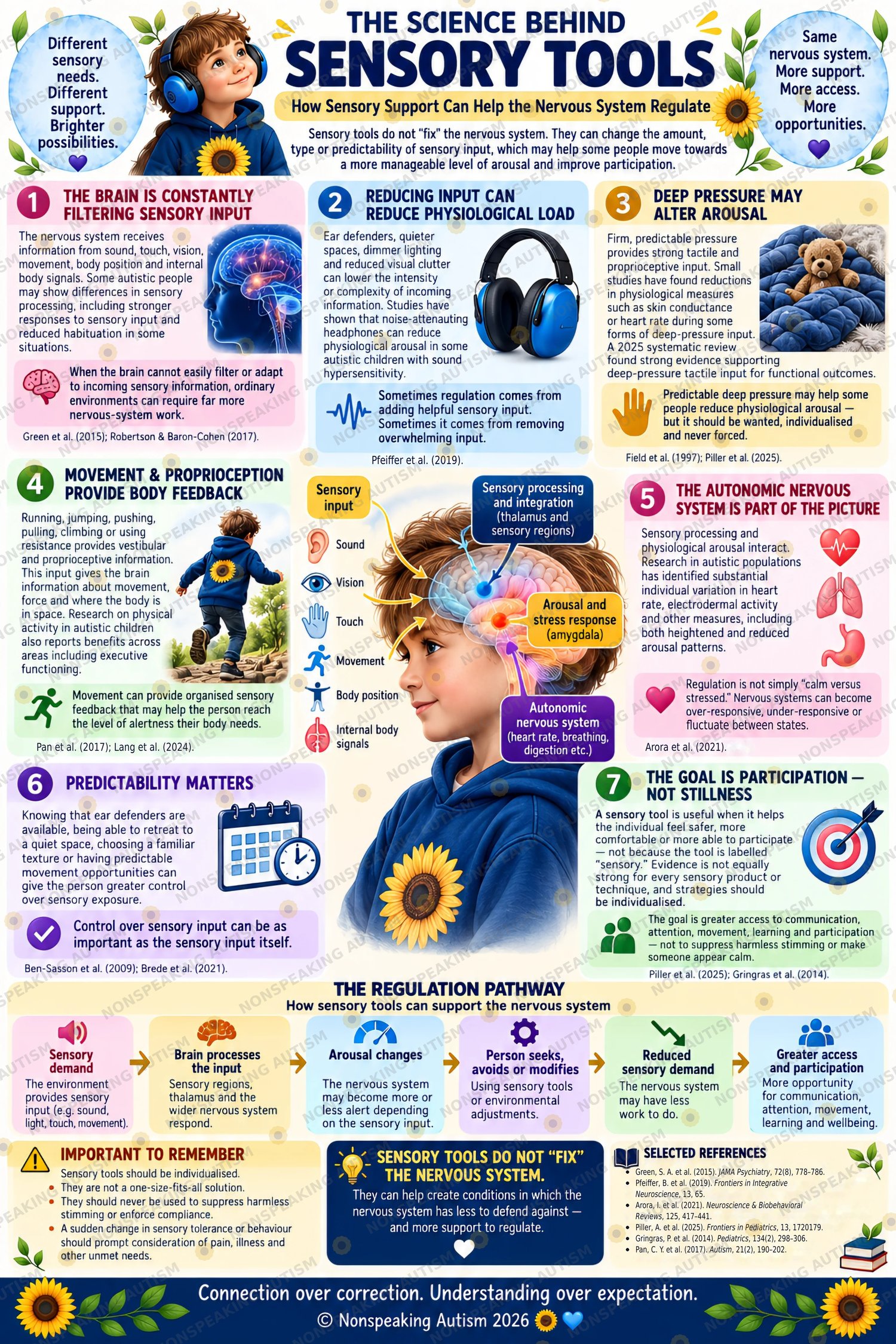
The Science Behind Sensory Tools is a research-informed educational poster exploring some of the science and reasoning behind sensory supports for autistic people.
Rather than presenting sensory tools as treatments that “fix” the nervous system, this resource explains a more accurate and individualized approach:
Sensory tools may change the amount, type or predictability of sensory input — which can help some people move towards a more manageable level of arousal and improve participation.
The central message is:
Sensory tools do not “fix” the nervous system.
They can help create conditions in which the nervous system has less to defend against — and more support to regulate.
🧠 What This Poster Explores
The poster breaks sensory support down into seven key areas:
1️⃣ The Brain Is Constantly Filtering Sensory Input
2️⃣ Reducing Input Can Reduce Physiological Load
3️⃣ Deep Pressure May Alter Arousal
4️⃣ Movement & Proprioception Provide Body Feedback
5️⃣ The Autonomic Nervous System Is Part of the Picture
6️⃣ Predictability Matters
7️⃣ The Goal Is Participation — Not Stillness
It also introduces a simple Regulation Pathway, helping families and professionals understand how sensory demands, processing, arousal and environmental adaptations can interact.
1️⃣ The Brain Is Constantly Filtering Sensory Input
The nervous system continuously receives information from the world and from within the body.
This includes:
sound
touch
vision
movement
body position
internal body signals
The brain has to process, prioritize and respond to this incoming information.
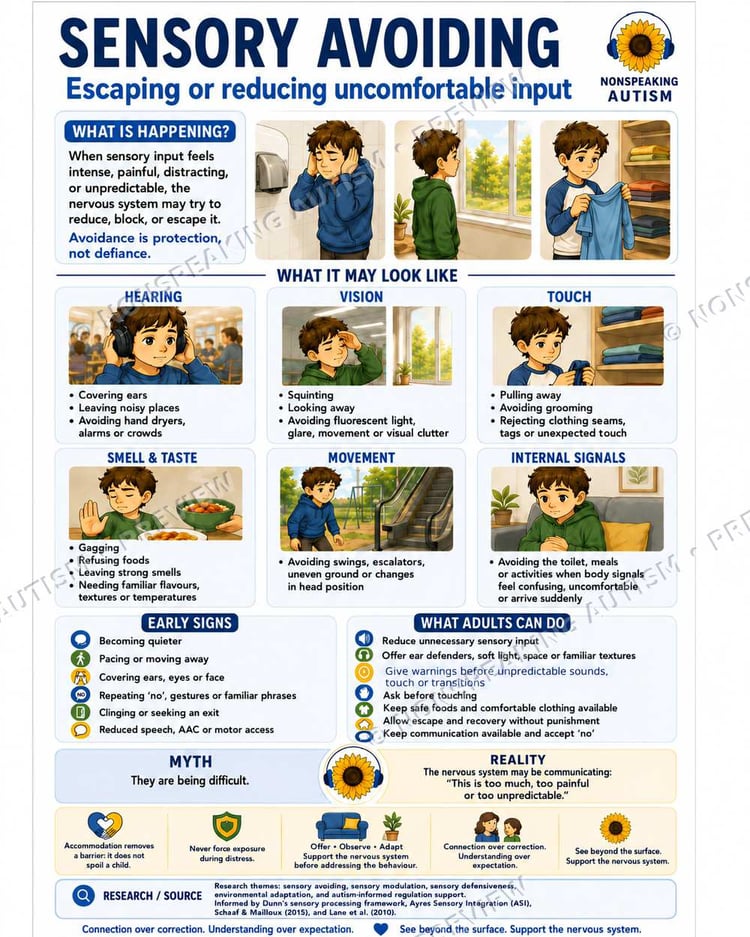
Autistic people can experience sensory information differently, including patterns of heightened sensitivity, reduced responsiveness and sensory seeking.
For some people, ordinary environments may therefore require substantially more sensory-processing work.
A classroom, supermarket or family gathering that appears manageable from the outside may contain multiple competing sensory demands.
Understanding this can change the question from:
“Why can't they just ignore it?”
to:
“How much sensory information are they having to process?”
🎧 2️⃣ Reducing Input Can Reduce Physiological Load
Sometimes regulation support is not about adding more sensory input.
It is about reducing overwhelming input.
Examples can include:
ear defenders
noise-reducing headphones
quieter spaces
dimmer lighting
reduced visual clutter
fewer competing sensory demands
For a person with sensory hypersensitivity, reducing the intensity or complexity of incoming information may make an environment easier to manage.
Research has also investigated noise-attenuating headphones for autistic children with auditory hypersensitivity, with findings suggesting potential reductions in physiological arousal for some participants.
This does not mean headphones will regulate every autistic person.
It means that for some individuals, changing the environment can be part of the support.
Sometimes regulation comes from adding helpful sensory input.
Sometimes it comes from removing overwhelming input.
🖐️ 3️⃣ Deep Pressure May Alter Arousal
Firm, predictable pressure provides strong tactile and proprioceptive input.
Some autistic people actively seek forms of pressure and report finding them comfortable or regulating.
Research into deep-pressure approaches has reported changes in physiological measures for some participants, but responses vary and the evidence should not be interpreted as showing that deep pressure works universally.
Examples of pressure-related sensory experiences might include preferred firm pressure or appropriately selected sensory supports.
The important words are:
individual
wanted
safe
appropriate
Deep pressure should never be forced because someone is autistic or distressed.
A sensory strategy that a person dislikes is not supportive simply because somebody else finds it calming.
🏃 4️⃣ Movement & Proprioception Provide Body Feedback
Movement and proprioception provide the nervous system with information about where the body is, how it is moving and how much force is being used.
Activities can include:
running
jumping
pushing
pulling
climbing
carrying
resistance activities
Some autistic people seek significant amounts of movement or proprioceptive input.
For some individuals, organized movement may support alertness, attention, body awareness or regulation.
But movement needs are also highly individual.
One person may seek jumping and running.
Another may prefer slow movement.
Another may find particular vestibular experiences uncomfortable.
The aim is not to prescribe movement simply because someone is autistic.
It is to understand what kind of input the individual person's body appears to need and prefer.
❤️ 5️⃣ The Autonomic Nervous System Is Part of the Picture
Sensory processing does not happen separately from the rest of the body.
The autonomic nervous system is involved in functions including:
heart rate
breathing
digestion
arousal
responses to stress and safety
Research in autistic populations has identified differences and substantial individual variation in physiological measures such as heart-rate variability and arousal.
This helps illustrate an important point:
Regulation is not simply “calm versus stressed.”
A nervous system can become highly activated, under-responsive, fatigued or fluctuate between states.
Outward appearance also does not necessarily tell us exactly what is happening internally.
A person who looks still may be highly distressed.
A person who is moving may be successfully regulating.
That is one reason stillness should not be treated as the definition of regulation.
🗓️ 6️⃣ Predictability Matters
The sensory experience itself is only part of the picture.
Control and predictability can matter too.
Knowing that ear defenders are available...
Being able to retreat to a quieter space...
Choosing whether to use a particular sensory support...
Having familiar movement opportunities...
Knowing what will happen next...
These can provide greater control over sensory exposure.
An unpredictable sound that someone cannot escape may be experienced very differently from a sound they have chosen and can stop.
This is why sensory support should consider not only:
“What sensory input is present?”
but also:
“How much choice, predictability and control does the person have?”
🎯 7️⃣ The Goal Is Participation — Not Stillness
A sensory tool is useful when it helps the individual person.
It should not be considered successful merely because someone looks quieter.
Useful outcomes might instead include greater access to:
communication
attention
movement
learning
relationships
play
daily activities
community participation
comfort and wellbeing
A child who moves while listening may still be learning.
An autistic person who stims may be regulating effectively.
Someone wearing headphones may be increasing their ability to remain in an environment rather than withdrawing from it.
The goal is not to produce the outward appearance of calm.
The goal is meaningful access and participation.
🔄 The Regulation Pathway
🔊 Sensory Demand
The environment provides sensory information — such as sound, light, touch or movement.
⬇️
🧠 The Brain Processes the Input
Sensory information is processed across the nervous system.
⬇️
⚙️ Arousal Changes
Depending on the sensory input and individual nervous system, a person may become more or less alert.
⬇️
🧩 The Person Seeks, Avoids or Modifies
They may use sensory tools, movement, communication or environmental adjustments.
⬇️
🌿 Reduced Sensory Demand
The nervous system may then have less sensory work to do.
⬇️
💙 Greater Access & Participation
There may be greater opportunity for:
communication
attention
movement
learning
and participation.
This diagram is an educational simplification, not a complete neurological model or a prediction of how every autistic person's nervous system will respond.
🌻 Different Sensory Needs Need Different Support
There is no universal autistic sensory profile.
One person may be highly sensitive to noise while actively seeking movement.
Another may dislike light touch but enjoy firm pressure.
Someone may enjoy loud music they control while struggling with unpredictable background noise.
A sensory tool that is invaluable for one person may be unnecessary or uncomfortable for another.
Sensory needs can also vary according to:
environment
fatigue
sleep
stress
pain
illness
hunger
emotional state
other demands
That is why sensory tools should always be individualized.
Different sensory needs.
Different support.
Brighter possibilities.
🚫 Sensory Tools Are Not About Making Someone Look Less Autistic
A sensory strategy should not automatically be used to:
stop harmless stimming
force eye contact
produce stillness
increase compliance
make someone tolerate avoidable distress
or
make an autistic person appear more neurotypical
If a person is safely stimming, moving or using another harmless strategy to regulate, outward difference is not automatically a problem that needs correcting.
Before removing a coping strategy, ask:
What is it helping this person manage?
🔬 Research-Informed — With Important Limits
This resource draws on research examining autistic sensory processing, sensory reactivity, auditory hypersensitivity, deep pressure, movement, physiological arousal and participation.
Research supports the importance of sensory differences in autism, but the evidence for specific sensory interventions and individual sensory products varies.
This distinction matters.
Evidence that autistic people experience sensory-processing differences does not mean every product marketed as a “sensory tool” has been proven to regulate the nervous system.
Some interventions have stronger evidence than others, and even where research identifies an average effect, individual responses can differ substantially.
For this reason, the poster deliberately uses language such as:
“may help”
“for some people”
and
“should be individualized.”
Sensory support should be based on the person, not simply the product.
📚 Selected References
Green, S. A., Hernandez, L., Tottenham, N., Krasileva, K., Bookheimer, S. Y., & Dapretto, M. (2015). Neurobiology of sensory overresponsivity in youth with autism spectrum disorders. JAMA Psychiatry, 72(8), 778–786.
Pfeiffer, B., Stein Duker, L. I., Murphy, A., & Shui, C. (2019). Effectiveness of noise-attenuating headphones on physiological responses for children with autism spectrum disorders. Frontiers in Integrative Neuroscience, 13, 65.
Arora, I., Bellato, A., & Ropar, D. (2021). Autonomic function in autism and ADHD: A systematic review of heart rate variability. Neuroscience & Biobehavioral Reviews, 125, 471–491.
Piller, A., et al. (2025). Frontiers in Pediatrics, 13, 1720179.
Pan, C.-Y., et al. (2017). Autism, 21(2), 190–202.
Ben-Sasson, A., Hen, L., Fluss, R., Cermak, S. A., Engel-Yeger, B., & Gal, E. (2009). A meta-analysis of sensory modulation symptoms in individuals with autism spectrum disorders. Journal of Autism and Developmental Disorders, 39, 1–11.
Brede, J., et al. (2021). Research examining autistic sensory experiences, environmental demands and control/predictability.
Gringras, P., et al. (2014). Research relevant to sensory supports and weighted products.
Evidence note: The reference list supports the broader educational themes of the poster. It should not be interpreted as evidence that every sensory tool pictured is independently proven to be effective for every autistic person.
👨👩👧 Who Is This Resource For?
This poster may be useful for:
- autistic children, young people and adults
- parents and caregivers
- families exploring sensory support
- teachers and classroom staff
- SENCOs and SEND professionals
- occupational therapists
- speech and language professionals
- psychologists and allied professionals
- support workers
- early-years professionals
- autism and disability organizations
- sensory-friendly settings
- professional-development and staff-training environments
It can be used at home, school, clinics and professional settings as a visual educational resource and conversation starter.
📦 What You Receive
Your purchase includes:
1 × The Science Behind Sensory Tools educational poster
1 × high-resolution printable PDF
The purchased file is supplied clear and without the promotional preview watermark shown on the Payhip listing image.
Watermarks shown in promotional images are used for preview and copyright protection only and are not present on the purchased resource.
Digital download only — no physical product will be shipped.
⚠️ Important Educational & Safety Disclaimer
This resource is provided for educational and informational purposes only. It is not medical advice, diagnosis, occupational therapy assessment, treatment, or an individualized sensory plan.
Sensory processing and regulation are highly individual. A sensory tool or environmental adjustment that helps one autistic person may be ineffective, uncomfortable or inappropriate for another.
The term “sensory tool” does not mean an item has been scientifically proven to regulate every person's nervous system. Evidence varies substantially between specific sensory approaches, interventions and products.
Sensory tools should not be used to suppress harmless stimming, force compliance, increase tolerance of avoidable distress, or make an autistic person appear calmer or less autistic.
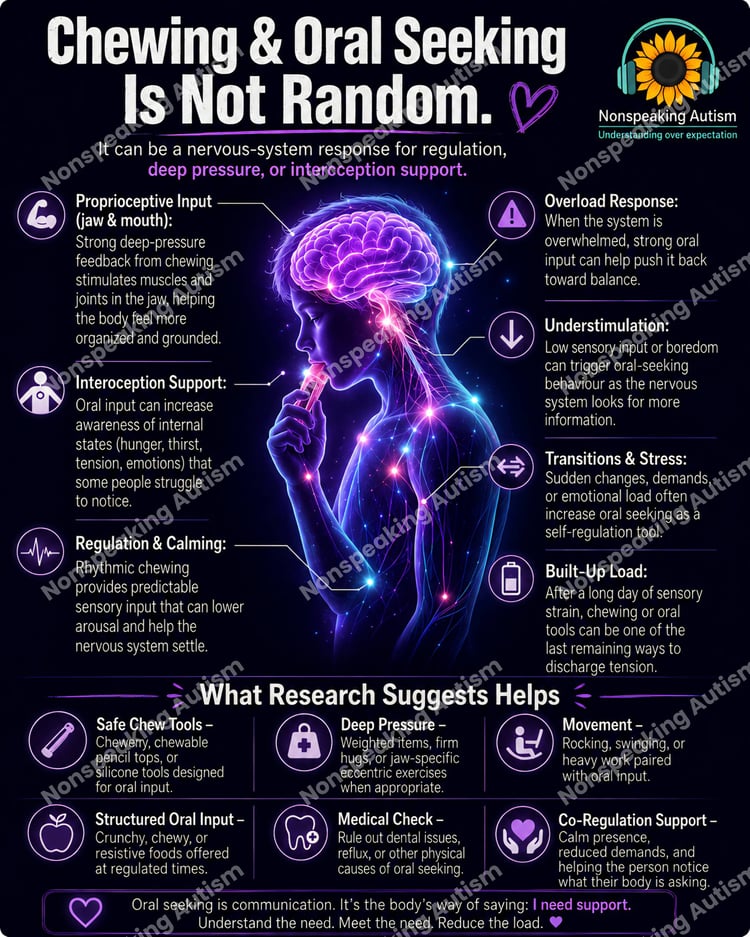
Deep-pressure approaches, weighted products, movement equipment, chew tools, hearing protection and other sensory supports should be selected and used safely and appropriately. Relevant product-specific risks and professional guidance should be considered where necessary.
A sudden, significant, severe or unexplained change in sensory tolerance, behaviour, communication, responsiveness or regulation should not automatically be attributed to autism or sensory processing. Pain, illness, injury, medication effects, sleep difficulties and other unmet needs may require appropriate medical or professional assessment.
The neurological diagrams and pathways on this poster are educational simplifications. Human sensory processing and autonomic regulation are complex and the illustrations should not be interpreted as complete neurological models or predictions of an individual's response.
💛 The Message Behind the Resource
The value of a sensory tool is not determined by how expensive it is.
It is not determined by how “therapeutic” it looks.
And it is not determined by whether it makes someone sit still.
Its value is determined by what it does for that individual person.
Does it make the environment more manageable?
Does it reduce unnecessary sensory load?
Does it give them more control?
Does it help them communicate?
Does it help them remain somewhere they want or need to be?
Does it support movement, learning, connection or participation?
If the answer is yes, it may be a useful support.
If it does not help, we do not need to force it simply because it has been labelled a sensory tool.
Same nervous system.
More support.
More access.
More opportunities.
Sensory tools do not “fix” the nervous system.
They may help create conditions in which the nervous system has less to defend against — and more support to regulate.
Connection over correction. Understanding over expectation.
© Nonspeaking Autism 2026 🌻💙