
Understanding Autistic Nervous System Signals
Understanding Autistic Nervous System Signals
Safety, Stress, Sensory Seeking, Overload, Pain, Uncertainty & Recovery
A Research-Informed Educational Poster
Before distress is interpreted simply as “behaviour,” it can be helpful to look at what the person’s body, movement, communication and environment may already be signalling.
Autistic children can experience sensory input, uncertainty, physical discomfort, communication demands and stress in highly individual ways. What appears externally as pacing, withdrawal, increased movement, reduced speech, covering the ears, repetitive actions or a sudden change in behaviour may provide useful information — but no single behaviour tells us exactly what is happening inside.
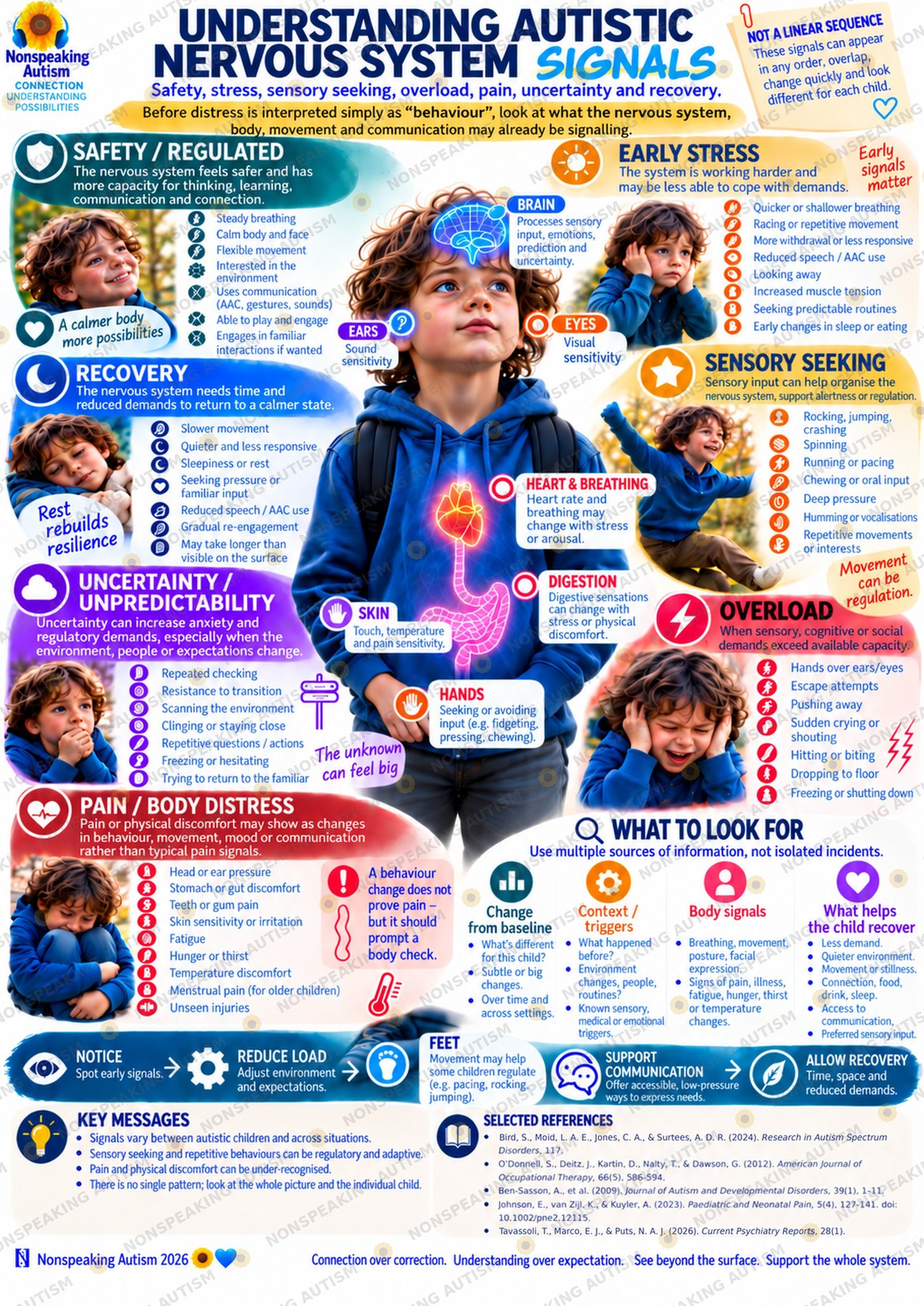
Understanding Autistic Nervous System Signals is a detailed educational poster designed to help parents, carers, educators and professionals look beyond the surface and consider the whole child, the context and changes from their individual baseline.
The central message is:
Notice the signals. Reduce the load. Support communication. Allow recovery.
🧠 What This Poster Explores
The poster brings together several areas that can influence an autistic person’s regulation and participation:
- safety and regulation
- early signs of stress
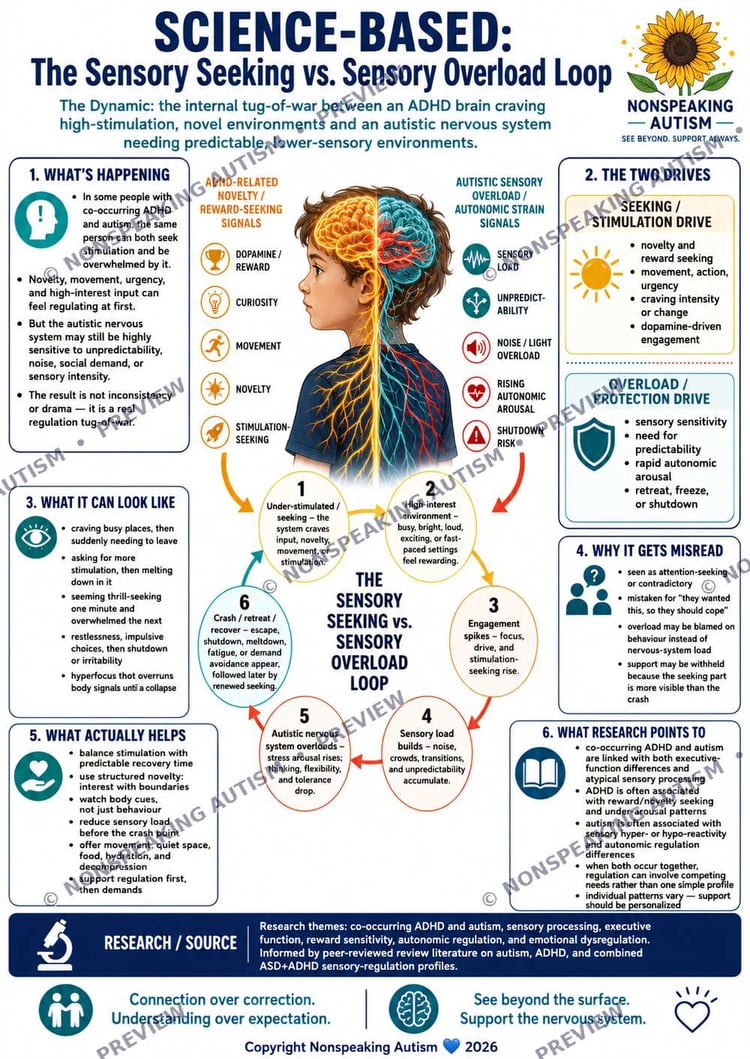
- sensory seeking
- sensory overload
- uncertainty and unpredictability
- pain and physical discomfort
- communication changes
- recovery needs
- body and physiological signals
- context and environmental triggers
Importantly, these are not presented as a fixed sequence.
Signals may appear in different orders, overlap, change quickly or look completely different from one person to another.
🛡️ Safety & Regulation
When a person feels sufficiently safe and regulated, they may have greater capacity for:
thinking
learning
communication
connection
play
and engagement.
Possible signs might include steady breathing, relaxed movement, interest in the environment, use of familiar communication methods and engagement in preferred interactions.
But “regulated” should never simply mean looking still, quiet or compliant.
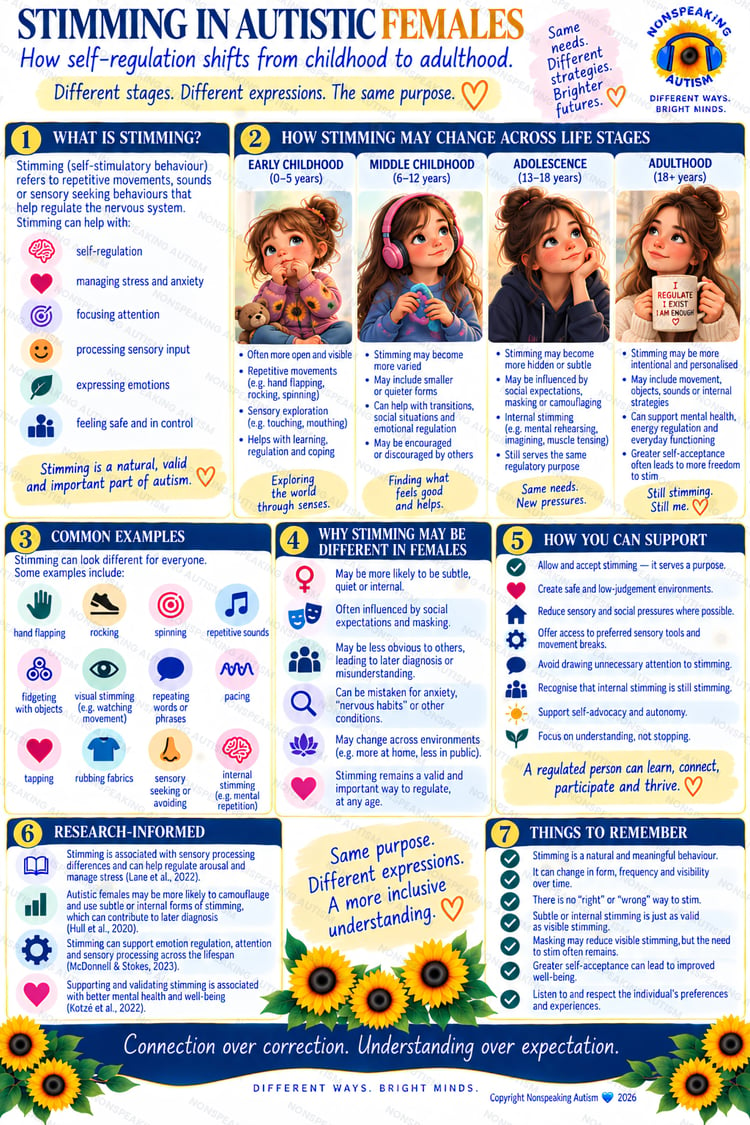
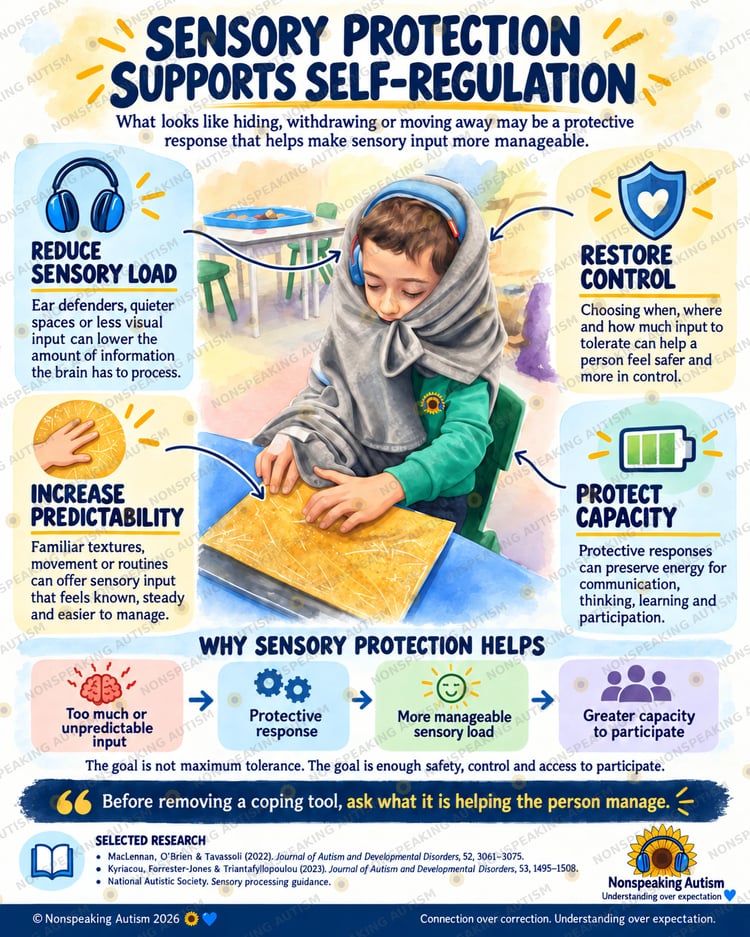
A person may regulate through movement, stimming, reduced interaction, sensory tools or other individualized strategies.
Regulation is about access and capacity — not performing calmness.
☀️ Early Stress
Early changes can matter.
For some people, increasing load may be associated with changes such as:
- quicker or shallower breathing
- racing or repetitive movement
- increased withdrawal
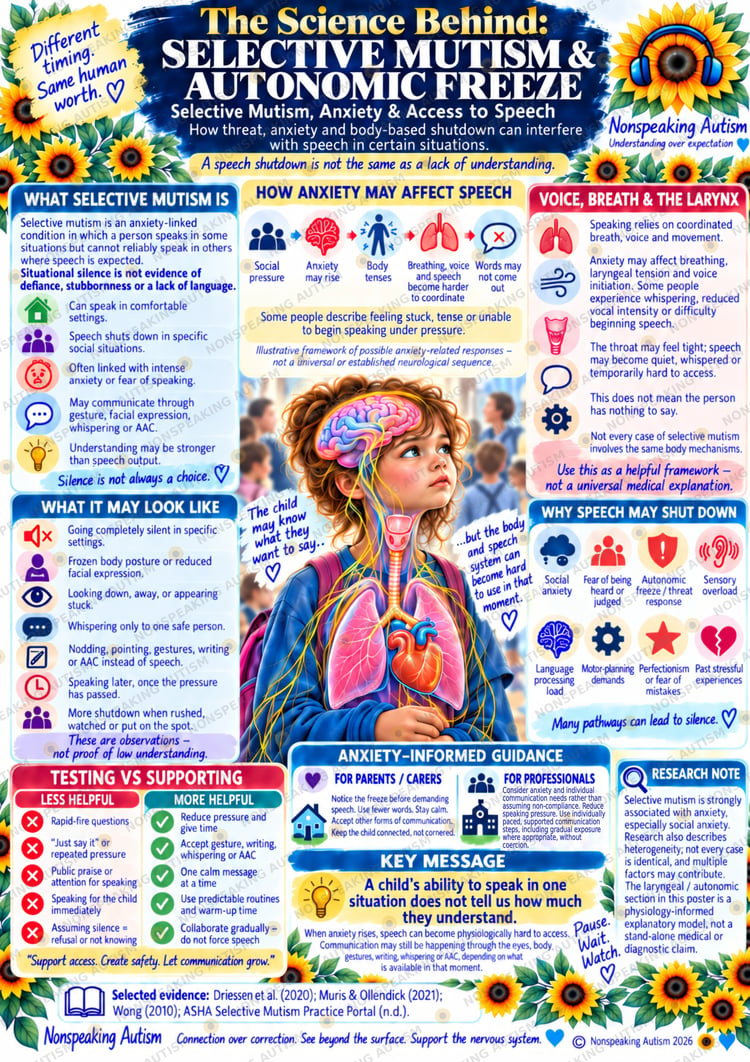
- reduced speech or AAC access
- looking away
- increased muscle tension
- seeking greater predictability
- changes in sleep or eating
These signs are not diagnostic and do not have one universal meaning.
The useful question is:
“What has changed for this person?”
Recognising individual patterns earlier may allow support to be adjusted before distress becomes much harder to manage.
⭐ Sensory Seeking
Sensory-seeking behaviour can serve many purposes.
Examples may include:
rocking
jumping
crashing
spinning
running or pacing
chewing or oral input
deep pressure
humming or vocalising
repetitive movement
or engagement with strong interests.
Sensory seeking should not automatically be interpreted as misbehaviour.
For some people, particular sensory input may be enjoyable or may support regulation, attention or body awareness.
Movement can be meaningful.
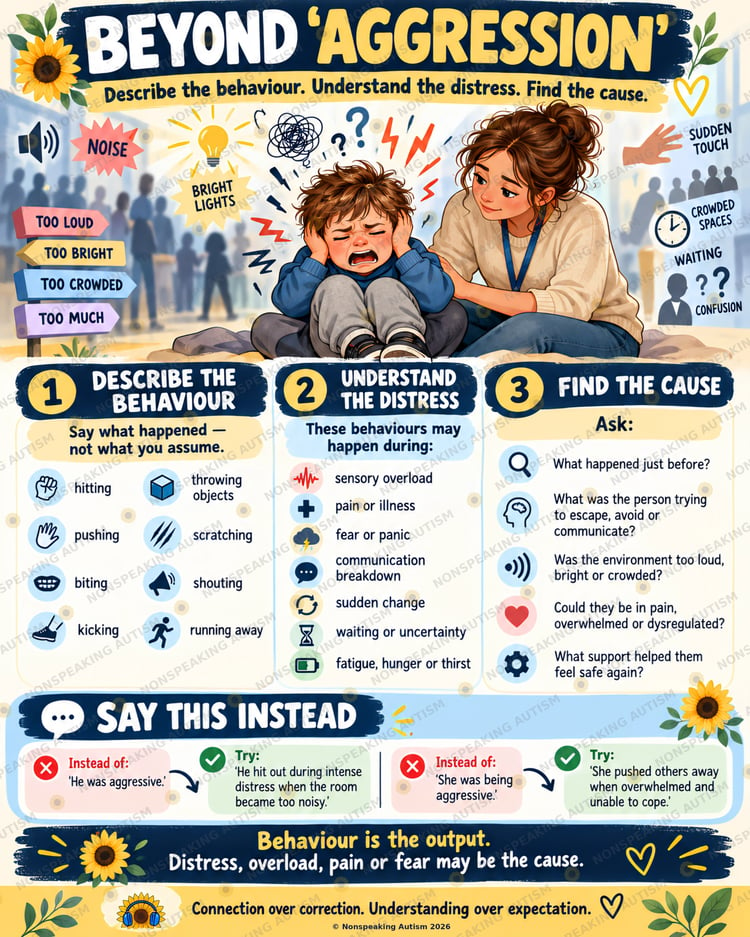
⚡ Sensory Overload
Sensory, cognitive and social demands can sometimes accumulate beyond what a person can comfortably manage.
Possible signs of overload may include:
covering ears or eyes
attempting to escape
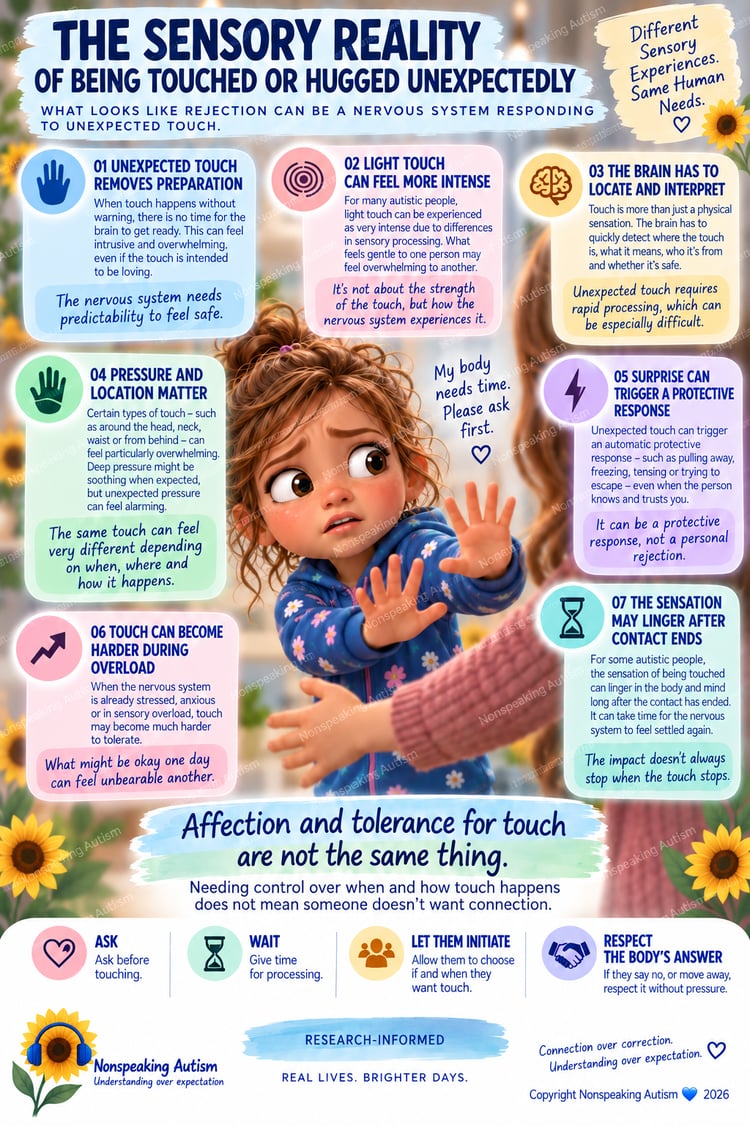
pushing away
sudden crying or shouting
dropping to the floor
freezing
shutting down
or actions that could place the person or others at risk.
These behaviours do not prove sensory overload.
They are signals to look more closely at context.
Consider:
noise • lighting • touch • crowds • communication demands • transitions • waiting • pain • fatigue • hunger • uncertainty
and the cumulative load the person may already have been carrying.
❓ Uncertainty & Unpredictability
Not knowing what will happen next can add significant demand for some autistic people.
Possible responses may include:
- repeated checking
- difficulty transitioning
- scanning the environment
- staying close to a familiar person
- repetitive questions or actions
- hesitation or freezing
- returning to familiar routines
Again, these behaviours can have many explanations.
The aim is not to label them automatically as anxiety.
Instead, ask whether greater predictability, preparation, visual information, processing time or clearer communication might help.
❤️ Pain & Body Distress
One of the most important messages in this resource is:
A behaviour change does not prove pain — but it should prompt us to consider the body.
Potential sources of discomfort might include:
head or ear pain
stomach or gastrointestinal discomfort
teeth or gum pain
skin irritation
fatigue
hunger
thirst
temperature discomfort
menstrual pain where relevant
or an unseen injury.
Research indicates that autistic children can communicate pain through both verbal and nonverbal responses, reinforcing the importance of individualized and holistic assessment rather than assuming an absence of typical pain communication means an absence of pain. DOI
Do not assume every change is behavioural.
🫁 The Whole Body Matters
Sensory and stress experiences are not limited to what we can see externally.
The poster encourages consideration of possible changes involving:
🧠 Brain
Sensory processing, emotion, prediction and uncertainty.
👂 Ears
Sound sensitivity.
👁️ Eyes
Visual sensitivity.
❤️ Heart & Breathing
Heart rate and breathing can change with arousal and stress.
🖐️ Skin
Touch, temperature and pain sensitivity.
🫃 Digestion
Digestive sensations may interact with stress or physical discomfort.
✋ Hands
Fidgeting, pressing, chewing or other seeking/avoiding patterns.
The illustration is educational rather than a literal neurological map or diagnostic model.
🌙 Recovery Is Part of Regulation
The end of visible distress does not necessarily mean that recovery is complete.
Recovery may involve:
slower movement
reduced interaction
sleepiness or rest
familiar sensory input
less speech or AAC use
reduced demands
pressure or movement if preferred
quiet
and gradual re-engagement.
A person may need longer to recover than is externally obvious.
Rest rebuilds resilience.
The goal should not be to rush somebody immediately back into the demands that contributed to overload.
🔍 What Should We Look For?
Rather than interpreting one isolated behaviour, the poster encourages adults to use multiple sources of information.
1️⃣ Change From Baseline
What is different for this particular person?
Is the change subtle or significant?
Is it occurring repeatedly or across settings?
2️⃣ Context & Triggers
What happened immediately beforehand?
Has the environment changed?
Were there transitions, demands, unfamiliar people, sensory changes or uncertainty?
3️⃣ Body Signals
Look at possible changes in:
breathing • movement • posture • facial expression • energy • sleep • appetite • pain communication • temperature
4️⃣ What Helps Recovery?
Does the person appear to benefit from:
fewer demands
a quieter environment
movement
stillness
connection
food or drink
sleep
communication access
or preferred sensory input?
Look for patterns — not isolated incidents.
💬 Keep Communication Accessible
Communication is particularly important when someone is distressed.
Some people may have less access to speech during periods of significant sensory or emotional load.
Others may primarily communicate through AAC or another method.
Support may include:
AAC
symbols
gesture
pointing
typing
writing
body movement
familiar yes/no systems
and speech when accessible.
Do not require someone to regain fluent speech before their communication is taken seriously.
Offer accessible, low-pressure ways to express needs.
🌻 A Practical Support Pathway
The poster provides four simple principles:
👁️ NOTICE
Spot individual early signals.
⚙️ REDUCE LOAD
Adjust the environment and unnecessary expectations.
💬 SUPPORT COMMUNICATION
Keep accessible communication available without increasing pressure.
🌿 ALLOW RECOVERY
Provide time, space and reduced demands.
These principles are intended to support observation and reflection — not replace individualized professional assessment.
🔬 Research-Informed
This resource is informed by research examining autistic sensory processing, sensory-related behaviour, pain communication and nervous-system-related experiences.
For example, research has identified relationships between sensory-processing characteristics and behaviour/adaptive functioning in autistic children, while also demonstrating substantial individual variation. PubMed
A 2023 scoping review of pain communication found that autistic children may communicate pain through both verbal and nonverbal responses and highlighted the importance of holistic approaches to pain assessment. DOI
The poster therefore deliberately avoids claiming that a particular outward signal has one fixed internal meaning.
📚 Selected Research & References
O'Donnell, S., Deitz, J., Kartin, D., Nalty, T., & Dawson, G. (2012). Sensory processing, problem behavior, adaptive behavior, and cognition in preschool children with autism spectrum disorders. American Journal of Occupational Therapy, 66(5), 586–594. DOI: 10.5014/ajot.2012.004168. PubMed
Johnson, E., van Zijl, K., & Kuyler, A. (2023). Pain communication in children with autism spectrum disorder: A scoping review. Paediatric and Neonatal Pain, 5(4), 127–141. DOI: 10.1002/pne2.12115. DOI
The poster itself also contains additional selected research concerning sensory processing, distress and nervous-system signals.
Evidence Note
These references support the broader research principles behind the resource. They should not be interpreted as validating every individual behaviour, body signal or support strategy shown on the poster.
The categories Safety/Regulated, Early Stress, Sensory Seeking, Overload, Uncertainty/Unpredictability and Recovery are educational ways of organizing information. They are not a validated clinical staging system, and an autistic person should not be expected to progress through them in a fixed order.
👨👩👧 Who Is This Resource For?
This poster may be useful for:
- parents and carers
- autistic people and their supporters
- teachers and teaching assistants
- SENCOs and SEND teams
- mainstream and specialist schools
- occupational therapists
- speech and language therapists
- healthcare professionals
- psychologists
- support workers
- respite and social-care teams
- multidisciplinary teams
- autism and disability organisations
It may be particularly useful for staff training, parent/carer education, professional reflection and conversations about individualized support.
📦 What You Receive
Your purchase includes:
1 × Understanding Autistic Nervous System Signals educational poster
1 × high-resolution printable digital PDF
The purchased file is supplied clear and without the promotional preview watermark shown on the Payhip listing image.
The watermark visible on preview images is used for copyright and listing protection only and is not included on the purchased file.
Digital download only — no physical product will be shipped.
⚠️ Important Disclaimer
This is a research-informed educational resource.
It is not medical advice, diagnosis, therapy, a validated nervous-system assessment, sensory assessment, occupational therapy assessment, pain assessment, psychological assessment, behaviour assessment, crisis plan or substitute for individualized professional evaluation.
The behaviours and body signals shown are examples of possibilities, not fixed meanings.
The same outward behaviour can occur for many different reasons. Observation alone cannot establish whether a person is experiencing sensory overload, anxiety, pain, illness, fear or another internal state.
Do not assume that significant behavioural or communication changes are simply part of autism.
Sudden, severe, unusual, persistent or unexplained changes, suspected pain, injury, illness, altered consciousness, breathing difficulties, seizures or other concerning physical symptoms should receive appropriate medical assessment. Seek urgent or emergency medical assistance where indicated.
Individual experiences vary considerably, and support should be based on the person's own communication, preferences, patterns, circumstances and professional assessment where appropriate.
©️ Copyright & Permitted Use
Copyright © 2026 Nonspeaking Autism. All rights reserved.
Purchase permits use for personal/home use, your own classroom or educational setting, your own clinic or individual professional educational practice, and direct educational/support work with people you support.
The digital file may not be resold, redistributed, file-shared, uploaded elsewhere, commercially reproduced, altered for resale or incorporated into another product for sale or distribution.
Please direct other individuals, schools or organisations wishing to obtain a copy to the original Nonspeaking Autism product listing.
💛 The Message Behind the Resource
What we see on the outside is only part of the picture.
Movement can communicate something.
Silence can communicate something.
Seeking sensory input can serve a purpose.
Withdrawal may tell us that the load has changed.
A sudden behaviour change may tell us to check the body.
And recovery may continue long after the visible distress has passed.
We do not need to assign a meaning to every movement.
We need to notice, stay curious, preserve communication and respond to the individual person in front of us.
Notice early signals. Reduce unnecessary load. Support communication. Allow recovery.
See beyond the surface. Support the whole system.
Connection over correction. Understanding over expectation. 💙🌻
© Nonspeaking Autism 2026