
🌻 WHEN DISTRESS LOOKS LIKE AGGRESSION
🌻 WHEN DISTRESS LOOKS LIKE AGGRESSION
Understanding Physical Outbursts in Autistic Children
Research-Informed Educational Poster | UK Edition
💙 Look beyond the behaviour without overlooking safety.
Hitting, kicking, biting, scratching, throwing objects or self-injury can be frightening and difficult experiences for autistic children, their families, carers and the people supporting them.
When physical outbursts occur, adults may understandably focus on stopping the immediate behaviour. However, focusing only on what can be seen may mean important contributing factors are missed.
For some autistic children, physical outbursts may occur alongside sensory overload, pain, communication difficulties, anxiety, unexpected changes or demands that have become difficult to manage.
These experiences do not have one universal explanation.
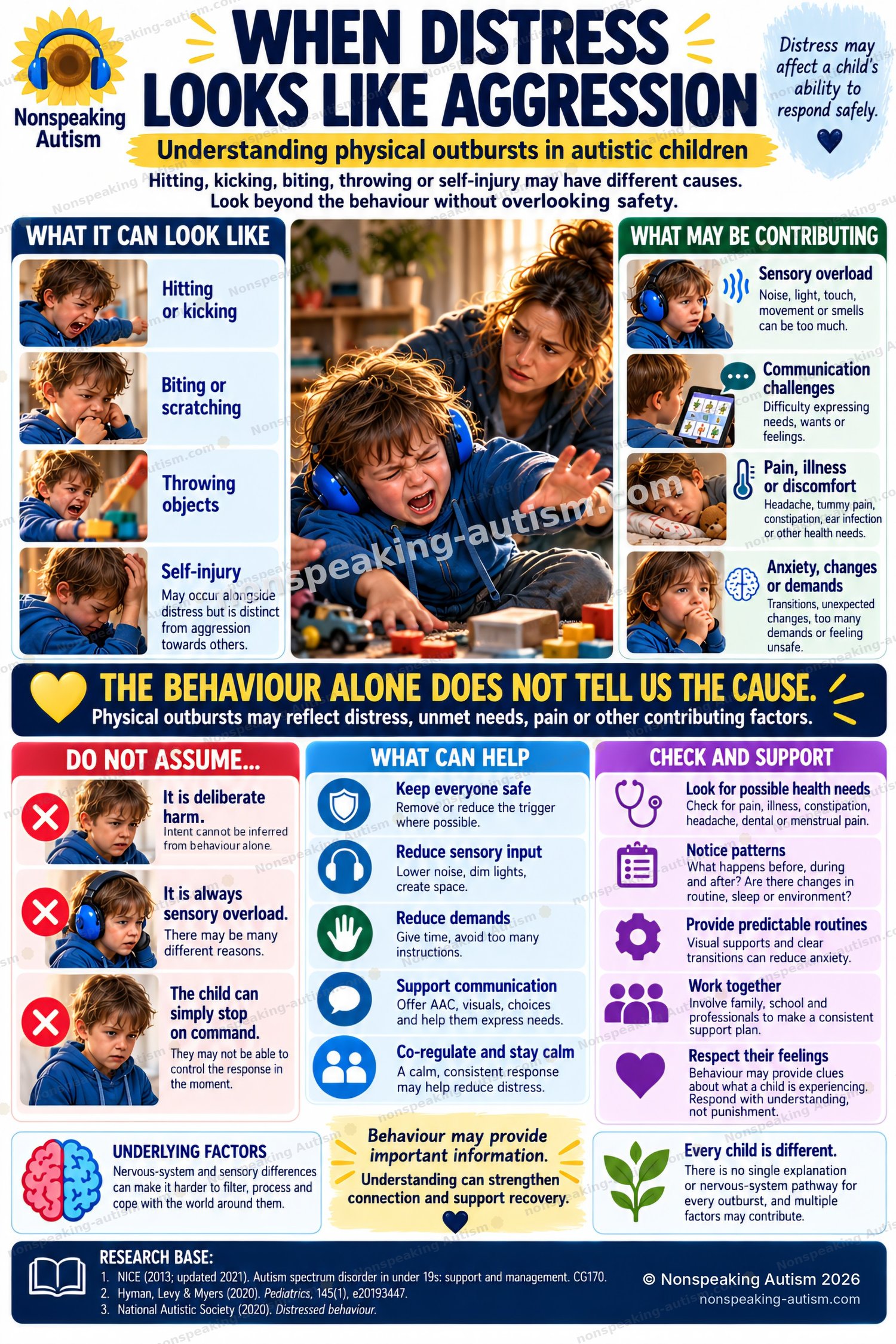
When Distress Looks Like Aggression is a compassionate, research-informed educational poster designed to help adults recognise possible contributors to physical outbursts, respond with greater understanding and prioritise everyone's safety.
The poster encourages a shift away from automatically assuming that a child is deliberately trying to cause harm.
Instead, it asks adults to consider:
What might the child be experiencing, what support do they need, and how can everyone be kept safe?
🧠 WHAT THIS POSTER EXPLORES
1. What Physical Distress May Look Like
Physical outbursts can take different forms, including:
- Hitting or kicking.
- Biting or scratching.
- Throwing objects.
- Self-injurious actions.
These behaviours may occur suddenly or develop as distress increases.
The poster also makes an important distinction: self-injury and aggression towards others are not the same thing, even though both may occur during periods of distress.
Neither should be dismissed, and both require appropriate safety considerations.
An outward behaviour alone cannot establish why it happened.
2. Sensory Overload
Some autistic children experience sensory input differently.
Sounds, bright lighting, touch, movement, crowded environments or strong smells may become uncomfortable, distracting or overwhelming.
A child experiencing sensory distress may have difficulty managing additional demands.
Possible signs include covering their ears, attempting to leave, increased movement, withdrawal or physical distress.
What may help:
- Reduce unnecessary noise.
- Adjust lighting where possible.
- Provide access to a quieter space.
- Respect personal space and sensory preferences.
- Allow recovery time after overwhelming experiences.
Sensory overload is one possible contributor, not an explanation for every physical outburst.
3. Communication Difficulties and Unmet Needs
Communication involves much more than spoken language.
Autistic children may communicate through speech, gestures, facial expressions, movement, vocalisations, objects, pictures, typing or augmentative and alternative communication (AAC).
During distress, a child may find it harder to express what they need or access their usual communication methods.
They may be trying to communicate:
- Stop.
- No.
- Help.
- That hurts.
- I need space.
- I do not understand.
- Something is wrong.
Adults should not assume that a child has no understanding simply because they cannot respond verbally in that moment.
What may help:
- Use calm, clear and simple language.
- Allow additional processing time.
- Keep AAC and familiar communication supports available.
- Offer meaningful choices.
- Recognise non-speaking communication.
- Respond to early indications of discomfort.
Communication access should remain available during distress, not only when a child is calm.
4. Pain, Illness and Physical Discomfort
Physical discomfort is an important consideration when a child experiences new, unusual or escalating distress.
Possible contributors include:
- Headaches or migraines.
- Dental or ear pain.
- Constipation or abdominal discomfort.
- Illness or infection.
- Sleep difficulties or fatigue.
- Menstrual discomfort.
- Other unmet physical health needs.
Some children may have difficulty identifying, describing or communicating pain.
A change in behaviour may therefore be one reason to investigate possible health concerns.
What may help:
- Look for changes from the child's usual behaviour.
- Consider recent illness, sleep, eating and toileting patterns.
- Take possible pain seriously.
- Seek medical advice when distress is unexplained, persistent, severe or different from the child's usual presentation.
A physical outburst should never automatically be assumed to be sensory or behavioural when a medical cause may be present.
5. Anxiety, Change and Increasing Demands
Transitions, uncertainty, unexpected changes and excessive demands may contribute to distress for some autistic children.
A child may be coping with several pressures at once, such as:
- A change in routine.
- An unfamiliar environment.
- Repeated instructions.
- A difficult transition.
- Social expectations.
- Sensory discomfort.
- Uncertainty about what happens next.
The combined demands may exceed what the child can comfortably manage at that moment.
What may help:
- Make routines more predictable where useful.
- Explain changes in accessible ways.
- Offer choices and processing time.
- Reduce unnecessary instructions.
- Adapt expectations to the child's current needs.
- Recognise when the child requires a break.
💛 WHAT ADULTS SHOULD NOT AUTOMATICALLY ASSUME
The poster challenges three common interpretations.
❌ “The child is deliberately trying to hurt someone.”
Intent cannot reliably be determined from an outward behaviour alone. The context, risks and possible causes need to be considered.
❌ “It must be sensory overload.”
Sensory overload may contribute, but pain, communication difficulties, anxiety, environmental demands and other factors may also be relevant.
❌ “The child can simply stop if told to.”
During intense distress, a child's ability to process instructions or change their response may be reduced.
This does not mean that physical harm should be accepted or ignored.
It means that protecting safety and understanding the contributing factors should happen together.
🛡️ WHAT MAY HELP DURING AN OUTBURST
Keep Everyone Safe
Prioritise the immediate safety of the child and others.
Where possible, calmly reduce hazards, create space and move other people away from danger.
Avoid unnecessary confrontation, punishment or escalating demands.
Follow an appropriate individual safety plan where one exists.
Reduce Sensory Input
Consider whether noise, lighting, crowding or unwanted touch is increasing distress.
Offer access to a calmer environment when safe and appropriate.
Reduce Demands
During intense distress, repeated questions and instructions may become difficult to process.
Use brief, predictable communication and allow time.
Support Communication
Keep preferred communication methods accessible.
Respect gestures, movement, AAC and other individual signals.
Offer Calm, Consistent Support
A familiar adult's calm and predictable response may help some children feel safer.
However, closeness, touch and verbal reassurance should always be guided by the child's preferences and immediate safety needs.
Do not force physical comfort or touch.
🌱 CHECK, UNDERSTAND AND PLAN SUPPORT
Once immediate safety has been addressed, adults can work together to understand possible patterns.
Look for Health Needs
Consider whether pain, illness, constipation, fatigue or another physical concern may have contributed.
Notice Patterns
Explore what happened before, during and after the incident.
Useful questions include:
- What changed in the environment?
- Was the child trying to communicate something?
- Were demands increasing?
- Was there a sensory trigger?
- Was the child tired, hungry or uncomfortable?
- What helped the child recover?
Provide Predictable Support
Visual information, familiar routines and clear transitions may reduce uncertainty for some children.
Work Together
Parents, carers, schools and relevant professionals can share observations and agree on a consistent, individualised support plan.
The child's own views and communication should be included wherever possible.
Respect Feelings and Support Recovery
After an incident, the child may need time, reduced demands, reassurance, rest or access to preferred regulation supports.
Reflection and problem-solving are often more accessible after immediate distress has passed.
Understanding the child should be part of the response, not an alternative to keeping people safe.
🔬 RESEARCH-INFORMED EDUCATIONAL CONTENT
This poster draws on established autism guidance and clinical literature.
The evidence supports considering multiple factors when assessing behaviour that challenges, including communication needs, physical health, mental health, environmental conditions and changes in routine.
NICE guidance recommends considering these factors and developing individualised support plans rather than relying on assumptions based only on outward behaviour.
Research and guidance also support investigating medical and developmental needs and coordinating support across relevant settings.
Important evidence distinction:
The poster does not claim that every physical outburst is caused by nervous-system overload, that every instance of aggression is involuntary or that one strategy will be effective for every child.
Physical outbursts may have different functions and contributing factors. Individual assessment, context and safety are essential.
📚 SELECTED RESEARCH AND GUIDANCE
1. National Institute for Health and Care Excellence (NICE). (2013; updated 2021).
Autism spectrum disorder in under 19s: support and management. Clinical guideline CG170.
https://www.nice.org.uk/guidance/cg170
This guidance recommends considering communication difficulties, physical and mental health conditions, sensory environments, changes in routine and other factors when understanding behaviour that challenges.
2. Hyman, S. L., Levy, S. E., & Myers, S. M. (2020).
Identification, evaluation, and management of children with autism spectrum disorder.
Pediatrics, 145(1), e20193447.
https://doi.org/10.1542/peds.2019-3447
This clinical report discusses comprehensive assessment and management of autistic children's developmental, behavioural and health needs.
3. National Autistic Society.
Distressed behaviour. Autism information and guidance.
The National Autistic Society provides information for understanding and responding to distress in autistic people.
Transitions Series – Research & References
• Birkett, L., McGrath, L., & Tucker, I. (2022). Muting, filtering and transforming space: Autistic children's sensory 'tactics' for navigating mainstream school space following transition to secondary school. Emotion, Space and Society, 42, 100872. https://doi.org/10.1016/j.emospa.2022.100872
• Brewer, A. T., Strickland-Cohen, K., Dotson, W., & Williams, D. C. (2014). Advance notice for transition-related problem behavior: Practice guidelines. Behavior Analysis in Practice, 7(2), 117–125. https://doi.org/10.1007/s40617-014-0014-3
• Buckle, K. L., Leadbitter, K., Poliakoff, E., & Gowen, E. (2021). "No way out except from external intervention": First-hand accounts of autistic inertia. Frontiers in Psychology, 12, 631596. https://doi.org/10.3389/fpsyg.2021.631596
• National Institute for Health and Care Excellence (2013, updated 2021). Autism spectrum disorder in under 19s: support and management (CG170). https://www.nice.org.uk/guidance/cg170
• Oldenburg, K., Gibbons, T., Welch, C., Tint, A., & Albin, M. (2026). Describing the communication of autistic people during experiences of distress: A scoping review. Autism, 30(4), 884–900. https://doi.org/10.1177/13623613261417933
• Piller, A., McHugh Conlin, L., Glennon, T., Andelin, L., Auld-Wright, K., Teng, J., & Tarver, T. (2025). Systematic review of sensory-based interventions for children and youth (2015–2024). Frontiers in Pediatrics, 13, 1720179. https://doi.org/10.3389/fped.2025.1720179
• National Autistic Society. Preference for order, predictability or routine. https://www.autism.org.uk/advice-and-guidance/topics/behaviour/dealing-with-change
• Leicestershire Partnership NHS Trust. Autism Space – information, advice and resources for autistic people in Leicester, Leicestershire and Rutland. https://www.leicspart.nhs.uk/autism-space/
Evidence Note
These sources provide general clinical and educational context. They do not prove a single cause for physical outbursts in an individual child.
The illustrations and explanations are simplified educational material, not a neurological assessment or a validated method for identifying the cause of aggression or self-injury.
Sources:
- Brewer et al. 2014 (PubMed Central)
- Oldenburg et al. 2026 (publisher listing via DOI)
- NAS – Preference for order, predictability or routine
- NHS England – ChatAutism and Autism Space
👨👩👧 WHO IS THIS RESOURCE FOR?
This educational poster may be useful for:
- Parents and carers of autistic children.
- Families supporting children who experience intense distress.
- Mainstream and specialist school staff.
- SENCOs and SEND teams.
- Teaching assistants and learning support workers.
- Occupational therapists.
- Speech and language therapists.
- Educational psychologists.
- Paediatric and community healthcare professionals.
- Autism support services.
- Residential and respite support teams.
- Staff training and continuing professional development.
- Parent and carer support groups.
It may also support collaborative discussions about reasonable adjustments, communication needs, safety planning and individual support arrangements.
🏫 HOW THIS POSTER CAN BE USED
At home: As a reference for recognising possible contributors to distress and discussing practical ways to improve safety and support.
In schools: To encourage staff to consider sensory, communication, health and environmental factors when responding to physical outbursts.
In therapy or clinical environments: As a visual conversation aid alongside appropriate individual assessment and professional guidance.
During SEND training: To encourage compassionate, informed responses that recognise both the child's needs and the safety of everyone involved.
In parent and carer groups: To support discussion, understanding and shared learning.
The poster can support professional conversations but does not replace an individual behaviour support or risk management plan.
📦 WHAT YOU RECEIVE
1 × When Distress Looks Like Aggression educational poster — UK Edition
The poster includes:
- Common forms of physical outbursts.
- Possible contributing factors.
- Misinterpretations adults should avoid.
- Immediate safety and support considerations.
- Practical communication and sensory adjustments.
- Health needs and pattern observation.
- Research-informed educational notes.
- Nonspeaking Autism branding and illustrations.
Format: Printable digital poster.
Print size: A2 (420 × 594 mm) if supplied in the standard A2 print-ready PDF format.
Watermarks: The listing preview is watermarked for copyright protection. The customer download should be supplied as a clear, unwatermarked file.
Digital download only — no physical product will be shipped.
⚠️ IMPORTANT EDUCATIONAL AND SAFETY DISCLAIMER
This resource is intended for educational and awareness purposes only.
It is not a diagnostic tool, clinical assessment, treatment programme, individual behaviour support plan or substitute for medical or professional advice.
Physical aggression and self-injury can create serious safety risks. Compassionate understanding does not remove the need to protect the child and other people from harm.
Where there is ongoing or significant risk, seek support from appropriately qualified healthcare or specialist professionals and ensure an individualised safety and support plan is in place.
Physical intervention or restraint should never be treated as a routine regulation strategy. Any restrictive intervention must comply with applicable law, safeguarding requirements, professional guidance and relevant organisational policies.
Seek medical assessment for sudden, unusual, persistent or severe distress, particularly where pain or illness may be involved.
If someone is in immediate danger or there is a medical emergency in the UK, call 999 or 112.
Every child is different. Strategies should be individualised, proportionate, safe and responsive to the child's needs and communication.
©️ COPYRIGHT AND PERMITTED USE
Copyright © 2026 Nonspeaking Autism. All rights reserved.
Permitted Use
Purchasers may print and publicly display this poster in:
- Homes and family settings.
- Educational settings and classrooms.
- Clinical and therapy environments.
- Workplaces and staff training rooms.
- Community and support settings.
Printed copies may be used as visual educational references and discussion aids.
Not Permitted
The following are not permitted without prior written authorisation:
- Reselling or redistributing the digital PDF.
- Sharing the purchased digital file with third parties.
- Uploading the file publicly or to shared download platforms.
- Editing, rebranding or removing copyright information.
- Reproducing the poster as part of another commercial product.
- Claiming the illustrations, design or written content as your own.
Purchase provides a licence to use the resource as described above. Copyright remains with Nonspeaking Autism.
💛 THE MESSAGE BEHIND THIS RESOURCE
When a child hits, kicks, bites, throws objects or hurts themselves, the immediate priority must be safety.
But once we look beyond the visible behaviour, we may begin to recognise needs that were not obvious at first.
A child may be experiencing pain.
They may be overwhelmed by their environment.
They may be struggling to communicate.
They may be frightened, exhausted or facing demands they cannot manage at that moment.
Sometimes several factors occur together.
Behaviour may provide important information. Understanding can strengthen connection and support recovery.
The goal is not to excuse harm or overlook risk.
The goal is to respond in ways that protect people, investigate possible causes and help the child access more effective support.
Connection over correction.
Understanding over expectation.
🌻 Nonspeaking Autism
Different needs. Equal belonging.
© 2026 Nonspeaking Autism. All rights reserved.


