
The Sensory Reality of Washing Hair in the Shower
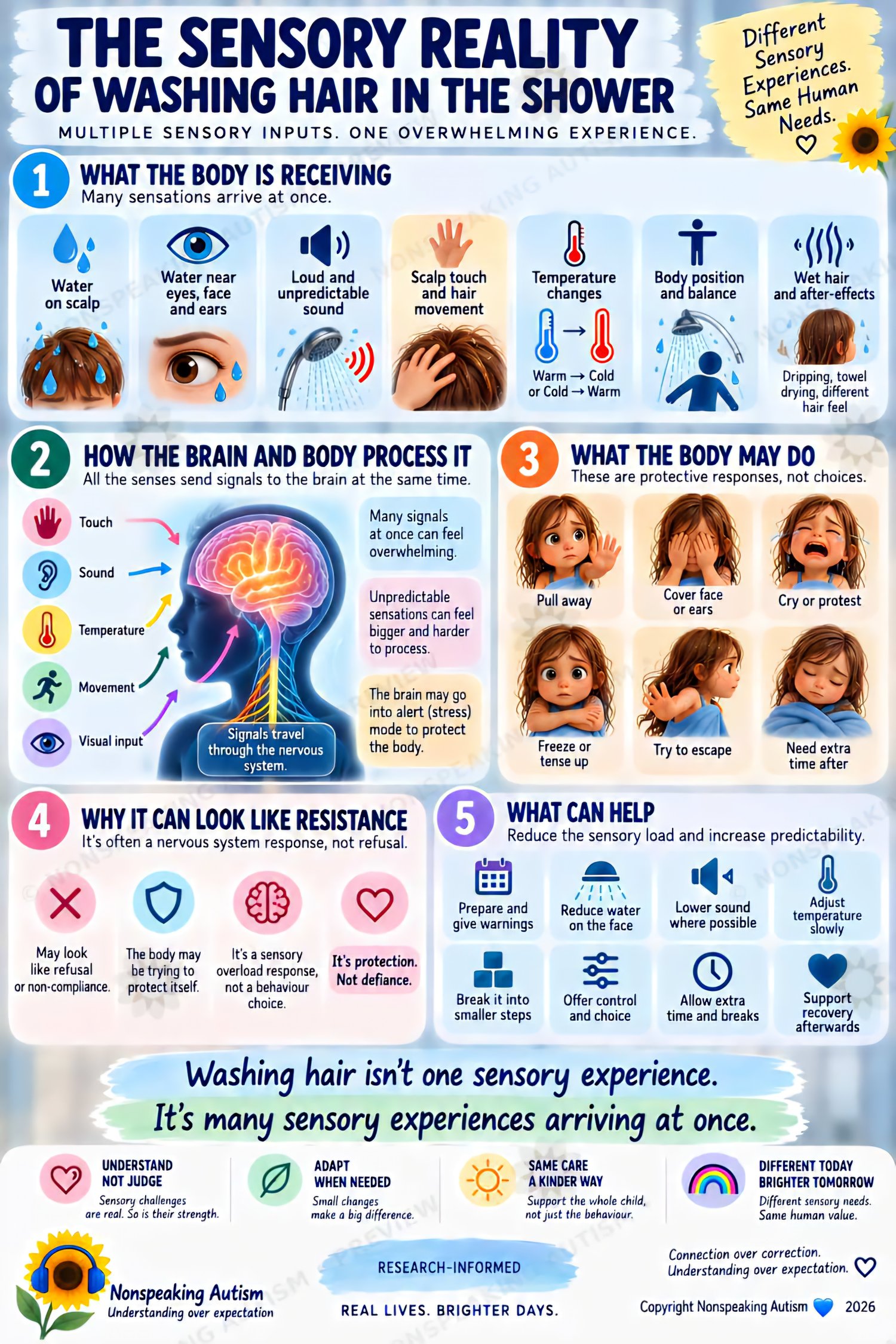
The Sensory Reality of Washing Hair in the Shower — Autism Sensory Processing Educational Poster
Multiple sensory inputs. One overwhelming experience.
For many autistic and sensory-sensitive people, washing hair in the shower is not simply a routine hygiene task. It can involve water, sound, touch, temperature, movement, visual input, balance and unpredictable sensations all happening at the same time.
This research-informed educational poster explores the sensory reality behind hair washing and helps explain why something that may appear simple from the outside can feel intense or overwhelming to the nervous system.
Rather than viewing distress, avoidance or resistance as difficult behaviour, this resource encourages parents, carers, educators and professionals to consider what the body may be experiencing and communicating.
💙 Understand, not judge. Adapt when needed. Support the whole person.
🌻 What This Poster Explores
The poster breaks the hair-washing experience into five easy-to-understand areas.
1. What the body is receiving
Hair washing can involve many simultaneous sensory experiences, including:
- Water hitting the scalp
- Water near the eyes, face and ears
- Loud or unpredictable shower sounds
- Scalp touch and movement of the hair
- Changes in water and room temperature
- Changes in body position and balance
- The sensations of wet hair, dripping, towel drying and the after-effects of washing
2. How the brain and body process it
Touch, sound, temperature, movement and visual information can all arrive at the nervous system together.
For someone who processes sensory information differently, multiple or unpredictable sensations may feel particularly intense. The poster provides a simple visual explanation of how sensory signals travel through the nervous system and how overload may contribute to a protective stress response.
3. What the body may do
Sensory overwhelm can appear in many different ways. A person may:
- Pull away
- Cover their face or ears
- Cry or protest
- Freeze or tense their body
- Try to escape
- Need additional recovery time afterwards
These responses should be understood in context. What looks like refusal from the outside may sometimes be a response to sensory discomfort, uncertainty or overload.
4. Why it can look like resistance
A central message of this resource is that behaviour alone does not tell us what someone is experiencing internally.
What appears to be non-compliance may sometimes reflect a nervous system attempting to protect itself.
It may be protection, not defiance.
5. What can help
The poster also includes practical, compassionate approaches that may make hair washing more manageable for some individuals, such as:
- Preparing the person and giving warnings
- Reducing water on the face where possible
- Lowering unnecessary sound
- Adjusting temperature gradually
- Breaking the task into smaller steps
- Offering genuine control and choices
- Allowing additional time and breaks
- Supporting recovery afterwards
Support should always be individualised. What feels calming or manageable for one person may not feel the same for another.
💙 Why This Resource Matters
Hair washing can easily become a source of stress for both the person experiencing sensory discomfort and those supporting them.
Understanding the sensory components behind the experience can shift the conversation from:
“Why are they refusing?”
to:
“What is making this difficult, and what could we change?”
That change in perspective can encourage greater compassion, autonomy and practical problem-solving.
The goal is not to force tolerance of distress. It is to understand the individual experience, reduce unnecessary sensory load where possible and find supportive approaches that respect the person.
🏫 Ideal For
This educational poster may be useful for autistic individuals, parents and carers, SEND teachers, schools, nurseries, occupational therapy and therapy environments, support workers, healthcare and clinical settings, sensory rooms, autism training, professional development, community organisations and neurodiversity education.
It can also be displayed in bathrooms, changing areas or support spaces as a visual reminder that everyday personal-care activities can involve far more sensory processing than is immediately visible.
📦 What You Receive
Your purchase includes:
1 × The Sensory Reality of Washing Hair in the Shower educational poster
Size: A2 — 420 × 594 mm
Format: High-quality digital PDF
Orientation: Portrait
Watermark: The purchased PDF is supplied clear and unwatermarked
Delivery: Digital download only
No physical poster or product will be shipped.
Watermarked images used in the product listing are for preview and copyright-protection purposes only.
🖨️ Printing
The PDF has been prepared on an exact 420 × 594 mm A2 page, making it suitable for professional or home printing where A2 printing is supported.
For best results, select A2 / Actual Size / 100% scale in your printer settings rather than automatically stretching the artwork to fit another page size.
Colours may vary slightly between screens and printers depending on monitor calibration, printer, paper and ink.
⚠️ Educational Disclaimer
This resource is intended for education, awareness and general understanding only.
It is not a diagnostic tool, medical advice, occupational therapy assessment or a replacement for individual advice from an appropriately qualified healthcare or allied-health professional.
Sensory experiences vary significantly between individuals. Not every autistic person will experience hair washing, water, touch, sound or temperature in the ways described in this poster.
Sudden or significant distress associated with bathing, hair washing, the scalp, ears, skin, temperature or water should not automatically be assumed to be sensory. Pain, skin conditions, ear problems and other medical or physical causes may need appropriate professional assessment.
Any adaptations or sensory strategies should be appropriate to the individual and used with consideration for their comfort, communication, consent, autonomy and safety.
©️ Usage & Copyright
This digital resource is for the purchaser's personal, educational or professional use.
You may print the poster for your own home, classroom, educational environment, workplace, clinic or professional setting.
The digital file itself may not be resold, redistributed, shared, copied for commercial distribution, uploaded to file-sharing platforms, offered as a free download, or incorporated into another product for resale.
Copyright © Nonspeaking Autism 2026. All rights reserved.
Different sensory experiences. Same human needs. 💙Connection over correction. Understanding over expectation.