
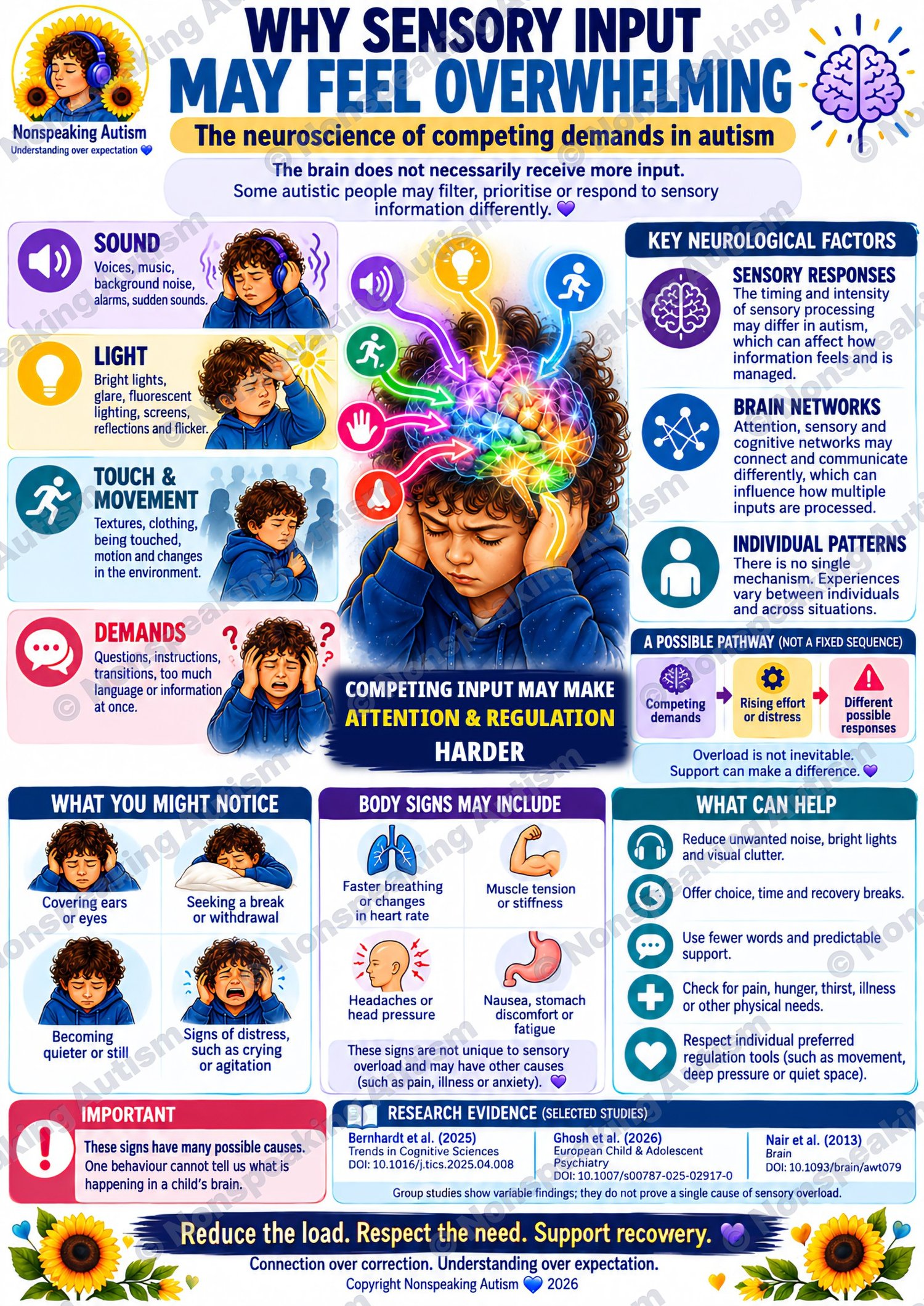
💙 WHY SENSORY INPUT MAY FEEL OVERWHELMING
💙 WHY SENSORY INPUT MAY FEEL OVERWHELMING
The Neuroscience of Competing Demands in Autism
UK Edition | Research-Informed Autism & Sensory Processing Educational Poster | Nonspeaking Autism
🌻 The brain does not necessarily receive more sensory input. Some autistic people may filter, prioritise or respond to sensory information differently.
A classroom may sound manageable to one person but feel intensely overwhelming to another.
Bright lighting, background conversations, unexpected touch, movement and repeated instructions may all compete for attention.
For some autistic children and adults, processing several demands at once can become exhausting or distressing.
A child may cover their ears, become quieter, seek space or show visible signs of distress.
These responses are not necessarily deliberate misbehaviour.
They may reflect an experience that has become difficult to process, tolerate or manage.
Why Sensory Input May Feel Overwhelming is an illustrated, research-informed educational poster exploring how sensory information, attention, brain networks, physical responses and environmental demands may interact in autism.
It introduces relevant neuroscience without claiming that every autistic person experiences sensory overload in the same way or that one neurological mechanism explains every response.
The central message:
Reduce the load. Respect the need. Support recovery.
🧠 UNDERSTANDING SENSORY OVERWHELM
Sensory overwhelm may occur when sensory experiences and other demands become difficult to manage.
This does not necessarily mean the brain receives a greater amount of sensory information.
Instead, differences in how information is detected, processed, prioritised or responded to may influence how an environment feels.
For example, several conversations, bright lighting, movement and instructions may compete for attention.
Some autistic people may find particular sounds, lights or textures especially uncomfortable.
Others may experience difficulty when multiple demands occur together, even if each demand might be manageable separately.
Sensory experiences are highly individual.
The same environment can be comfortable for one person and overwhelming for another.
🌈 WHAT THIS POSTER EXPLORES
1. SOUND — WHEN EVERYDAY NOISE BECOMES DIFFICULT
Sounds may include:
- Conversations
- Music
- Background noise
- Alarms
- Sudden or unpredictable sounds
- Several competing sources of noise
A child may struggle to follow speech when multiple sounds occur at once.
They may cover their ears, move away or seek a quieter environment.
The experience may relate to sound intensity, unpredictability, competing input or other individual factors.
The question is not only whether a sound is objectively loud, but how it affects the person's comfort and ability to participate.
2. LIGHT — WHEN VISUAL INPUT BECOMES OVERWHELMING
Visual demands may include:
- Bright lighting
- Glare
- Fluorescent lighting
- Screens
- Reflections
- Flickering lights
- Busy visual environments
Some autistic individuals may find these experiences uncomfortable, distracting or exhausting.
Adjusting lighting, reducing glare or offering a different workspace may improve accessibility for some people.
Not everyone requires the same adjustments.
3. TOUCH & MOVEMENT — WHEN PHYSICAL SENSATIONS COMPETE
Touch and movement experiences may include:
- Clothing textures
- Unexpected touch
- Crowded spaces
- Physical movement
- Changes in body position
- Movement occurring nearby
Some individuals may experience particular tactile or movement sensations as unpleasant or difficult to predict.
Others may actively seek movement or preferred tactile input.
Sensory seeking and sensory avoidance can also occur in the same person.
Preferences and responses should be understood individually rather than assumed from a diagnosis.
4. DEMANDS — WHEN INFORMATION BECOMES TOO MUCH
Sensory experiences are not the only demands a person may be managing.
Additional demands can include:
- Questions
- Instructions
- Transitions
- Social expectations
- Decision-making
- Waiting
- Processing spoken language
- Multiple tasks at once
For some autistic people, competing sensory, cognitive and communication demands may make attention and self-regulation more difficult.
Reducing unnecessary instructions or allowing additional processing time may help.
🔬 KEY NEUROLOGICAL FACTORS
The poster introduces three areas of neuroscience relevant to sensory processing differences.
1. SENSORY RESPONSES
Research suggests that sensory processing can differ in autism.
Differences may involve the timing, intensity or interpretation of sensory responses.
However, findings vary across studies and individuals.
It would be inaccurate to suggest that every autistic brain processes sensory information in one particular way.
2. BRAIN NETWORKS
Sensory processing, attention and cognition involve interacting brain networks.
Research has explored differences in network activity and connectivity in autism.
These findings may contribute to understanding why some individuals experience competing demands differently.
However, group-level research does not establish what is happening in an individual person's brain during a specific episode of distress.
A brain illustration cannot diagnose sensory overload or reveal one person's neurological state.
3. INDIVIDUAL PATTERNS
There is no single neurological explanation for every experience of sensory overwhelm.
Sensory preferences and responses may vary according to:
- The type of sensory input
- The environment
- Physical wellbeing
- Fatigue
- Emotional state
- Predictability
- Communication demands
- Previous experiences
- Individual sensory preferences
Understanding the person's experience is more useful than assuming one universal neurological mechanism.
💛 A POSSIBLE PATHWAY — NOT A FIXED SEQUENCE
The poster illustrates one possible relationship:
Competing demands → Rising effort or distress → Different possible responses
This is an educational example, not a proven or universal neurological sequence.
For some individuals, multiple demands may increase the effort required to remain engaged.
If those demands become overwhelming, a person may need to withdraw, reduce input or seek support.
However, responses can develop differently and may be influenced by several factors.
Sensory overload is not inevitable, and appropriate support can make a meaningful difference.
💙 WHAT YOU MIGHT NOTICE
The poster highlights possible outward signs of sensory overwhelm.
These include:
Covering Ears or Eyes
A person may attempt to reduce uncomfortable sound or visual input.
Seeking a Break or Withdrawing
Moving away may provide relief from competing sensory or social demands.
Becoming Quieter or Still
Some individuals may communicate less, withdraw or appear less responsive when overwhelmed.
Crying, Agitation or Visible Distress
A person may show distress when their current environment or demands become difficult to manage.
These are possible responses, not diagnostic signs.
The same outward behaviour may have many different causes.
🫀 BODY SIGNS THAT MAY ACCOMPANY DISTRESS
Sensory overwhelm may occur alongside physical sensations such as:
- Faster breathing
- Changes in heart rate
- Muscle tension
- Stiffness
- Headaches
- Head pressure
- Nausea
- Stomach discomfort
- Fatigue
These experiences are not unique to sensory overload.
They may also reflect pain, illness, anxiety, dehydration, fatigue or other medical concerns.
A child may be experiencing several factors at once.
Physical symptoms should never automatically be attributed to autism or sensory processing differences.
🌻 WHAT CAN HELP?
The poster introduces five practical approaches.
1. REDUCE UNWANTED SENSORY INPUT
Where possible:
- Reduce unnecessary background noise
- Adjust bright lighting
- Minimise visual clutter
- Offer quieter environments
- Respect touch preferences
- Reduce avoidable sensory demands
Environmental adjustments should be based on the person's preferences and needs.
2. OFFER CHOICE, TIME & RECOVERY BREAKS
Allow the person opportunities to:
- Take breaks
- Move to a quieter space
- Choose between accessible options
- Rest
- Recover after demanding activities
- Communicate when they need support
Breaks should not have to be earned through compliance.
3. USE FEWER WORDS & PREDICTABLE SUPPORT
During periods of distress, processing spoken language may become more difficult.
Support may include:
- Calm communication
- Short, clear instructions
- Additional processing time
- Visual supports
- Predictable routines
- Preparation for changes
- Access to AAC or alternative communication
Do not pressure speech or insist on immediate responses.
4. CHECK PHYSICAL NEEDS
Before assuming sensory overload, consider:
- Pain
- Hunger
- Thirst
- Illness
- Fatigue
- Poor sleep
- Other physical discomfort
If symptoms are unusual, severe or persistent, seek appropriate professional advice.
5. RESPECT INDIVIDUAL REGULATION PREFERENCES
Some people may prefer:
- Movement
- Quiet spaces
- Familiar sensory tools
- Ear defenders
- Rest
- Preferred stimming
- Welcomed deep pressure
Deep pressure should only be considered when safe, appropriate and wanted by the person.
No single strategy works for everyone.
Support should reduce barriers, respect autonomy and improve meaningful participation.
🏫 USING THIS RESOURCE IN UK SCHOOLS & SEND SETTINGS
This poster can help teachers, teaching assistants, SENCOs and other professionals understand how competing sensory and cognitive demands may affect autistic pupils.
It may support discussions about:
- Classroom noise
- Lighting and visual clutter
- Sensory-friendly environments
- Communication access
- Processing time
- Predictable transitions
- Reasonable adjustments
- Access to quiet spaces
- Movement and rest breaks
- Individual sensory preferences
- Recovery after overwhelming experiences
A pupil who struggles to follow instructions in a busy classroom may be experiencing several competing demands rather than simply refusing to listen.
A pupil who withdraws may need environmental adjustments or recovery time.
A pupil who becomes distressed may need adults to reduce demands and consider physical wellbeing.
This resource can support collaborative planning between families, schools and relevant professionals.
Where appropriate, it may contribute to SEND support discussions or an Education, Health and Care Plan (EHCP) in England.
The aim is to make participation more accessible, not to force children to tolerate overwhelming environments.
📚 RESEARCH & SCIENTIFIC EVIDENCE
The poster references research examining sensory processing, brain networks and related experiences in autism.
Research suggests that sensory responses and patterns of brain activity may differ between autistic and non-autistic groups.
However, findings are variable and cannot establish a single neurological explanation for every individual's sensory experiences.
Selected Research Printed on the Poster
Bernhardt et al. (2025)
Trends in Cognitive Sciences.
DOI: 10.1016/j.tics.2025.04.008
Ghosh et al. (2026)
European Child & Adolescent Psychiatry.
DOI: 10.1007/s00787-025-02917-0
Nair et al. (2013)
Brain.
DOI: 10.1093/brain/awt079
FURTHER RESOURCES
- National Autistic Society – Autism and sensory processing: https://www.autism.org.uk/advice-and-guidance/topics/sensory-differences/sensory-differences/all-audiences
- National Autistic Society – Meltdowns: a guide for all audiences: https://www.autism.org.uk/advice-and-guidance/topics/behaviour/meltdowns/all-audiences
- Falkirk Council – Making sense of sensory behaviour (booklet): https://falkirk.gov.uk/media/9892c1e1-a778-483c-b70f-4bc6601aa2cc
RESEARCH & REFERENCES
Brain networks and information processing (Key Neurological Factors)
- Bernhardt, B. C., Valk, S. L., Hong, S.-J., Soulières, I., & Mottron, L. (2025). Autism-related shifts in the brain's information processing hierarchy. Trends in Cognitive Sciences, 29(10), 942–955. https://doi.org/10.1016/j.tics.2025.04.008
- Nair, A., Treiber, J. M., Shukla, D. K., Shih, P., & Müller, R.-A. (2013). Impaired thalamocortical connectivity in autism spectrum disorder: A study of functional and anatomical connectivity. Brain, 136(6), 1942–1955. https://doi.org/10.1093/brain/awt079
Sensory responses: timing and intensity (Key Neurological Factors)
- Ghosh, A., Nasarre-Nacenta, N., Baumeister, S., Holz, N. E., Banaschewski, T., Brandeis, D., Aggensteiner, P.-M., & Kaiser, A. (2026). Neurophysiological alterations during sensory processing in autism – a meta-analysis. European Child & Adolescent Psychiatry, 35(3), 767–784. https://doi.org/10.1007/s00787-025-02917-0
Sensory reactivity, body signals and individual patterns
- Tavassoli, T., Marco, E. J., & Puts, N. (2026). Sensory reactivity in autism: Integrating behavioural, affective, physiological, and neural dimensions. Current Psychiatry Reports, 28, 36. https://doi.org/10.1007/s11920-026-01682-4
- Zadok, E., Golan, O., Lavidor, M., & Gordon, I. (2024). Autonomic nervous system responses to social stimuli among autistic individuals: A systematic review and meta-analysis. Autism Research, 17(3), 497–511. https://doi.org/10.1002/aur.3068
Foundational references printed on the poster: Bernhardt et al. (2025); Ghosh et al. (2026); Nair et al. (2013).
Reference verification note: These citations have been transcribed from the poster. Their full bibliographic details and precise relevance to each scientific statement have not been independently verified for this listing.
SCIENTIFIC EVIDENCE NOTE
The poster's brain illustration and arrows are simplified educational representations.
They are not brain scans, anatomical pathways or proof of a particular mechanism.
Research involving groups of autistic participants cannot determine the precise cause of one person's distress.
One outward behaviour cannot reveal what is happening inside an individual's brain.
This poster is intended to encourage informed understanding, not to provide a neurological diagnosis.
Sources:
- National Autistic Society: Meltdowns
- NHS Scotland Right Decisions: Autistic meltdowns and shutdowns
- Reframing Autism: All About Autistic Shutdowns
👨👩👧 WHO IS THIS RESOURCE FOR?
This educational poster may be useful for:
- Parents and carers of autistic children
- Autistic young people and adults
- Teachers and teaching assistants
- SENCOs and SEND teams
- Occupational therapists
- Speech and language therapists
- Educational psychologists
- Paediatric and healthcare professionals
- Family support workers
- Early years practitioners
- Professionals supporting sensory accessibility
- Anyone seeking to understand sensory processing differences in autism
It may be displayed in homes, classrooms, SEND support areas, therapy rooms, staff training spaces and other educational settings.
📦 WHAT YOU RECEIVE
PAID DIGITAL DOWNLOAD — INDIVIDUAL POSTER
Your purchase includes:
1 × Why Sensory Input May Feel Overwhelming — The Neuroscience of Competing Demands in Autism
The poster features:
- Sensory input examples covering sound, light, touch and movement
- Social, cognitive and communication demands
- Key neurological factors
- A simplified brain-network illustration
- One possible pathway of competing demands and distress
- Possible signs of sensory overwhelm
- Physical symptoms that may accompany distress
- Practical support strategies
- Research references and scientific cautions
- Nonspeaking Autism illustrated design
The product listing image contains promotional preview watermarks.
The purchased printable version should be supplied without these preview watermarks.
Digital download only — no physical poster will be posted.
Exact print dimensions and resolution should be confirmed against the final downloadable file.
⚠️ IMPORTANT DISCLAIMER
This resource is provided for educational and informational purposes only.
It is not a medical diagnosis, neurological assessment, psychological assessment, occupational therapy assessment, sensory assessment or individualised treatment plan.
Sensory overwhelm may overlap with anxiety, pain, illness, fatigue, communication difficulties and other experiences.
The examples and neurological explanations presented are simplified and should not be used to identify the cause of an individual's behaviour.
Sudden, severe, unexplained or persistent changes in responsiveness, physical wellbeing or behaviour should be assessed by an appropriate healthcare professional.
Support should be individualised, safe, consent-aware and responsive to the person's communication and preferences.
©️ COPYRIGHT & PERMITTED USE
Copyright © 2026 Nonspeaking Autism. All rights reserved.
Purchase permits personal, family, classroom, school and individual professional educational use.
You may print the poster for these purposes.
You may not:
- Resell the poster or digital file
- Redistribute the purchased file
- Upload the original file to another website or digital platform
- Remove the branding and claim the artwork as your own
- Reproduce the artwork commercially
- Include the poster in another product for resale without permission
Please share the original Payhip product link rather than distributing the purchased digital file.
💛 THE MESSAGE BEHIND THIS RESOURCE
A sound that seems ordinary to one person may feel overwhelming to another.
A bright classroom may create barriers that are not immediately visible.
Several conversations, instructions and sensory experiences may become difficult to manage together.
And a child who covers their ears, withdraws or becomes distressed may be communicating that something needs to change.
We do not need to identify one exact neurological mechanism before offering support.
We can reduce unnecessary sensory demands.
We can respect individual preferences.
We can make communication accessible.
We can check physical needs.
And we can allow recovery without punishment or pressure.
The goal is not to make sensory distress invisible.
The goal is to reduce barriers and support the person experiencing it.
Reduce the load. Respect the need. Support recovery. 💜
🌻 Connection over correction. Understanding over expectation. 💙
Nonspeaking Autism © 2026