
Research-Informed Regulation Strategies Support During & After Overload
Research-Informed Regulation Strategies
Support During & After Overload
De-Escalation • Co-Regulation • Recovery • Sensory Support • Safety
When an autistic person is experiencing intense overload or a meltdown, more talking, more demands and more pressure may make an already overwhelmed situation harder.
Support during these moments should prioritise immediate safety, reduced sensory and social load, accessible communication and co-regulation. And when the visible distress has passed, recovery may still be needed.
Research-Informed Regulation Strategies is a practical educational poster from Nonspeaking Autism, designed to help parents, carers, educators and professionals respond to overload with greater understanding, safety and compassion.
💛 Meltdowns are not wilful behaviour.
During overload, access to language, flexible thinking, communication and self-regulation may change. The goal is not to lecture someone out of distress.
The goal is to make the situation safer and reduce what their nervous system has to manage.
🛡️ What Support Is For
During significant overload, support may need to focus on four priorities:
- Protect immediate safety
- Reduce incoming sensory and social load
- Support co-regulation rather than compliance
- Allow recovery before problem-solving
This changes the question from:
“How do I make them calm down?”
to:
“What can I reduce, change or provide to make this situation safer and more manageable?”
🌻 Stage 1: De-Escalation — During Overload
1️⃣ Reduce Input Immediately
Look at the environment.
Where possible:
- dim bright lighting
- lower noise
- reduce the number of people nearby
- pause non-essential questions
- reduce instructions
- stop unnecessary demands
- remove competing sensory input
- provide access to a quieter environment
Sometimes changing the environment can be more helpful than asking the overwhelmed person to change their behaviour.
Reduce the load before adding another demand.
2️⃣ Co-Regulate
The supporter becomes part of the environment too.
Helpful approaches may include:
- a calm, neutral presence
- slower movements
- fewer words
- predictable language
- allowing physical space
- reducing unnecessary questions
- avoiding confrontational body language
Co-regulation does not mean controlling another person's emotions.
It means trying not to add additional threat or pressure while offering a safer, more predictable presence.
3️⃣ Offer Space & Communication Access
Speech may become harder to access during significant distress.
Keep alternative communication available, including:
- AAC
- communication boards
- symbols
- typing
- writing
- pointing
- gestures
- yes/no responses
- familiar communication systems
Do not require speech, eye contact or explanations before communication is respected.
💬 Communication should remain available when communication becomes hardest.
4️⃣ Support Body-Based Regulation — If Wanted
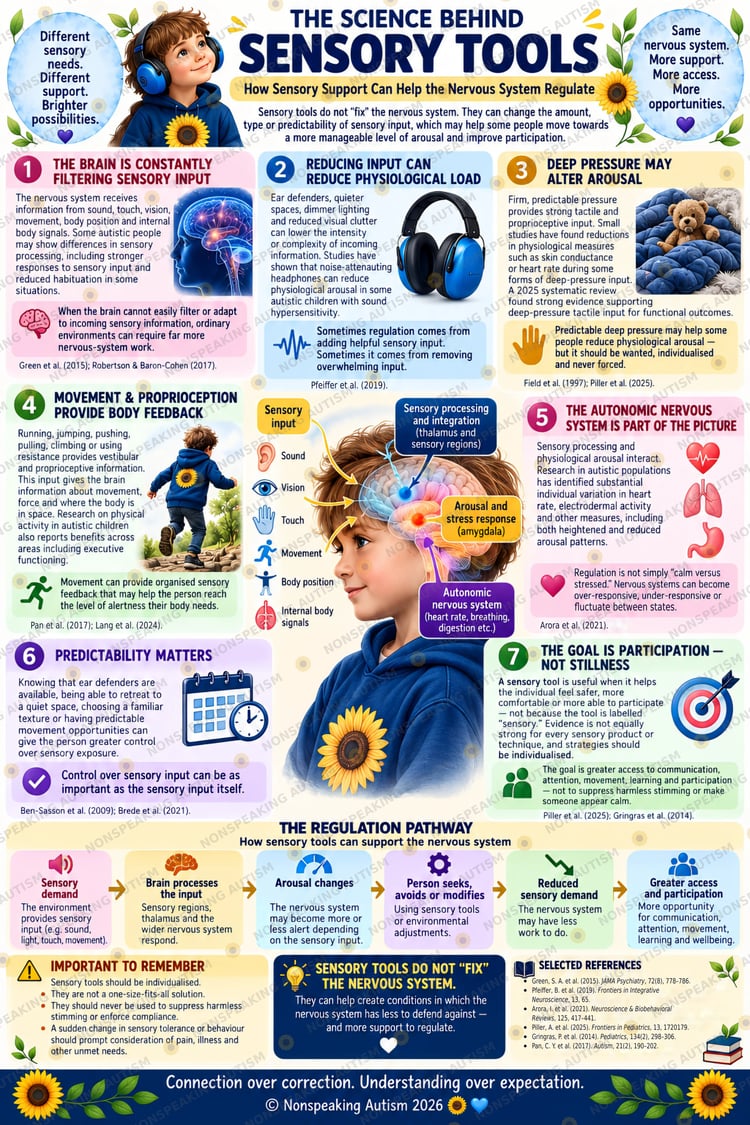
Some people may benefit from familiar sensory or movement strategies, such as:
- preferred movement
- heavy-work activities
- familiar sensory objects
- ear defenders or headphones
- a quieter environment
- preferred repetitive movement or stimming
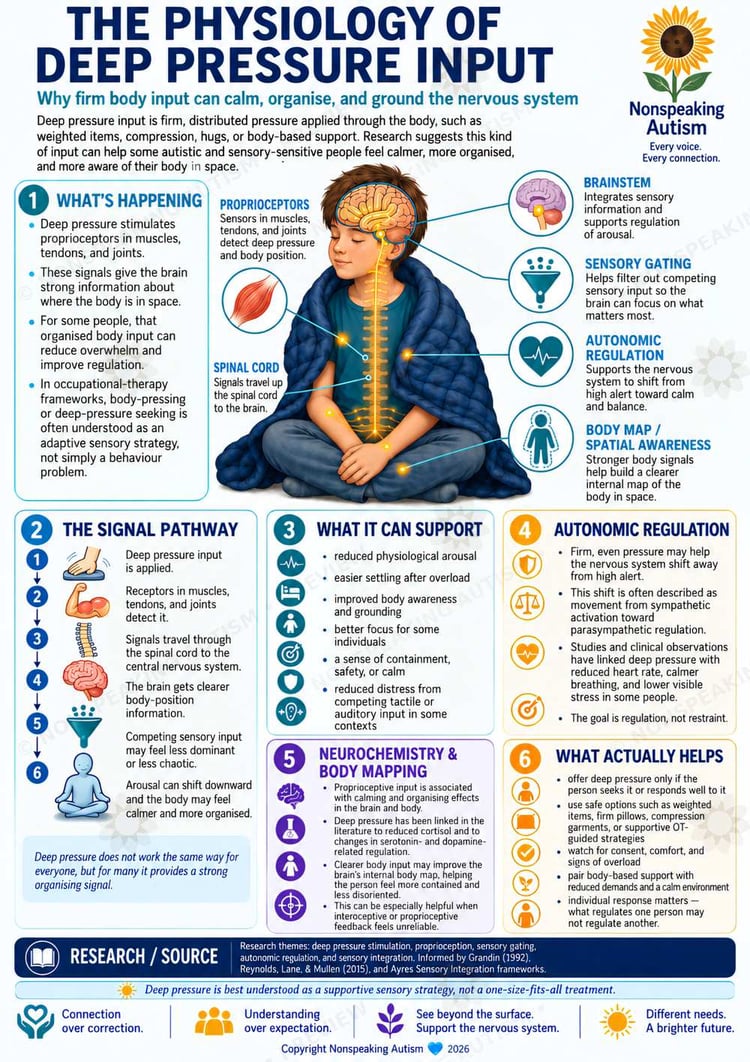
- deep pressure when actively sought, welcomed and safe
These are options — not prescriptions.
What regulates one person may be ineffective or distressing for another.
⚠️ Deep Pressure & Weighted Items
Deep pressure and weighted products should not be presented as universal autism interventions.
Research on deep-pressure responses is limited and individual responses vary.
Weighted items should similarly not be treated as a guaranteed calming strategy.
Offer preferred support. Observe the response. Never force sensory input.
5️⃣ Protect Immediate Safety
When there is an immediate risk of injury:
- move hard or dangerous objects where feasible
- create physical space
- reduce crowding
- keep responses calm and non-threatening
- follow the person's existing individualized safety or crisis plan
- seek appropriate assistance where necessary
Safety is the priority — not immediate compliance.
This poster is not instruction in restraint, seclusion or restrictive intervention.
🔵 Stage 2: Recovery Phase — The “Sensory Hangover”
The visible peak of distress ending does not necessarily mean the person has completely recovered.
The phrase “sensory hangover” is used here as accessible educational shorthand for a period of continuing fatigue, vulnerability or increased sensitivity following overload.
It is not a medical diagnosis or validated clinical stage.
1️⃣ Expect Slower Processing
After significant overload, some people may temporarily experience:
- slower response times
- reduced speech access
- reduced communication
- fatigue
- increased sensory sensitivity
- reduced tolerance for demands
- a greater need for predictability
Give the person time.
Silence does not need to be filled with more questions.
2️⃣ Keep the Environment Low-Demand
Recovery may be supported by an environment that is:
- quieter
- dimmer if preferred
- familiar
- predictable
- less socially demanding
- lower in sensory load
Recovery is not the time to immediately restore every previous demand.
3️⃣ Meet Body Needs
Consider basic physical needs such as:
- hydration
- food
- toileting
- sleep or rest
- temperature comfort
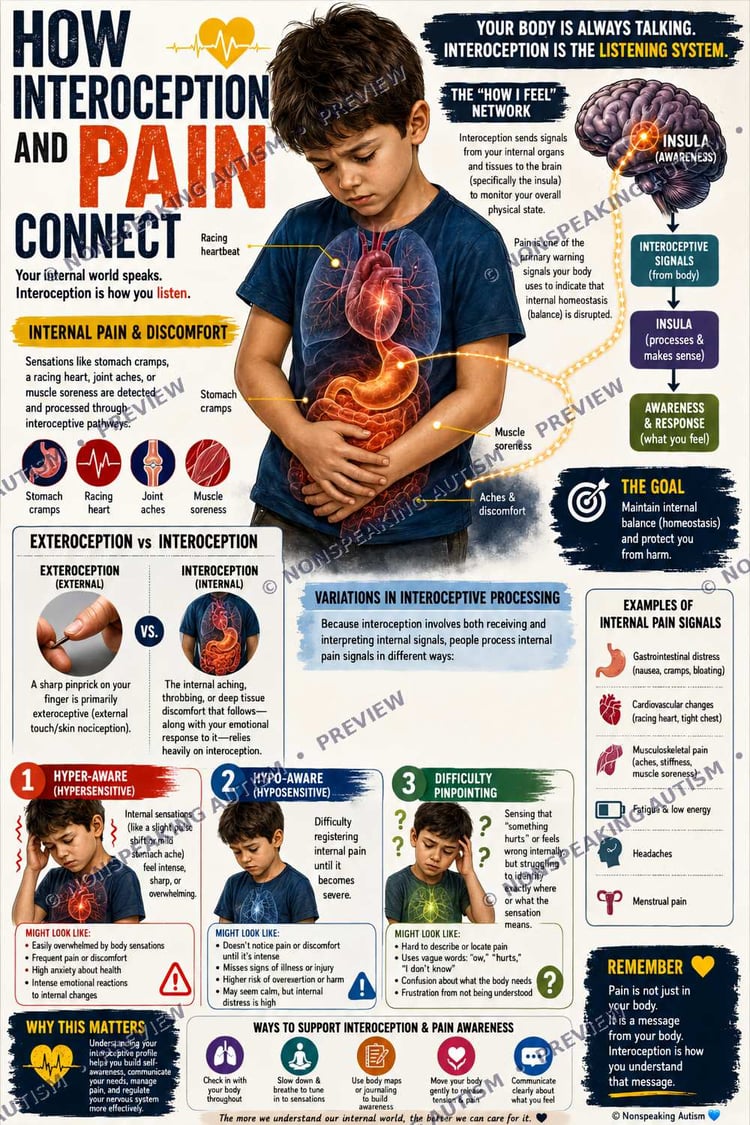
- pain
- injury
- illness
- fatigue
Changes in behaviour should not automatically be attributed to autism or sensory processing.
Check the body too.
4️⃣ Delay Reflection
Immediately after a meltdown may not be the best time for:
- lengthy debriefing
- demanding explanations
- insisting on apologies
- teaching lessons
- problem-solving
- discussing consequences
Reflection may be much more meaningful when regulation and communication access have returned.
Recovery first. Reflection later.
5️⃣ Allow Genuine Recovery Time
Recovery can take different amounts of time for different people.
It may take:
minutes, hours or longer, depending on the individual, the intensity of the experience, physical wellbeing and the surrounding environment.
Avoid assuming that someone is completely recovered simply because their outward behaviour has become quieter.
🚫 What Not to Do
During or immediately following overload, avoid automatically:
- arguing or giving lengthy lectures
- adding unnecessary sensory or social demands
- removing communication or coping tools as punishment
- forcing eye contact
- forcing touch
- forcing conversation
- demanding immediate explanations
- assuming quietness means recovery is complete
The aim is to reduce unnecessary pressure rather than escalate it.
🧠 Why These Strategies May Help
A supportive response can work through several overlapping principles:
Reduced load → Lower demand → Greater access to communication → Safer recovery
Reducing unnecessary sensory and social demands can make the environment easier to process.
A calm and predictable supporter may reduce additional interpersonal pressure.
Meeting body needs can address factors such as hunger, fatigue, thirst, pain or temperature discomfort that may otherwise add to distress.
Predictable recovery support may also help preserve trust, participation and communication.
🔎 Look Beyond the Meltdown
No outward behaviour tells us its cause with certainty.
Consider the whole picture:
- What happened beforehand?
- Was the environment overwhelming?
- Were demands accumulating?
- Was communication becoming difficult?
- Was something unpredictable?
- Was the person exhausted?
- Could they be hungry or thirsty?
- Could something hurt?
- What support did they seek?
- What helped afterwards?
Observe the pattern. Consider the context. Individualise the support.
🔬 What the Research Suggests
Research consistently documents sensory-processing differences in autism, while responses and support needs vary substantially between individuals.
Research has also explored sensory responsivity, physiological reactivity, stimming and sensory-based interventions.
The evidence does not support treating one sensory strategy as a universal solution for autistic distress.
In particular, research concerning deep pressure and weighted products remains mixed or limited for many outcomes.
The strongest practical principle is therefore:
Individualise. Offer. Observe. Adapt. Never force.
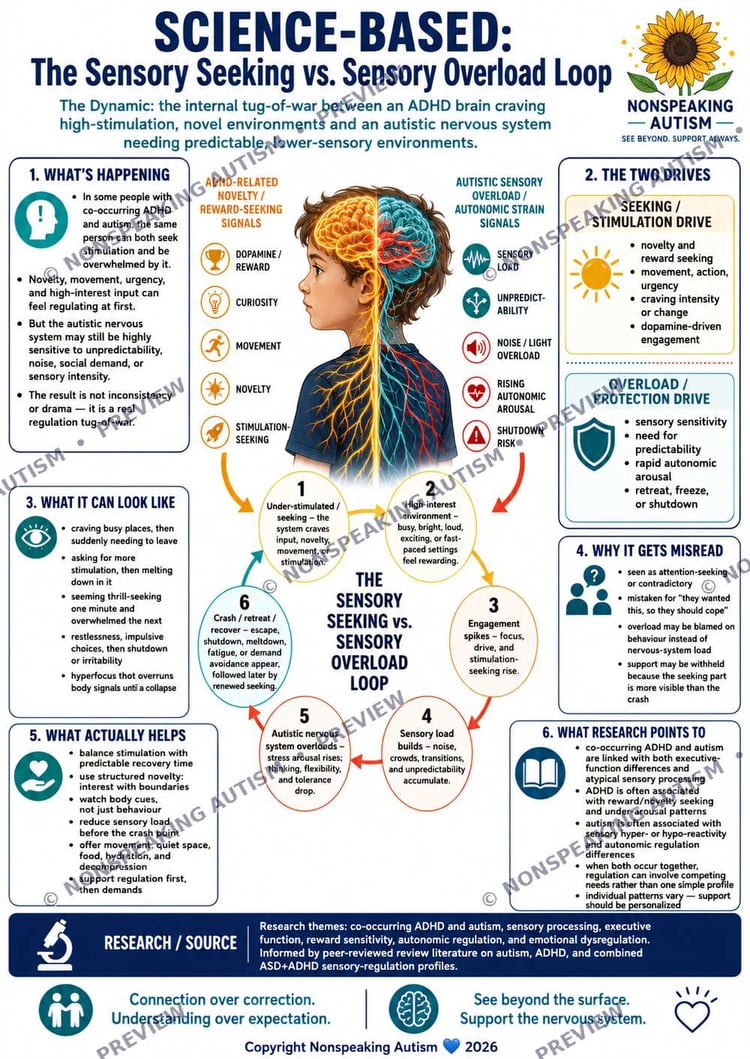
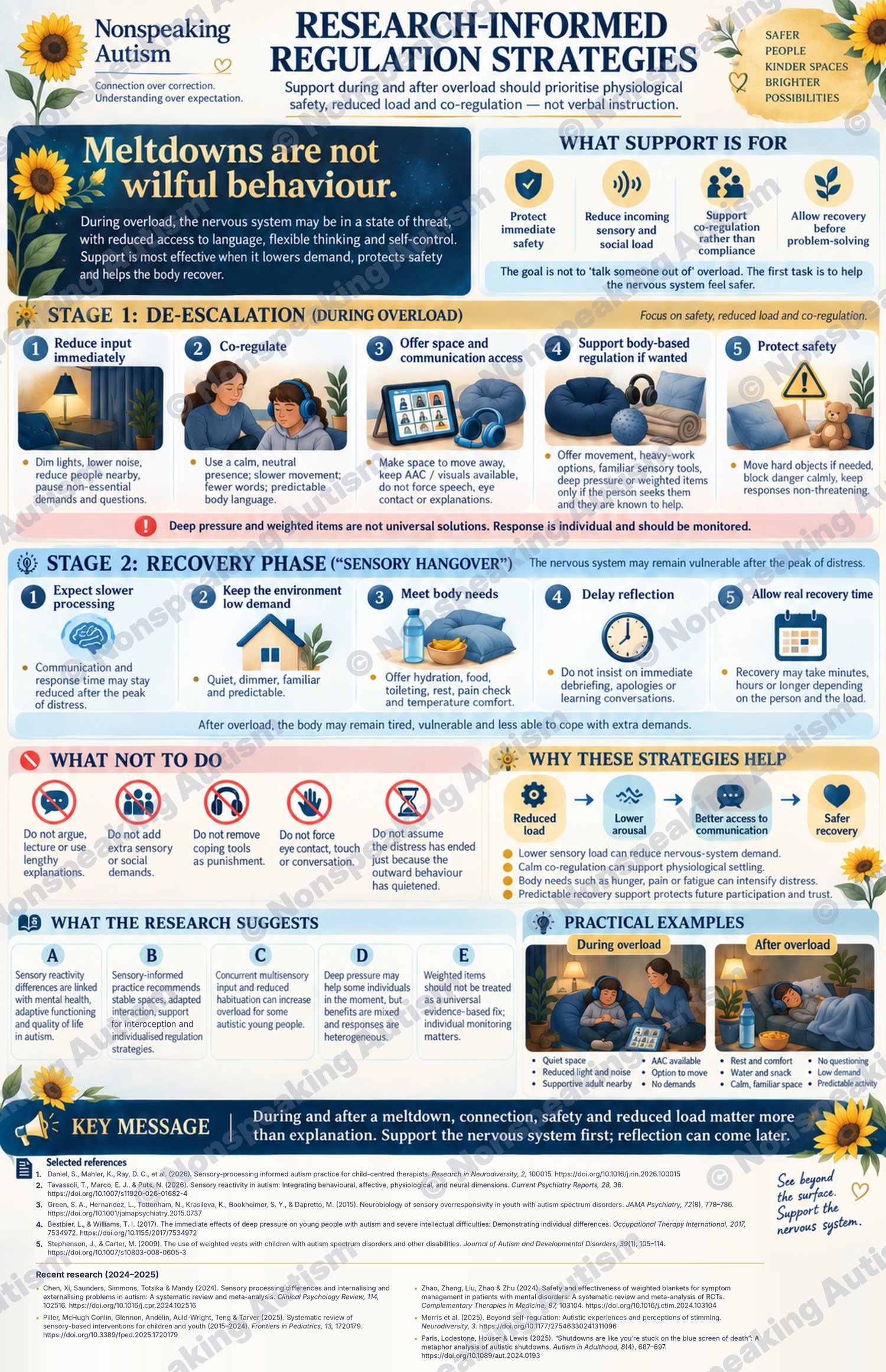
🔬 WHAT THE RESEARCH SUGGESTS A — Sensory reactivity differences are linked with mental health, adaptive functioning and quality of life in autism. B — Sensory-informed practice recommends stable spaces, adapted interaction, support for interoception and individualised regulation strategies. C — Concurrent multisensory input and reduced habituation can increase overload for some autistic young people. D — Deep pressure may help some individuals in the moment, but benefits are mixed and responses are heterogeneous. E — Weighted items should not be treated as a universal evidence-based fix; individual monitoring matters.
🏡 PRACTICAL EXAMPLES During overload: quiet space • reduced light and noise • supportive adult nearby • AAC available • option to move • no demands After overload: rest and comfort • water and snack • calm, familiar space • no questioning • low demand • predictable activity 📣 KEY MESSAGE During and after a meltdown, connection, safety and reduced load matter more than explanation. Support the nervous system first; reflection can come later.
🚫 WHAT NOT TO DO - Do not argue, lecture or use lengthy explanations. - Do not add extra sensory or social demands. - Do not remove coping tools as punishment. - Do not force eye contact, touch or conversation. - Do not assume the distress has ended just because the outward behaviour has quietened.
✨ WHY THESE STRATEGIES HELP Reduced load → Lower arousal → Better access to communication → Safer recovery - Lower sensory load can reduce nervous-system demand. - Calm co-regulation can support physiological settling. - Body needs such as hunger, pain or fatigue can intensify distress. - Predictable recovery support protects future participation and trust.
💛 A NOTE ON SAFETY AND CONSENT
Deep pressure, weighted items, touch and heavy-work activities should always be offered, never imposed, and only used where the person seeks them and they are known to help. The person must be able to move away from or remove any pressure or weighted item themselves, and pressure or weighted items must never be used to hold a person still or as a form of restraint. Weighted products should be used only with individual advice from an occupational therapist, following safe-use guidance and with monitoring. Coping tools and recovery support must never be withheld as a consequence.
📚 Selected Research & References
Ben-Sasson, A., Gal, E., Fluss, R., Katz-Zetler, N., & Cermak, S. A. (2019). Update of a meta-analysis of sensory symptoms in ASD: A new decade of research. Journal of Autism and Developmental Disorders, 49, 4974–4996.
Chen, Y., Xi, Z., Saunders, R., Simmons, D., Totsika, V., & Mandy, W. (2024). A systematic review and meta-analysis of the relationship between sensory processing differences and internalising/externalising problems in autism. Clinical Psychology Review, 114, 102516.
Edelson, S. M., Edelson, M. G., Kerr, D. C., & Grandin, T. (1999). Behavioral and physiological effects of deep pressure on children with autism: A pilot study evaluating the efficacy of Grandin's Hug Machine. American Journal of Occupational Therapy, 53(2), 145–152.
Bestbier, L., & Williams, T. I. (2017). The immediate effects of deep pressure on young people with autism and severe intellectual difficulties: Demonstrating individual differences. Occupational Therapy International, 2017, 7534972.
Stephenson, J., & Carter, M. (2009). The use of weighted vests with children with autism spectrum disorders and other disabilities. Journal of Autism and Developmental Disorders, 39(1), 105–114.
🔗 FURTHER RESOURCES Autistica — Supporting autistic people who are overwhelmed or having a meltdown Practical guidance from a UK autism research charity on reducing input, letting one person lead and avoiding talk of consequences. https://www.autistica.org.uk/what-is-autism/supporting-meltdowns National Autistic Society — Meltdowns What meltdowns are, their causes, and how to anticipate them and reduce how often they happen. https://www.autism.org.uk/advice-and-guidance/behaviour/meltdowns National Autistic Society — Sensory differences and mental health A summary of research on how sensory reactivity, uncertainty and anxiety connect in autistic children. https://www.autism.org.uk/advice-and-guidance/professional-practice/sensory-mental-health National Autistic Society — Ten simple sensory strategies for autistic children Practical environmental and regulation ideas from an occupational therapist. https://www.autism.org.uk/advice-and-guidance/professional-practice/sensory-strategies Royal College of Occupational Therapists — Weighted blankets guide Official guidance on the safe use of weighted blankets, useful for anyone considering weighted items. https://www.rcot.co.uk/latest-news/rcot-weighted-blankets-guide-occupational-therapists
🔬 Up-to-date research (2024–2026) Daniel, S., Mahler, K., Ray, D. C., Sharp, K., Clairy, K., Inderbitzen, S. M., Laurent, A. C., Fede, J. H., & Delafield-Butt, J. T. (2026). Sensory-processing informed autism practice for child-centred therapists. Research in Neurodiversity, 2, 100015. https://doi.org/10.1016/j.rin.2026.100015 [on poster] → Supports: B (sensory-informed practice); Stage 1: Co-regulate; Stage 2: Meet body needs (interoception) Tavassoli, T., Marco, E. J., & Puts, N. A. J. (2026). Sensory reactivity in autism: Integrating behavioural, affective, physiological, and neural dimensions. Current Psychiatry Reports, 28, Article 36. [on poster] → Supports: A (sensory reactivity); C (multisensory overload); "Why these strategies help" Luo, H., et al., & Schwarzlose, R. (2026). Specific, replicable behavioral and neural correlates of sensory over-responsivity in childhood. Journal of the American Academy of Child & Adolescent Psychiatry. Published online 13 August 2026. → Supports: A; Stage 1: Reduce input immediately Chen, Y., Xi, Z., Saunders, R., Simmons, D., Totsika, V., & Mandy, W. (2024). A systematic review and meta-analysis of the relationship between sensory processing differences and internalising/externalising problems in autism. Clinical Psychology Review, 114, 102516. https://doi.org/10.1016/j.cpr.2024.102516 [on poster] → Supports: A (sensory reactivity and mental health) Piller, A., McHugh Conlin, J., Glennon, T. J., Andelin, L., Auld-Wright, K., Teng, K., & Tarver, T. (2025). Systematic review of sensory-based interventions for children and youth (2015–2024). Frontiers in Pediatrics, 13, 1720179. https://doi.org/10.3389/fped.2025.1720179 [on poster] → Supports: D (deep pressure); Stage 1: Support body-based regulation if wanted Zhao, Y., Zhang, Q., Liu, Z., Zhao, Z., & Zhu, Q. (2024). Safety and effectiveness of weighted blankets for symptom management in patients with mental disorders: A systematic review and meta-analysis of randomized controlled trials. Complementary Therapies in Medicine, 87, 103104. https://doi.org/10.1016/j.ctim.2024.103104 [on poster] → Supports: E (weighted items are not a universal fix) Morris, I. F., Sykes, J. R., Paulus, E. R., Dameh, A., Razzaque, A., Vander Esch, L., Gruenig, J., & Zelazo, P. D. (2025). Beyond self-regulation: Autistic experiences and perceptions of stimming. Neurodiversity, 3. https://doi.org/10.1177/27546330241311096 [on poster] → Supports: Stage 1: movement and familiar sensory tools; "Do not remove coping tools as punishment" Therrien, M. C. S., Whalon, K., Nunes, D., Marti, P., & Sellers, A. (2025). A systematic review of AAC interventions using speech generating devices for autistic preschoolers. Augmentative and Alternative Communication, 41(2). https://doi.org/10.1080/07434618.2025.2479768 → Supports: Stage 1: Offer space and communication access ("keep AAC / visuals available") Paris, K., Lodestone, A. Z., Houser, M., & Lewis, L. F. (2025). "Shutdowns are like you're stuck on the blue screen of death": A metaphor analysis of autistic shutdowns. Autism in Adulthood, 8(4), 687–697. https://doi.org/10.1089/aut.2024.0193 [on poster] → Supports: Stage 2: Expect slower processing; "Do not assume the distress has ended" Ali, D., Bougoure, M., Cooper, B., Quinton, A. M. G., Tan, D., Brett, J., Mandy, W., Maybery, M., Magiati, I., & Happé, F. (2025). Burnout as experienced by autistic people: A systematic review. Clinical Psychology Review, 122, 102669. https://doi.org/10.1016/j.cpr.2025.102669 → Supports: Stage 2: Allow real recovery time; "After overload, the body may remain tired" Kumar, J., Hartzell, C., Abelson, E., Jastrowski Mano, K., & Chidambaran, V. (2026). Prevalence, expression, assessment, mechanisms, and management of pain in autistic children: A scoping review. A&A Practice, 20(4), e02178. https://doi.org/10.1213/XAA.0000000000002178 → Supports: Stage 2: Meet body needs ("pain check"); "Body needs such as hunger, pain or fatigue can intensify distress" 📖 Foundational research also cited on the poster Green, S. A., Hernandez, L., Tottenham, N., Krasileva, K., Bookheimer, S. Y., & Dapretto, M. (2015). Neurobiology of sensory overresponsivity in youth with autism spectrum disorders. JAMA Psychiatry, 72(8), 778–786. https://doi.org/10.1001/jamapsychiatry.2015.0737 → Supports: C (concurrent multisensory input and reduced habituation) Bestbier, L., & Williams, T. I. (2017). The immediate effects of deep pressure on young people with autism and severe intellectual difficulties: Demonstrating individual differences. Occupational Therapy International, 2017, 7534972. https://doi.org/10.1155/2017/7534972 → Supports: D (individual responses to deep pressure) Stephenson, J., & Carter, M. (2009). The use of weighted vests with children with autism spectrum disorders and other disabilities. Journal of Autism and Developmental Disorders, 39(1), 105–114. https://doi.org/10.1007/s10803-008-0605-3 → Supports: E (weighted vests) Lewis, L. F., & Stevens, K. (2023). The lived experience of meltdowns for autistic adults. Autism, 27(6), 1817–1825. https://doi.org/10.1177/13623613221145783 → Supports: "Meltdowns are not wilful behaviour"; Stage 2: Delay reflection 🔬 How the research is used Findings are presented as group-level evidence, not predictions about an individual. Research supports reducing sensory and social load, offering co-regulation and allowing recovery, but the evidence for specific tools such as deep pressure and weighted items is mixed, and responses vary widely. That is why the poster asks you to offer, monitor and follow the person's own preferences. Observe the individual. Look at context. Track patterns. Adjust support. Review again.
Sources:
- Daniel et al. 2026 – Strathprints
- Bestbier & Williams 2017 – DOAJ
- Stephenson & Carter 2009 – Macquarie University
📖 Evidence Note
The references support the broader principles behind this resource, including sensory-processing differences, individual variability and the need for caution when interpreting sensory interventions.
They do not validate every strategy on this poster as an effective intervention for every autistic person.
Terms such as “sensory hangover,” “overload” and “nervous-system support” are used as accessible educational language and should not be interpreted as formal diagnoses or proof of a particular neurological mechanism in an individual.
This is a research-informed practical resource, not a standardized or validated clinical regulation assessment or treatment protocol.
👨👩👧 Who Is This Resource For?
This poster may be useful for:
- autistic people and their supporters
- parents and carers
- teachers and teaching assistants
- SENCOs and SEND teams
- mainstream and specialist schools
- support workers
- respite services
- occupational therapists
- speech and language therapists
- healthcare professionals
- social-care professionals
- psychologists
- multidisciplinary teams
- autism and disability organisations
It can support home use, classroom practice, staff training, professional reflection and discussions about individualized regulation support.
📦 What You Receive
Your purchase includes:
1 × Research-Informed Regulation Strategies educational poster
1 × high-resolution printable digital PDF
The purchased file is supplied clear and without the promotional preview watermark shown in the Payhip listing image.
Watermarks visible in preview images are for copyright and listing protection only.
Digital download only — no physical product will be shipped.
⚠️ Important Disclaimer
This is a research-informed educational resource.
It is not medical advice, diagnosis, occupational therapy assessment, sensory assessment, behavioural assessment, psychological assessment, Functional Behaviour Assessment, individualized crisis plan, safeguarding plan, risk assessment or treatment protocol.
Support should be individualized and should respect communication, preferences, consent/assent, physical health and safety.
Do not force deep pressure, weighted products, touch, movement, eye contact or other sensory input.
Sudden, severe, unusual, painful or unexplained changes in behaviour, consciousness, communication or physical condition should receive appropriate professional or medical assessment.
Where there is significant or foreseeable risk of harm, appropriate individualized safety planning and qualified professional support may be required. In a medical emergency, seek appropriate emergency assistance.
©️ Copyright & Permitted Use
Copyright © 2026 Nonspeaking Autism. All rights reserved.
Purchase permits use for:
- personal and family use
- your own classroom or educational setting
- your own clinic or individual professional educational practice
- direct support work
The resource may not be resold, redistributed, file-shared, uploaded elsewhere, commercially reproduced, altered for resale or incorporated into another product for sale or distribution.
Please direct others who would like their own copy to the original Nonspeaking Autism listing.
💛 The Message Behind the Resource
During overload, the person does not necessarily need more instruction.
They may need:
Less sensory load.
Less social pressure.
Fewer words.
More communication access.
More space.
More safety.
More time.
And afterwards, they may need something equally important:
Recovery.
During and after a meltdown, connection, safety and reduced load matter more than explanation.
Support the nervous system first; reflection can come later.
See beyond the surface. Support the nervous system.
Connection over correction. Understanding over expectation. 💛🌻
© Nonspeaking Autism 2026