

Understanding Toe Walking: Sensory, Motor & Regulation
Understanding Toe Walking: Sensory, Motor & Regulation
Understanding the Pattern • Checking Comfort, Mobility & Safety • Supporting the Whole Person
A Research-Informed Educational Poster
Toe walking describes walking on the balls of the feet with little or no heel contact.
It is a gait pattern — not a diagnosis and not a single explanation.
Toe walking is reported more frequently in autistic children than in many non-autistic populations, but seeing an autistic child walk on their toes does not tell us why they are doing it.
For one child, sensory preferences may contribute. For another, motor or biomechanical factors may be important. For another, the pattern may relate to several interacting factors — or require medical assessment to identify an underlying cause.
Understanding Toe Walking: Sensory, Motor & Regulation is a research-informed educational poster from Nonspeaking Autism designed to help families, educators and professionals move away from assumptions and towards observation, individualized assessment and appropriate support.
The central message is:
Understand the pattern. Check comfort, mobility and safety. Support the whole person.
🦶 What Is Toe Walking?
Toe walking is a gait pattern in which the heel has little or no contact with the ground during walking.
Some children may toe walk occasionally, while others may do so frequently or persistently.
The important question is not simply:
“How do we stop the toe walking?”
A more useful starting point is:
“What might be contributing to this child's gait, and is it affecting comfort, mobility, function or safety?”
🧠 Sensory Possibilities
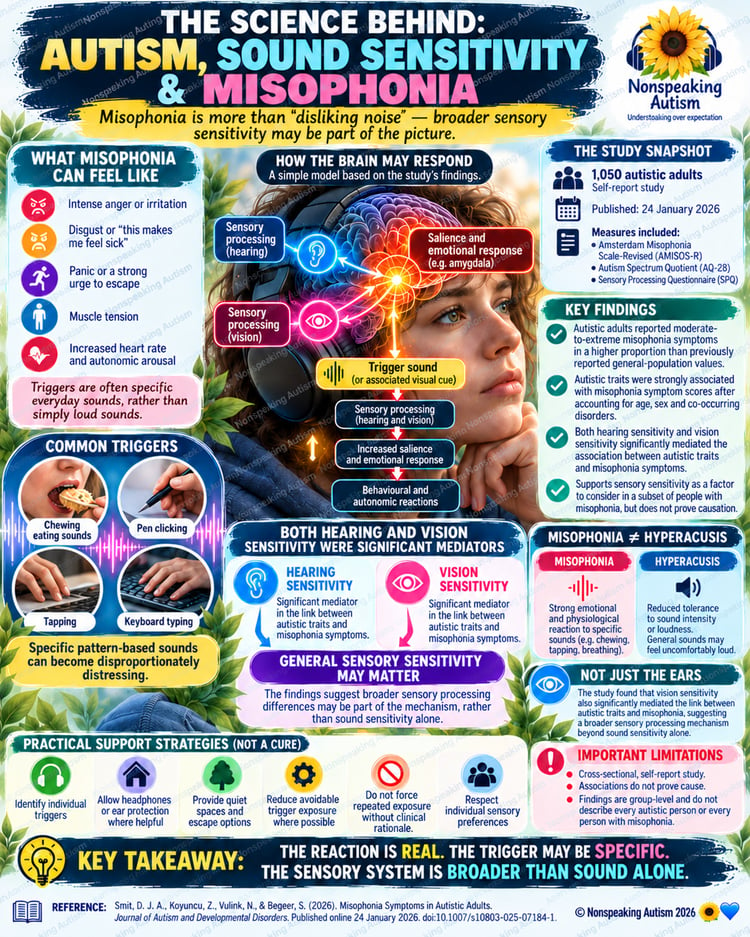
Sensory differences are one possible area to consider.
For some children:
- particular floor textures or temperatures may be uncomfortable
- pressure through the forefoot may feel preferable
- movement or proprioceptive input may influence how they move
- sensory experiences may vary across different environments
However:
Sensory differences are a possible contributor for some children — not a proven universal cause of autistic toe walking.
Toe walking should therefore not automatically be labelled “sensory seeking.”
Observation can suggest useful questions, but it cannot establish the cause by itself.
⚙️ Motor & Biomechanical Factors
Physical and motor factors may also contribute to persistent toe walking.
Areas that may need consideration include:
🦵 Calf Muscles
Persistent toe walking may be associated with calf tightness in some individuals.
🦶 Achilles Tendon
Flexibility may differ and may need professional assessment where toe walking is persistent.
↔️ Ankle Range of Motion
Some children may develop or have reduced ankle dorsiflexion.
⚖️ Foot, Ankle Strength & Balance
Strength, stability and balance can contribute to gait.
🧩 Motor Coordination
Movement planning and coordination may also be relevant for some children.
Persistent toe walking can sometimes occur alongside reduced ankle flexibility or contracture, although this varies considerably between individuals.
❤️ Regulation & Context
A child's gait may not look identical in every situation.
Families may notice that toe walking:
- becomes more noticeable during excitement or energetic play
- changes during periods of stress, fatigue or overwhelm
- differs between home, school and outdoor environments
- changes depending on footwear or surfaces
- appears less noticeable in some calmer or more familiar circumstances
These observations can be useful when building a fuller picture.
But they should be treated as clues rather than proof.
A change associated with excitement does not prove a regulation mechanism, just as a change across surfaces does not prove a sensory cause.
Observe. Understand. Support. Don't assume.
✅ Can the Person Comfortably Put Their Heels Down?
One useful distinction is whether the person can comfortably achieve heel contact.
Some people may walk on their toes some or much of the time but remain physically able to stand or walk with their heels down.
This does not mean persistent toe walking should automatically be ignored.
If the pattern continues, affects function or raises concerns, assessment may still be useful to explore contributing factors.
❌ What If They Cannot Comfortably Put Their Heels Down?
Persistent toe walking accompanied by difficulty achieving heel contact deserves closer attention.
Possible concerns may include:
- restricted ankle movement
- tight calf muscles
- Achilles tendon tightness
- discomfort
- altered mobility
These are not things to diagnose from observation alone.
Individual professional assessment is important when movement appears physically restricted or uncomfortable.
🩺 When to Seek Assessment
Professional advice is particularly important where there is:
- persistent toe walking beyond the early walking years
- toe walking predominantly on one side
- new-onset toe walking after previously walking heel-to-toe
- pain
- weakness
- frequent falls
- loss of previously acquired motor skills
- reduced ankle movement
- difficulty putting the heels down
Unilateral or newly acquired toe walking warrants prompt clinical assessment, because not all toe walking is developmental, sensory or autism-related.
Depending on the circumstances, assessment may involve a GP, paediatrician, physiotherapist or another appropriately qualified healthcare professional.
🌱 What Support Can Look Like
Support should depend on the individual person and the underlying factors identified.
It may include:
🔎 Observe Patterns
Notice when toe walking occurs, where it happens and whether particular surfaces, footwear, environments, activities or physical states appear relevant.
📋 Check Function & Comfort
Consider whether the person is experiencing:
pain • fatigue • falls • mobility difficulty • reduced range of motion • problems participating in everyday activities
👩⚕️ Seek Appropriate Assessment
Physiotherapy, paediatric, occupational therapy or other assessment may help identify relevant motor, biomechanical, sensory or medical factors.
🌻 Support Sensory Comfort Where Relevant
Appropriate footwear, environmental changes or activity choices may be useful where sensory needs genuinely contribute.
💛 Avoid Assuming Defiance
Toe walking is not evidence that a child is deliberately refusing to walk “properly.”
🎯 Match Intervention to Need
Treatment decisions should depend on the underlying cause, age, mobility, functional impact and individual circumstances.
There is no single approach that is appropriate for every child who toe walks.
🔬 What Does the Evidence Tell Us?
Research indicates that toe walking is reported more frequently among autistic children, but the evidence does not establish one autism-specific cause.
Potential contributors discussed in the literature include:
sensory factors • motor differences • biomechanics • development • neurological or medical factors
Research examining sensory-processing explanations has not established sensory differences as a universal explanation for idiopathic toe walking.
This distinction matters.
An association with autism does not make every instance of toe walking “an autism behaviour.”
The appropriate response is to understand the individual presentation and investigate clinically where indicated.
📚 Selected Research & References
Donne, J. H., et al. (2023). Research examining toe walking and autism. Acta Paediatrica, 112, 1620–1632.
Valagussa, G., et al. (2018). Research examining motor characteristics and toe walking in autism. Autism Research, 11, 1404–1415.
Perricone, C., et al. (2026). Research concerning toe walking in autism and potential contributing factors. Frontiers in Medicine, 13, Article 1832930.
American Academy of Orthopaedic Surgeons (AAOS). Toe Walking in Children. OrthoInfo clinical guidance.
🔎 Evidence Note
The references support the broader principles that toe walking can occur more frequently in autistic populations, can have multiple possible contributors and requires individualized assessment when persistent or concerning.
They should not be interpreted as proving that sensory processing causes toe walking in a particular child.
The anatomical and brain illustrations on this poster are educational representations, not individualized medical findings or diagnostic models.
👨👩👧 Who Is This Resource For?
This poster may be useful for:
- autistic people and their families
- parents and carers
- teachers and teaching assistants
- SENCOs and SEND teams
- occupational therapists
- physiotherapists
- paediatric professionals
- healthcare professionals
- support workers
- early-years professionals
- mainstream and specialist schools
- autism and disability organisations
It can support parent/carer education, staff training and conversations with professionals about persistent or changing gait patterns.
📦 What You Receive
Your purchase includes:
1 × Understanding Toe Walking: Sensory, Motor & Regulation educational poster
1 × high-resolution printable digital PDF
The purchased file is supplied clear and without the promotional preview watermark shown on the Payhip listing image.
Watermarks visible on Payhip preview images are used for copyright and listing protection only.
Digital download only — no physical product will be shipped.
⚠️ Important Medical Disclaimer
This poster is a research-informed educational resource.
It is not a diagnostic tool and does not provide medical advice, neurological assessment, orthopaedic assessment, physiotherapy assessment, occupational therapy assessment or individualized treatment recommendations.
Toe walking can have multiple developmental, biomechanical, neurological, muscular, sensory and other possible explanations. Autism should not automatically be assumed to explain a person's gait.
Persistent toe walking, inability to comfortably place the heels down, pain, weakness, frequent falls, loss of skills, reduced ankle movement, significant functional difficulty, one-sided toe walking or new toe walking after previously established heel-to-toe walking should be discussed with an appropriately qualified healthcare professional.
Treatment should be determined according to the individual's assessment and needs rather than from the poster alone.
©️ Copyright & Permitted Use
Copyright © 2026 Nonspeaking Autism. All rights reserved.
Purchase permits use for personal/home use, your own classroom or educational setting, your own clinic or individual professional educational practice, and direct educational/support work with people you support.
The digital file may not be resold, redistributed, file-shared, uploaded elsewhere, commercially reproduced, altered for resale or incorporated into another product for sale or distribution.
Please direct others who would like their own copy to the original Nonspeaking Autism listing.
💛 The Message Behind the Resource
Different bodies move in different ways.
A visible movement pattern tells us what we can see — not automatically why it is happening.
Toe walking may have sensory relevance for some people.
Motor or biomechanical factors may matter.
Physical restriction may need assessment.
Context may provide useful clues.
And sometimes several factors may interact.
The goal is neither to ignore the movement nor immediately try to suppress it.
It is to:
**Understand the pattern.
Check comfort, mobility and safety.
Support the whole person.**
Different paths. Same potential. 💙
Connection over correction. Understanding over expectation.
© Nonspeaking Autism 2026 🌻💙