
Sensory Protection Supports Self-Regulation
Sensory Protection Supports Self-Regulation
Understanding why hiding, withdrawing or moving away may be a protective response — not something that automatically needs to be stopped
What looks like avoidance, hiding, withdrawing, covering up or moving away can sometimes be an autistic person's way of protecting themselves from sensory input that has become difficult to process.
A child who puts up their hood, covers their ears, moves to the edge of a room, seeks a familiar texture or leaves a noisy space may not be refusing to participate.
They may be trying to make participation possible.
Sensory Protection Supports Self-Regulation is a research-informed educational poster designed to help parents, caregivers, educators and professionals understand sensory-protective responses through a more compassionate and practical lens.
Instead of immediately asking:
“How do we stop this behaviour?”
the resource encourages us to ask:
“What is this helping the person manage?”
The central message is:
The goal is not maximum tolerance.
The goal is enough safety, control and access to participate.
🧠 What Is Sensory Protection?
Sensory protection describes actions or environmental changes that can help a person reduce, control or make sensory input more manageable.
For an autistic person, this might include:
- wearing ear defenders or headphones
- moving somewhere quieter
- covering their ears
- using a hood, blanket or familiar clothing
- moving away from a busy area
- seeking familiar textures
- reducing visual input
- taking a sensory break
- choosing where to sit
- using repetitive movement or familiar routines
- limiting exposure to overwhelming input
The specific response will differ from person to person.
What matters is understanding what function the response may be serving for that individual.
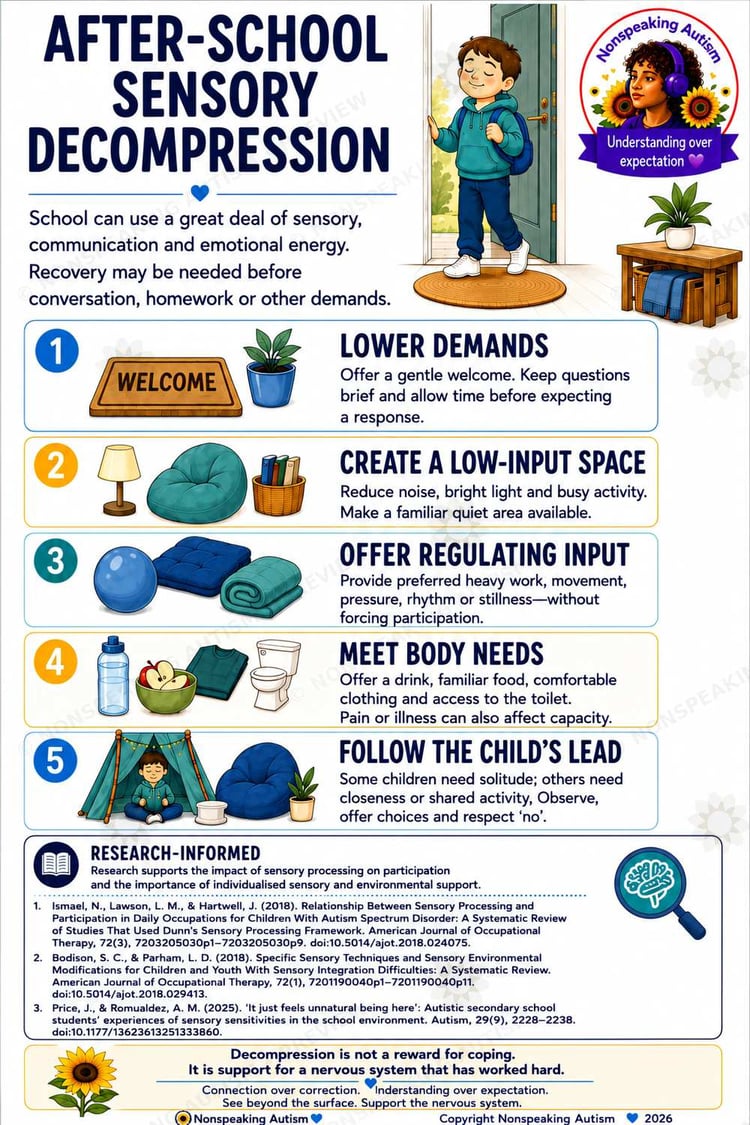
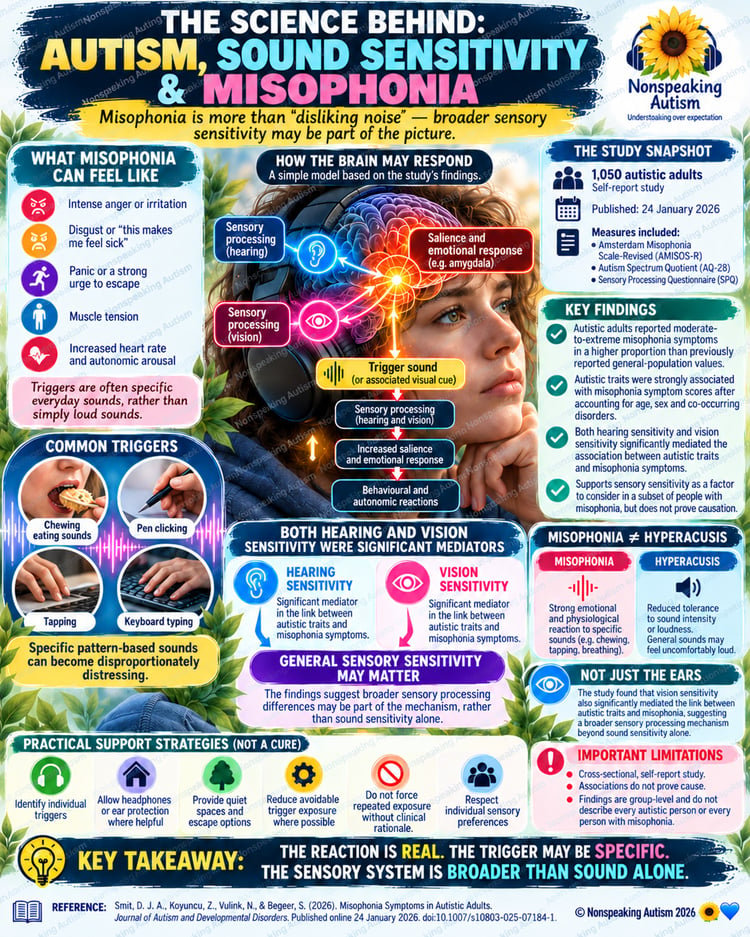
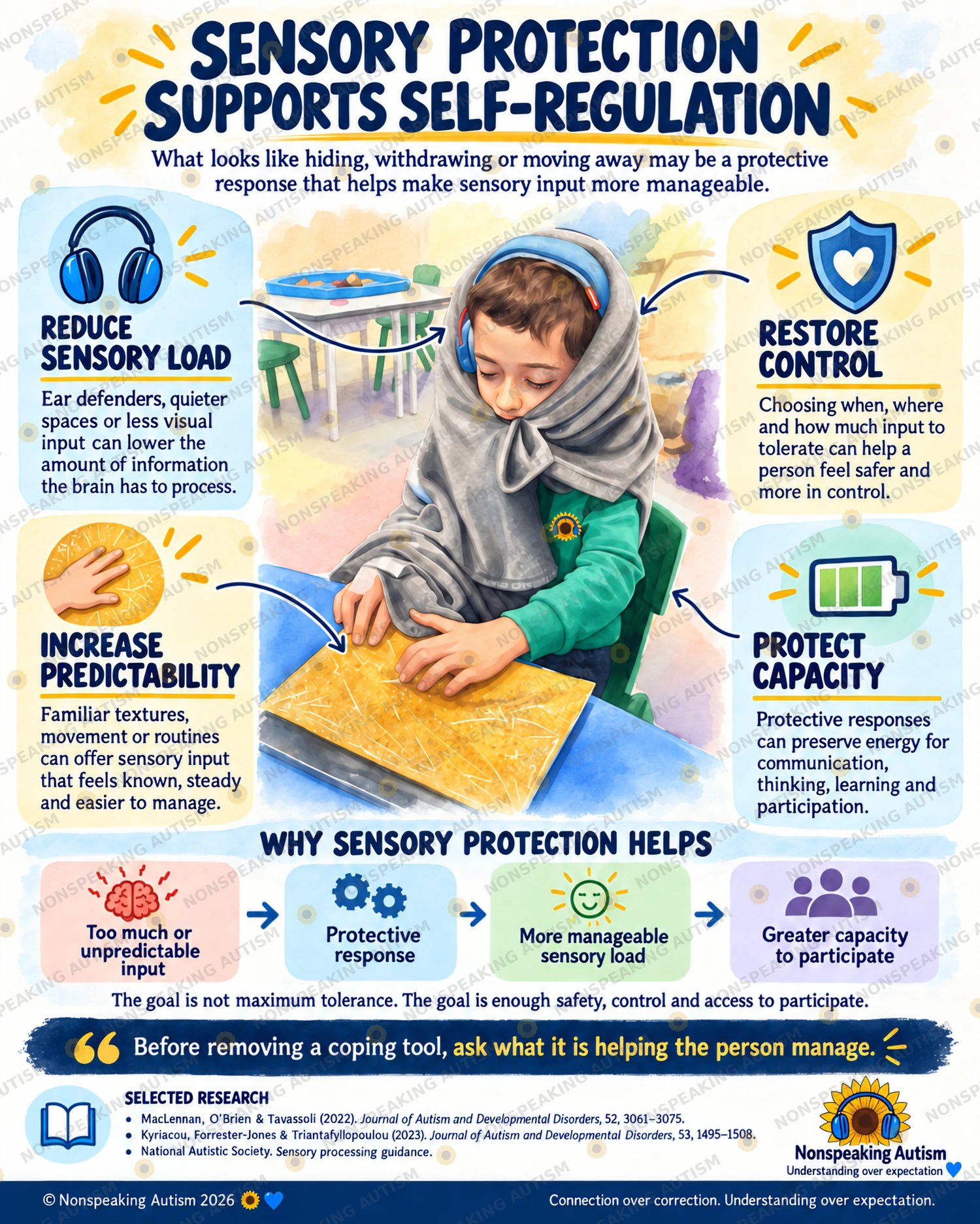
🎧 Reduce Sensory Load
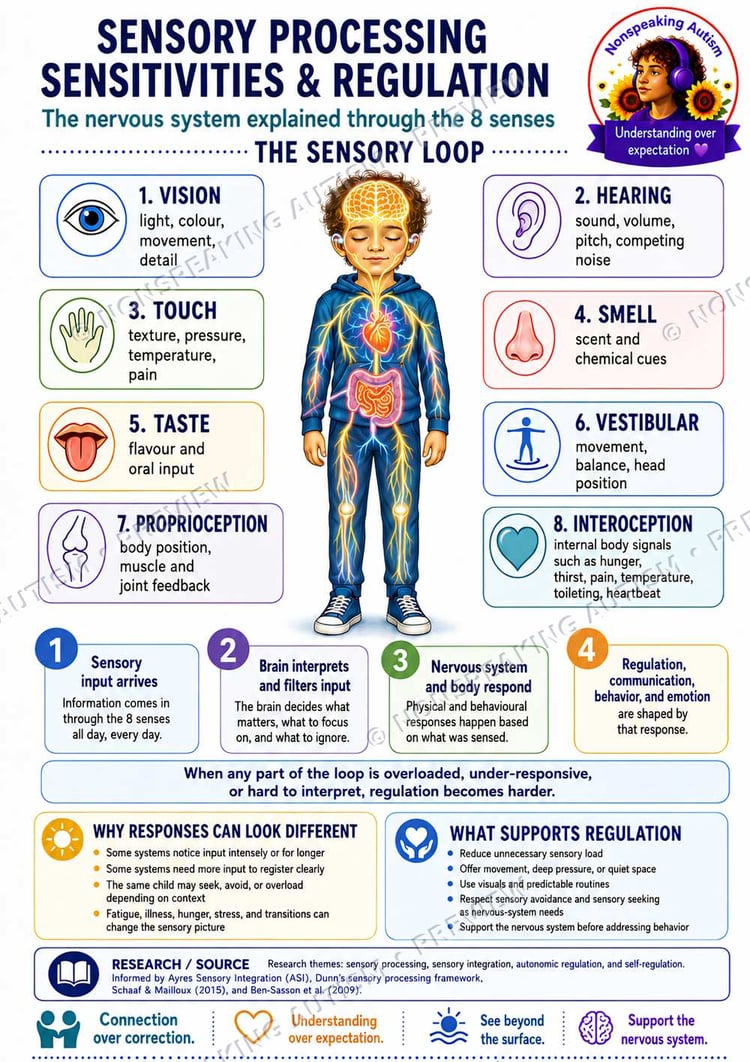
Busy environments can contain many competing forms of sensory information.
Noise, voices, movement, lighting, touch, smells and unpredictable activity may all need to be processed simultaneously.
For someone who finds that input difficult to filter or regulate, reducing unnecessary sensory information may make the environment easier to manage.
This might involve:
ear defenders
a quieter space
less visual clutter
lower lighting where appropriate
greater personal space
temporary access to a calmer environment
The purpose is not necessarily to eliminate sensory experiences.
It is to reduce unnecessary load so the person has more capacity for communication, thinking, learning and participation.
🌻 Increase Predictability
Sensory experiences are not only affected by intensity.
Predictability can matter too.
A familiar sensation that someone has chosen may be easier to manage than an unexpected sensation over which they have little control.
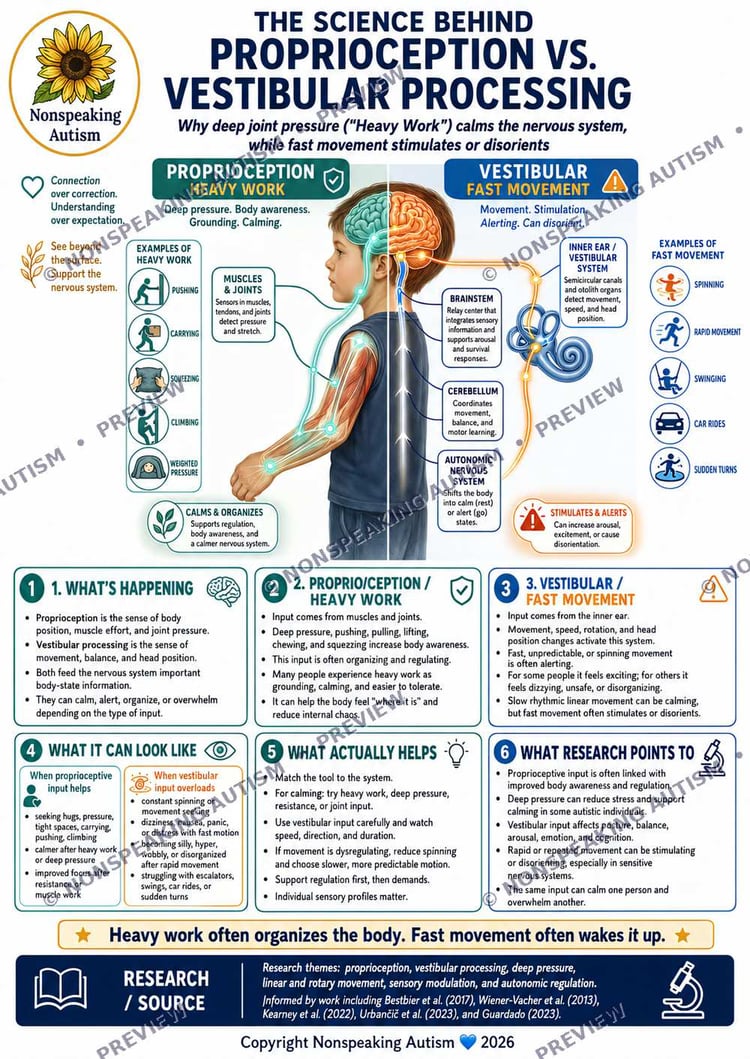
Familiar textures, movements, objects or routines may provide sensory input that feels known, steady and predictable.
This can help explain why someone may repeatedly seek the same blanket, clothing, movement, object, seat or routine.
Instead of automatically removing the familiar strategy, it can be useful to understand what predictability it is providing.
🛡️ Restore a Sense of Control
Having some control over sensory exposure can make an important difference.
Being able to choose:
when
where
how long
and
how much
sensory input to experience may help a person feel safer and more able to participate.
This distinction matters.
There is a difference between choosing to experience a challenging environment with access to breaks and being prevented from escaping input that has become overwhelming.
Supporting autonomy can include allowing someone to indicate:
“Too much.”
“I need a break.”
“Not now.”
“I need somewhere quieter.”
Communication does not have to be spoken for those messages to matter.
🔋 Protect Capacity
Every person has a limited amount of capacity available at a particular moment.
When substantial energy is being used to manage sensory input, less may be available for:
communication
learning
problem-solving
social interaction
emotional regulation
following instructions
executive functioning
participation
A sensory-protective response may therefore help preserve capacity for something else that matters.
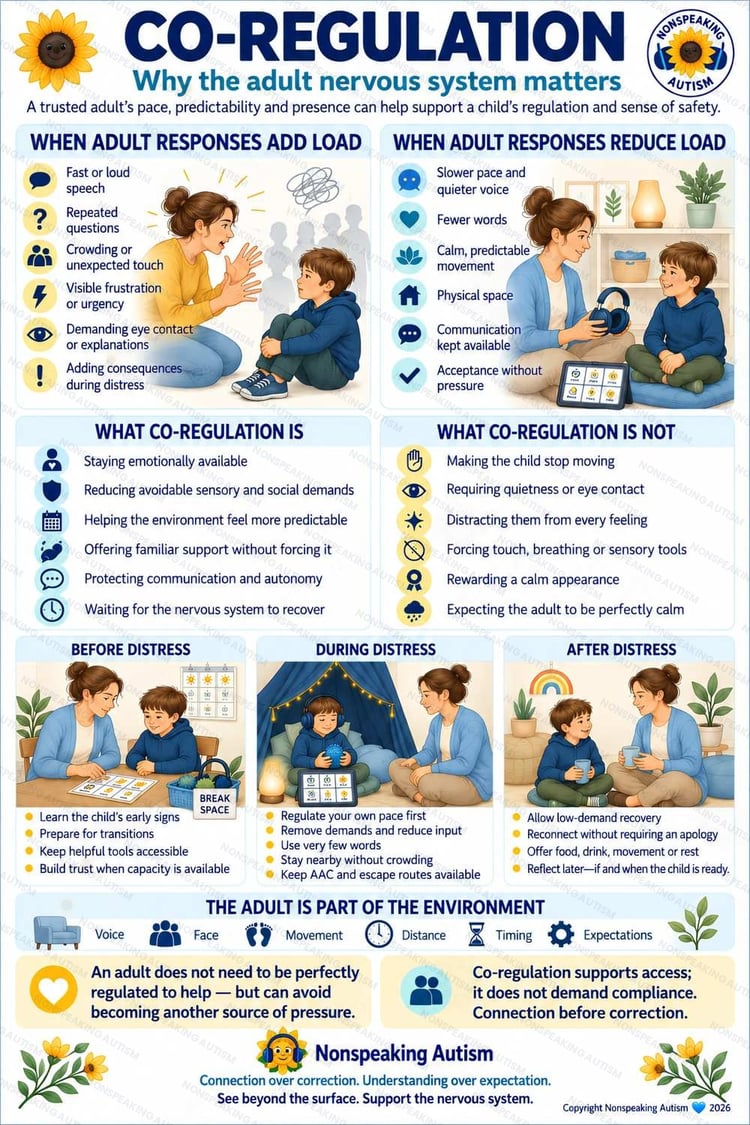
A child wearing ear defenders in a classroom, for example, may not be disengaging from learning.
Reducing auditory load may be part of what enables them to remain in the environment and participate.
🔄 Why Sensory Protection Can Help
The poster illustrates a useful way of thinking about sensory protection:
Too much or unpredictable input
⬇️
Protective response
⬇️
More manageable sensory load
⬇️
Greater capacity to participate
This should not be interpreted as a universal neurological sequence or guarantee.
Autistic sensory experiences are highly individual.
Instead, it provides a practical framework for considering why a behaviour that appears avoidant from the outside may sometimes be functional and protective.
💙 Before Removing a Coping Tool, Understand Its Purpose
A coping strategy should not automatically be removed simply because it looks unusual, inconvenient or different from what other people are doing.
Before removing or discouraging a harmless strategy, consider:
What sensory input is happening right now?
What changed immediately before this response?
Does the person appear calmer when they use it?
Does it help them remain in the environment?
Does it support communication or participation?
What happens when the strategy is unavailable?
Is there a genuine safety concern, or does the behaviour simply look different?
If a strategy is unsafe, harmful or creating another significant problem, an appropriate alternative may be needed.
But where a coping tool is safe and effective, the question should not automatically be:
“How do we remove it?”
It may be:
“How can we make sure this person can access what helps?”
🌿 Regulation Before Participation
Participation is difficult when a person's resources are being consumed by trying to tolerate an overwhelming environment.
Reducing sensory load is therefore not necessarily “letting someone avoid life.”
Sometimes it is an access strategy.
A quieter environment may allow communication.
Ear defenders may make a classroom manageable.
A familiar texture may provide predictability.
A break may allow someone to return.
Greater control may reduce distress.
The goal is not to remove every challenge or guarantee constant comfort.
It is to create a level of sensory accessibility that gives the person a meaningful opportunity to participate.
Access and participation can matter more than outward tolerance.
♾️ Sensory Needs Are Individual
There is no single autistic sensory profile.
One person may be highly sensitive to sound but actively seek movement.
Another may enjoy loud music they control but struggle with unpredictable background noise.
Someone may need ear defenders in one environment but not another.
Needs may also change according to:
fatigue
stress
illness
pain
sleep
hunger
environment
uncertainty
other demands
This is why sensory support should be individualized rather than prescribed according to diagnosis alone.
🔬 Research-Informed
This resource is informed by research concerning sensory processing in autism, sensory reactivity, environmental context, participation and autistic experiences of sensory environments.
Research supports the understanding that sensory-processing differences are common among autistic people and can have meaningful effects on everyday participation and wellbeing.
However, sensory experiences vary considerably between individuals, and not every withdrawal, avoidance or protective behaviour has a sensory cause.
The poster therefore encourages observation, curiosity and individualized support rather than assumptions.
Sensory tools should also not be presented as guaranteed treatments. What helps one person may be ineffective or uncomfortable for another.
The most useful support is responsive to the individual person's sensory profile, communication, preferences, environment and goals.
👨👩👧 Who Is This Resource For?
This poster may be useful for:
- autistic children, teenagers and adults
- parents and caregivers
- families learning about sensory processing
- teachers and classroom staff
- special-education and SEND professionals
- teaching assistants and support staff
- occupational therapists
- speech and language professionals
- psychologists and allied-health professionals
- early-years professionals
- support workers
- autism and disability organizations
- sensory-friendly environments
- professional-development and staff-training settings
It can be used as a family education resource, classroom visual, staff-training aid or conversation starter around sensory accessibility.
📦 What You Receive
Your purchase includes:
1 × Sensory Protection Supports Self-Regulation educational poster
1 × high-resolution PDF
The purchased file is supplied clear and without the promotional preview watermark shown in the Payhip listing image.
Watermarks visible on promotional images are used for preview and copyright protection only and are not present on the purchased resource.
Digital download only — no physical product will be shipped.
⚠️ Important Educational Disclaimer
This resource is provided for educational and informational purposes only.
It is not medical advice, diagnosis, occupational-therapy assessment, sensory assessment, treatment or an individualized support plan.
Autistic people have highly individual sensory experiences. A strategy that helps one person may not help another, and behaviours such as hiding, withdrawing, covering the body, moving away or reduced participation can occur for many different reasons.
These behaviours should therefore not automatically be assumed to be sensory responses.
Sudden, severe, unusual or prolonged changes in behaviour, communication, responsiveness or functioning — particularly where there may be pain, illness, breathing difficulties, altered consciousness or significant distress — should receive appropriate professional or medical assessment.
Where individualized sensory or occupational support is required, advice should be sought from an appropriately qualified professional.
💛 The Message Behind the Resource
Sometimes adults see a child moving away and think:
“They're avoiding.”
They see headphones and think:
“They need to learn to tolerate the noise.”
They see a hood, blanket or familiar object and think:
“We need to get them out of that habit.”
But there is another question worth asking first:
What is this helping them manage?
A coping strategy may be the very thing allowing someone to remain in the classroom.
A quieter space may be what enables them to recover and return.
Predictability may reduce the amount of sensory uncertainty they are carrying.
Control over sensory exposure may make participation feel safer.
Support does not always mean increasing tolerance.
Sometimes good support means reducing unnecessary barriers so that a person has more capacity for the things that matter.
Before removing a coping tool, ask what it is helping the person manage.
The goal is not maximum tolerance.
The goal is enough safety, control and access to participate.
Connection over correction.
Understanding over expectation.
See beyond the surface.
©️ Copyright & Permitted Use
Copyright © 2026 Nonspeaking Autism. All rights reserved.
Purchase permits use for personal, home, classroom, school, clinic or individual professional educational purposes.
The digital file may not be resold, redistributed, file-shared, uploaded elsewhere, commercially reproduced, altered for resale or incorporated into another product for sale without permission.