
Why Autistic Females Are Overlooked
Why Autistic Females Are Overlooked
Why so many autistic girls and women are missed, misdiagnosed, or identified later in life
Autism in girls and women is not necessarily absent, less significant or “milder” simply because it is less visible.
For some autistic females, characteristics may be more socially subtle, internalised, compensated for or camouflaged. A girl may have friends, speak fluently, achieve good grades, use imagination and appear compliant — while still experiencing substantial sensory, social, cognitive or emotional demands.
As expectations increase through adolescence and adulthood, previously hidden difficulties may become harder to sustain, sometimes leading to exhaustion, shutdown, burnout or a later search for answers.
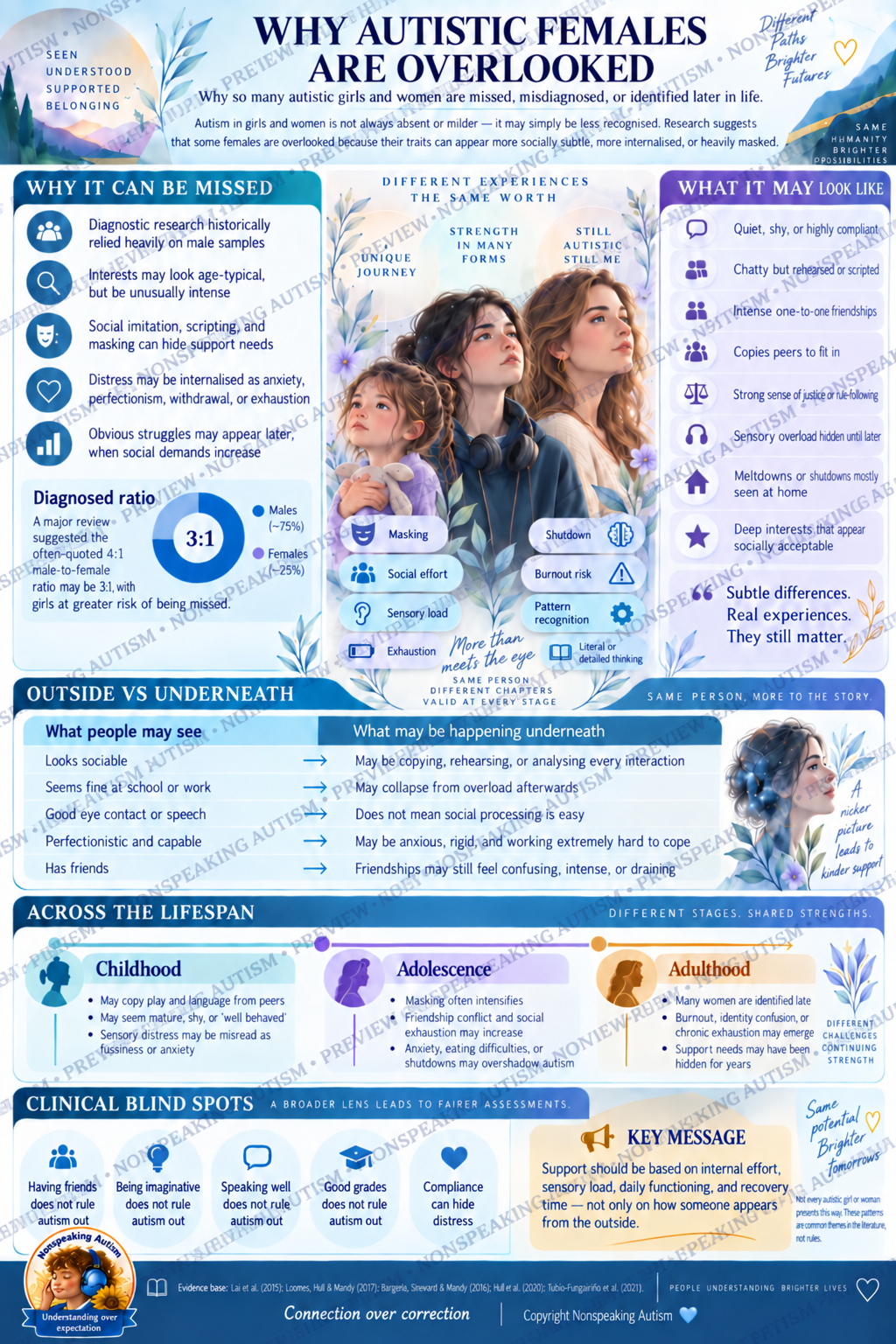
Why Autistic Females Are Overlooked is a research-informed educational poster designed to help families, educators and professionals look beyond traditional stereotypes and recognise the richer, more varied ways autism can present in girls and women.
The central message is:
Subtle differences. Real experiences. They still matter.
And most importantly:
Support should be based on internal effort, sensory load, daily functioning and recovery time — not only on how someone appears from the outside.
🧠 What This Poster Explores
This visual resource brings together several important areas involved in the recognition of autism in girls and women, including:
- Why autistic females may sometimes be missed or identified later
- The historical influence of male-dominated autism research
- Social imitation, scripting and masking
- Internalised distress
- Sensory differences that may not be immediately visible
- Intense interests that appear socially conventional
- Friendship and social-processing differences
- The mismatch between outward capability and internal effort
- How presentation may change across childhood, adolescence and adulthood
- Why common assumptions can create clinical and educational blind spots
- Why good speech, friendships, imagination or academic achievement do not automatically rule out autism
- The importance of considering recovery time and the cost of coping
This is not intended to create a new stereotype of what an autistic girl “looks like.”
There is no single female autism profile.
🔎 Why Autism Can Be Missed
Our understanding of autism has developed enormously, but historical autism research and clinical descriptions have often included substantially more males than females.
This matters because expectations about what autism is “supposed” to look like can influence what adults notice.
Some autistic girls may have interests that appear age-typical or socially conventional while the intensity, depth or way those interests are experienced differs.
Others may use:
Social imitation — watching and copying peers.
Scripting — preparing or rehearsing what to say.
Masking or camouflaging — modifying or concealing aspects of autistic presentation.
People-pleasing or compliance — working hard to meet expectations even when doing so is exhausting.
Distress may also become more visible as anxiety, perfectionism, withdrawal or exhaustion rather than through the behaviours people stereotypically associate with autism.
None of these characteristics proves that somebody is autistic.
But they demonstrate why relying on a narrow picture can leave genuine support needs unseen.
👩 What Autism May Look Like in Some Girls & Women
Possible presentations illustrated on the poster include:
Quiet, shy or highly compliant
Chatty but rehearsed or scripted
Intense one-to-one friendships
Copying peers to fit in
A strong sense of justice or preference for rules
Sensory overload that remains hidden until later
Meltdowns or shutdowns occurring predominantly in safer environments such as home
Deep interests that appear socially acceptable
These are examples — not diagnostic criteria.
Some autistic girls will display several of these characteristics. Others will display none of them.
Some will have very obvious autistic characteristics from childhood.
Others may not understand their own differences until adolescence or adulthood.
Different experiences. The same worth.
🎭 Masking, Social Effort & Hidden Load
One reason autism can sometimes be difficult to recognise is that observable social behaviour does not necessarily reveal how much processing is required underneath.
An autistic person may learn social rules intellectually rather than navigating them intuitively.
She may rehearse conversations.
She may monitor her facial expression or tone.
She may copy the language, interests or mannerisms of peers.
She may suppress stimming.
She may analyse interactions afterwards.
From the outside, this can sometimes look effortless.
Internally, it may involve considerable social effort, sensory load, uncertainty and fatigue.
Camouflaging is not exclusive to females and is not experienced by every autistic girl or woman. It should therefore be considered as one possible part of a person's presentation rather than treated as a defining feature of female autism.
↔️ Outside vs. Underneath
The poster highlights the importance of considering what outward observations may fail to capture.
“Looks sociable”
Underneath, she may be copying, rehearsing or consciously analysing interactions.
“Seems fine at school or work”
She may use substantial energy to maintain that appearance and experience overload or exhaustion afterwards.
“Good eye contact and speech”
Neither fluent speech nor eye contact tells us how easy social processing is for the person.
“Perfectionistic and capable”
Achievement may coexist with anxiety, rigidity or an extremely high internal effort to cope.
“Has friends”
Having friendships does not automatically tell us whether those relationships are easy to navigate or maintain.
Same person. More to the story.
🌱 Across the Lifespan
Autism is lifelong, but its outward presentation and the demands placed upon a person can change.
Childhood
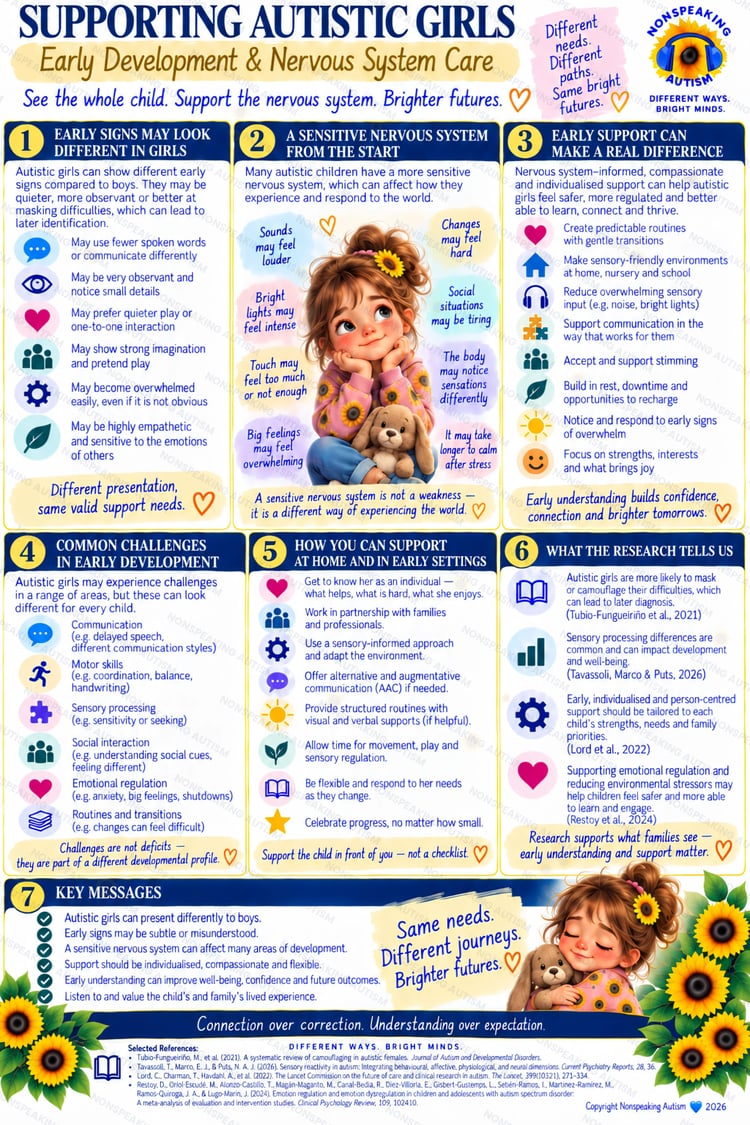
Some autistic girls may copy peers' play or language, appear mature or “well behaved,” or have sensory distress interpreted primarily as fussiness or anxiety.
Adolescence
Social relationships become more complicated and expectations increase.
Masking may intensify for some young people, while friendship difficulties, social exhaustion, anxiety, eating difficulties or shutdowns may become more noticeable.
This does not mean autism suddenly developed during adolescence.
Sometimes the environment simply begins demanding more than existing coping strategies can sustainably manage.
Adulthood
Some women reach adulthood before autism is considered.
Years of unexplained difficulties may be accompanied by burnout, identity confusion, chronic exhaustion or a sense that everyday life requires substantially more effort than it appears to require for others.
For some, later identification can provide a new framework through which to understand earlier experiences.
Same person. Different chapters. Valid at every stage.
👁️ Clinical & Educational Blind Spots
This poster challenges several assumptions that can contribute to autistic people being overlooked.
“She has friends, so she cannot be autistic.”
Autistic people can and do have friendships.
The clinically relevant question is not simply whether friends exist, but how social relationships are understood, navigated and experienced.
“She has a vivid imagination.”
Imaginative or pretend play does not automatically exclude autism.
“She speaks really well.”
Fluent speech does not necessarily mean that all aspects of communication, social processing or regulation are easy.
“Her grades are excellent.”
Academic ability and autism are not mutually exclusive.
A high-achieving student may still require sensory, executive-function, communication or emotional support.
“She's so compliant.”
Compliance does not automatically equal wellbeing.
A child may work exceptionally hard to meet expectations while keeping distress internal.
A broader lens leads to fairer assessment.
💙 Why Recognition Matters
Recognition should never be about finding something “wrong” with a girl or woman.
It is about understanding her experience accurately enough to provide support that actually fits.
Greater understanding can help adults consider:
- Internal effort rather than appearance alone
- Sensory needs
- Communication differences
- Social-processing demands
- Executive-function needs
- Emotional wellbeing
- Recovery after demanding environments
- Appropriate accommodations
- Autonomy and individual preferences
- The person's own description of her experience
Someone should not need to look visibly distressed before their difficulties are taken seriously.
A richer picture can lead to kinder, more appropriate support.
🔬 Research-Informed
This resource draws on research examining sex/gender differences in autism, autistic females, camouflaging, diagnostic recognition and lived experience.
The evidence base represented on the poster includes work by:
Lai et al. (2015) — research and clinical discussion concerning sex/gender differences in autism and their implications for recognition.
Loomes, Hull & Mandy (2017) — a systematic review and meta-analysis examining the male-to-female ratio in autism. Their findings challenged the historically repeated 4:1 assumption and estimated a ratio closer to 3:1 in the analysed evidence.
Bargiela, Steward & Mandy (2016) — qualitative research exploring the experiences of women diagnosed with autism in adulthood, including themes around missed recognition and adapting to social expectations.
Hull et al. (2020) — research contributing to understanding autistic female presentation and camouflaging.
Tubío-Fungueiriño et al. (2021) — a systematic review examining social camouflaging in autistic females.
Research in this area continues to develop. Findings based on groups should not be turned into rules about individuals, and sex/gender differences in autism are considerably more complex than a single ratio or “female profile” can capture.
Research identifies patterns. Good support still begins with the individual.
👩👧 Who Is This Resource For?
This poster may be particularly useful for:
- Autistic girls and women
- People exploring possible later autistic identification
- Parents and carers
- Families and partners
- Early-years practitioners
- Teachers and teaching assistants
- SENCOs and SEND teams
- Mainstream and specialist schools
- Colleges and universities
- Autism and inclusion teams
- Occupational therapists
- Speech and language professionals
- Psychologists and assessment professionals
- Healthcare and social-care professionals
- Support workers
- Family-support organisations
- Autism and SEND training
- Professional-development settings
It can be used at home, in educational settings, SEND spaces, clinics, therapy rooms or professional training as a visual starting point for discussions about autistic female presentation, masking, recognition and hidden support needs.
📦 What You Receive
Your purchase includes:
1 × Why Autistic Females Are Overlooked — Educational Poster
1 × high-resolution PDF
This is a digital educational resource from Nonspeaking Autism.
The purchased version is supplied clear and without the promotional preview watermark. Watermarks visible on Payhip listing images are used for preview and copyright-protection purposes only.
Digital download only — no physical product will be shipped.
⚠️ Important Disclaimer
This resource is provided for educational and informational purposes only.
It is not medical advice, a diagnostic tool, therapy or a substitute for an individual autism assessment or guidance from an appropriately qualified professional.
The characteristics illustrated are possible examples, not a checklist for identifying autism in girls or women.
Having friends, using eye contact, speaking fluently, engaging in imaginative play, achieving academically or appearing socially capable neither establishes nor rules out autism.
Likewise, being shy, anxious, perfectionistic, highly compliant, socially rehearsed or experiencing sensory difficulties does not by itself mean somebody is autistic.
Not every autistic girl or woman masks, and camouflaging also occurs among autistic people of other genders.
If autism is suspected, assessment should consider the person's developmental history, current presentation, functioning and individual circumstances, rather than relying on a poster or any single characteristic.
New, severe or concerning changes in physical health, mental health, eating, communication, behaviour or everyday functioning should receive appropriate professional assessment rather than automatically being attributed to autism.
💛 The Message Behind the Resource
For too long, our picture of autism has sometimes been narrower than autistic people's actual lives.
A girl can have friends and be autistic.
She can speak fluently and be autistic.
She can use imagination and be autistic.
She can achieve highly and still need support.
She can behave impeccably at school while arriving home completely exhausted.
And a woman can spend decades appearing capable before finally finding an explanation for why maintaining that appearance has required so much effort.
The answer is not to replace one stereotype with a new stereotype of “female autism.”
It is to widen the lens.
To listen.
To look beyond performance.
To consider the internal cost of coping.
And to understand the person in front of us as an individual.
Subtle differences. Real experiences. They still matter.
More than meets the eye.
Same person. Different chapters. Valid at every stage.
Connection over correction.
Understanding over expectation.
© Nonspeaking Autism 2026. All rights reserved.