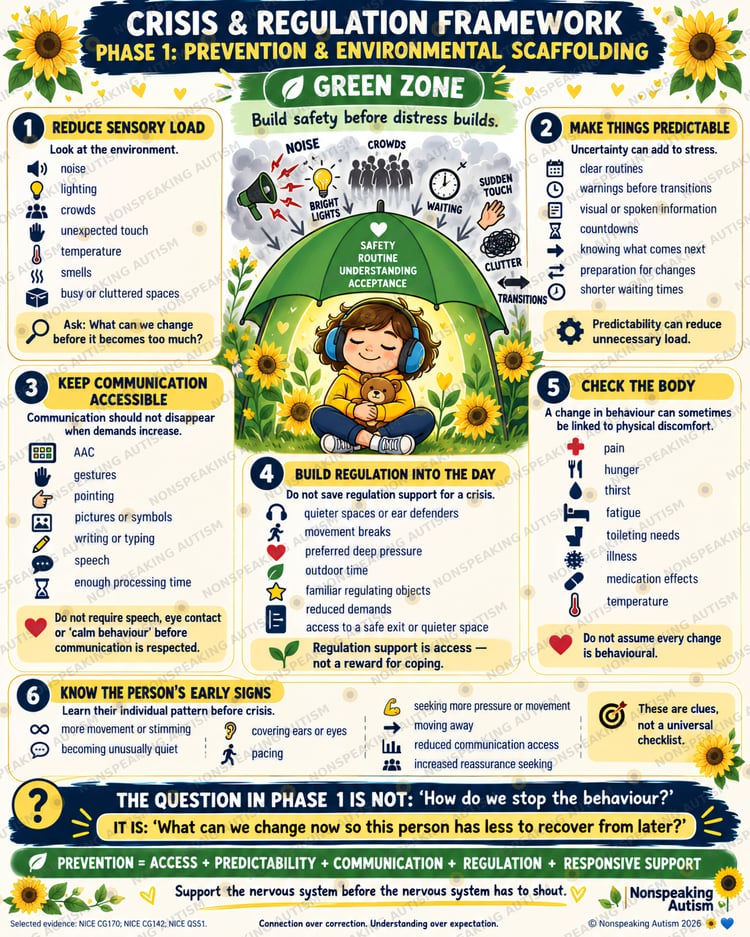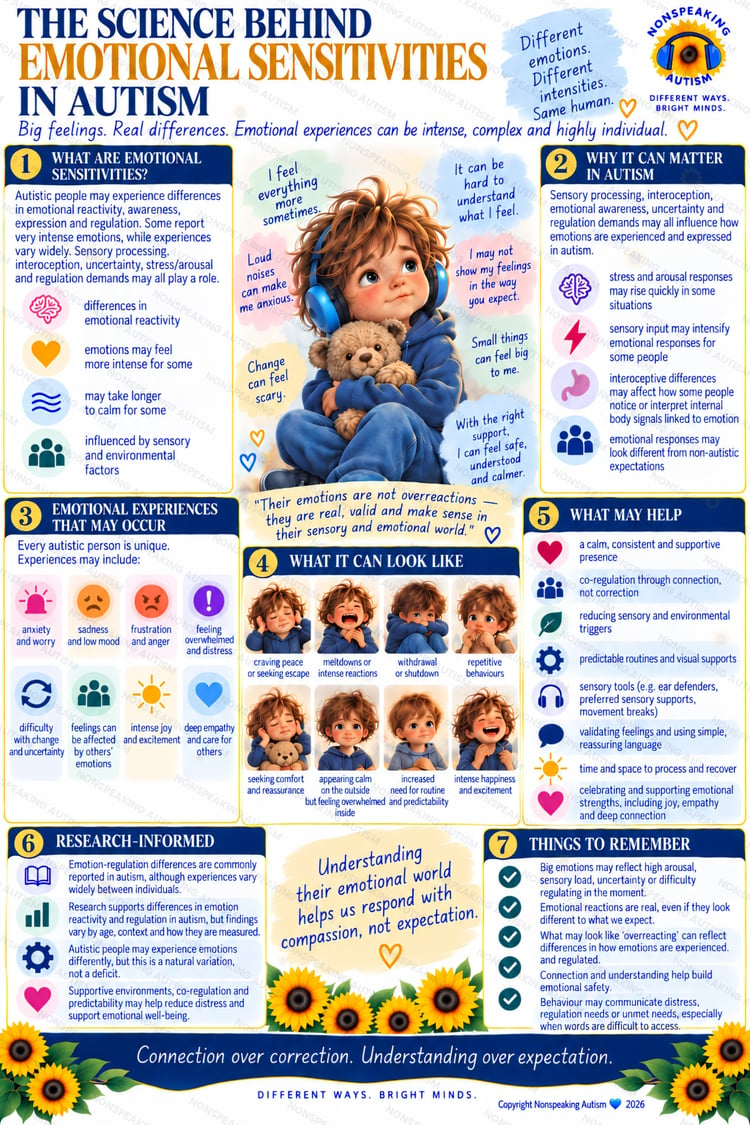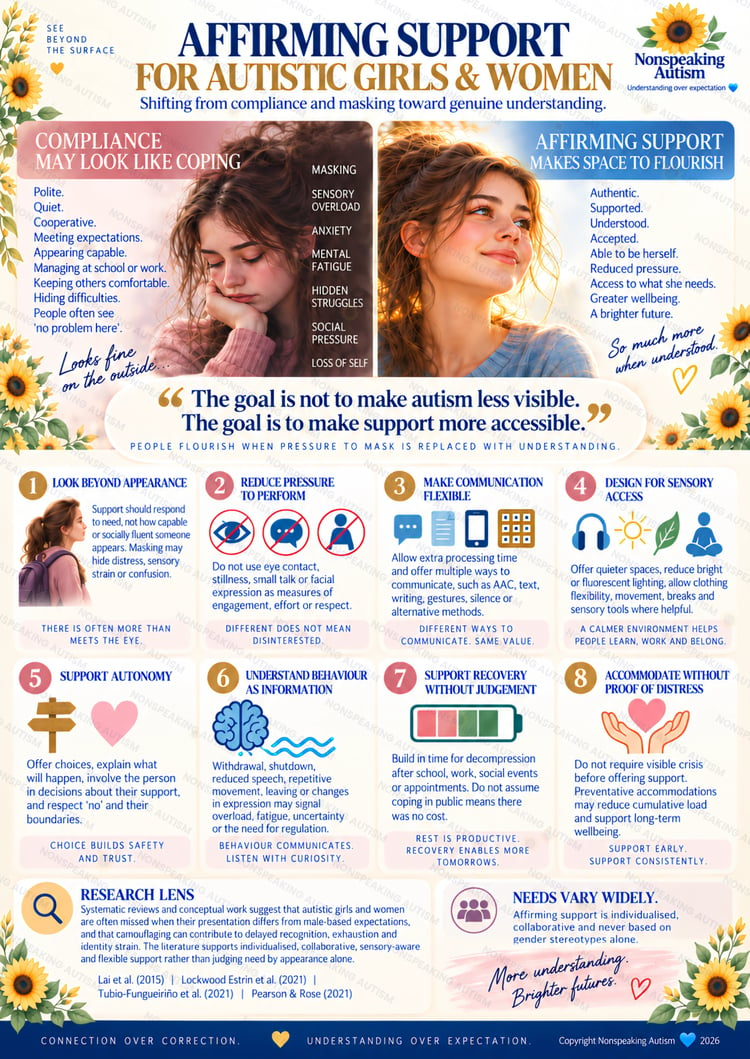

The Science Behind: Proprioception Body Position, Deep Pressure and Signals to the Brain
The Science Behind: Proprioception
Body Position, Deep Pressure and Signals to the Brain
Research-Informed Autism & Sensory Processing Educational Poster
Proprioception is sometimes described as the body's internal sense of position and movement.
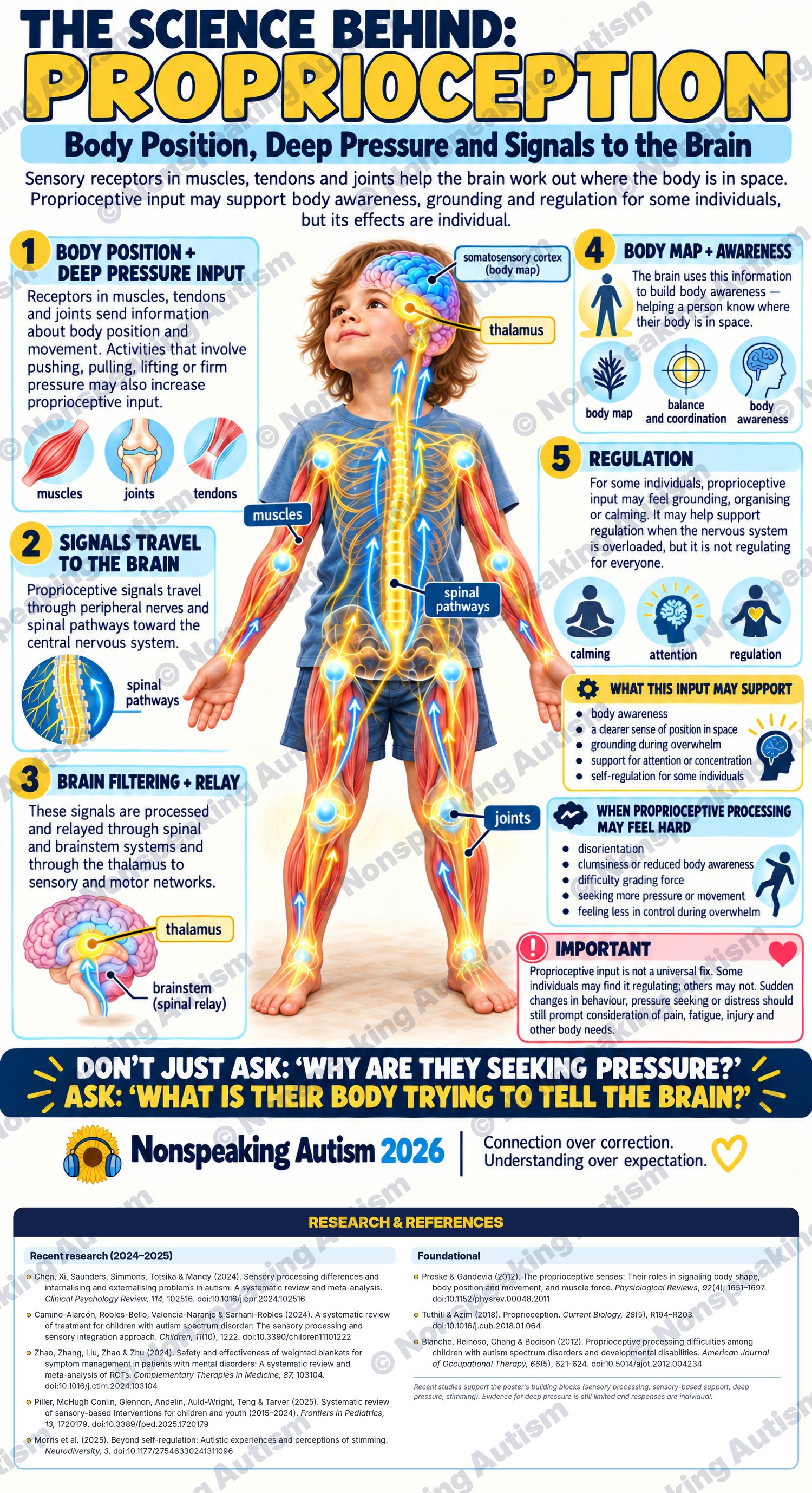
Sensory receptors associated with muscles, tendons and joints contribute information that helps the nervous system understand where the body is, how it is moving and how much force is being used.
For some autistic people, activities involving movement, resistance or firm pressure may feel organising, grounding or supportive. For others, the same input may be uncomfortable, ineffective or unwanted.
The Science Behind: Proprioception is a detailed, research-informed educational poster from Nonspeaking Autism, created to help families, educators and professionals understand proprioceptive processing without presenting sensory strategies as universal treatments.
The central question is not simply:
“Why are they seeking pressure?”
but:
“What is their body trying to tell the brain?”
🧠 What This Poster Explores
The poster takes the reader through proprioception from the body towards the nervous system, exploring:
- body position and movement
- muscles, tendons and joints
- proprioceptive sensory information
- peripheral nerves and spinal pathways
- brainstem and thalamic relay
- sensory and motor processing
- body mapping and body awareness
- deep-pressure input
- attention and context
- possible relationships with regulation
- sensory-seeking behaviour
- individual differences in sensory processing
Rather than assigning one meaning to a behaviour, the resource encourages people to observe patterns, consider context and remain curious about individual sensory needs.
1️⃣ Body Position & Deep-Pressure Input
Receptors associated with muscles, tendons and joints contribute information about movement, force and body position.
Activities involving:
- pushing
- pulling
- lifting
- carrying
- resistance
- movement
- some forms of firm pressure
may increase proprioceptive input.
But the effect of that input cannot be assumed from the activity alone.
The same sensory experience can affect different people differently.
2️⃣ How Signals Reach the Nervous System
Proprioceptive information travels through peripheral nerves and spinal pathways towards the central nervous system.
The poster provides an accessible visual representation of this process, helping readers understand that sensory experiences involve communication between the body, spinal pathways and brain rather than being simply a matter of behaviour.
3️⃣ Brain Processing & Relay
Sensory information is processed through interconnected nervous-system pathways.
The poster introduces structures including the:
- spinal pathways
- brainstem
- thalamus
- somatosensory cortex
These structures are shown as an educational simplification of a much more complex biological system.
Sensory perception is not produced by one isolated brain area, and attention, context, previous experience and other sensory information can influence how input is experienced.
4️⃣ Body Map & Awareness
The somatosensory system contributes to the brain's representation of the body.
This can support our awareness of:
- where different parts of the body are
- movement
- position
- force
- coordination
- interaction with the environment
Proprioception also works alongside other sensory and motor systems rather than functioning independently.
5️⃣ Proprioception & Regulation
For some people, proprioceptive or preferred pressure-based input may feel:
- grounding
- organising
- predictable
- calming
- focusing
- supportive during periods of overload
However, this is not a universal response.
Deep pressure should not be presented as something that automatically “regulates the nervous system,” and it should never be forced.
💛 Preferred sensory input is individual.
⚙️ What Proprioceptive Input May Support
Depending on the individual and context, proprioceptive experiences may be associated with:
- body awareness
- a clearer sense of body position
- movement and coordination
- grounding during overwhelm
- attention or concentration
- self-generated sensory regulation
- sensory exploration
These are possibilities rather than guaranteed effects.
🔎 When Proprioceptive Processing May Feel Difficult
Individual sensory experiences can vary considerably.
A person might experience things such as:
- difficulty judging force
- reduced awareness of body position
- seeking stronger movement or pressure
- challenges coordinating movement
- feeling less physically organised during overload
But none of these signs, individually or collectively, establishes a diagnosis or proves a particular neurological cause.
The whole person and context matter.
❤️ Sensory Seeking Is Not Automatically a Problem
Seeking movement or pressure can sometimes serve a useful purpose for the individual.
Before trying to stop a repetitive sensory behaviour, consider:
When does it happen?
Does it increase during uncertainty, waiting or overload?
Does it appear to support concentration?
Does the person choose it?
Does it help them feel comfortable?
Is it safe?
Could pain or physical discomfort also be involved?
This shifts the focus from:
“How do we stop this?”
towards:
“What might this sensory input be doing for this person?”
🩺 Sensory Seeking vs Pain or Physical Need
Changes in pressure seeking, movement or posture should not automatically be interpreted as sensory regulation.
Sudden, intense, persistent or unusual changes can also warrant consideration of:
- pain
- injury
- muscular discomfort
- joint problems
- fatigue
- illness
- medication effects
- other physical or medical needs
A sensory explanation should not replace appropriate medical assessment when something appears painful, new or concerning.
🤲 Deep Pressure: An Important Caution
Research into deep-pressure interventions is still limited, and individual responses vary.
Some people report or demonstrate positive responses to preferred pressure, while others may find pressure uncomfortable or distressing.
Therefore:
Offer — don't force.
Consent, assent, comfort and the individual's response matter.
Deep pressure should never be treated as a universal autism intervention or a guaranteed way to produce calm behaviour.
🔬 Research-Informed
This poster draws on research examining:
- sensory processing in autism
- proprioception and body representation
- sensory-motor differences
- interoception
- stimming and sensory experiences
- deep-pressure responses
The evidence supports the broader understanding that sensory processing differences are common in autism and can affect everyday experiences, while also showing substantial individual variation.
The precise purpose of an individual's sensory-seeking behaviour cannot be determined from appearance alone.
📚 Selected Research & References
Ben-Sasson, A., Gal, E., Fluss, R., Katz-Zetler, N., & Cermak, S. A. (2019). Update of a meta-analysis of sensory symptoms in ASD: A new decade of research. Journal of Autism and Developmental Disorders, 49, 4974–4996.
Prosk, E., & Gandevia, S. C. (2012). The proprioceptive senses: Their roles in signaling body shape, body position and movement, and muscle force. Physiological Reviews, 92(4), 1651–1697.
Tuthill, J. C., & Azim, E. (2018). Proprioception. Current Biology, 28(5), R194–R203.
Blanche, E. I., Reinoso, G., Chang, M. C., & Bodison, S. (2012). Proprioceptive processing difficulties among children with autism spectrum disorders and developmental disabilities. American Journal of Occupational Therapy, 66(5), 621–624.
Chen, Y., Xi, Z., Saunders, R., Simmons, D., Totsika, V., & Mandy, W. (2024). A systematic review and meta-analysis of the relationship between sensory processing differences and internalising/externalising problems in autism. Clinical Psychology Review, 114, 102516.
🔗 FURTHER RESOURCES National Autistic Society — Autism and sensory processing An accessible overview of sensory differences, including how autistic people can be over- or under-sensitive, often with a mix of both. https://www.autism.org.uk/advice-and-guidance/about-autism/sensory-processing National Autistic Society — Ten simple sensory strategies for autistic children Practical ideas from an occupational therapist, including movement breaks and options for children who seek pressure. https://www.autism.org.uk/advice-and-guidance/professional-practice/sensory-strategies Royal College of Occupational Therapists — Sensory approaches RCOT's resource page on sensory approaches for children and young people. https://www.rcot.co.uk/explore-resources/children-young-people-families/sensory-approaches Royal College of Occupational Therapists — Weighted blankets guide Official guidance on the safe use of weighted blankets, useful for families considering weighted items. https://www.rcot.co.uk/latest-news/rcot-weighted-blankets-guide-occupational-therapists Hypermobility Syndromes Association — Joint hypermobility, neurodivergence, dysautonomia and pain A UK charity summary of research on hypermobility, body awareness and pain in neurodivergent people. https://www.hypermobility.org/post/joint-hypermobility-links-neurodivergence-to-dysautonomia-and-pain 📚 RESEARCH & REFERENCES This poster is research-informed, drawing on recent published literature (2024–2026) on body representation, postural control, sensory neurophysiology, sensory-based support, deep pressure, stimming, joint hypermobility and pain in autism, alongside foundational neuroscience on proprioception. 🔬 Up-to-date research (2024–2026) Mourad, J., Daniels, K., Bogaerts, K., Sourbron, B., Meekers, S., Vanbuel, A., Van Beers, R., Mattheeussen, M., Desseilles, M., & Bonnechère, B. (2026). Reframing body representations in autistic individuals: A systematic review. Autism Research, 19(6), e70254. https://doi.org/10.1002/aur.70254 → Supports: 4 Body Map + Awareness; "clumsiness or reduced body awareness" Gardinal, M., Fiebrantz, A. L. S., Viana, M. O., Rodacki, A. L. F., & Pavão, S. L. (2026). Dynamic postural control in children with autism spectrum disorder: A systematic review. Physical & Occupational Therapy in Pediatrics, 46(2), 172–203. https://doi.org/10.1080/01942638.2025.2564233 → Supports: 4 Body Map + Awareness ("balance and coordination") Ghosh, A., Nasarre-Nacenta, N., Baumeister, S., Holz, N. E., Banaschewski, T., Brandeis, D., Aggensteiner, P.-M., & Kaiser, A. (2026). Neurophysiological alterations during sensory processing in autism: A meta-analysis. European Child & Adolescent Psychiatry, 35(3), 767–784. https://doi.org/10.1007/s00787-025-02917-0 → Supports: 2 Signals Travel to the Brain; 3 Brain Filtering + Relay Tavassoli, T., Marco, E. J., & Puts, N. A. J. (2026). Sensory reactivity in autism: Integrating behavioural, affective, physiological, and neural dimensions. Current Psychiatry Reports, 28, Article 36. → Supports: 1 Body Position + Deep Pressure Input; 5 Regulation Chen, Y., Xi, Z., Saunders, R., Simmons, D., Totsika, V., & Mandy, W. (2024). A systematic review and meta-analysis of the relationship between sensory processing differences and internalising/externalising problems in autism. Clinical Psychology Review, 114, 102516. https://doi.org/10.1016/j.cpr.2024.102516 [on poster] → Supports: When Proprioceptive Processing May Feel Hard; "seeking more pressure or movement" Camino-Alarcón, J., Robles-Bello, M. A., Valencia-Naranjo, N., & Sarhani-Robles, A. (2024). A systematic review of treatment for children with autism spectrum disorder: The sensory processing and sensory integration approach. Children, 11(10), 1222. https://doi.org/10.3390/children11101222 [on poster] → Supports: What This Input May Support Zhao, Y., Zhang, Q., Liu, Z., Zhao, Z., & Zhu, Q. (2024). Safety and effectiveness of weighted blankets for symptom management in patients with mental disorders: A systematic review and meta-analysis of randomized controlled trials. Complementary Therapies in Medicine, 87, 103104. https://doi.org/10.1016/j.ctim.2024.103104 [on poster] → Supports: 5 Regulation; "Proprioceptive input is not a universal fix" Piller, A., McHugh Conlin, J., Glennon, T. J., Andelin, L., Auld-Wright, K., Teng, K., & Tarver, T. (2025). Systematic review of sensory-based interventions for children and youth (2015–2024). Frontiers in Pediatrics, 13, 1720179. https://doi.org/10.3389/fped.2025.1720179 [on poster] → Supports: 1 Deep Pressure Input; 5 Regulation ("its effects are individual") Morris, I. F., Sykes, J. R., Paulus, E. R., Dameh, A., Razzaque, A., Vander Esch, L., Gruenig, J., & Zelazo, P. D. (2025). Beyond self-regulation: Autistic experiences and perceptions of stimming. Neurodiversity, 3. https://doi.org/10.1177/27546330241311096 [on poster] → Supports: 5 Regulation; "self-regulation for some individuals" Baeza-Velasco, C., Vergne, J., Poli, M., Kalisch, L., & Calati, R. (2025). Autism in the context of joint hypermobility, hypermobility spectrum disorders, and Ehlers–Danlos syndromes: A systematic review and prevalence meta-analyses. Autism, 29(8), 1939–1958. https://doi.org/10.1177/13623613251328059 → Supports: When Proprioceptive Processing May Feel Hard; Important ("pain, fatigue, injury") Kumar, J., Hartzell, C., Abelson, E., Jastrowski Mano, K., & Chidambaran, V. (2026). Prevalence, expression, assessment, mechanisms, and management of pain in autistic children: A scoping review. A&A Practice, 20(4), e02178. https://doi.org/10.1213/XAA.0000000000002178 → Supports: Important ("Sudden changes in behaviour, pressure seeking or distress should still prompt consideration of pain") 📖 Foundational research also cited on the poster Proske, U., & Gandevia, S. C. (2012). The proprioceptive senses: Their roles in signaling body shape, body position and movement, and muscle force. Physiological Reviews, 92(4), 1651–1697. https://doi.org/10.1152/physrev.00048.2011 Tuthill, J. C., & Azim, E. (2018). Proprioception. Current Biology, 28(5), R194–R203. https://doi.org/10.1016/j.cub.2018.01.064 Blanche, E. I., Reinoso, G., Chang, M. C., & Bodison, S. (2012). Proprioceptive processing difficulties among children with autism spectrum disorders and developmental disabilities. American Journal of Occupational Therapy, 66(5), 621–624. https://doi.org/10.5014/ajot.2012.004234 🔬 How the research is used Findings are presented as group-level evidence, not predictions about an individual. Research can describe how proprioception works and identify patterns in autistic groups; it cannot tell us why one person seeks pressure or movement, or what it does for them. Evidence for deep pressure and sensory-based approaches is still developing, and responses are individual. Observe the individual. Look at context. Track patterns. Adjust support. Review again.
Sources:
- Zhao et al. 2024 – PubMed
- Camino-Alarcón et al. 2024 – Children (MDPI)
- Tuthill Lab reviews
- Blanche et al. 2012 – AJOT
📖 Evidence Note
The research above supports the broader educational principles presented in this resource.
It should not be interpreted as evidence that every autistic person has proprioceptive difficulties, that every instance of pressure seeking has the same function, or that deep pressure reliably produces regulation.
The anatomical illustration is an educational representation, not a complete map of proprioceptive neuroanatomy.
This poster is research-informed but is not a standardized or validated sensory assessment.
⚠️ IMPORTANT
Proprioceptive input is not a universal fix. Some individuals may find it regulating; others may not. Sudden changes in behaviour, pressure seeking or distress should still prompt consideration of pain, fatigue, injury and other body needs. Don't just ask: "Why are they seeking pressure?" Ask: "What is their body trying to tell the brain?"
💛 A NOTE ON SAFETY AND CONSENT
Pressure and heavy-work activities should always be offered, never imposed. The person must be able to move away from or remove any pressure or weighted item themselves, and pressure should never be used to hold a person still or as a form of restraint. For weighted products such as blankets, vests or lap pads, seek individual advice from an occupational therapist and follow safe-use guidance.
👨👩👧 Who Is This Resource For?
Suitable for:
- autistic people and their families
- parents and carers
- teachers and teaching assistants
- SENCOs and SEND teams
- mainstream and specialist schools
- occupational therapists
- speech and language therapists
- support workers
- healthcare professionals
- social-care professionals
- autism and disability organisations
- students and professionals learning about sensory processing
It can be used for home education, classroom displays, staff training, sensory-support discussions and professional reflection.
📦 What You Receive
Your purchase includes:
1 × The Science Behind: Proprioception — Body Position, Deep Pressure and Signals to the Brain educational poster
1 × high-resolution printable digital PDF
The purchased file is supplied clear and without the promotional preview watermark.
Any watermarks visible in the Payhip listing images are included for preview and copyright protection only.
Digital download only — no physical product will be shipped.
⚠️ Important Disclaimer
This resource is for educational and informational purposes only.
It is not medical advice, diagnosis, occupational therapy assessment, sensory assessment, psychological assessment, treatment plan or individualized clinical recommendation.
Sensory experiences and responses vary considerably between people.
Do not force deep pressure, touch, movement or other sensory input. Sensory support should respect the person's preferences, communication, consent/assent, physical safety and individual needs.
Sudden, severe, painful, persistent or unexplained changes in movement, pressure seeking, coordination or behaviour should be appropriately assessed rather than automatically attributed to autism or sensory processing.
©️ Copyright & Permitted Use
Copyright © 2026 Nonspeaking Autism. All rights reserved.
Purchase permits use for personal/family use, your own classroom or educational setting, your own clinic or individual professional educational practice, and direct support work.
The resource may not be resold, redistributed, file-shared, uploaded elsewhere, commercially reproduced, altered for resale or incorporated into another product for sale or distribution.
Please direct others who would like their own copy to the original Nonspeaking Autism listing.
💛 The Message Behind the Resource
A person seeking movement or pressure is not necessarily displaying a behaviour that needs to be eliminated.
Their body may be seeking information, predictability, movement, pressure or a sensory experience that feels useful to them.
Observe.
Stay curious.
Check for discomfort.
Respect sensory preferences.
And remember that the person is always more important than making their behaviour look typical.
DON'T JUST ASK: “WHY ARE THEY SEEKING PRESSURE?”
ASK: “WHAT IS THEIR BODY TRYING TO TELL THE BRAIN?”
Connection over correction. Understanding over expectation. 💛🌻
© Nonspeaking Autism 2026