
Co-Occurring Dyspraxia (DCD) & Motor Coordination in Autism
Co-Occurring Dyspraxia (DCD) & Motor Coordination in Autism
Understanding the Connection • Supporting the Whole Person
A Research-Informed Educational Poster
Motor differences are common in autism, yet they can sometimes receive less attention than communication, sensory or social differences.
For some autistic people, difficulties with planning, coordinating and carrying out movement can affect handwriting, dressing, eating, using tools, physical education, play, self-care and everyday independence.
Some autistic people may also meet the diagnostic criteria for Developmental Coordination Disorder (DCD) — often referred to as dyspraxia — but autism and DCD are distinct neurodevelopmental conditions. Motor difficulty in an autistic person does not automatically mean they have DCD.
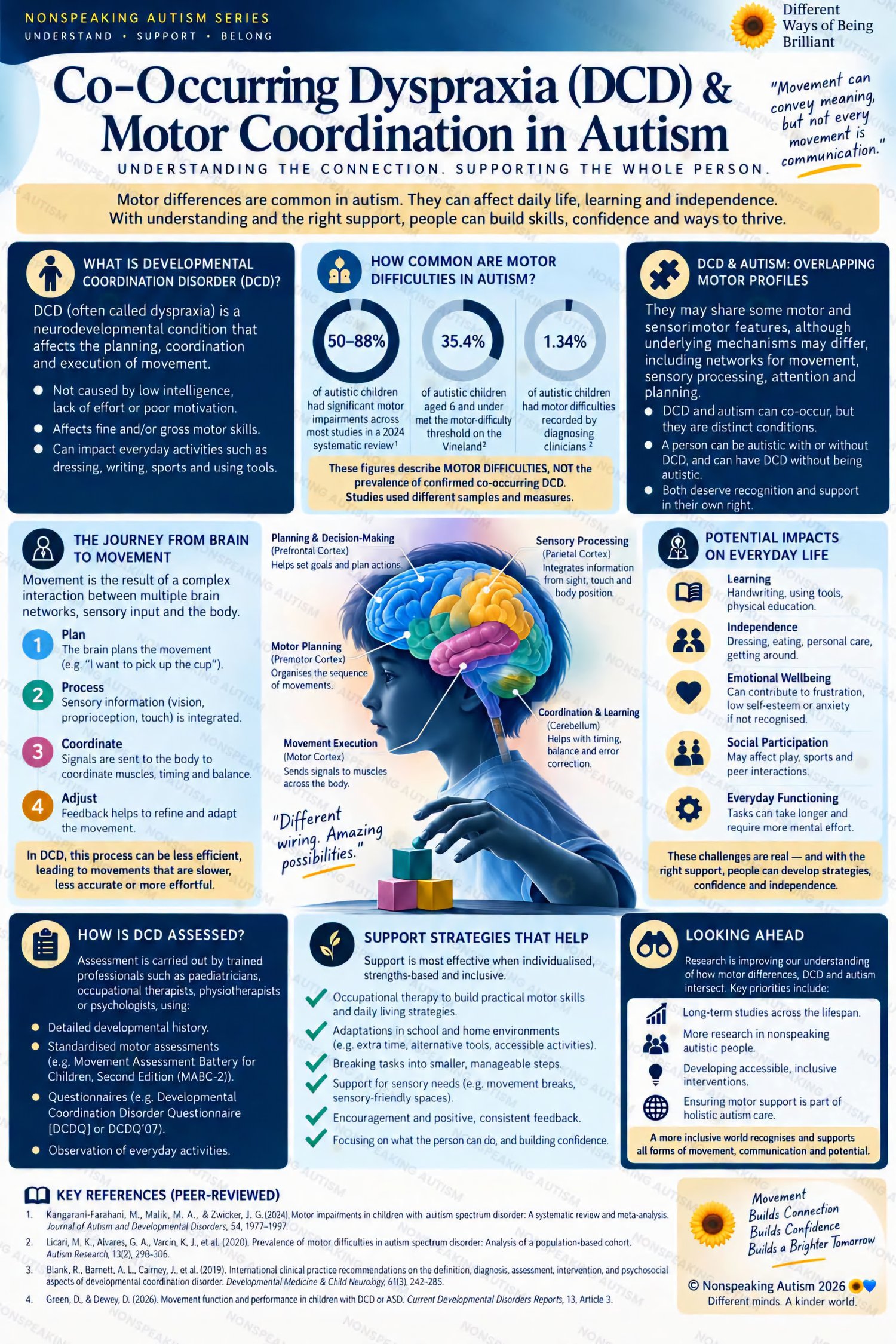
Co-Occurring Dyspraxia (DCD) & Motor Coordination in Autism is a research-informed educational poster designed to help families, educators and professionals understand motor differences without confusing movement difficulty with intelligence, motivation or understanding.
The central message is:
Movement can convey meaning — but not every movement is communication.
And importantly:
Difficulty coordinating movement does not equal difficulty thinking.
🧠 What Is Developmental Coordination Disorder (DCD)?
Developmental Coordination Disorder is a neurodevelopmental condition involving significant difficulty acquiring and executing coordinated motor skills.
Depending on the individual, this may affect activities such as:
- handwriting
- dressing
- using cutlery
- manipulating objects
- using tools
- sports
- balance
- learning new movements
- everyday self-care activities
DCD is not explained by laziness, poor effort or low intelligence.
Assessment considers whether motor difficulties are significantly affecting everyday functioning and whether another condition better explains them.
♾️ Autism & Motor Differences
Motor differences are widely reported among autistic children.
These can involve areas such as:
gross motor coordination
fine motor skills
balance
motor planning
timing
movement execution
and sensorimotor integration.
Research reviews have found substantial motor impairment across autistic samples, although estimates vary considerably depending on the population, age, measures and thresholds used.
This is an important distinction:
Motor difficulty is not automatically DCD.
An autistic person can:
have autism without DCD
have both autism and DCD
and a person can have DCD without being autistic.
Recognising one condition should not prevent appropriate investigation of the other.
📊 How Common Are Motor Difficulties?
Research suggests that clinically meaningful motor difficulties may occur in a substantial proportion of autistic children.
However, prevalence estimates vary depending on:
- age
- study population
- assessment method
- motor threshold
- diagnostic methodology
- whether studies measure motor impairment or formally diagnosed DCD
The percentages shown on the poster should therefore be understood as findings from particular studies — not a universal prevalence rate for DCD in autism.
Motor impairment and diagnosed DCD are not interchangeable.
This distinction is especially important when interpreting research statistics.
DCD & Autism — Overlapping Motor Profiles
Autism and DCD can share some observable motor and sensorimotor features.
However, this does not mean they are the same condition or necessarily arise from the same underlying mechanisms.
Research continues to investigate differences and overlaps involving:
- motor planning
- movement execution
- sensory processing
- attention
- learning
- coordination
- timing
- feedback and adaptation
The most useful approach is therefore not to assume a diagnosis from appearance alone.
Recognise the difficulty → understand its impact → assess appropriately → provide support.
🧠 The Journey From Brain to Movement
Movement is extraordinarily complex.
The poster presents a simplified four-stage educational model:
1️⃣ PLAN
The person forms an intention or movement goal.
2️⃣ PROCESS
Relevant sensory information — including vision, touch and proprioceptive information — contributes to movement.
3️⃣ COORDINATE
The nervous system coordinates the muscles, timing and balance required for the action.
4️⃣ ADJUST
Feedback helps the person refine and adapt the movement.
The brain illustration highlights areas involved in movement planning, sensory processing, motor execution, coordination and learning.
It is important to understand that this is a simplified educational illustration.
Movement depends on distributed brain and body systems rather than a single brain region performing each function independently.
✍️ What Motor Differences Can Affect
Motor coordination difficulties can influence much more than sport.
📚 Learning
They may affect:
- handwriting
- manipulating classroom equipment
- using tools
- practical activities
- physical education
- completing tasks efficiently
A student may understand the academic task while finding its physical execution considerably harder.
🧍 Independence & Daily Living
Motor demands occur throughout everyday life.
Depending on the person, difficulties might affect:
- dressing
- fastenings
- eating
- preparing food
- personal care
- organising belongings
- using everyday tools
- navigating physical environments
Some tasks may take more time, concentration and effort than observers realise.
💛 Emotional Wellbeing
Repeated difficulty with everyday motor tasks can contribute to:
- frustration
- reduced confidence
- avoidance
- anxiety about particular activities
- embarrassment
- reluctance to participate
The answer should not be to assume that the person simply needs to “try harder.”
Sometimes the task itself needs adapting.
👥 Social Participation
Many social activities contain hidden motor demands.
Play, playground activities, sport, group games, crafts and community activities can all involve coordination.
Someone who avoids these activities may therefore be responding to motor demands, sensory demands, previous experiences or several factors together.
Avoidance alone does not tell us why.
⚙️ Everyday Functioning
A task that appears effortless to another person may require substantial:
planning • sequencing • concentration • coordination • correction • physical effort
for somebody with motor difficulties.
Taking longer does not mean understanding less.
📋 How Is DCD Assessed?
DCD should not be diagnosed from a poster or informal checklist.
Assessment is carried out by appropriately trained professionals and may involve:
- developmental history
- standardized motor assessment
- questionnaires
- observation of everyday functioning
- consideration of how difficulties affect daily life
- assessment of whether another medical or neurological condition better explains the difficulties
Depending on local pathways, professionals may include paediatricians, occupational therapists, physiotherapists, psychologists and other appropriately qualified clinicians.
Formal assessment tools can include measures such as the Movement Assessment Battery for Children — Second Edition (MABC-2) and questionnaires such as the Developmental Coordination Disorder Questionnaire (DCDQ).
Assessment should consider the whole person, rather than a test score in isolation.
🌱 Support Strategies That May Help
Support should be individualized, strengths-based and participation-focused.
Depending on the person's needs, useful approaches may include:
💙 Occupational Therapy
OT may help identify barriers within meaningful daily activities and develop individualized strategies for participation and independence.
🏫 Environmental Adaptations
At school or home, this might include:
- additional time
- alternative ways of completing tasks
- adapted equipment
- accessible activities
- reducing unnecessary handwriting demands where appropriate
🪜 Breaking Tasks Into Manageable Steps
Complex motor tasks may become more accessible when they are taught or presented in smaller components.
🌻 Supporting Sensory Needs
Where relevant, movement breaks, environmental adjustments and sensory accommodations may improve access.
💬 Encouraging, Specific Feedback
Support should build skills and confidence rather than repeatedly highlighting what somebody cannot do.
⭐ Build From Strengths
Motor support should not eclipse the person's interests, abilities, communication, autonomy or wider identity.
Support the task — not just the performance.
🗣️ Motor Difficulty Is Not a Measure of Intelligence
This deserves particular emphasis.
Difficulty performing a movement does not, by itself, tell us what somebody:
knows
understands
remembers
wants
or is capable of learning.
For people who also have communication differences, adults should be particularly careful not to infer intellectual ability solely from speech, handwriting, speed, coordination or visible motor performance.
Presume competence while providing the support necessary to demonstrate it.
🔬 Research-Informed
Research increasingly recognises motor differences as an important part of the broader autistic phenotype.
Systematic reviews and population-based research have identified substantial rates of motor difficulties in autistic children, while international DCD guidance emphasises appropriate assessment and individualized intervention.
At the same time, the evidence requires careful interpretation.
Studies use different samples, age groups, motor assessments and thresholds. A child meeting a research threshold for motor difficulty has not necessarily received — or met the full criteria for — a clinical diagnosis of DCD.
Research identifies patterns. Assessment identifies individual needs.
📚 Selected Research & References
Kangarani-Farahani, M., Malik, M. A., & Zwicker, J. G. (2024). Motor impairments in children with autism spectrum disorder: A systematic review and meta-analysis. Journal of Autism and Developmental Disorders, 54, 1977–1997.
Licari, M. K., Alvares, G. A., Varcin, K., et al. (2020). Prevalence of motor difficulties in autism spectrum disorder: Analysis of a population-based cohort. Autism Research, 13(2), 298–306.
Blank, R., Barnett, A. L., Cairney, J., et al. (2019). International clinical practice recommendations on the definition, diagnosis, assessment, intervention, and psychosocial aspects of developmental coordination disorder. Developmental Medicine & Child Neurology, 61(3), 242–285.
🔎 Evidence Note
These references support the broader principles concerning motor differences in autism, DCD assessment and individualized support.
The prevalence figures displayed on the poster come from specific studies using different populations and methodologies. They should not be combined or interpreted as the prevalence of formally diagnosed co-occurring DCD in all autistic children.
The illustrated Plan → Process → Coordinate → Adjust pathway and labelled brain regions are educational simplifications. They do not represent a validated diagnostic model or prove the neurological cause of an individual's motor difficulties.
🔭 Looking Ahead
Research into autism and motor coordination continues to develop.
Important priorities include:
long-term research across the lifespan
more research involving nonspeaking autistic people
accessible and inclusive interventions
better recognition of motor difficulties
and
ensuring motor support forms part of holistic autistic support when needed.
The goal should not be to make everybody move in exactly the same way.
The goal is to reduce barriers and increase access, confidence, participation and independence.
👨👩👧 Who Is This Resource For?
This poster may be useful for:
- autistic people and their families
- parents and carers
- people with DCD/dyspraxia
- teachers and teaching assistants
- SENCOs and SEND teams
- mainstream and specialist schools
- occupational therapists
- physiotherapists
- paediatric professionals
- psychologists
- speech and language therapists
- support workers
- healthcare and social-care teams
- autism and disability organisations
It may be used for family education, staff training, professional reflection and conversations about motor accessibility and support.
📦 What You Receive
Your purchase includes:
1 × Co-Occurring Dyspraxia (DCD) & Motor Coordination in Autism educational poster
1 × high-resolution printable digital PDF
The purchased file is supplied clear and without the promotional preview watermark shown on the Payhip listing image.
Watermarks visible on preview images are used for copyright and listing protection only.
Digital download only — no physical product will be shipped.
⚠️ Important Disclaimer
This is a research-informed educational resource.
It is not a diagnostic or screening tool and does not provide medical advice, neurological assessment, occupational therapy assessment, physiotherapy assessment, psychological assessment, DCD diagnosis or individualized treatment recommendations.
Motor difficulties can have multiple causes. Autism does not automatically mean DCD, and motor coordination difficulties should not be used on their own to diagnose either condition.
Where motor difficulties significantly affect everyday functioning, development, safety or participation, appropriate individualized professional assessment should be considered.
New, sudden or unexplained changes in movement, balance, strength, coordination or physical functioning may require medical assessment rather than being assumed to be part of autism or DCD.
©️ Copyright & Permitted Use
Copyright © 2026 Nonspeaking Autism. All rights reserved.
Purchase permits use for personal/home use, your own classroom or educational setting, your own clinic or individual professional educational practice, and direct educational/support work with people you support.
The digital file may not be resold, redistributed, file-shared, uploaded elsewhere, commercially reproduced, altered for resale or incorporated into another product for sale or distribution.
Please direct others wishing to obtain a copy to the original Nonspeaking Autism listing.
💛 The Message Behind the Resource
Movement is visible.
The effort behind it often isn't.
A child may know exactly what they want to do while finding the motor planning or execution difficult.
They may understand the task while needing longer to physically complete it.
They may have remarkable ideas while handwriting makes those ideas difficult to demonstrate.
And they may need adaptation rather than repeated demands to “try harder.”
Understanding motor differences allows us to replace judgement with support.
**Movement builds connection.
Confidence builds participation.
Support builds possibilities.**
Different minds. A kinder world. 💛🌻
© Nonspeaking Autism 2026