
💙 THE SCIENCE BEHIND MOTOR COORDINATION IN AUTISM
💙 THE SCIENCE BEHIND MOTOR COORDINATION IN AUTISM
From Planning an Action to Movement, Pointing & AAC Access
UK Edition | Research-Informed Autism, Motor Skills & Communication Educational Poster | Nonspeaking Autism
🌻 Motor difficulty does not mean lack of understanding.
A child may know exactly what they want to do but find it difficult to coordinate the movement needed to do it.
They may understand a question but struggle to point accurately.
They may recognise the symbol they want on an AAC device but need more time, better positioning or an alternative access method to select it.
They may find handwriting, fastening buttons, balancing or planning a sequence of movements more demanding than expected.
These difficulties should not automatically be interpreted as refusal, lack of effort or limited understanding.
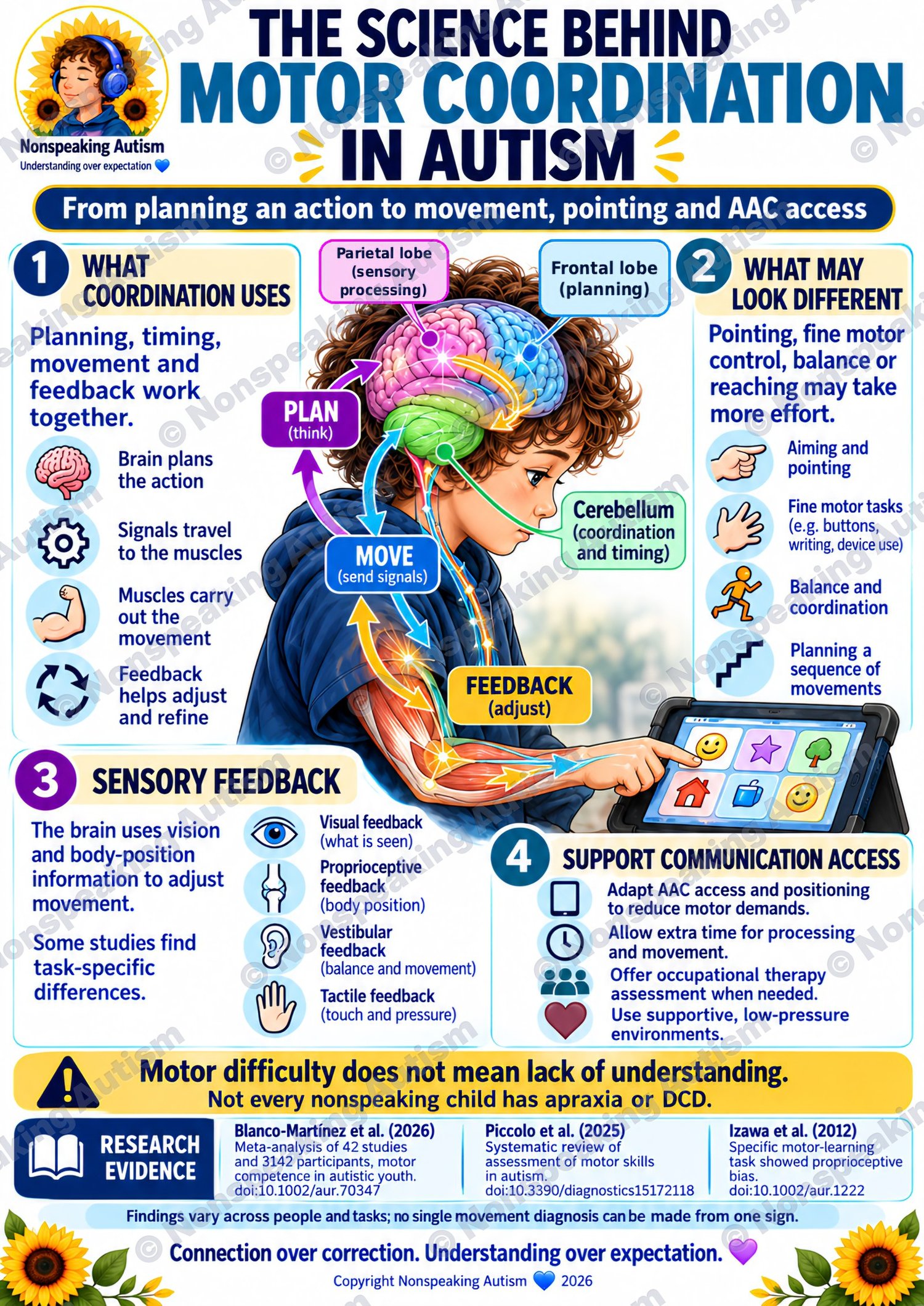
The Science Behind Motor Coordination in Autism is an illustrated, research-informed educational poster exploring how movement planning, timing, sensory feedback and physical coordination work together.
It also highlights why motor accessibility matters for communication, particularly when children use augmentative and alternative communication (AAC).
Designed for parents, carers, teachers, SENCOs, occupational therapists, speech and language therapists and other professionals, this poster encourages a more informed and compassionate understanding of motor differences.
The central message:
Motor difficulty does not mean lack of understanding.
🧠 UNDERSTANDING MOTOR COORDINATION IN AUTISM
Motor coordination involves multiple processes working together.
These include planning an action, preparing the movement, activating muscles, monitoring what happens and making adjustments.
For example, pointing to a symbol on an AAC device may require a person to:
- Identify the intended target
- Plan a reaching movement
- Coordinate their arm, hand and fingers
- Maintain an appropriate body position
- Judge the distance to the target
- Use visual and body-position feedback
- Adjust the movement if necessary
- Complete the selection
This may appear to be a simple action from the outside.
However, it can involve considerable coordination.
Research has identified motor differences in some autistic populations, although the type and extent of these differences vary considerably.
Not every autistic person experiences motor coordination difficulties, and no single motor profile applies to everyone.
🌈 WHAT THIS POSTER EXPLORES
1. WHAT MOTOR COORDINATION USES
The poster explains four interconnected elements of movement.
Planning
The nervous system helps organise the intended action.
Movement signals
Motor pathways transmit signals involved in activating and coordinating muscles.
Movement
Muscles and joints work together to carry out the action.
Feedback
Information from the senses helps the nervous system monitor and adjust movement.
The poster illustrates these processes as a simplified cycle:
PLAN → MOVE → FEEDBACK → ADJUST
In real movement, these processes interact continuously rather than operating as one rigid sequence.
2. WHAT MAY LOOK DIFFERENT
Some autistic children may experience greater difficulty or effort with particular motor tasks.
The poster highlights:
Aiming and pointing
Reaching towards or accurately selecting a target may require additional effort.
Fine motor tasks
Activities such as writing, fastening buttons and using devices may be more difficult.
Balance and coordination
Walking, running, balancing or adjusting body position may involve additional challenges.
Planning sequences of movement
Tasks involving several coordinated actions may be difficult to organise or complete.
These differences are not proof of a particular diagnosis.
They may reflect motor coordination differences, fatigue, sensory factors, physical discomfort or other individual needs.
🔬 THE BRAIN AND MOTOR COORDINATION
The poster uses a simplified brain illustration to introduce several regions associated with movement and sensory processing.
Frontal Regions
Frontal brain networks contribute to planning, selecting and controlling actions.
Parietal Regions
Parietal networks contribute to integrating sensory information and representing body position and space.
Cerebellum
The cerebellum contributes to movement timing, coordination, adaptation and other functions.
These regions work as parts of wider, interacting neural systems.
Motor coordination does not depend on one brain region acting alone.
The illustration is educational, not a medical scan or an exact representation of neural pathways.
Research findings about brain function cannot establish the cause of a particular child's motor difficulty without appropriate assessment.
🖐️ SENSORY FEEDBACK AND MOVEMENT
Movement depends partly on information from the body and surrounding environment.
The poster explores four forms of sensory feedback.
Visual Feedback
Vision helps a person identify targets, monitor movement and adjust actions.
For example, looking at an AAC symbol may help guide a hand towards the intended location.
Proprioceptive Feedback
Proprioception provides information about body position and movement.
It contributes to awareness of where the arms, hands and other body parts are positioned.
Vestibular Feedback
The vestibular system contributes to balance, head movement and orientation.
It works alongside vision and proprioception during many activities.
Tactile Feedback
Touch and pressure information help the nervous system monitor contact with objects and surfaces.
For example, tactile feedback can contribute to how a person grips an object or interacts with a touchscreen.
These sensory systems interact.
Some studies identify task-specific differences in sensory-motor processing among autistic participants.
However, research findings vary, and sensory feedback differences should not automatically be assumed in every autistic child.
💬 MOTOR COORDINATION AND AAC ACCESS
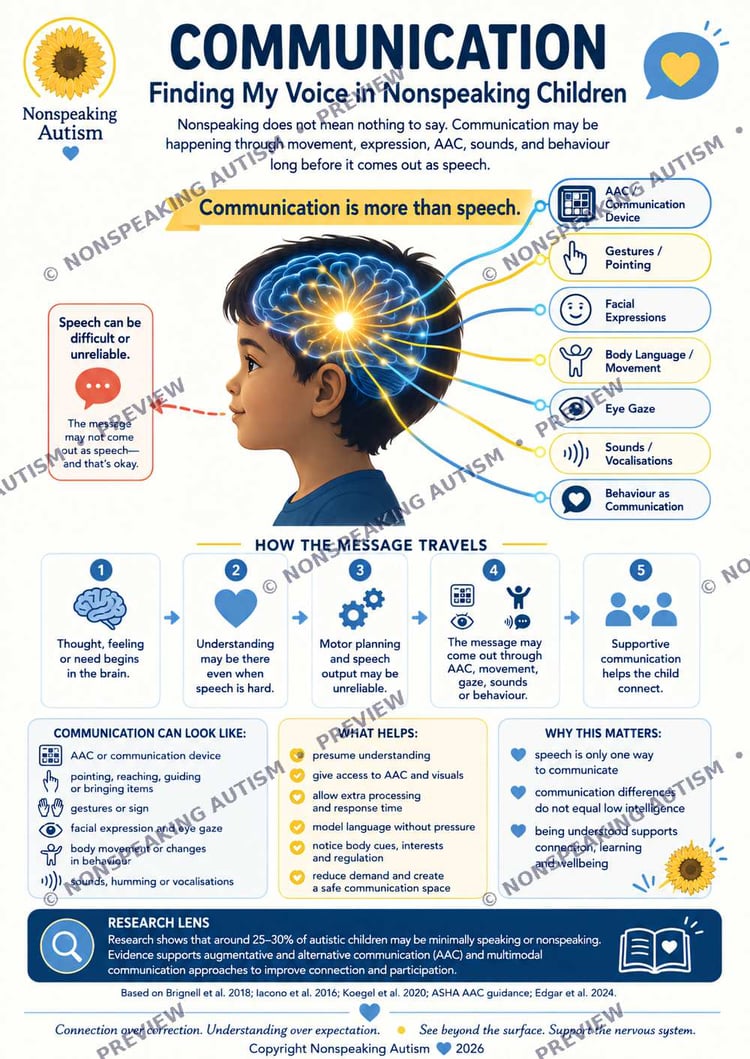
One of the most important messages of this poster concerns communication.
Knowing what to communicate and physically producing a response are not the same thing.
A child may understand language or have a clear communication intention but experience difficulty carrying out a particular movement.
For some individuals, challenges with pointing, reaching, maintaining posture or selecting a small target can create barriers to using AAC.
Possible barriers include:
- Small symbols
- Difficult screen positioning
- Inadequate seating support
- Fatigue
- Repeated movement demands
- Limited processing time
- Difficulties with accurate selection
- Lack of suitable alternative access methods
These barriers should be assessed rather than interpreted as evidence that the person does not understand or cannot benefit from AAC.
Supporting Communication Access
Practical adjustments may include:
- Positioning the AAC device comfortably
- Adjusting symbol size and spacing
- Reviewing seating and posture
- Allowing additional time
- Reducing unnecessary motor demands
- Considering appropriate access methods
- Providing occupational therapy input when needed
- Involving a speech and language therapist with AAC expertise
Depending on individual needs, AAC access may involve direct touch, switches, eye-gaze technology or other suitable methods.
AAC access should be matched to the person, rather than expecting the person to adapt to an inaccessible device.
A motor difficulty should not be used to make assumptions about a person's intelligence, understanding or communication potential.
💛 MOTOR DIFFICULTIES, APRAXIA AND DCD
The poster includes an important distinction:
Not every nonspeaking child has apraxia or developmental coordination disorder (DCD).
Motor coordination difficulties can occur for different reasons.
Developmental Coordination Disorder
DCD is a neurodevelopmental condition involving significant motor coordination difficulties that affect everyday functioning.
It requires appropriate clinical assessment and should not be diagnosed from one motor behaviour.
Apraxia
Apraxia refers to difficulties with aspects of planning or carrying out learned, purposeful movements, depending on the specific condition and clinical context.
Different forms of apraxia affect different functions.
For example, childhood apraxia of speech concerns speech motor planning and programming. It should not be assumed simply because a child is nonspeaking.
Autism and Motor Differences
Some autistic people experience motor difficulties without meeting criteria for DCD or a particular form of apraxia.
Others may have co-occurring conditions.
A diagnosis cannot be established from difficulty pointing, handwriting, balancing or using AAC alone.
🌻 HOW TO SUPPORT MOTOR ACCESS
The poster highlights four practical principles.
1. ADAPT AAC ACCESS AND POSITIONING
Review whether the communication system is physically accessible.
Consider:
- Device placement
- Seating and posture
- Target size
- Reach distance
- Fatigue
- Alternative access methods
2. ALLOW EXTRA TIME
Movement may take additional planning and coordination.
Avoid rushing a response or assuming that delayed movement means the person has not understood.
3. OFFER OCCUPATIONAL THERAPY ASSESSMENT WHEN NEEDED
An occupational therapist may help assess functional motor difficulties, positioning and everyday activities.
For AAC, collaborative assessment with speech and language therapy and relevant specialist services may be appropriate.
4. USE SUPPORTIVE, LOW-PRESSURE ENVIRONMENTS
Reduce unnecessary performance pressure.
Offer accessible choices, appropriate assistance and opportunities to practise meaningful activities.
Support should be based on the person's goals, comfort and functional needs.
The aim is to improve access and participation, not to demand perfect movement.
🏫 USING THIS RESOURCE IN UK SCHOOLS & SEND SETTINGS
Motor coordination differences can affect many school activities.
Examples include:
- Handwriting
- Using scissors
- Managing clothing fastenings
- Physical education
- Moving between classrooms
- Carrying equipment
- Using a tablet or AAC device
- Selecting symbols on communication boards
- Completing tasks under time pressure
A pupil may understand an instruction but struggle to complete the required motor response.
A child may know an answer but be unable to demonstrate it through handwriting or pointing.
This poster can support discussions about:
- Reasonable adjustments
- Alternative methods of recording work
- AAC access
- Motor-friendly classroom layouts
- Additional processing and movement time
- Occupational therapy referrals
- Assistive technology
- Collaboration between teachers, SENCOs, occupational therapists and speech and language therapists
Where appropriate, these needs may be considered within individual SEND support planning or an Education, Health and Care Plan (EHCP) in England.
Assessment of understanding should not depend solely on one inaccessible method of physical response.
📚 RESEARCH & SCIENTIFIC EVIDENCE
The poster references studies and reviews relating to motor coordination, motor assessment and proprioceptive processing in autism.
Research suggests that motor differences occur in some autistic individuals and may affect everyday activities.
However, findings vary across people, tasks and assessment methods.
Selected Research Printed on the Poster
Blanco-Martínez et al. (2026)
A meta-analysis described on the poster as involving 42 studies and 3,142 participants, examining motor competence in autistic youth.
DOI: 10.1002/aur.70347
Piccolo et al. (2025)
A systematic review of motor-skills assessment in autism.
DOI: 10.3390/diagnostics15172118
Izawa et al. (2012)
Research investigating motor learning and proprioceptive processing in a specific task.
DOI: 10.1002/aur.1222
- Blanco-Martínez, N., González-Devesa, D., Varela, S., Carballo-Afonso, R., & Ayán, C. (2026). Impaired motor competence in children and adolescents with autism spectrum disorder: Evidence from a systematic review and meta-analysis. Autism Research, e70347. https://doi.org/10.1002/aur.70347
- Piccolo, A., Raciti, C., Di Cara, M., Portaro, S., Muratore, R., De Domenico, C., Fulgenzi, A., Settimo, C., Quartarone, A., Cucinotta, F., & Alito, A. (2025). Motor coordination assessment in autism spectrum disorder: A systematic review. Diagnostics, 15(17), 2118. https://doi.org/10.3390/diagnostics15172118
- Izawa, J., Pekny, S. E., Marko, M. K., Haswell, C. C., Shadmehr, R., & Mostofsky, S. H. (2012). Motor learning relies on integrated sensory inputs in ADHD, but over-selectively on proprioception in autism spectrum conditions. Autism Research, 5(2), 124–136. https://doi.org/10.1002/aur.1222
Reference verification note: These details have been transcribed from the supplied poster. The full bibliographic records, study sample figures and exact relevance of each citation have not been independently checked for this listing.
SCIENTIFIC EVIDENCE NOTE
The brain and movement pathways shown on the poster are simplified educational illustrations.
They are not diagnostic brain images or proof of a particular neurological cause.
Research findings from groups cannot establish an individual person's motor profile.
Motor differences should be assessed in the context of functional needs, communication access and the individual's experiences.
👨👩👧 WHO IS THIS RESOURCE FOR?
This educational poster may be useful for:
- Parents and carers of autistic children
- Autistic young people and adults
- Families supporting nonspeaking children
- Teachers and teaching assistants
- SENCOs and SEND teams
- Occupational therapists
- Speech and language therapists
- AAC specialists
- Educational psychologists
- Physiotherapists
- Paediatric and healthcare professionals
- Early years practitioners
- Anyone supporting motor accessibility and communication
It may be displayed in homes, classrooms, SEND support areas, therapy rooms, AAC assessment settings and professional training spaces.
📦 WHAT YOU RECEIVE
PAID DIGITAL DOWNLOAD — INDIVIDUAL POSTER
Your purchase includes:
1 × The Science Behind Motor Coordination in Autism — Educational Poster
The poster features:
- Motor planning, movement and feedback
- A simplified illustration of relevant brain regions
- Examples of motor coordination differences
- Visual, proprioceptive, vestibular and tactile feedback
- Pointing and fine motor demands
- Motor accessibility and AAC
- Practical communication support strategies
- Important distinctions concerning apraxia and DCD
- Selected research references
- Nonspeaking Autism illustrated design
The product listing image contains promotional preview watermarks.
The purchased printable file should be supplied without these preview watermarks.
Digital download only — no physical poster will be posted.
Exact print dimensions and resolution should be confirmed against the final downloadable file.
⚠️ IMPORTANT DISCLAIMER
This resource is intended for educational and informational purposes only.
It does not constitute a diagnosis of autism, developmental coordination disorder, apraxia or any other condition.
It is not a substitute for occupational therapy, speech and language therapy, physiotherapy, neurological assessment or an individualised AAC assessment.
Motor difficulties may have several causes and should be considered in the context of the person's overall health, development and functional needs.
Sudden or unexplained loss of movement, weakness, coordination or other neurological function requires prompt medical assessment.
Support should be individualised, respectful, accessible and responsive to the person's communication and preferences.
©️ COPYRIGHT & PERMITTED USE
Copyright © 2026 Nonspeaking Autism. All rights reserved.
Purchase permits personal, family, classroom, school and individual professional educational use.
You may print the poster for these purposes.
You may not:
- Resell the poster or digital file
- Redistribute the purchased file
- Upload it to another website or digital platform
- Remove the branding and claim the artwork as your own
- Reproduce it commercially
- Include it in another product for resale without permission
Please share the original Payhip listing rather than distributing the purchased file.
💛 THE MESSAGE BEHIND THIS RESOURCE
A child may know the answer but struggle to point.
A child may understand an instruction but need more time to carry out the movement.
A child may have something important to communicate but find the available AAC system physically difficult to use.
A child may struggle with handwriting, balance or fine motor tasks without lacking motivation or understanding.
Movement is not the same as comprehension.
Physical access is not the same as communication ability.
And difficulty completing a motor task should not automatically be interpreted as refusal.
We can adapt the environment.
We can provide accessible communication.
We can allow time.
We can seek appropriate professional support.
And we can recognise that a person's understanding may not be fully reflected by the movements they can produce.
Motor difficulty does not mean lack of understanding.
🌻 Connection over correction. Understanding over expectation. 💙
Nonspeaking Autism © 2026