

🌻 LOOK BEYOND THE RESPONSE
🌻 LOOK BEYOND THE RESPONSE
Understanding What May Be Happening Beneath Autistic Behaviour
UK Edition | Research-Informed Autism & SEND Educational Poster | Nonspeaking Autism
💙 Observe the response. Explore the reason. Adapt the support.
When an autistic child covers their ears, moves away, repeats movements, becomes distressed or struggles to communicate, adults may focus on what the child is doing rather than what the child may be experiencing.
But behaviour does not happen in isolation.
A child may be responding to overwhelming sensory input, physical discomfort, communication barriers, environmental demands or several experiences occurring together.
The same outward response can have different explanations.
A child covering their ears may be experiencing uncomfortable sound, anticipating a distressing noise or seeking relief from a busy environment.
A child moving away may need a quieter space, a break from demands or support with an unfamiliar situation.
A child who cannot immediately express a need may understand far more than they can communicate through speech or movement at that moment.
The response is something we can observe. The reason requires curiosity, communication and context.
This illustrated, research-informed educational poster encourages parents, carers, teachers and professionals to look beyond outward behaviour and consider what may be contributing to a child's experience.
Rather than assuming refusal, defiance or deliberate disruption, it promotes compassionate observation, accessible communication and individualised support.
🧠 WHAT DOES “LOOK BEYOND THE RESPONSE” MEAN?
Looking beyond the response means recognising that outward behaviour alone cannot reliably tell us what someone is feeling, thinking or needing.
For autistic children, responses may be influenced by sensory experiences, physical wellbeing, communication access, motor demands and the surrounding environment.
These factors can overlap.
For example, a child may be tired, experiencing sensory overload and finding it difficult to communicate a need at the same time.
Another child may be comfortable with the sensory environment but distressed by an unexpected change.
There is no universal explanation for covering ears, withdrawing, stimming, crying or finding communication difficult.
Understanding requires looking at the whole situation, not simply the behaviour.
🌈 WHAT THIS POSTER EXPLORES
1. SENSORY INPUT
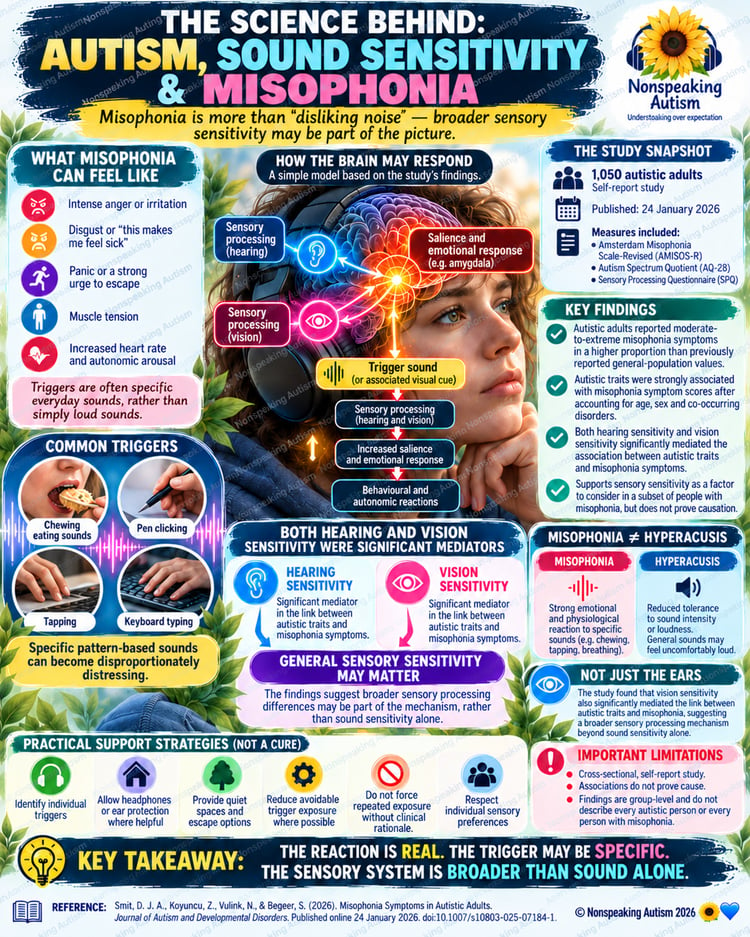
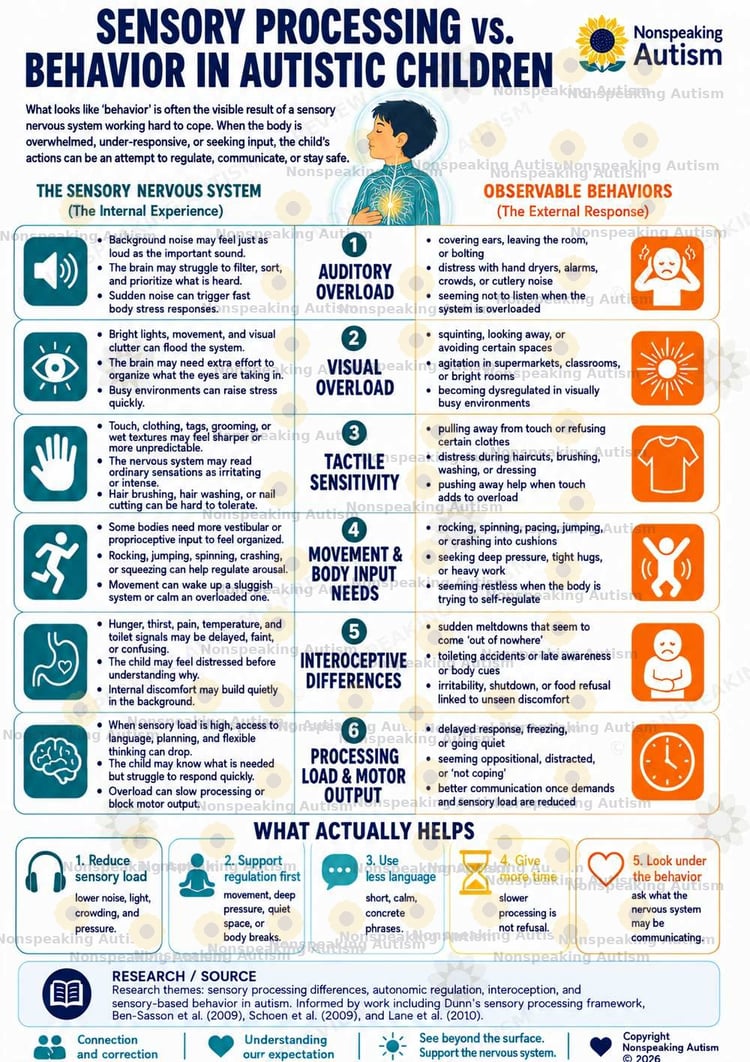
Sights, sounds, touch, smells, movement and other sensory experiences can feel intense, unpredictable or overwhelming.
Some autistic children experience sensory input differently from those around them.
Possible contributing factors include:
- Loud or competing sounds
- Bright or flickering lighting
- Unexpected touch
- Strong smells
- Crowded environments
- Uncomfortable clothing or textures
- Movement and balance demands
- Several sensory experiences happening at once
A child may cover their ears, move away, seek a familiar sensation or become distressed.
These responses may be attempts to manage an uncomfortable experience.
Sensory preferences vary between individuals and across situations.
Support begins by asking what the environment feels like to the child, not whether it seems uncomfortable to someone else.
2. BODY NEEDS
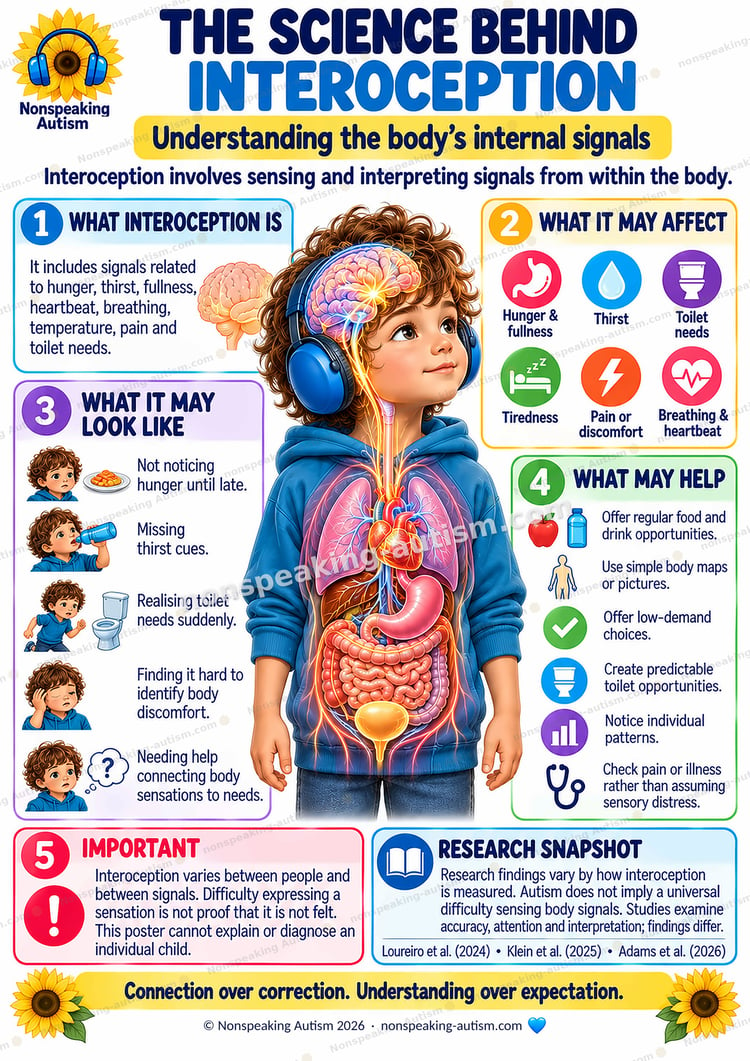
Pain, discomfort, hunger, thirst, fatigue, illness or changes in physical wellbeing can influence how a child feels and responds.
Physical needs may be overlooked when behaviour is interpreted only through an autism or sensory-processing lens.
A child may become less responsive, restless, upset or withdrawn because they are uncomfortable or unwell.
Possible factors to consider include:
- Hunger or thirst
- Tiredness or poor sleep
- Headaches
- Constipation or abdominal discomfort
- Dental or ear pain
- Illness
- Temperature discomfort
- Physical fatigue
Some children may find it difficult to recognise, describe or communicate internal sensations.
Others may recognise exactly what is wrong but have difficulty accessing the communication or support they need.
Never assume that distress is “just autism” when a physical need or medical concern may be involved.
3. COMMUNICATION & MOTOR ACCESS
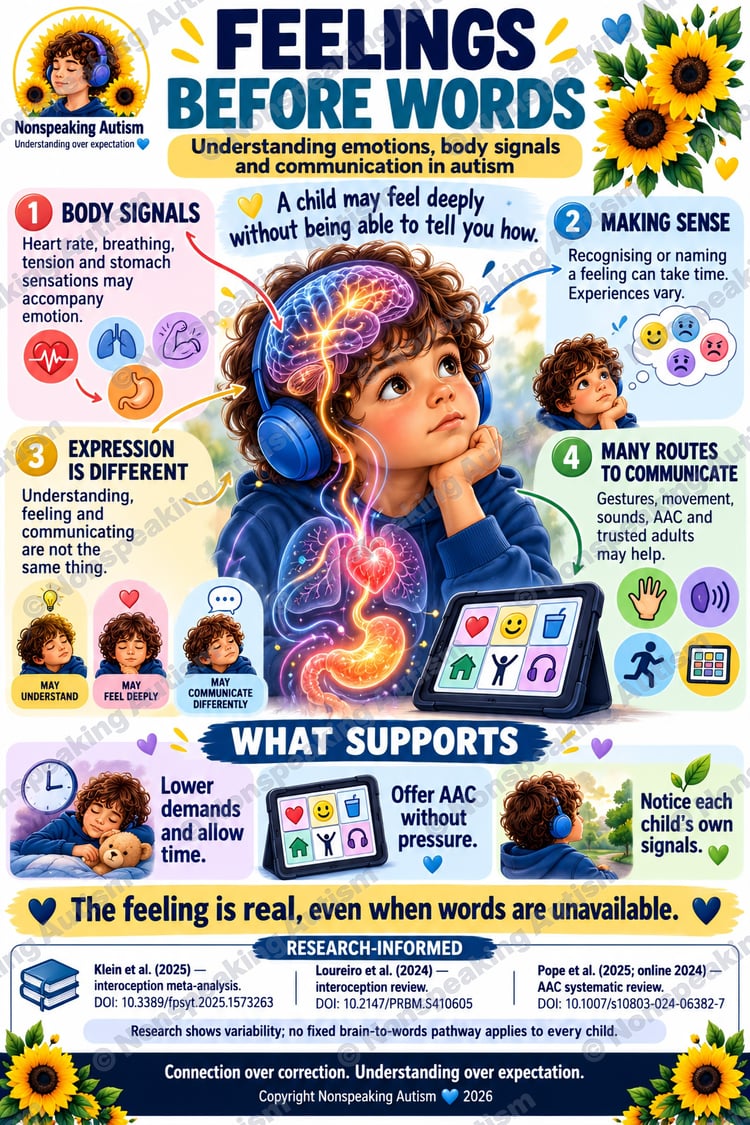
Understanding and expression are different.
A child may understand a situation, instruction or question but be unable to respond in the expected way.
Communication can be affected by:
- Speech differences
- Processing time
- Motor planning and coordination
- Difficulty accessing an AAC device
- Fatigue
- Distress
- Environmental demands
- Limited communication choices
A child who does not answer verbally may still understand what has been said.
A child who struggles to point accurately may need motor support or an alternative way to make a selection.
A child using AAC may need appropriate positioning, accessible vocabulary, modelling and time.
Communication access is not a reward. It is a fundamental part of participation and autonomy.
4. ENVIRONMENT & CHANGE
Uncertainty, waiting, unfamiliar places, transitions and unexpected demands can increase stress.
Environmental demands may include:
- Sudden changes in routine
- Unfamiliar locations
- Busy classrooms
- Waiting without knowing how long
- Unexpected transitions
- Multiple instructions
- Social expectations
- Limited opportunities for choice
- Activities that are physically or cognitively demanding
For some autistic children, predictability and preparation may reduce uncertainty.
Others may benefit from more flexibility, control or opportunities to choose how they participate.
The aim is not to remove every challenge, but to reduce avoidable barriers and provide appropriate support.
💙 WHAT YOU MAY SEE
The poster illustrates five possible outward responses.
Covering Ears or Eyes
This may occur in response to uncomfortable sensory input, anticipation, distress or another individual reason.
Stepping Away or Withdrawing
A child may be seeking distance from an overwhelming situation, needing recovery time or responding to discomfort.
Repeating Movements or Self-Regulating
Repetitive movement or stimming may serve different purposes, including enjoyment, expression, sensory exploration or regulation.
Harmless stimming should not automatically be discouraged.
Becoming Distressed or Overwhelmed
Crying, visible distress or difficulty continuing an activity may indicate that something has become too difficult, uncomfortable or demanding.
Difficulty Accessing AAC or Expressing Needs
Communication may become harder because of motor, sensory, physical, emotional or environmental barriers.
A child's difficulty responding should not automatically be interpreted as a lack of understanding.
These are possible patterns, not diagnostic rules.
💛 HOW YOU CAN SUPPORT
The poster introduces four compassionate principles.
1. CHECK COMFORT AND SAFETY
Before interpreting behaviour, consider:
- Is the child in pain?
- Could they be hungry or thirsty?
- Are they tired or unwell?
- Is something physically uncomfortable?
- Are they experiencing emotional distress?
- Is there an immediate safety concern?
Observe changes from the child's usual presentation and seek appropriate medical advice when needed.
2. REDUCE UNWANTED INPUT
Consider whether adjustments could make the environment more accessible.
Examples include:
- Minimising unnecessary noise
- Adjusting bright lighting
- Reducing crowding
- Offering a quieter space
- Allowing sensory breaks
- Respecting touch preferences
- Reducing unnecessary demands
Environmental adjustments should be guided by the person's preferences and needs.
3. OFFER COMMUNICATION CHOICES
Communication should remain accessible, especially during distress.
Support may include:
- AAC devices
- Communication boards
- Gestures
- Typing
- Visual choices
- Yes/no responses
- Extra processing time
- Opportunities to communicate without speech
Do not pressure a child to speak, make eye contact or communicate in one prescribed way.
Presume the person has something meaningful to communicate, even when their preferred method is not immediately available.
4. WATCH PATTERNS AND ADAPT
Consider what happens before, during and after a response.
Look for patterns involving:
- Sensory environments
- Physical needs
- Time of day
- Communication barriers
- Transitions
- Fatigue
- Social or educational demands
- Recovery opportunities
Collaborate with the child, family and relevant professionals to understand what helps.
The purpose of observation is to improve support, not to reduce a person to a behaviour chart.
🏫 USING THIS RESOURCE IN UK SCHOOLS & SEND SETTINGS
This poster can support discussions about autism, communication access, sensory needs and reasonable adjustments.
It may help school staff reflect on situations in which a pupil:
- Covers their ears during lessons
- Leaves a busy classroom
- Becomes distressed during transitions
- Uses repetitive movement to self-regulate
- Finds it difficult to respond verbally
- Struggles to access AAC
- Needs additional processing time
- Appears overwhelmed by environmental demands
It can support conversations between parents, carers, teachers, teaching assistants, SENCOs, occupational therapists, speech and language therapists and other professionals.
Possible school adjustments include:
- Reducing unnecessary sensory barriers
- Supporting predictable transitions
- Ensuring AAC remains available
- Providing meaningful communication choices
- Offering rest and recovery opportunities
- Considering physical health and comfort
- Adapting expectations to the pupil's current capacity
Where relevant, these discussions may contribute to individual support planning or an Education, Health and Care Plan (EHCP) in England.
The goal is to understand barriers and support participation, not to demand compliance regardless of distress.
🔬 RESEARCH & GUIDANCE-INFORMED
This poster draws on research and professional guidance relating to autism, sensory processing differences, communication access, physical wellbeing and environmental support.
Research supports the importance of considering individual sensory experiences and the broader context of distress.
However, no single behaviour reliably identifies one internal cause.
The poster should therefore be used as a framework for compassionate reflection, not as a method for diagnosing sensory overload, pain, anxiety or communication difficulties.
📚 Selected Research & Guidance
National Institute for Health and Care Excellence (NICE).
Autism spectrum disorder in under 19s: Support and management (CG170).
https://www.nice.org.uk/guidance/cg170
This guidance supports considering communication needs, physical and mental health, environmental factors and individual circumstances when assessing distress or behaviour that challenges.
Piller, A., et al. (2025).
Systematic review of sensory-based interventions for children and youth (2015–2024).
Frontiers in Pediatrics, 13, Article 1720179.
https://doi.org/10.3389/fped.2025.1720179
This review examines evidence for sensory-based interventions. Its findings should not be interpreted as proof that every sensory strategy works for every autistic person.
Falkirk Council.
Making Sense of Sensory Behaviour.
An educational resource addressing sensory experiences and the importance of understanding individual responses.
Research Evidence Note
These sources support the broader educational principles presented in the poster.
They do not establish that a particular outward response always has a sensory, emotional, physical or communication-related explanation.
The examples are illustrative, and the poster is not a validated behavioural assessment, sensory assessment or diagnostic tool.
- Falkirk Council. Making sense of sensory behaviour [Booklet]. https://falkirk.gov.uk/media/9892c1e1-a778-483c-b70f-4bc6601aa2cc
- National Institute for Health and Care Excellence. (2013, updated 2021). Autism spectrum disorder in under 19s: Support and management (CG170). https://www.nice.org.uk/guidance/cg170
- Piller, A., McHugh Conlin, J., Glennon, T. J., Andelin, L., Auld-Wright, K., Teng, K., & Tarver, T. (2025). Systematic review of sensory-based interventions for children and youth (2015–2024). Frontiers in Pediatrics, 13, 1720179. https://doi.org/10.3389/fped.2025.1720179
Sources:
- Falkirk Council: Making Sense of Sensory Behaviour
- Bradford schools sensory profile resource (for comparison)
👨👩👧 WHO IS THIS RESOURCE FOR?
- Parents and carers of autistic children
- Autistic young people and adults
- Teachers and teaching assistants
- SENCOs and SEND teams
- Occupational therapists
- Speech and language therapists
- Educational psychologists
- Paediatric and healthcare professionals
- Family support workers
- Early years practitioners
- Professionals supporting AAC and communication access
- Anyone seeking a more compassionate understanding of autistic behaviour
It may be displayed in homes, classrooms, SEND support areas, therapy rooms, staff rooms and other educational environments.
📦 WHAT YOU RECEIVE
PAID DIGITAL DOWNLOAD — INDIVIDUAL POSTER
Your purchase includes:
1 × Look Beyond the Response — Understanding What May Be Happening Beneath Autistic Behaviour
The poster features:
- Four areas that may influence a child's response
- Sensory input and sensory overwhelm
- Physical and internal body needs
- Communication and motor access
- Environmental demands and change
- Five illustrated examples of outward responses
- Four practical principles for compassionate support
- Research-informed educational content
- Nonspeaking Autism branding
The listing image contains promotional preview watermarks. The purchased printable file should be provided without these preview watermarks.
Digital download only — no physical poster will be posted.
The exact printable dimensions and resolution should be confirmed against the final downloadable file.
⚠️ IMPORTANT DISCLAIMER
This resource is intended for educational and informational purposes only.
It is not a medical diagnosis, behavioural assessment, sensory assessment, occupational therapy assessment, speech and language assessment or individualised treatment plan.
Behaviour and communication may be influenced by many factors, including pain, illness, fatigue, sensory experiences, emotional distress, communication barriers and environmental demands.
The same outward response may have different explanations.
Do not use this poster to diagnose a cause or dismiss possible medical concerns.
Sudden, severe, unusual or persistent changes in behaviour, responsiveness, communication or physical wellbeing should be discussed with an appropriate healthcare professional.
Support should always be individualised, safe, respectful and responsive to the person's communication and preferences.
©️ COPYRIGHT & PERMITTED USE
Copyright © 2026 Nonspeaking Autism. All rights reserved.
Purchase permits personal, family, classroom, school and individual professional educational use.
You may print the poster for use within these settings.
You may not:
- Resell the poster or digital file
- Redistribute the purchased file
- Upload it to another website or digital platform
- Remove the branding and claim the artwork as your own
- Reproduce the artwork commercially
- Include the poster in another product for resale without permission
Please share the original Payhip product link rather than redistributing the purchased digital file.
💛 THE MESSAGE BEHIND THIS RESOURCE
A child covering their ears may be overwhelmed.
A child moving away may need space.
A child repeating movements may be regulating, expressing themselves or simply enjoying movement.
A child struggling to use AAC may understand what they want to say but need better access to communicate it.
A child becoming distressed may be experiencing pain, fatigue, uncertainty or several difficulties at once.
We cannot always understand the reason by looking at the response alone.
But we can respond with curiosity.
We can check comfort and safety.
We can reduce unnecessary barriers.
We can make communication accessible.
And we can listen to what the person shows and tells us.
Do not stop at what the behaviour looks like. Consider what the person may be experiencing.
Observe the response. Explore the reason. Adapt the support.
🌻 Connection over correction. Understanding over expectation. 💙
Nonspeaking Autism © 2026