
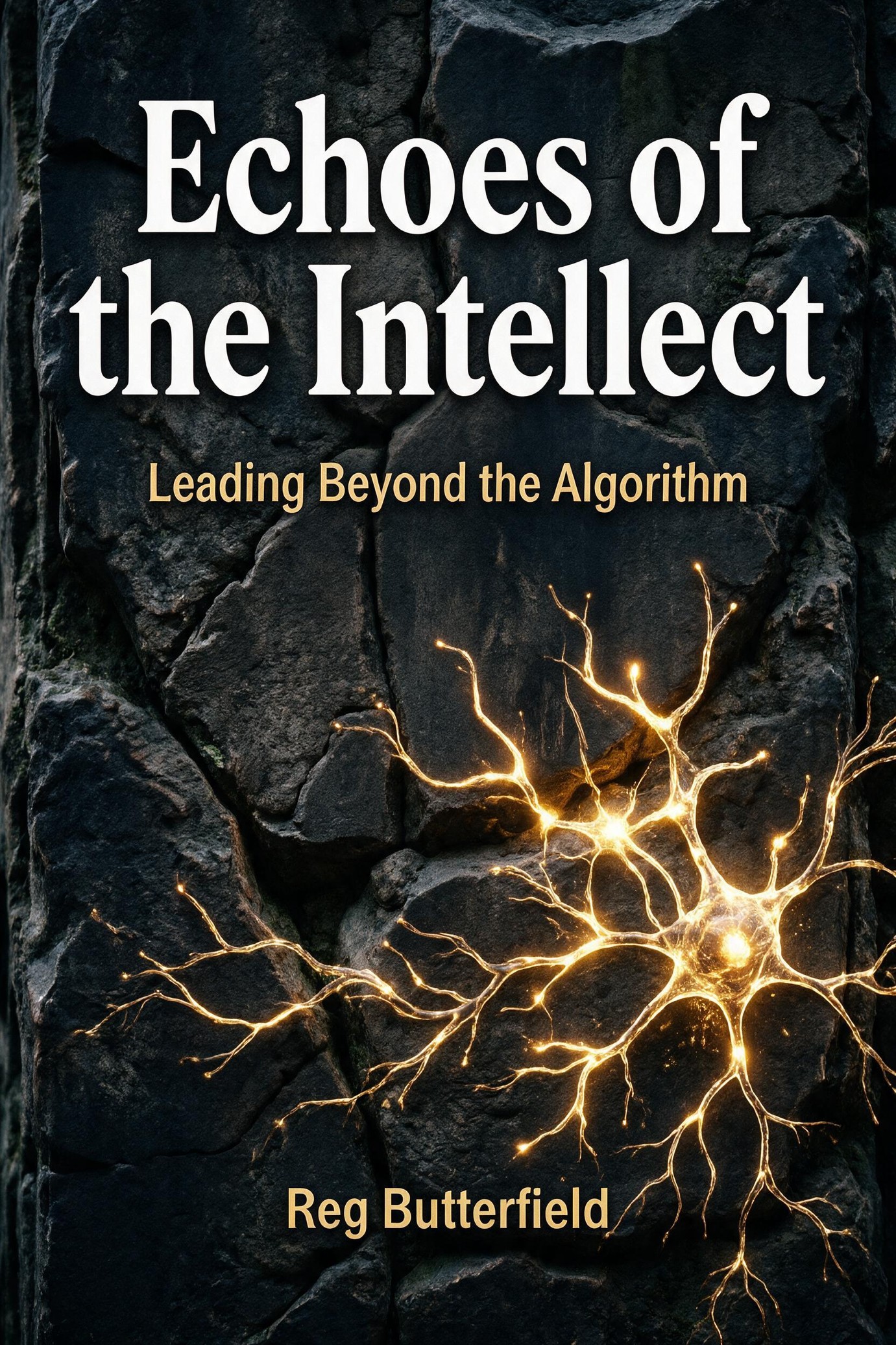
Echoes of the Intellect
Echoes of the Intellect: Leading Beyond the Algorithm
Artificial Intelligence is not an unprecedented rupture in human history, nor is it an alien intelligence invading our world. It is the logical, inevitable culmination of a recurring evolutionary cycle. In Echoes of the Intellect, Dr Reg Butterfield proposes a radical shift in how we understand the rise of the machine. Drawing on the megalithic ruins of ancient civilisations, the cyclic cosmologies of ancient India, the depth psychology of Carl Jung, and the cutting-edge science of complex systems, this book dismantles the myth of linear progress.
The Core Argument
The book establishes a comprehensive master hypothesis: AI represents the absolute zenith of the material intellect and the total externalisation of human analytical processing. Because AI lacks biological embodiment and true consciousness, it cannot replace human being; it can only replace human doing. By automating the mechanics of survival and data processing, AI strips away the illusion that human value lies in mere productivity. To avoid the systemic collapse that has befallen previous complex civilisations, humanity must consciously pivot from external complication to internal consciousness, embodied empathy, and ethical purpose.
A Unique Methodology
Rather than offering a superficial overview of current tech trends, this book utilises history as a critical heuristic. By examining the structural isomorphisms of previous eras, from the Saudeleur Dynasty at Nan Madol to the lost sciences of antiquity, readers build a diagnostic lens to recognise the warning signs of our own digital age. The text rigorously stress-tests these historical and philosophical frameworks against modern evolutionary biology, information theory, and the philosophy of mind, ensuring the arguments remain grounded in empirical science rather than mysticism.
Practical Applications for Leaders
The final section translates these profound insights into actionable organisational design. Through verified, real-world case studies, the book contrasts the dehumanising extremes of algorithmic management with pioneering models of relational stewardship and self-managing ecosystems. It provides management students, academics, and business leaders with a clear roadmap for transitioning from an economy of processing to an economy of meaning.
Who Should Read This Book
This book is essential reading for management and business students, organisational development practitioners, and leaders navigating the AI transition. It is also designed for general readers seeking a rigorous, deeply historical, and profoundly human perspective on the future of work and the evolution of consciousness.