
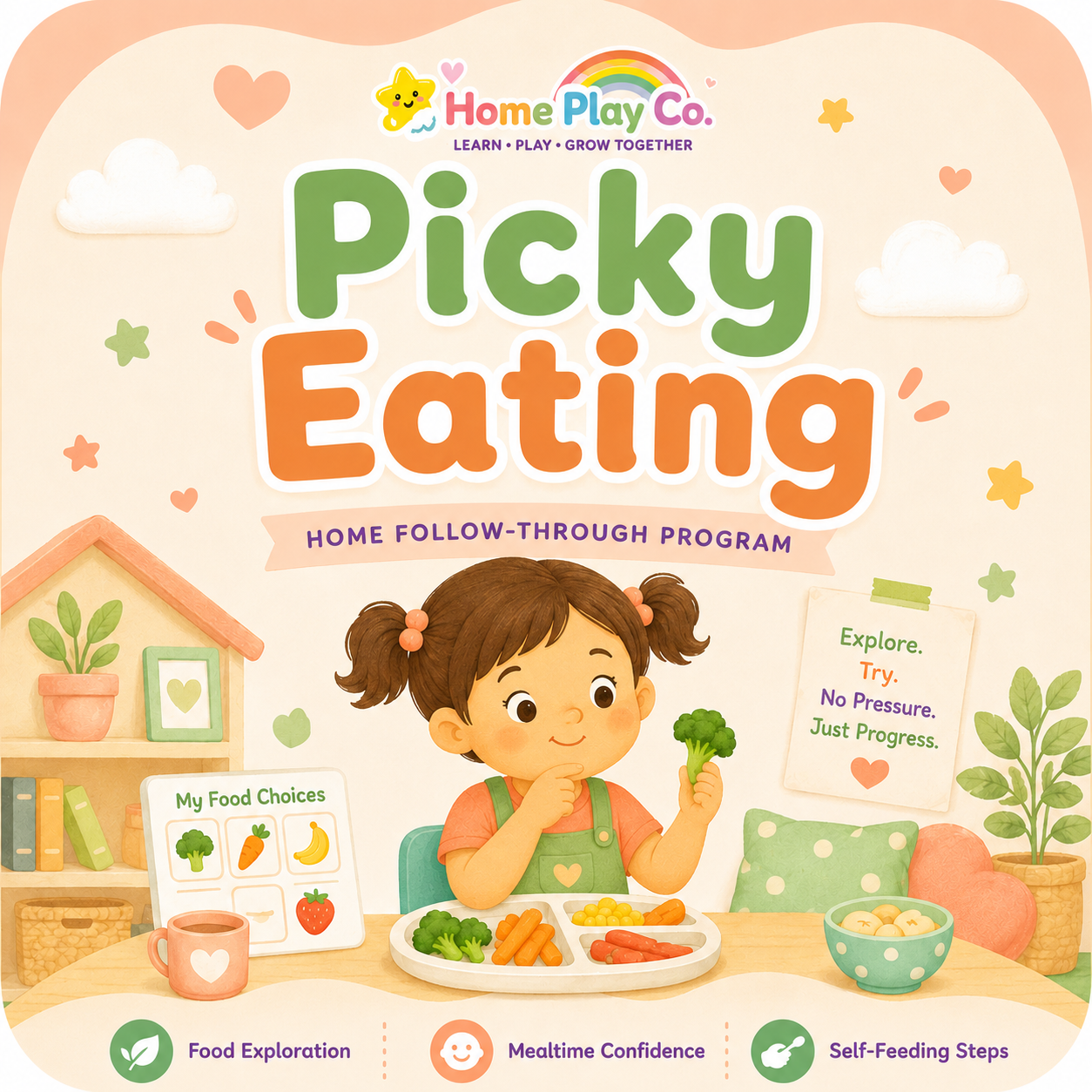
Picky Eating Support Home Follow Through
HELP YOUR CHILD BUILD FOOD TOLERANCE, MEALTIME CONFIDENCE, FOOD EXPLORATION, ORAL-SENSORY COMFORT, AND CALMER EATING ROUTINES — WITH STEP-BY-STEP PARENT GUIDANCE AT HOME
If you’ve ever found yourself thinking:
• “Ang konti lang ng kinakain niya…”
• “Paulit-ulit na lang same food ang tinatanggap niya…”
• “Ayaw niya tikman kahit konting bagong food lang…”
• “Kapag may new texture, smell, color, or ulam, umaayaw agad…”
• “Mealtime lagi na lang stressful, negotiation, iyakan, or habulan…”
• “Hindi ko alam paano siya tutulungan kumain ng mas varied without forcing or pressuring him/her…”
Or maybe you’ve tried everything already.
You offered different food.
You changed the plate.
You tried rewards.
You tried “one bite lang.”
You tried hiding food.
You tried waiting for hunger.
You tried explaining, encouraging, or even pleading.
Pero kahit anong effort, your child may still refuse, gag, cry, spit out, turn away, cover mouth, push the plate, or only eat the same safe foods again and again.
Because honestly, picky eating can feel very emotional for parents.
Hindi lang siya about food.
It can feel like worry.
“Enough ba kinakain niya?”
“Healthy ba siya?”
“Paano kung lumala?”
“Paano kung puro processed food na lang?”
“Paano kung hindi siya kumain sa school or outside?”
“Paano ko siya tutulungan without making mealtime traumatic?”
You’re not alone.
And one important thing to remember is this:
Picky eating is not always just “maarte sa food.”
It is not just about:
• being choosy
• being stubborn
• being spoiled
• refusing because they want control
• needing more gutom
• or forcing the child to taste until they get used to it
Because for many children, eating is connected to many small skills and comfort areas that still need support.
Sometimes, children still need help with:
• tolerating food on the plate
• looking at new food without distress
• smelling food
• touching food
• exploring textures
• accepting tiny changes
• chewing and oral awareness
• managing strong smells or mixed textures
• joining mealtime routines
• feeling safe enough to try
• communicating “no,” “help,” “all done,” or “try later” without meltdown
And for many parents, the hardest part is not wanting the child to eat.
It is knowing how to support food exploration without pressure, power struggles, or making the child more resistant.
This is where this guide comes in.
WHAT THIS IS
This is a Home Follow-Through Picky Eating Guide designed to help you support your child’s food tolerance, mealtime participation, food exploration, sensory comfort, and calmer eating routines in a clearer, gentler, and more structured way at home.
This is not just a food list.
This is not just a meal plan.
This is not just “hide vegetables in food.”
And this is not a promise that your child will suddenly eat everything overnight.
This is a parent coaching system that helps you understand what feeding-related skills to practice first, how to introduce food exposure gently, what to say during refusal, how to reduce pressure at mealtime, and how to respond when your child cries, gags, spits out, pushes food away, avoids textures, or refuses new food.
It helps your child move from:
👉 “limited food choices / ayaw mag-try / stressed sa mealtime / sensitive sa texture, smell, or new food”
to
👉 “more guided, more supported, and more comfortable with gradual food exploration and calmer mealtime routines at home”
Inside, you’ll learn:
• how to support food tolerance without forcing bites
• how to introduce new food slowly through look, smell, touch, and taste readiness
• how to reduce mealtime pressure and power struggles
• how to support sensory sensitivities around texture, smell, color, and mixed foods
• how to help your child tolerate food near them, on the plate, and during family meals
• how to respond when your child refuses, gags, cries, spits out, or pushes food away
• how to use parent scripts that encourage exploration without shame
• how to turn everyday meals into gentle food confidence practice
All based on real home follow-through, not random food tricks, not pressure-based feeding, and not forcing the child to “just take one bite.”
SAMPLE LIVE PREVIEW CLICK HERE
SAMPLE LIVE PREVIEW CLICK HERE
WHY THIS WORKS
Most parents are not lacking effort.
Many parents are already cooking, preparing options, offering new foods, researching recipes, buying snacks, adjusting meals, encouraging bites, and worrying about nutrition.
But effort can feel heavy when every meal becomes a battle.
Because without guidance, picky eating support can easily become:
“Try mo lang.”
“Isang bite lang.”
“Sayang food.”
“Bakit ayaw mo?”
“Kain ka muna bago play.”
“Hindi ka tatayo hangga’t hindi mo nauubos.”
And after a while, both parent and child can feel stressed.
The parent feels anxious.
The child feels pressured.
Mealtime feels unsafe.
And instead of becoming more open to food, the child may become more avoidant, more selective, or more resistant.
This guide works differently because picky eating support is broken down into smaller, more doable steps.
Not just:
“Make the child eat.”
But:
✔ Can my child tolerate the food near them?
✔ Can my child look at new food without distress?
✔ Can my child smell the food?
✔ Can my child touch the food?
✔ Can my child explore texture safely?
✔ Can my child tolerate tiny changes to preferred food?
✔ Is my child overwhelmed by smell, texture, color, or mixed foods?
✔ How do I respond when my child refuses without making it a fight?
✔ How do I build food confidence before expecting eating?
Instead of leaving you to guess, this guide gives you a clearer direction.
So you are not just offering food and hoping your child will suddenly try.
You are helping your child practice the foundation behind eating confidence, one small food exposure at a time.
So instead of:
“Hindi ko alam paano siya tutulungan kumain ng ibang food.”
It becomes:
“Mas alam ko na what to practice, what to say, how to expose food gently, and how to support mealtime without pressure.”
SAMPLE LIVE PREVIEW CLICK HERE
SAMPLE LIVE PREVIEW CLICK HERE
WHAT’S INSIDE THE GUIDE
A structured Picky Eating Home Follow-Through Guide designed to help parents support food tolerance, food exploration, sensory comfort, mealtime participation, oral-sensory readiness, new food exposure, refusal support, and calmer eating routines through real-life home practice.
Inside the guide, you’ll find:
• progressive picky eating activities arranged by phase/category
• step-by-step parent coaching for every activity
• embedded parent scripts so you know what to say during refusal, food exposure, mealtime resistance, and small wins
• simple materials list using real food, plates, utensils, snack items, cups, sensory-safe tools, and common home items
• activity goals and target feeding-related skills
• support for children who refuse, gag, spit out, push food away, cry, cover mouth, avoid textures, or eat only limited foods
• guidance for food tolerance, looking, smelling, touching, tasting readiness, food play, oral exploration, and mealtime routines
• gentle support strategies for refusal, sensory discomfort, pressure, food rigidity, gagging, anxiety, and mealtime stress
• real-life practice ideas for snack time, mealtime, food prep, grocery exposure, family meals, and food play routines
• parent-friendly explanations so you understand why picky eating is not solved by pressure alone
• organized Notion layout for easy access
• mobile-friendly guide you can open while guiding your child
PROGRAM COVERAGE
MEALTIME READINESS
• helping your child feel safer during mealtime
• reducing pressure before expecting food exploration
• creating predictable mealtime routines
• helping your child participate without immediate pressure to eat everything
FOOD TOLERANCE
• tolerating food on the table
• tolerating food on the plate
• tolerating new food near preferred food
• building comfort before expecting tasting
LOOK, SMELL, TOUCH, TASTE READINESS
• helping your child explore food step by step
• starting with looking and smelling before touching or tasting
• making food exposure less overwhelming
• supporting progress without forcing bites
SENSORY FOOD EXPLORATION
• exploring texture, temperature, smell, color, and shape
• helping your child become more familiar with different food properties
• supporting children who are sensitive to slimy, crunchy, wet, dry, mixed, or strong-smelling foods
• making food exploration feel safer and more playful
ORAL-SENSORY COMFORT
• supporting awareness around mouth, lips, tongue, and chewing
• helping your child become more comfortable with food touching the mouth
• practicing gentle oral exploration when appropriate
• supporting children who are cautious with new tastes and textures
PREFERRED FOOD EXPANSION
• making tiny changes to accepted foods
• slowly expanding variety from familiar food
• reducing food rigidity through small, manageable adjustments
• helping your child tolerate new brands, shapes, cuts, colors, or pairings
NEW FOOD EXPOSURE
• introducing new food without pressure
• using repeated exposure in small steps
• helping your child build familiarity before tasting
• reducing fear or resistance around unfamiliar food
MEALTIME COMMUNICATION
• helping your child communicate “no,” “help,” “all done,” “more,” “try later,” or “too much”
• supporting verbal, minimally verbal, and nonverbal children
• reducing crying, pushing, or gagging as the only communication
• giving your child safer ways to express food discomfort
REFUSAL SUPPORT
• responding when your child says no
• reducing power struggles during meals
• using calm scripts during refusal
• keeping boundaries without forcing or shaming
GAGGING, SPITTING, AND FOOD AVOIDANCE SUPPORT
• understanding that gagging and spitting may be signs of discomfort or overwhelm
• responding calmly when food is rejected
• reducing panic and pressure during difficult moments
• knowing when professional feeding support may be needed
FAMILY MEAL PARTICIPATION
• helping your child sit with the family
• tolerating food smells and food variety nearby
• joining small parts of mealtime routines
• building mealtime participation beyond eating volume
FOOD PREP AND FOOD PLAY
• letting your child wash, mix, scoop, pour, smell, touch, or arrange food
• building familiarity outside pressure-filled eating moments
• making food less unfamiliar through play and preparation
• supporting confidence before tasting
REAL-LIFE FOOD CONFIDENCE PRACTICE
• practicing during snack time, meals, grocery routines, food prep, and family meals
• building carryover from food play to mealtime
• helping parents guide food exposure realistically
• making food learning part of everyday life
SAMPLE LIVE PREVIEW CLICK HERE
SAMPLE LIVE PREVIEW CLICK HERE
HOW YOU WILL USE THIS
This is not a force-feeding method.
This is not a strict meal plan.
This is not a “finish your plate” approach.
You use this when:
• your child eats only a limited variety of food
• your child refuses new food
• your child is sensitive to smell, texture, color, or mixed food
• your child gags, spits out, cries, or pushes food away
• mealtime becomes stressful or emotional
• your child eats the same preferred foods repeatedly
• your child avoids family meals or food exposure
• you want to support food exploration without pressure or shame
• you want clearer direction on how to help your child slowly accept more foods
Simple flow:
• Start with your child’s current food tolerance level
• Choose one feeding-related skill to practice
• Begin with low-pressure exposure
• Use the suggested parent script
• Let your child explore through look, smell, touch, and small steps
• Respect signs of overwhelm while still keeping gentle structure
• Repeat during real routines without forcing bites
No food battles.
No shame.
No pressure to finish the plate.
The goal is not to make your child eat everything right away.
The goal is to help your child slowly build food tolerance, sensory comfort, mealtime participation, and eating confidence through parent-guided follow-through at home.
SAMPLE LIVE PREVIEW CLICK HERE
SAMPLE LIVE PREVIEW CLICK HERE
WHO THIS IS FOR
✔ parents of toddlers, preschoolers, and young children who need support with picky eating, food tolerance, mealtime participation, and food exploration
✔ parents of kids around ages 2–7 who eat limited foods, refuse new food, avoid textures, gag, spit out, push food away, or become stressed during mealtime
✔ also helpful for some older kids who may still need support with food tolerance, sensory food exploration, mealtime routines, oral-sensory comfort, or food flexibility because of developmental delays, sensory needs, neurodevelopmental conditions, communication delays, or other learning/developmental needs
✔ kids who:
• eat only a small list of accepted foods
• refuse new food immediately
• avoid certain textures, smells, colors, or mixed foods
• gag, spit out, cry, or push food away
• have strong reactions during mealtime
• struggle with food flexibility
• need support tolerating food on the plate or near them
• need pressure-free food exposure
✔ parents who want structured picky eating support at home
✔ parents who want to guide food exploration gently without forcing, bribing, shaming, or turning every meal into a fight
WHO THIS IS NOT FOR
✘ if you want instant food variety overnight
✘ if you want a strict meal plan only
✘ if you prefer force-feeding, threatening, shaming, or pressure-based eating
✘ if you want random recipe ideas only without parent guidance
✘ if you do not want to model, guide, repeat, and support food exposure consistently
✘ if you are looking for a replacement for feeding therapy, occupational therapy, speech therapy, pediatric care, nutrition guidance, developmental evaluation, or medical advice
✘ if your child has choking, swallowing difficulty, severe gagging, weight loss, poor growth, dehydration, severe constipation, pain, vomiting, or medical feeding concerns that need professional support
This is for gradual, consistent, parent-guided picky eating follow-through at home.
HOW TO ACCESS AFTER PURCHASE VIA WEBSITE
After payment, Payhip website will automatically provide the file/access details. Inside, you’ll find the Notion guide link. Open the link using your phone, tablet, or laptop.
You can view the guide directly through the link, or duplicate it to your own free Notion account if you prefer having your own copy.
No need to print everything.
No complicated setup.
Just open the link, choose the activity or food tolerance skill, and follow the guide step by step.
This is a one-time payment only.
You’ll get lifetime access to the guide, including future updates if we improve or add helpful parts to the guide.
After-sales assistance is also available. If you have questions about accessing the guide or using it, you may message us on our Facebook Page.
ASSISTED PURCHASE TRANSACTION VIA FB PAGE MESSENGER:
If you don’t have a debit card, credit card, or PayPal account, you may still purchase through assisted transaction via Messenger.
Just send us a message on our Facebook Page and we’ll guide you through the payment and access process.
After payment confirmation, we will send your Notion access link through Messenger or email.
Facebook Page:
https://www.facebook.com/homeplaycomainfbpage
WHAT YOU WILL RECEIVE
• instant access link after purchase
• full digital guide inside Notion
• organized picky eating follow-through system by phase/category
• step-by-step parent coaching
• embedded parent scripts
• support for children who refuse, gag, spit out, cry, push food away, avoid textures, or eat only limited foods
• food tolerance practice for mealtime readiness, food exposure, sensory exploration, oral comfort, preferred food expansion, food communication, and family meal participation
• mobile-friendly access
• one-time payment only
• lifetime access to the guide link
• lifetime updates whenever improvements or helpful additions are added
• after-sales assistance for access or guide-related questions
• option to duplicate to your own Notion account optional only
FAQs
Is this a meal plan?
No. This is not a strict meal plan. This is a parent-guided picky eating support guide focused on food tolerance, sensory comfort, food exploration, mealtime routines, and gradual exposure.
Is this for diagnosed kids only?
No. This can be used whether your child has a diagnosis or not.
What age is this for?
This is mainly for toddlers, preschoolers, and young children around ages 2–7, but some older children may still benefit if they need support with food tolerance, sensory food exploration, mealtime routines, oral-sensory comfort, or food flexibility due to developmental delays, sensory needs, neurodevelopmental conditions, communication delays, or other learning/developmental needs.
Will this make my child eat new food right away?
No. This guide does not promise instant food acceptance. It helps your child build food comfort gradually through repeated, low-pressure exposure.
What if my child eats only a few foods?
This guide can help you start from your child’s current accepted foods and slowly build tolerance, flexibility, and exposure in small steps.
What if my child refuses even to touch new food?
That is okay. The guide starts with earlier steps like tolerating food nearby, looking, smelling, and being around the food before expecting touch or taste.
What if my child gags or spits food out?
The guide includes calm response strategies, but frequent gagging, choking, swallowing difficulty, vomiting, pain, or severe food refusal should be assessed by a feeding therapist, pediatrician, or qualified professional.
Kailangan ba verbal ang child para magamit ito?
No. Food tolerance and mealtime participation can be supported through gestures, visuals, pointing, choices, modeled words, simple cues, and supported communication.
Does this replace feeding therapy?
No. This is a parent-friendly home follow-through guide. It does not replace feeding therapy, occupational therapy, speech therapy, pediatric care, nutrition guidance, developmental evaluation, medical advice, or professional intervention.
What if my child is already in therapy?
You can use this as home follow-through support between sessions, as long as it aligns with your child’s therapist’s or feeding specialist’s guidance.
What if my child has autism, sensory needs, GDD, ADHD traits, or developmental delay?
This guide may be used as gentle home support for some children with developmental, sensory, communication, or neurodevelopmental needs, as long as activities are matched to the child’s current ability and done with patience, flexibility, safety awareness, and professional guidance when needed.
Do I need special materials?
No. Most activities use real food, preferred food, small portions, plates, utensils, cups, containers, napkins, food prep items, and simple home materials.
Kailangan ba matagal gawin every day?
No. Short, repeated food exposure moments are often more doable than long mealtime battles. Consistency matters more than length.
Should I force one bite?
This guide does not use force as the main method. It supports gradual exposure, food comfort, sensory tolerance, and parent-guided steps before expecting tasting.
Can this help with school readiness?
Yes. Mealtime participation, food tolerance, snack routines, asking for help, and being able to sit with food nearby can support school, therapy, daycare, and group settings.
Can I use this with other HFT guides?
Yes. Picky Eating connects well with Sensory Regulation, Daily Life Skills, Routine and Transitions, Following Instructions, Self Regulation, Big Emotions + Behaviour, Behaviour Support, and Safety Rules and Boundaries.
What if my child has weight loss or poor growth?
If your child has weight loss, poor growth, dehydration, very limited intake, swallowing difficulty, choking, frequent vomiting, severe gagging, severe constipation, or medical feeding concerns, please consult a pediatrician, feeding therapist, dietitian, or qualified professional.
SAMPLE LIVE PREVIEW CLICK HERE
SAMPLE LIVE PREVIEW CLICK HERE
FINAL NOTE
Your child is not automatically “maarte,” “spoiled,” or “stubborn” just because eating is hard right now.
And you are not a bad parent just because mealtime feels stressful, repetitive, or emotionally heavy.
Sometimes, what your child needs is not more pressure to take a bite.
Sometimes, what you need is not another random food hack.
Sometimes, the missing piece is a clearer step-by-step way to build food comfort during real mealtime moments.
Picky eating is not just about food preference.
It can involve sensory comfort, body readiness, oral awareness, routine, communication, trust, and repeated safe exposure.
One food tolerated nearby.
One smell explored.
One touch accepted.
One tiny change noticed.
One calmer mealtime at a time.
This guide is designed to give you clearer direction, so you are not left guessing daily how to support your child’s picky eating.
For older kids with developmental, sensory, communication, feeding, oral-motor, or neurological concerns, use the activities gently, slowly, and with the right level of support.
This system helps you support your child’s food tolerance, mealtime confidence, food exploration, sensory comfort, and calmer eating routines step by step, at home.
Should you have any concerns, pls direct message us to our Facebook Page:
https://www.facebook.com/homeplaycomainfbpage
We’d love to assist you further!
Thank you so much!