

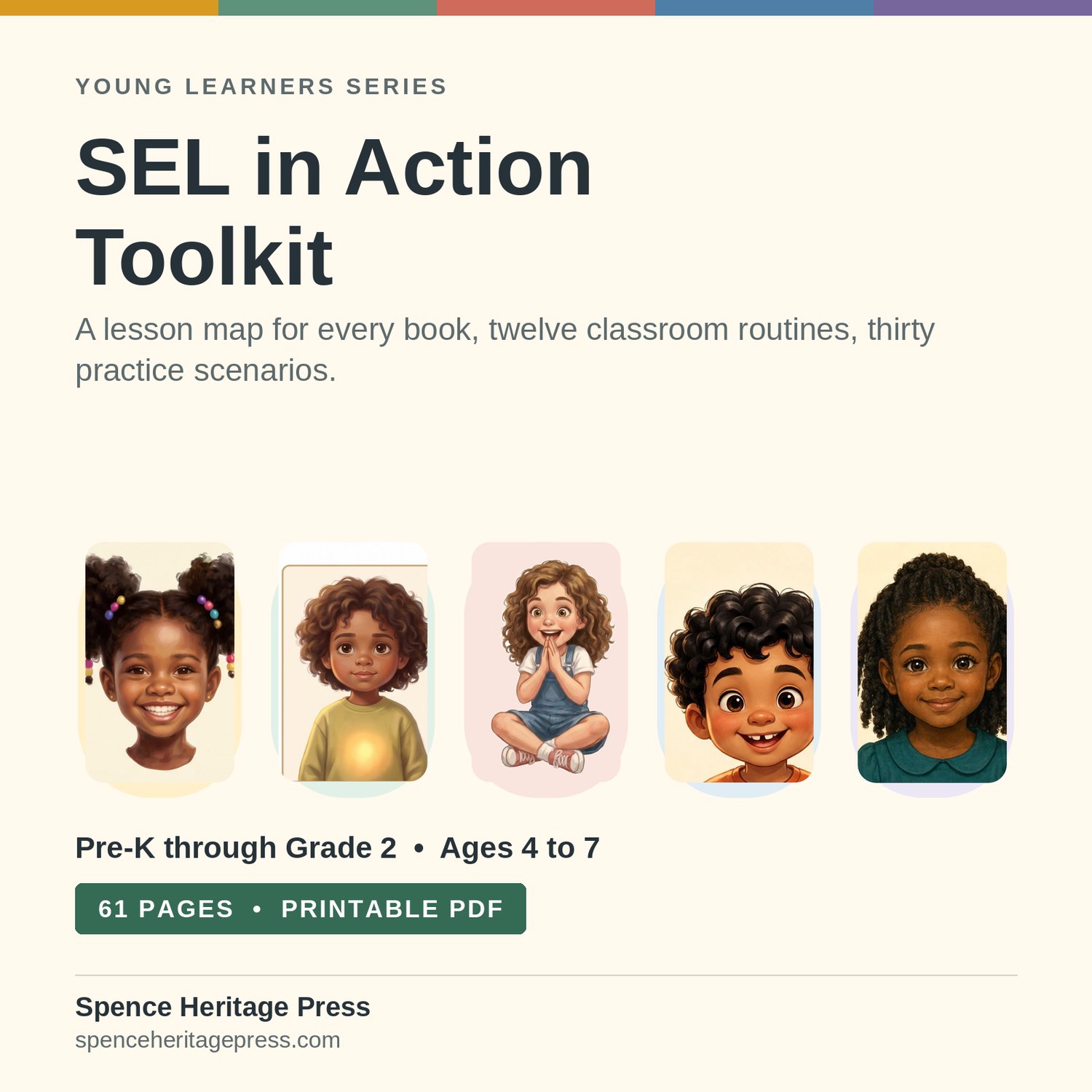
SEL in Action Toolkit
You already have the books. What you do not have is the forty minutes on a Sunday night to work out where to pause, what to ask, and how to keep the skill alive on Wednesday.
That is what this is.
The six-step lesson
Every lesson follows the same shape, so you learn it once and use it five times. Prime for two minutes before reading. Read aloud, stopping at three places marked in the lesson map. Talk, using sentence frames that give children language for what they noticed. Do, through movement, drawing, or role play. Carry one short routine through the rest of the week. Connect by sending home the matching family card.
Twenty to twenty-five minutes for the core lesson. Two to five minutes a day after that.
What is inside
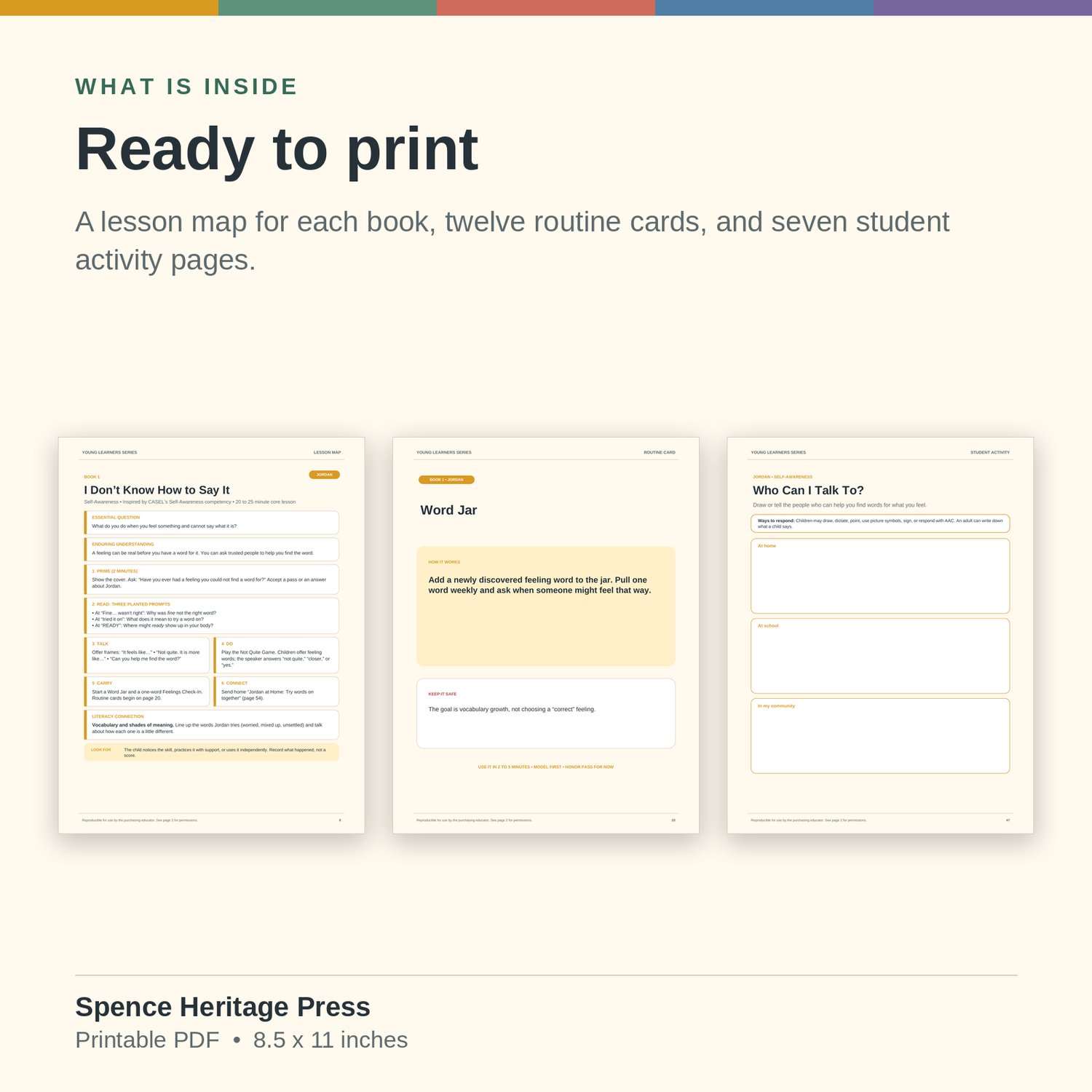
A lesson map for each of the five books, plus a capstone lesson that brings all five together. Each map carries the essential question, the Prime prompt, three read-aloud pause points keyed to exact lines in the book, sentence frames, an activity, a carry routine, and a family card.
A five-week rollout, if you want the sequence planned for you, and a quick start page if you would rather begin on Monday.
Twelve routine cards, formatted to print and cut: Word Jar, Feelings Check-In, River Breath, Feet on the Floor, Feelings Thermometer, Stop Think Choose, The Not Quite Game, Found Things Basket, The Other Side Spot, What Else Could Be True?, The Two Ends, and The Three Steps.
Thirty practice scenario cards, six per skill, for the small moments that come up between lessons.
Five character posters. Seven student activity pages. Five family connection cards. An observation tool for recording what you actually see. An administrator brief for the person who approves the purchase. Optional New York State connections.
How it is built
Sequenced, active, focused, and explicit practice, the SAFE features described by Durlak et al. (2011). Participation is invited, never required. No child has to disclose a personal experience; answering about the character is a complete answer. Speaking, pointing, drawing, signing, picture symbols, and AAC all count. No routine is ever used as a consequence. The classroom conditions page states all of this on one sheet you can hand to a substitute.
What it is not
It is not an assessment. No screening, no diagnosis, no scored rubric, no benchmark rating. The observation tool records a quotation or an action, and its bands describe one moment rather than a fixed level.
It also does not replace your school's adopted SEL curriculum, counseling services, behavioral supports, safeguarding procedures, or tiered intervention system. It sits alongside them.
You need the books.
Every lesson map is keyed to exact phrases in the five picture books. This is a companion to them, not a substitute, and on its own it will not do much.
What you get
One printable PDF, 61 pages, 8.5 x 11 inches. Pages marked reproducible may be copied for the children at the purchasing classroom or program site. Multi-site and district licenses are available on request.
Not sure yet
Five SEL Routines You Can Use Tomorrow is a free 15-page sample: the classroom conditions page, seven routine cards, and one complete lesson map. Run something with a group on Monday before you spend anything.