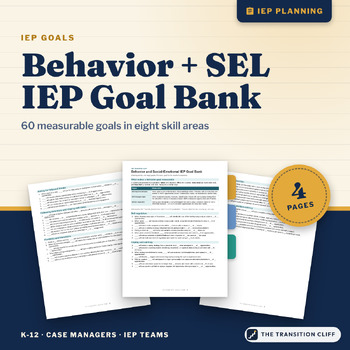
Behavior and Social Emotional IEP Goal Bank: 60 Measurable IEP Goals, High School
"Will improve behavior" is not a goal. Neither is "will make good choices." This goal bank shows the difference between a vague goal and one you can actually measure, then gives you 60 starting points to fit to your student.
What's included:
• A one page guide to what makes a behavior goal measurable (when, who, does what, how well)
• Vague vs measurable examples
• Three fully written sample goals
• 60 goal stems in eight skill areas, each with blanks for the student and criteria
How I'd use it:
These are starting points, not copy and paste. Fit every goal to the student's baseline and the data you actually collect. I'd keep this open next to your graph when you write the present levels, so the goal matches what you saw.
The eight areas are self regulation, coping and calming, asking for help and breaks, following directions and staying with tasks, flexibility and transitions, social interaction, conflict and problem solving, and self advocacy and self monitoring. Every goal has blanks so you can fill in the student's name, the numbers, and the time frame. The vague to measurable page also works as a quick training for new case managers or for a team writing goals together.
Who it's for: Teachers, case managers, school psychologists, and counselors. Grades K 12.
What you download: one printable PDF, 4 pages, US Letter, plus an editable Word file so you can type in it.
Made by Jeremy D. Gooch, special education teacher and transition coordinator. Drafting and layout had AI assistance; every page was checked by me.