

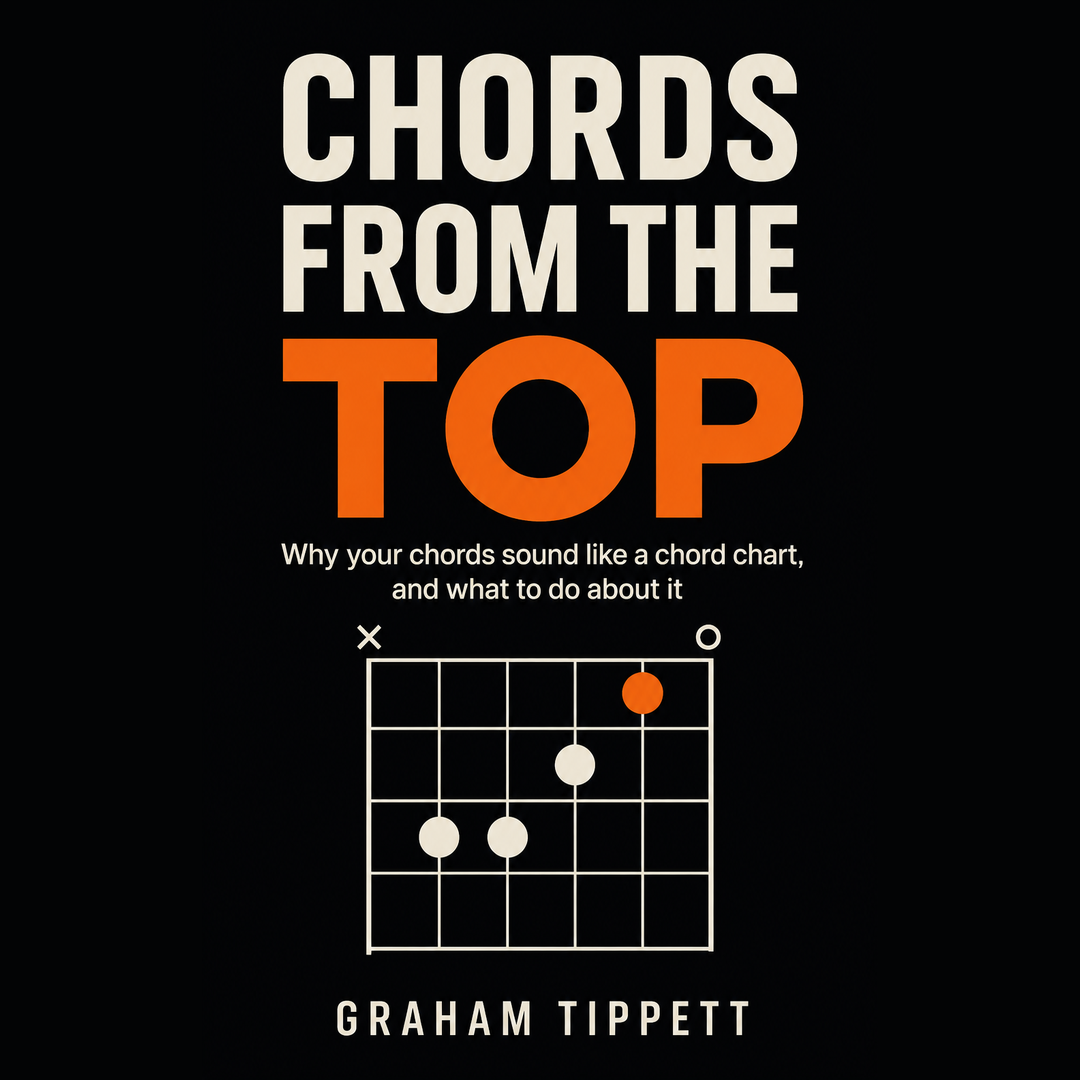
Chords From The Top
This is not a chord dictionary
No lookup section. No grid of shapes by key. No appendix of 500 voicings. If you want a reference to keep on the music stand, this isn't it, and I'd rather say so now than take your money.
The problem with every chord book you own
Almost all of them sort chords by the root. All the C chords, then the C sharps, then the Ds. It's a sensible way to print a book and a useless way to play one. It's also why you own eighty voicings and use six.
Here's what I think is going on. The root is the least important note in a chord. Nobody hears it. The bass player has it, it sits in the muddiest part of the range, and your listener worked out what chord you were on a bar ago.
What a listener actually tracks is the highest note. It moves like a melody, and everything underneath gets heard as accompaniment to it. That's why two guitarists playing the same progression can sound like two different musicians.
Organise your chords around that, and the shapes you already own start sounding like music instead of like a chord chart read out loud.
Try it before you buy anything
Play a C major chord. Any one. Now play it again with a different note on top. Same harmony, same symbol on the page, completely different musical statement. If you heard that, the book will make sense to you.
What's in it
Nine chapters, one idea, increasing scale.
1. The note nobody hears — the argument, and why the root is a bad index.
2. Three ideas, not twelve shapes — triads filed by which note is on top, not by position.
3. The 7th is one finger — major seventh, dominant, minor seventh and half-diminished turn out to be one shape with one note moving. Four chords, or one idea that produces four chords.
4. Take a note out — why removing notes makes a chord sound bigger rather than thinner, and which one goes first.
5. Extensions without new shapes — ninths, elevenths and thirteenths built entirely from triads you learned in chapter two, over a different bass note. No new grips at all. This is the chapter most people say changed how they see the fretboard.
6. Slash chords, plainly — one question resolves the whole notation.
7. Voice leading by top note — where the filing system stops being tidy and starts sounding composed. Includes the sound of the change to the IV chord in a blues that you've played ten thousand times without knowing what produced it.
8. Choosing what to leave out — wide voicings, made by omission.
9. Playing it — comping, chord melody, and rhythm playing that isn't strumming.
No notation required. Almost no theory beyond "a triad is three notes."
Who this is for
Self-taught players, usually fifteen to forty years in, who can get through a song without wrong notes and can hear that it sounds flat. Not wrong — flat. Like someone reading a list correctly.
Blues, soul, pop, rock and country players. That's where most of the examples come from.
You need open chords, barre chords, and the ability to read a chord diagram. That's it.
Who this is not for
- Beginners. This isn't a first guitar book.
- Anyone who wants a reference to look chords up in.
- Anyone wanting to learn standard notation.
- Anyone looking for songs, tab or arrangements.
- Players who want a jazz method specifically. The approach comes from that world; the book doesn't live there.
- Anyone who wants more chords. You have enough.
The free tool
There's a chord builder at on the website that thinks the same way. Rather than handing you a finished shape, it builds a chord from the ground up, one interval at a time, so you watch the thing being assembled instead of memorising the result. You end up with the chord's structure laid out across the whole fretboard — and once you can see where every chord tone sits, you can see which ones are available on top.
Free, no sign-up. Use it alongside the book, or use it first to work out whether this way of thinking suits you.
Format
Instant PDF download. 72 pages, in colour, designed to be read on a tablet or printed.