

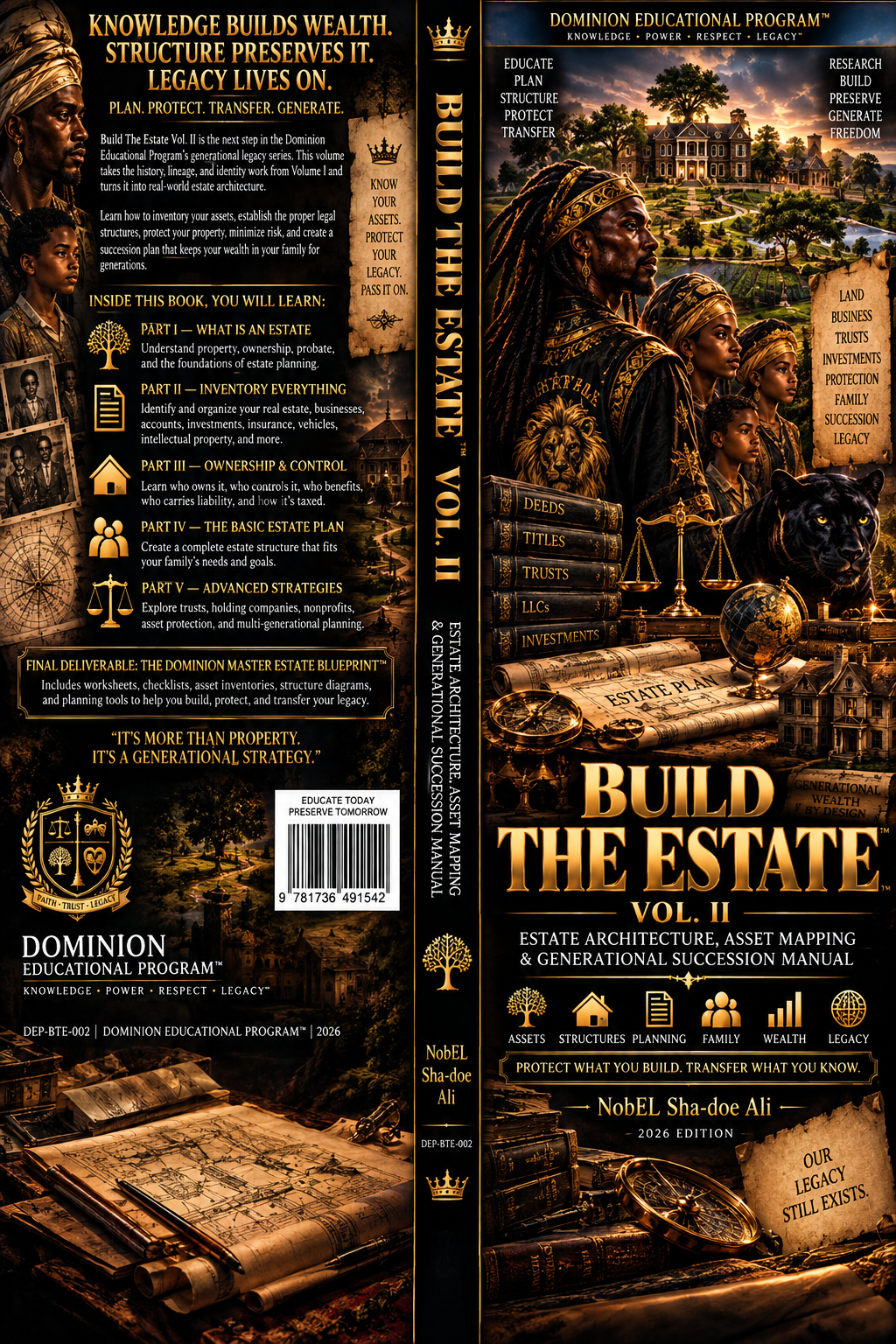
BUILD THE ESTATE™
BUILD THE ESTATE™
Estate Architecture, Asset Mapping & Generational Succession Manual
Volume II — The Dominion Land & Bloodline Legacy System™
You found the bloodline. Now it is time to build the estate around it.
BUILD THE ESTATE™ is Volume II of the Dominion Land & Bloodline Legacy System™, moving the family from genealogy and ancestral research into the practical work of estate architecture, asset mapping, ownership analysis, succession planning, and generational preservation.
Volume I asked:
Who is the family?
Volume II asks:
What has the family built, who legally owns and controls it, and how should it be organized for the generations that follow?
That question is much deeper than making a list of houses, land, businesses, or money.
An estate is a coordinated system of property, legal interests, ownership, title, possession, control, liabilities, contracts, beneficiaries, taxes, insurance, succession instructions, and supporting documents.
This manual teaches students how those pieces interact before they begin moving property, restructuring ownership, or attempting to fund advanced trust arrangements.
FROM PROPERTY TO ESTATE ARCHITECTURE
The education begins with the legal foundation.
Students learn the differences between property, ownership, title, possession, control, and beneficial interests, along with the distinctions between real property, tangible personal property, intangible property, probate property, and non-probate property.
The manual then moves into a comprehensive asset investigation.
Students examine and organize the family's:
- Land and houses
- Businesses and LLC interests
- Bank and cash accounts
- Investments and brokerage assets
- Retirement accounts
- Life insurance and other insurance
- Vehicles and equipment
- Valuable personal property
- Intellectual property
- Digital assets
- Contracts and receivables
- Mortgages, liens, guarantees, debts, and other liabilities
But finding an asset is only the beginning.
The next question is:
What is the family's actual legal relationship to it?
THE DOMINION SEVEN-QUESTION ASSET TEST™
Every significant asset is examined through seven fundamental questions:
Who owns it?
Who controls it?
Who benefits?
Who carries liability?
How is it taxed?
Who succeeds the controller?
What happens if ownership changes?
Those seven questions transform an ordinary property inventory into an estate architecture.
A house may have one owner but several occupants.
A business owner may own an LLC membership interest without personally owning the LLC's property.
A retirement account may remain individually owned during life while transferring at death through a beneficiary designation.
A trustee may hold legal title while beneficiaries possess defined beneficial interests.
And transferring an asset can affect tax basis, financing, insurance, creditor exposure, management authority, succession, and federal or state tax treatment.
Volume II teaches students to investigate those consequences before acting.
BUILDING THE COORDINATED ESTATE
Once the family's assets and liabilities have been identified, the manual moves into the foundation of estate planning.
Students study the functions and relationships among:
Wills • Pour-Over Wills • Revocable Living Trusts • Durable Powers of Attorney • Health-Care Directives • Beneficiary Designations • TOD/POD Arrangements • Guardianship Planning • Probate • Incapacity Planning • Successor Control
One of the most important principles of the Dominion curriculum is established here:
An irrevocable trust is not the entire estate plan.
A trust is one component of a larger legal and financial architecture.
Before constructing an advanced legacy structure, the family must comprehend how ownership, control, succession, business entities, beneficiary designations, liabilities, taxes, and governance fit together.
THE DOMINION ESTATE ARCHITECTURE
Volume II introduces a coordinated planning framework:
INDIVIDUAL / FAMILY
↓
REVOCABLE ESTATE SYSTEM
↓
IRREVOCABLE LEGACY SYSTEM
↓
BUSINESS / LLC SYSTEM
↓
FAMILY GOVERNANCE SYSTEM
These layers are not simply boxes on a diagram.
Each must perform a defined legal, administrative, financial, or succession function.
Students learn to map the existing structure first, design the proposed structure second, and only then determine whether a transfer should occur.
That includes one of the questions often missing from trust education:
What should NOT be transferred?
Not every asset belongs in an irrevocable trust.
Not every business interest can be freely assigned.
Not every mortgaged property can be transferred without additional analysis.
Retirement accounts operate under specialized federal tax and beneficiary rules.
Highly appreciated property requires basis analysis.
Business interests may be restricted by operating agreements, buy-sell provisions, lender covenants, or tax classifications.
Life insurance presents separate ownership, beneficiary, income-tax, and estate-tax questions.
BUILD THE ESTATE™ teaches students to investigate the asset before selecting the structure.
THE DOMINION TAXABLE-EVENT GATE™
Before a proposed transfer proceeds, the manual introduces another core Dominion control system:
STOP → IDENTIFY TRANSFER → IDENTIFY TAX → IDENTIFY BASIS → IDENTIFY LIABILITY → IDENTIFY CONTROL CHANGE → THEN PROCEED
The objective is not to move property merely because a trust or entity sounds protective.
The objective is to determine:
What legal event is actually occurring?
Who owns the property before and after the transaction?
Does the transaction create a gift?
Could income or gain be recognized?
What happens to tax basis?
Does debt remain attached?
Does liability move with the asset?
Who retains possession, enjoyment, management, or control?
What documents and third-party records must change before the transfer is actually complete?
The Dominion principle is simple:
Do not move the property until you comprehend the consequences of moving it.
FROM INFORMATION TO A MASTER BLUEPRINT
Throughout the manual, students work through professional estate-architecture systems involving:
Asset inventories • Ownership matrices • Liability schedules • Succession maps • Beneficiary audits • Business-interest reviews • Insurance analysis • Tax-basis research • Transfer analysis • Risk assessments • Irrevocable-asset candidate reviews • Professional-review checkpoints • Implementation and verification records
The objective is not merely to accumulate paperwork.
It is to create a defensible picture of the family's present estate and a researched plan for its future architecture.
By the end of Volume II, the student constructs the:
DOMINION MASTER ESTATE BLUEPRINT™
A comprehensive proposed estate map identifying:
what the family owns;
how each asset is titled and controlled;
where liabilities and restrictions exist;
how property currently transfers at death or incapacity;
who succeeds each decision-maker;
which assets should remain where they are;
which assets may be candidates for future legacy structures;
which transfers require additional legal, tax, lender, insurance, or professional review;
and
what must happen before any proposed transfer can be treated as completed.
THE DOMINION LAND & BLOODLINE LEGACY SYSTEM™
Volume I asked:
Who is the family?
Volume II asks:
What has the family built—and how should it be organized and preserved?
Volume III moves into the next stage:
Constructing and funding the irrevocable legacy system.
BUILD THE ESTATE™
Inventory it.
Verify it.
Map it.
Structure it.
Protect the succession.
Build the blueprint before moving the property.
Author: NobEL Sha-doe Ali
Dominion Educational Program™