
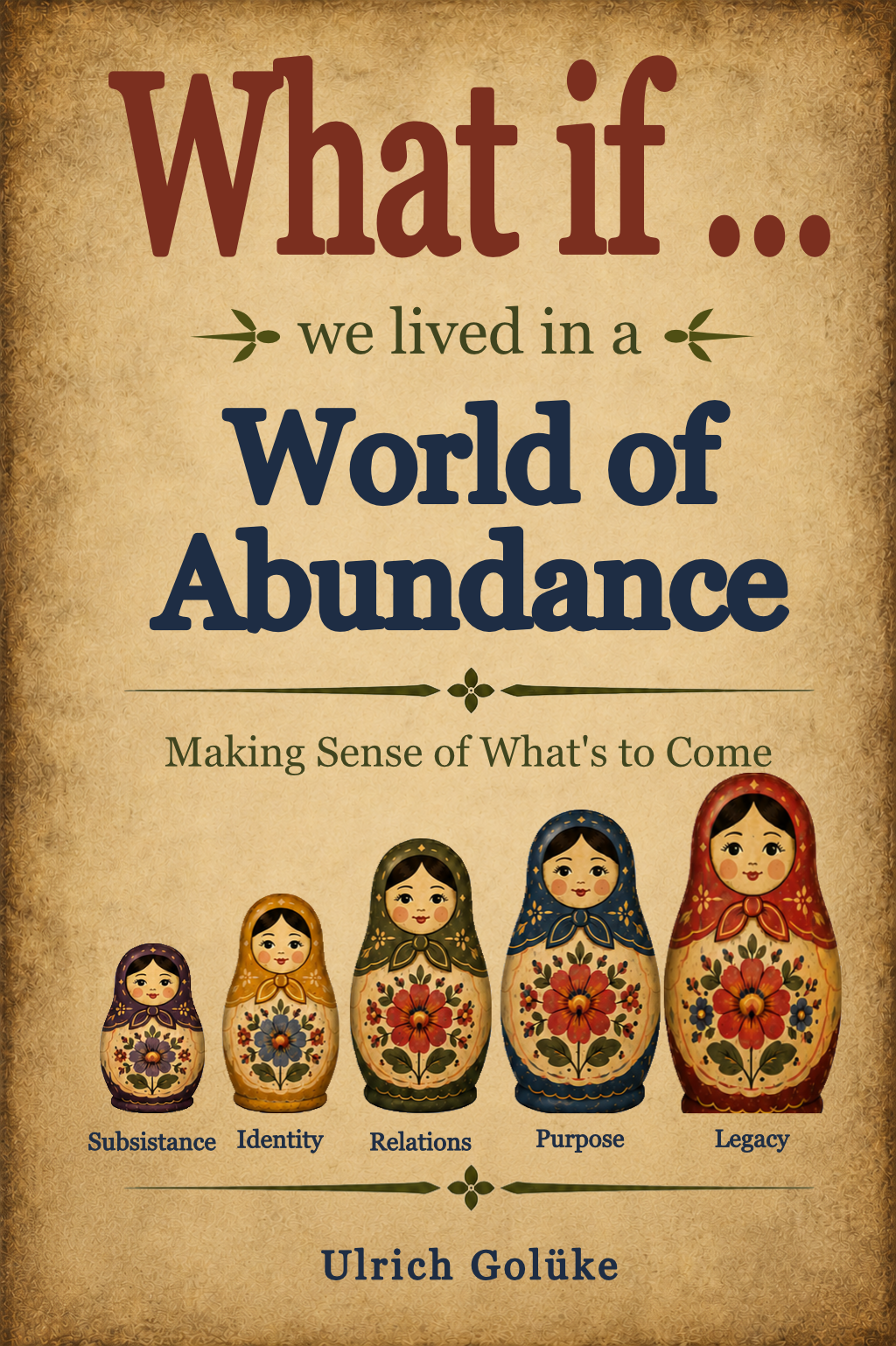
What if we lived in a World of Abundance
NOTE: >>> This is a slightly updated version of my former book On the Edge of Abundance. If you bought that one, no need to buy this one. <<<
Once we have enough – what else do we need?
Imagine a world in which there is an ever-increasing supply of the things we currently experience as being in short supply:
More energy.
More knowledge.
More automation.
More production capacity.
More material possibilities.
And now ask yourself the crucial question:
What, then, would actually still be our problem?
Perhaps scarcity does not disappear entirely.
Perhaps it merely changes form.
For a person can be materially well-provided for
and yet still not know who they are.
They can be free and yet still not know
what to do with their freedom.
They may possess everything and yet still feel
that something is missing.
So what happens to people in a world of increasing material abundance?
This book takes you on a thought experiment exploring:
IDENTITY: Who am I if I no longer have to define myself through achievement and possessions?
RELATIONS: What changes when economic dependencies become less important?
PURPOSE: What gives my life direction when survival is no longer the central goal?
LEGACY: What will remain of me when material possessions are no longer the most important thing?
This is not a book about predicting the future.
It is an invitation to reflect on a future that may be closer than we think.
From ‘How do we survive?’ to: ‘How do we want to live?’
For help installing the book on your eBook reader, check out this page.